


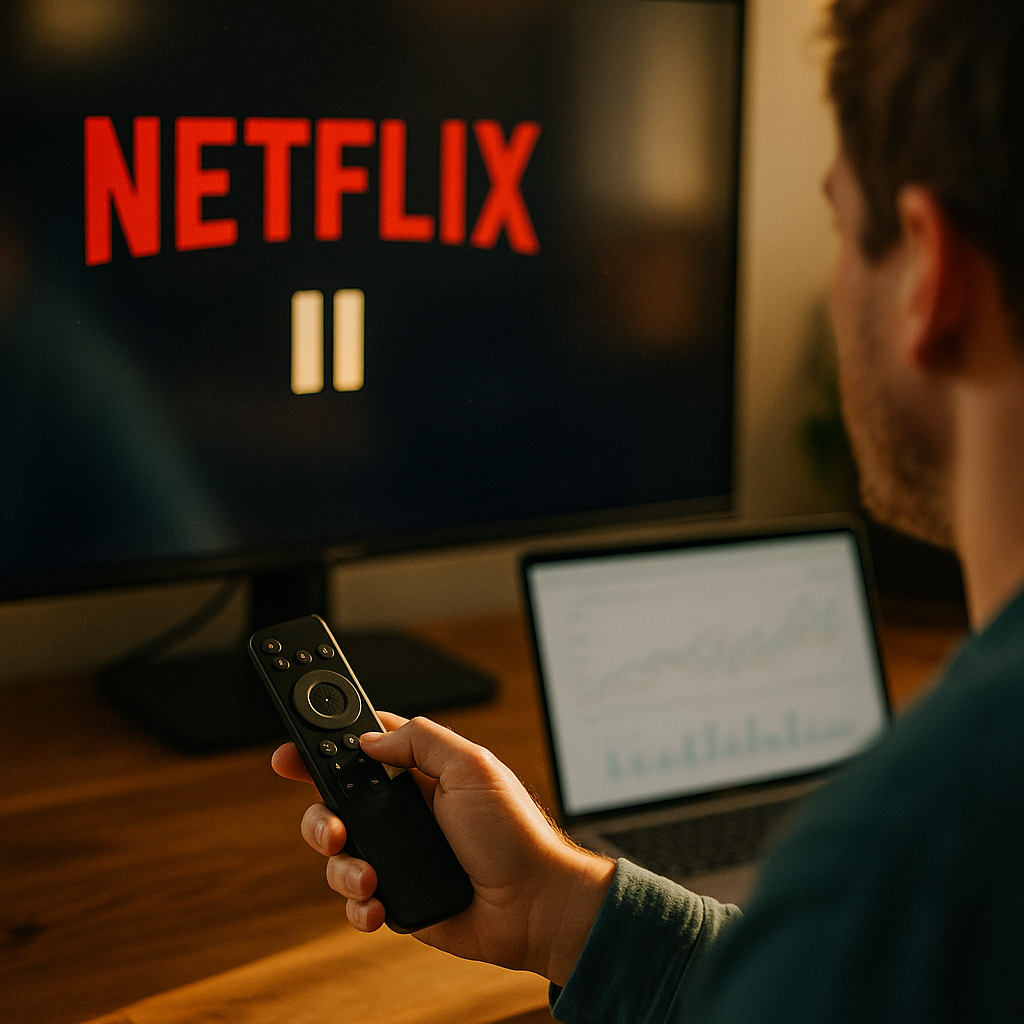
Netflix says viewers pause its shows roughly 60 times per hour of viewing. Multiply that by 300 million-plus subscribers and you get an inventory pool that shouldn’t exist anywhere else: a full-screen, zero-skip, zero-competition ad slot triggered by human behavior instead of a programmed break. Six months after Netflix pause-ads went live to broader advertiser access, the early data is in, and it’s forcing a rethink of what “precision targeting” means on streaming.
The Pitch Versus the Reality
Netflix positioned pause ads as the anti-preroll: no fast-forwarding, no bathroom-break skip, no ad blocker interference. The format freezes when a viewer hits pause, holds a static or lightly animated brand image on screen, and disappears the moment playback resumes. Simple. Almost boring, in a good way.
Early buyers treated it as a novelty add-on to standard CTV buys. That’s changing fast. Agencies running split tests across Netflix’s ad-supported tier are reporting completion rates north of 95% for pause units, compared to the 70-85% range typical of standard 15- and 30-second CTV spots that still get muted or walked away from mid-play. Completion isn’t the same as attention, but it’s a meaningfully different baseline than anything programmatic display or even mid-roll video has offered.
Advertisers running pause-ad pilots are seeing completion rates above 95%, a figure unheard of in standard CTV mid-roll inventory, which suggests the format’s real value isn’t reach, it’s guaranteed exposure.
That guarantee is the whole pitch. Netflix isn’t selling more eyeballs. It’s selling a moment when the eyeball is definitely, unambiguously there.
What “Precision” Actually Means Here
Precision targeting on pause inventory works differently than social or search. There’s no keyword intent signal, no click history, no lookalike audience built from pixel data. Netflix is leaning on its own first-party viewing data instead: genre affinity, time-of-day pause patterns, device type, and household-level demographic modeling built from subscription and profile data.
Practically, that means a beauty brand can target pause moments during romance or lifestyle content between 7 and 10pm on connected TVs, while a gaming brand targets pause events during action or sci-fi titles on any screen, any hour. It’s contextual targeting with behavioral triggers layered on top, not identity-based retargeting. For brands used to the granularity of Meta or TikTok’s ad managers, it will feel comparatively blunt. For brands used to linear TV’s total lack of targeting, it feels like magic.
The nuance matters for budget conversations. If your CFO is expecting programmatic-grade audience precision, set that expectation correctly before the campaign starts, not after the recap. Pause ads are contextually smart, not surveillance-smart. That’s a feature for privacy-conscious brands, but it’s a limitation for anyone chasing hyper-segmented personas.
CPMs Are Higher, and Buyers Are Paying Them Anyway
Reported CPMs for pause inventory are running 15-25% above Netflix’s standard mid-roll rates, according to agency buying desks tracking the format across the first two quarters of availability. That premium hasn’t scared off demand. If anything, scarcity is driving urgency: Netflix caps pause-ad frequency per household to avoid fatigue, which artificially limits inventory even as advertiser interest grows.
Buyers rationalize the premium with a simple argument: a guaranteed, undivided five-second view is worth more than a 15-second spot competing with a phone-scrolling viewer. Whether that math holds up depends entirely on creative quality and campaign goals, something we’ll get to shortly.
It’s a similar dynamic to what’s playing out across other premium CTV environments. The CTV inventory growth amid the attention recession has made buyers more willing to pay for formats that can prove genuine viewer focus, rather than just reach.
Where the Data Gets Genuinely Interesting
The most useful finding from six months of buyer feedback isn’t about the ad format at all. It’s about pause frequency patterns by content type. Data shared by agency measurement teams shows viewers pause documentaries and prestige drama far more often than comedy or reality content, likely because those genres invite reflection, note-taking, or second-screen checking. That single insight reshuffles media planning for entire categories.
- Financial services and B2B brands are gravitating toward documentary and drama adjacency, where pause frequency is highest and the audience skews toward decision-makers.
- CPG and snack brands are chasing comedy and reality slots despite lower pause volume, betting on mood-matched context over raw impression count.
- Auto and travel advertisers are testing dayparting around weekend binge sessions, when pause behavior spikes as households juggle multiple activities.
None of this was obvious from Netflix’s initial sales deck. It emerged from actual buyer testing, which is the whole point of an “early data” phase. Anyone waiting for a polished playbook before testing pause ads is going to be testing it after the smart money has already locked in the good genre adjacencies.
Creative Discipline Matters More Than Usual
Because the format is static or near-static, sloppy creative gets punished visibly. A cluttered frame with three CTAs and a QR code doesn’t work when the viewer has five seconds and zero motion to hold attention. Brands seeing the best recall lift are running single-message creative: one product, one visual, one line of copy, sometimes just a logo and a mood.
This is a meaningful departure from standard video ad production, and it’s catching some brand teams off guard. Agencies accustomed to repurposing 15-second cutdowns for pause slots are finding the assets underperform against purpose-built static creative. That’s an operational cost most media plans didn’t budget for, and it’s worth flagging early in ad-ops workflows where approvals already slow campaigns down.
How This Fits the Broader CTV Measurement Problem
Streaming advertising has always struggled with one core issue: proving someone actually watched. Nielsen panels, MRC-accredited viewability standards, and third-party verification tools like DoubleVerify and Integral Ad Science have tried to patch that gap for years. Pause ads sidestep the problem almost entirely, because the ad only appears when the platform can prove, definitively, that a human is looking at the screen and choosing not to look away.
That’s a rare thing in advertising: a format where the measurement problem is solved by the mechanic itself. Compare that to standard CTV mid-roll, where completion is assumed rather than confirmed, and it’s easy to see why measurement-obsessed buyers are reallocating test budgets. It echoes the shift agencies made with unified CTV playbooks built around Roku and Smartly integrations, where the goal was always tighter proof of delivery, not just bigger reach numbers.
Still, skepticism is warranted. Netflix controls the measurement environment end to end, and there’s limited third-party verification available on pause-specific metrics right now. Brands running six-figure tests should be pushing for independent measurement partnerships before scaling spend, not after. According to eMarketer’s connected TV research, advertiser demand for verified attention metrics on streaming has grown steadily as CTV ad spend has matured, and Netflix will eventually need to open the format to outside auditors if it wants premium CPMs to hold long term.
Should Your Brand Be Testing This Now?
If you’re running mid-to-large CTV budgets and haven’t allocated a test tranche to pause inventory, you’re behind, but not disastrously so. Six months of data is early, not conclusive. Here’s a reasonable framework:
- Start with 5-10% of your Netflix CTV spend on pause inventory, not more, until you have your own first-party recall data.
- Build creative specifically for the static format. Don’t repurpose video cutdowns.
- Match genre adjacency to campaign objective, not just audience demographic. Documentary/drama for consideration, comedy/reality for awareness and mood-based branding.
- Push for independent verification data in your contract terms, even if Netflix’s self-reported numbers look strong.
- Track recall and consideration lift separately from click-through, since pause ads have no click mechanism at all.
That last point trips up a lot of performance-minded teams. There’s no click, no swipe, no QR scan tracked natively. If your KPI stack is entirely bottom-funnel, pause ads will look like a black hole. If you’re measuring brand lift, unaided recall, or purchase intent shift, per Statista’s advertising effectiveness data on premium video formats, the format has a real shot at outperforming standard mid-roll on cost-per-point-of-lift.
The format’s rise also says something bigger about where brand strategy is heading generally: away from raw reach metrics and toward CFO-defensible, provable attention. That’s the same logic driving CFO-friendly creator deal structures gaining ground across influencer budgets. Streaming and creator media are converging on the same standard: prove the view happened, or don’t get paid the premium.
The Takeaway
Pause ads aren’t a replacement for your CTV mid-roll budget, they’re a precision layer on top of it. Test small, build format-native creative, demand independent verification before scaling past pilot budgets, and match genre adjacency to funnel stage rather than raw reach targets.
FAQs
What are Netflix pause ads and how do they work?
Pause ads are static or lightly animated ad units that appear on screen when a viewer pauses content on Netflix’s ad-supported tier. The ad disappears once playback resumes, and it can’t be skipped or fast-forwarded because it only exists during the pause itself.
How much do Netflix pause ads cost compared to standard CTV inventory?
Early buyer reports indicate pause-ad CPMs run roughly 15-25% higher than Netflix’s standard mid-roll video inventory, driven largely by high completion rates and capped frequency per household.
Can brands target specific audiences with Netflix pause ads?
Targeting relies on Netflix’s first-party viewing data, including genre affinity, device type, time of day, and household-level demographic modeling. It’s contextual and behavioral rather than identity-based, so it won’t match the granularity of social platform ad managers.
Do Netflix pause ads support click-throughs or QR codes?
No. The format has no native click or interaction mechanism. Brands testing pause ads need to shift measurement toward recall, consideration, and brand lift rather than direct-response metrics like click-through rate.
What creative works best for pause-ad inventory?
Single-message, static creative performs best. Ads with one product focus, minimal text, and no competing calls to action outperform repurposed video cutdowns, since viewers only have a few seconds of a non-moving frame to absorb the message.
Is there independent verification for Netflix pause-ad performance?
Third-party verification for pause-specific metrics is still limited. Brands running larger test budgets should negotiate for independent measurement partnerships in their contracts rather than relying solely on Netflix’s self-reported completion and recall data.
FAQs
Frequently Asked Questions
What are Netflix pause ads and how do they work?
Pause ads are static or lightly animated ad units that appear on screen when a viewer pauses content on Netflix’s ad-supported tier. The ad disappears once playback resumes, and it can’t be skipped or fast-forwarded because it only exists during the pause itself.
How much do Netflix pause ads cost compared to standard CTV inventory?
Early buyer reports indicate pause-ad CPMs run roughly 15-25% higher than Netflix’s standard mid-roll video inventory, driven largely by high completion rates and capped frequency per household.
Can brands target specific audiences with Netflix pause ads?
Targeting relies on Netflix’s first-party viewing data, including genre affinity, device type, time of day, and household-level demographic modeling. It’s contextual and behavioral rather than identity-based, so it won’t match the granularity of social platform ad managers.
Do Netflix pause ads support click-throughs or QR codes?
No. The format has no native click or interaction mechanism. Brands testing pause ads need to shift measurement toward recall, consideration, and brand lift rather than direct-response metrics like click-through rate.
What creative works best for pause-ad inventory?
Single-message, static creative performs best. Ads with one product focus, minimal text, and no competing calls to action outperform repurposed video cutdowns, since viewers only have a few seconds of a non-moving frame to absorb the message.
Is there independent verification for Netflix pause-ad performance?
Third-party verification for pause-specific metrics is still limited. Brands running larger test budgets should negotiate for independent measurement partnerships in their contracts rather than relying solely on Netflix’s self-reported completion and recall data.
Top Influencer Marketing Agencies
The leading agencies shaping influencer marketing in 2026
Agencies ranked by campaign performance, client diversity, platform expertise, proven ROI, industry recognition, and client satisfaction. Assessed through verified case studies, reviews, and industry consultations.
Moburst

-
2

The Shelf
Boutique Beauty & Lifestyle Influencer AgencyA data-driven boutique agency specializing exclusively in beauty, wellness, and lifestyle influencer campaigns on Instagram and TikTok. Best for brands already focused on the beauty/personal care space that need curated, aesthetic-driven content.Clients: Pepsi, The Honest Company, Hims, Elf Cosmetics, Pure LeafVisit The Shelf → -
3

Audiencly
Niche Gaming & Esports Influencer AgencyA specialized agency focused exclusively on gaming and esports creators on YouTube, Twitch, and TikTok. Ideal if your campaign is 100% gaming-focused — from game launches to hardware and esports events.Clients: Epic Games, NordVPN, Ubisoft, Wargaming, Tencent GamesVisit Audiencly → -
4

Viral Nation
Global Influencer Marketing & Talent AgencyA dual talent management and marketing agency with proprietary brand safety tools and a global creator network spanning nano-influencers to celebrities across all major platforms.Clients: Meta, Activision Blizzard, Energizer, Aston Martin, WalmartVisit Viral Nation → -
5

The Influencer Marketing Factory
TikTok, Instagram & YouTube CampaignsA full-service agency with strong TikTok expertise, offering end-to-end campaign management from influencer discovery through performance reporting with a focus on platform-native content.Clients: Google, Snapchat, Universal Music, Bumble, YelpVisit TIMF → -
6

NeoReach
Enterprise Analytics & Influencer CampaignsAn enterprise-focused agency combining managed campaigns with a powerful self-service data platform for influencer search, audience analytics, and attribution modeling.Clients: Amazon, Airbnb, Netflix, Honda, The New York TimesVisit NeoReach → -
7

Ubiquitous
Creator-First Marketing PlatformA tech-driven platform combining self-service tools with managed campaign options, emphasizing speed and scalability for brands managing multiple influencer relationships.Clients: Lyft, Disney, Target, American Eagle, NetflixVisit Ubiquitous → -
8

Obviously
Scalable Enterprise Influencer CampaignsA tech-enabled agency built for high-volume campaigns, coordinating hundreds of creators simultaneously with end-to-end logistics, content rights management, and product seeding.Clients: Google, Ulta Beauty, Converse, AmazonVisit Obviously →