


Sixty-Seven Percent of Enterprise CMOs Now Run AI on Two or More Platforms — Most Can’t Explain Why
That stat, from Forrester’s Q1 enterprise AI survey, reveals a deeper problem than tool sprawl. It signals that chief marketing officers are hedging instead of deciding. And when the two dominant platforms — OpenAI and Anthropic — are racing to build full-stack advertising ecosystems, hedging gets expensive fast. The OpenAI vs Anthropic battle for brand advertiser loyalty isn’t a philosophical debate anymore. It’s a procurement decision with budget implications, compliance exposure, and creative velocity on the line.
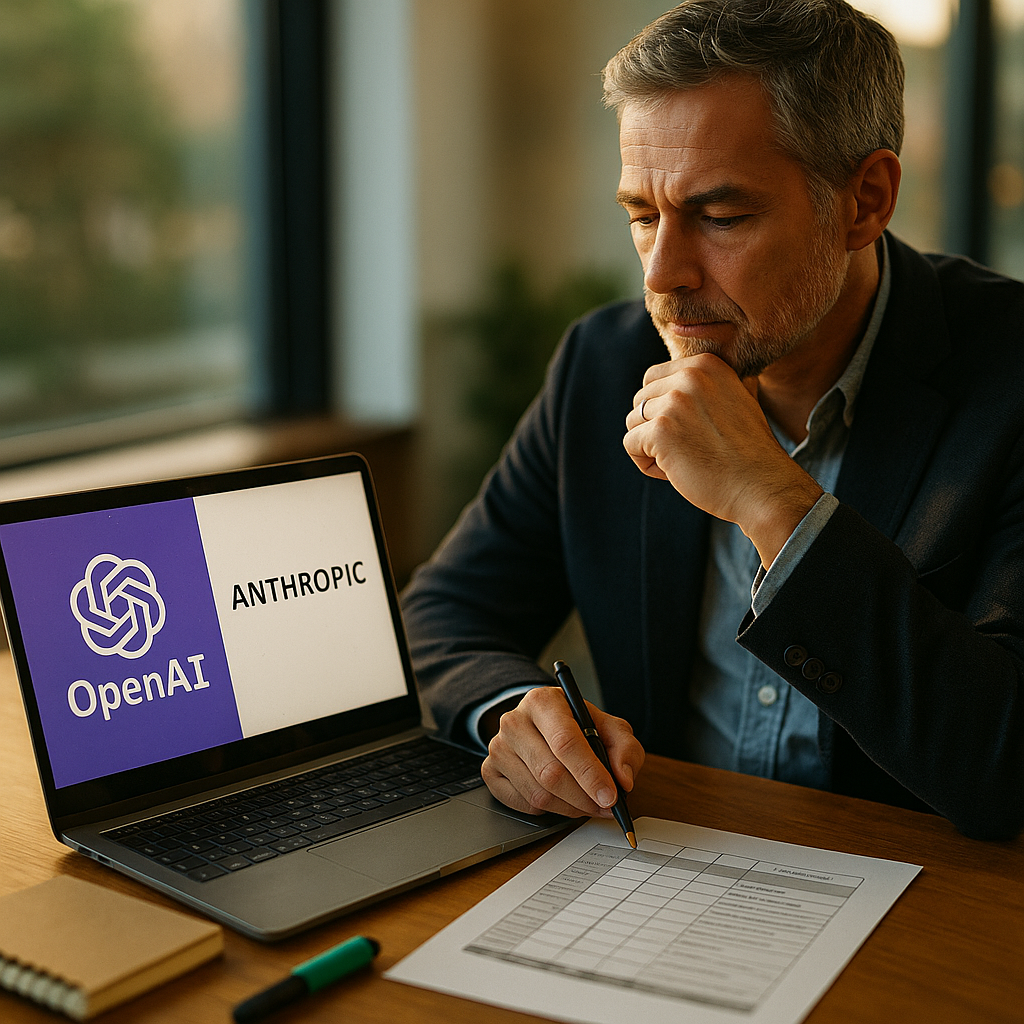
This decision matrix breaks down what actually matters for CMOs evaluating which platform deserves the enterprise contract — and which one gets cut.
The Advertising Ecosystem Gap Is Real
OpenAI moved first. Its partnership expansions with Meta’s ad infrastructure and programmatic demand-side platforms gave it early integration advantages. ChatGPT’s plugin architecture evolved into a full creative-to-distribution pipeline: ideation, copy generation, image creation via DALL·E 4, A/B variant testing, and now native ad placement through its Operator agent framework. For brands already embedded in the Meta-Google-TikTok trifecta, OpenAI slots in with minimal friction.
Anthropic took a different path. Claude’s enterprise API — particularly the Claude 3.5 Opus tier — prioritized structured output reliability and brand-safe content guardrails over broad ad-tech integrations. Anthropic’s partnerships lean toward enterprise middleware: Salesforce, Adobe Experience Platform, and custom agency builds through its partner program. If your media mix relies heavily on owned channels, CRM-triggered personalization, and first-party data activation, Anthropic’s ecosystem feels purpose-built.
The critical question isn’t which platform generates better ad copy. It’s which platform’s ecosystem reduces your integration tax — the hidden cost of connecting AI outputs to your actual media buying and measurement stack.
For a deeper comparison across personalization specifically, our analysis of AI personalization for brands covers the three-way landscape in detail.
Creative API Capabilities: Speed vs. Control
Here’s where the philosophical differences become operational realities.
OpenAI’s creative APIs prioritize speed and breadth. GPT-5’s multimodal capabilities allow brands to push a single brief and receive copy, image, and short-form video concepts in one API call. The creative throughput is staggering — enterprise clients report generating 200+ ad variants per campaign in under four hours. For performance marketers running high-volume programmatic, this is a genuine competitive edge.
But speed introduces risk. OpenAI’s content filtering, while improved, still produces occasional off-brand outputs that require human review loops. A CPG brand running 200 variants needs a QA layer, which means headcount or additional tooling. The net efficiency gain shrinks.
Anthropic’s creative APIs prioritize controllability. Claude’s Constitutional AI framework allows enterprise clients to embed brand guidelines, tone parameters, and category-specific restrictions directly into the model’s instruction layer. The output volume is lower — roughly 40-60% of OpenAI’s throughput on equivalent hardware — but the first-pass approval rate is measurably higher. Agencies using Claude for regulated industries (financial services, pharma, alcohol) report 78% first-pass compliance versus roughly 55% from GPT-5 in the same categories.
That 23-point gap matters. It’s the difference between a two-person review team and a six-person review team.
If you’re building creator briefs for AI content, the platform choice directly shapes how much human editing sits between generation and publish.
Safety Architecture: The Silent Dealbreaker
Brand safety in AI isn’t just about avoiding offensive outputs. It’s about auditability, regulatory defensibility, and reputational insurance. This is where the gap between the two platforms is widest — and where most CMO evaluations are weakest.
OpenAI operates on a moderation-layer model. Content passes through safety classifiers after generation. The system catches most issues, but it’s fundamentally reactive. When the FTC’s updated AI advertising guidelines require brands to demonstrate “reasonable pre-deployment review,” a post-generation filter may not satisfy auditors. OpenAI has added pre-generation instruction constraints in its enterprise tier, but these remain less granular than Anthropic’s approach.
Anthropic’s Constitutional AI bakes safety constraints into the generation process itself. The model doesn’t generate-then-filter; it reasons about constraints during generation. For enterprise brands, this distinction matters in three concrete ways:
- Audit trails: Claude’s enterprise API logs reasoning traces, showing why specific content choices were made. This is gold for compliance teams.
- Category exclusions: Brands can define prohibited adjacencies (e.g., no content that could be interpreted as medical advice) at the model level, not just the prompt level.
- Consistency under scale: Safety behavior degrades less under high-volume generation because constraints are architectural, not bolted on.
The human oversight question is central here. Our reporting on human oversight in agentic campaigns explores why even the best safety architecture still requires human checkpoints — but the right platform reduces how many checkpoints you need.
A Gartner survey found that 41% of enterprise brands have paused or reversed AI ad-generation pilots due to brand safety incidents. The platform with the stronger safety architecture doesn’t just reduce risk — it keeps programs from getting killed internally.
The Decision Matrix CMOs Actually Need
Forget feature-by-feature comparisons. The right framework maps platform strengths against your specific operating reality. Here’s a simplified decision matrix:
Choose OpenAI if:
- Your media mix is 60%+ paid social and programmatic display
- You run high-volume variant testing (100+ creatives per campaign)
- Your team has existing QA infrastructure or agency partners handling review
- Speed-to-market is your primary constraint
- You operate in low-regulation categories (apparel, entertainment, DTC consumer goods)
Choose Anthropic if:
- Your media mix emphasizes owned channels, email, and CRM-triggered content
- You operate in regulated or reputation-sensitive categories
- Compliance and audit documentation are board-level concerns
- Your team is lean and can’t absorb high QA volume
- You need deterministic brand-voice consistency across markets
Run both (deliberately, not by default) if:
- You manage sub-brands with fundamentally different risk profiles
- You’re actively benchmarking for a consolidation decision in 12-18 months
- Your agency partners are split across ecosystems and migration costs exceed dual-licensing
Understanding how revenue attribution reshapes budgets also informs this decision — whichever platform connects more cleanly to your measurement stack will win the attribution argument internally.
What About the Agency Layer?
Most enterprise brands don’t interact with these APIs directly. Agencies do. And agencies have their own platform preferences, often driven by volume licensing deals rather than brand-specific optimization.
Ask your agency partners three questions:
- Which platform’s API do you use for our account specifically, and why?
- What’s the first-pass approval rate on AI-generated creative for our brand versus your book average?
- Can you provide audit logs from the AI generation layer if our legal team requests them?
If they can’t answer all three clearly, you have a governance gap. The Stagwell-Trade Desk partnership is a useful reference point for how holding companies are formalizing AI platform selection at the agency level. Our coverage of the Stagwell and Trade Desk AI agent partnership breaks down the implications.
Pricing Isn’t Simple Either
OpenAI’s enterprise pricing runs on token volume with tiered discounts. High-throughput creative generation can scale costs quickly — one Fortune 500 advertiser reported $180K/month in API costs during peak campaign periods. Anthropic’s pricing is roughly 15-20% higher per token at equivalent tiers, but lower output volume per brief means total spend can actually be comparable or lower for brands that don’t need mass variant generation.
The real cost comparison requires factoring in your QA labor. If OpenAI generates 3x the variants but 45% need rework, you’re paying for volume you can’t use. Run the math on approved output per dollar, not raw output per dollar.
The Bottom Line for CMOs
Stop evaluating these platforms on capabilities alone. Evaluate them on fit — to your media mix, your risk profile, your team’s capacity, and your measurement infrastructure. Run a 90-day head-to-head pilot on a single campaign, measure approved creative output per dollar and time-to-compliance-sign-off, and let the data make the call.
FAQs
Which AI platform is better for enterprise brand advertising, OpenAI or Anthropic?
Neither is universally better. OpenAI excels for high-volume programmatic and paid social campaigns with existing QA infrastructure. Anthropic is stronger for regulated industries, lean teams, and brands prioritizing compliance auditability and brand-voice consistency. The right choice depends on your media mix, risk profile, and operational capacity.
How do OpenAI and Anthropic differ on brand safety for advertisers?
OpenAI uses a post-generation moderation layer that filters content after it is created. Anthropic’s Constitutional AI embeds safety constraints into the generation process itself, producing reasoning traces and audit logs. Anthropic’s approach typically yields higher first-pass compliance rates in regulated categories, while OpenAI’s approach allows faster throughput at the cost of more human review.
Can enterprise brands use both OpenAI and Anthropic simultaneously?
Yes, but only deliberately. Running both platforms makes sense when managing sub-brands with different risk profiles, actively benchmarking for a consolidation decision, or when agency partner migration costs exceed dual-licensing fees. Running both by default without a clear rationale leads to tool sprawl and wasted budget.
What should CMOs ask their agencies about AI platform selection?
CMOs should ask which platform API the agency uses for their specific account and why, what the first-pass approval rate on AI-generated creative is for their brand, and whether the agency can provide audit logs from the AI generation layer upon legal request. Inability to answer these questions signals a governance gap.
How should brands compare AI platform costs for advertising creative?
Brands should measure approved creative output per dollar rather than raw output per dollar. OpenAI may generate more variants at a lower per-token cost, but higher rework rates can erode that advantage. Anthropic’s higher per-token pricing often results in comparable total spend due to better first-pass approval rates and lower QA labor requirements.
Top Influencer Marketing Agencies
The leading agencies shaping influencer marketing in 2026
Agencies ranked by campaign performance, client diversity, platform expertise, proven ROI, industry recognition, and client satisfaction. Assessed through verified case studies, reviews, and industry consultations.
Moburst

-
2

The Shelf
Boutique Beauty & Lifestyle Influencer AgencyA data-driven boutique agency specializing exclusively in beauty, wellness, and lifestyle influencer campaigns on Instagram and TikTok. Best for brands already focused on the beauty/personal care space that need curated, aesthetic-driven content.Clients: Pepsi, The Honest Company, Hims, Elf Cosmetics, Pure LeafVisit The Shelf → -
3

Audiencly
Niche Gaming & Esports Influencer AgencyA specialized agency focused exclusively on gaming and esports creators on YouTube, Twitch, and TikTok. Ideal if your campaign is 100% gaming-focused — from game launches to hardware and esports events.Clients: Epic Games, NordVPN, Ubisoft, Wargaming, Tencent GamesVisit Audiencly → -
4

Viral Nation
Global Influencer Marketing & Talent AgencyA dual talent management and marketing agency with proprietary brand safety tools and a global creator network spanning nano-influencers to celebrities across all major platforms.Clients: Meta, Activision Blizzard, Energizer, Aston Martin, WalmartVisit Viral Nation → -
5

The Influencer Marketing Factory
TikTok, Instagram & YouTube CampaignsA full-service agency with strong TikTok expertise, offering end-to-end campaign management from influencer discovery through performance reporting with a focus on platform-native content.Clients: Google, Snapchat, Universal Music, Bumble, YelpVisit TIMF → -
6

NeoReach
Enterprise Analytics & Influencer CampaignsAn enterprise-focused agency combining managed campaigns with a powerful self-service data platform for influencer search, audience analytics, and attribution modeling.Clients: Amazon, Airbnb, Netflix, Honda, The New York TimesVisit NeoReach → -
7

Ubiquitous
Creator-First Marketing PlatformA tech-driven platform combining self-service tools with managed campaign options, emphasizing speed and scalability for brands managing multiple influencer relationships.Clients: Lyft, Disney, Target, American Eagle, NetflixVisit Ubiquitous → -
8

Obviously
Scalable Enterprise Influencer CampaignsA tech-enabled agency built for high-volume campaigns, coordinating hundreds of creators simultaneously with end-to-end logistics, content rights management, and product seeding.Clients: Google, Ulta Beauty, Converse, AmazonVisit Obviously →