


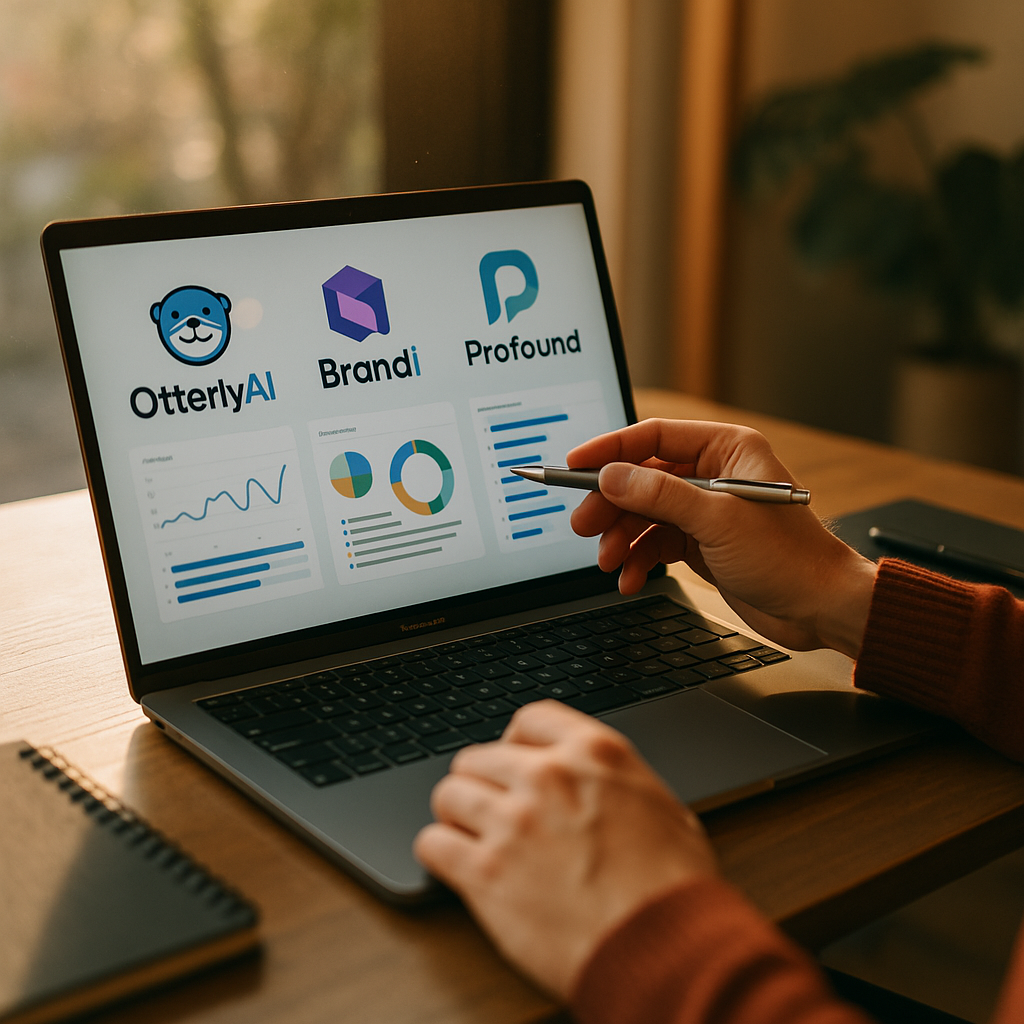
Only 9% of marketers say they can confidently measure how often their brand shows up in AI chatbot answers, according to recent surveys circulating in the martech press. Yet creator content is increasingly the raw material large language models cite when they answer product questions. If you run influencer programs and can’t see whether that content is actually surfacing in ChatGPT, Perplexity, or Gemini, you’re flying blind on one of the fastest growing discovery channels in marketing. GEO tracking platforms exist to close that gap, and three names keep coming up: OtterlyAI, Brandi AI, and Profound.
Why Creator Marketers Suddenly Need GEO Tools
For years, influencer marketing measurement meant engagement rate, reach, and maybe a last-click attribution model if you were lucky. Now there’s a new layer: generative engines synthesizing answers from across the web, including creator reviews, UGC, and affiliate content, and presenting a single summarized recommendation to the consumer. If your creators aren’t the source material behind that summary, a competitor’s are.
GEO (generative engine optimization) tracking platforms monitor how often, and how favorably, a brand appears inside AI generated answers. For creator marketers specifically, the relevant question is narrower: is the content we’re paying for actually feeding these answers, or is it invisible to the models that increasingly sit between creators and conversion?
Creator content that never gets cited by an AI engine is functionally the same as content that never ran, at least from a discovery standpoint. GEO tracking turns that invisible gap into a measurable one.
This is a natural extension of the measurement conversations already happening around platform reported conversions and attribution inflation. Marketers learned the hard way not to trust a single dashboard’s version of truth. GEO tracking deserves the same scrutiny before anyone builds a KPI around it.
OtterlyAI: Built for Marketers Who Live in Spreadsheets
OtterlyAI positions itself as the accessible entry point into AI search visibility tracking. It monitors brand mentions and citations across ChatGPT, Perplexity, and Google’s AI Overviews, then rolls that data into prompt level reports that resemble traditional SEO rank tracking tools.
What makes it relevant for creator teams: OtterlyAI lets you track specific prompts tied to campaign themes (think “best vitamin C serum for sensitive skin”) and see which domains, including creator blogs and UGC hosted content, get cited in the generated answer. If your influencer program drives backlinks or content hosted on review sites, you can watch whether that content starts appearing in AI citations over a campaign cycle.
The tradeoff is depth. OtterlyAI is strong on breadth of prompt tracking but lighter on the kind of granular content attribution that would tell you exactly which creator post triggered a citation. For teams running lean influencer operations without a dedicated analytics hire, that simplicity is a feature, not a bug.
Brandi AI: The Brand Perception Layer
Brandi AI leans harder into sentiment and narrative tracking than pure citation counting. It asks a different question: when AI engines do mention your brand, what story are they telling? Are you described as premium, budget, trustworthy, controversial?
For creator marketers, this matters because influencer content shapes brand narrative more directly than almost any other channel. A wave of creator reviews calling a skincare brand “overhyped” can quietly seed that framing into how models summarize the brand months later. Brandi AI’s sentiment layer gives marketing teams an early warning system, flagging when the language around their brand in AI outputs is drifting from their intended positioning before it becomes a PR problem.
The platform is less useful if your primary goal is counting raw citation volume or benchmarking against named competitors prompt by prompt. It’s a narrative health monitor more than a share of voice tracker, and teams should set expectations accordingly.
Profound: The Enterprise Answer
Profound has positioned itself as the enterprise grade option in this category, and the feature set reflects it. It tracks visibility across a wider set of AI engines, offers more sophisticated competitive benchmarking, and integrates with broader marketing data stacks rather than existing as a standalone report.
For larger brands running influencer programs across multiple markets and product lines, Profound’s ability to segment GEO visibility by region, product category, and even individual creator partnership makes it the closest thing to a true attribution layer in this space. That’s valuable if you’re trying to justify influencer budget to a CFO who wants to see a line connecting creator spend to AI visibility to downstream search behavior.
It’s also the most expensive and the steepest to implement. Smaller teams or agencies managing a handful of brand accounts will likely find the platform’s depth outpaces their actual reporting needs, and the onboarding lift isn’t trivial.
Head to Head: What Actually Differs
- Depth of prompt tracking: OtterlyAI and Profound both offer granular prompt level monitoring. Brandi AI trades some of that granularity for sentiment depth.
- Price and accessibility: OtterlyAI is the most approachable for small to mid-size teams. Profound sits at the enterprise end of the pricing spectrum.
- Creator content attribution: None of the three were built specifically for influencer marketing, so expect to do manual cross-referencing between your creator content calendar and whatever citation data the tool surfaces.
- Competitive benchmarking: Profound leads here, with the most mature tools for comparing your AI visibility against named competitors across markets.
- Narrative and sentiment: Brandi AI is the clear specialist if brand perception drift is your primary concern rather than raw mention counts.
None of these tools replace the fundamentals. You still need clean tracking on the creator side, which is why pairing GEO visibility data with a solid CRM dashboard tracking creator performance matters more than ever. GEO tells you if the content is surfacing. Your CRM tells you whether it’s actually driving revenue once it does.
How This Connects to Broader AI Search Shifts
GEO tracking doesn’t exist in isolation. It’s part of a larger shift where search behavior itself is fragmenting across voice assistants, on-device models, and chat interfaces. Our recent look at on-device AI search accuracy tradeoffs covers a related risk: as more search happens inside private, on-device models, even the best GEO tool may have visibility gaps it can’t close, because that query data never touches the open web where these trackers crawl.
That’s a real limitation worth flagging to stakeholders before you present GEO metrics as a complete picture. Treat these platforms as directional indicators, not gospel, the same way smart teams learned to treat real time GMV dashboards with healthy skepticism before trusting the numbers at face value.
Industry data from eMarketer and Statista both point to accelerating consumer adoption of AI chat interfaces for product research, which is exactly why this measurement category exists now and didn’t three years ago. HubSpot’s own marketing research has flagged similar adoption curves among B2B buyers, suggesting this isn’t a consumer-only phenomenon influencer teams can ignore.
Picking the Right Fit for Your Team
If you’re a lean team testing whether GEO visibility is worth tracking at all, start with OtterlyAI. The setup cost is low and the learning curve is short.
If brand reputation and narrative control are your bigger worry, particularly after a creator controversy or a wave of negative UGC, Brandi AI’s sentiment tracking earns its keep.
If you’re an enterprise brand with multiple product lines, international markets, and a CFO asking for attribution rigor, Profound is the only one of the three built to handle that complexity out of the box.
Whichever you choose, build the same governance discipline you’d apply to any other creator data source. Our creator data governance checklist is a useful starting framework for deciding who owns GEO data internally and how it gets validated before it lands in a quarterly report.
Frequently Asked Questions
FAQs
What is GEO tracking in marketing?
GEO tracking (generative engine optimization tracking) measures how often and how favorably a brand appears in AI generated answers from tools like ChatGPT, Perplexity, and Google’s AI Overviews. It’s the AI search equivalent of traditional SEO rank tracking.
Do OtterlyAI, Brandi AI, and Profound track creator content specifically?
Not directly. None of the three were built exclusively for influencer marketing. They track brand mentions and citations broadly, so marketers need to manually cross-reference citation data with their own creator content calendars to attribute visibility to specific campaigns.
Which GEO platform is best for small marketing teams?
OtterlyAI tends to be the most accessible option for small to mid-size teams, with a lower price point and simpler setup compared to Profound’s enterprise feature set.
Can GEO tracking replace traditional influencer measurement?
No. GEO tracking should supplement, not replace, existing performance measurement like CRM dashboards, affiliate tracking, and engagement metrics. It answers a different question: whether content is surfacing in AI answers, not whether it’s driving revenue.
Why does AI search visibility matter for influencer marketing budgets?
As more consumers research products through AI chat interfaces instead of traditional search, creator content that never gets cited by these engines loses a growing discovery channel. Tracking GEO visibility helps marketers justify or reallocate creator budget based on where content actually gets surfaced.
Pick one tool, run it against a single active campaign for 30 days, and compare its citation data against your actual creator content calendar before you commit budget to a full rollout. The gap between what these platforms promise and what they can verify is still wide enough to warrant a trial run, not a blind purchase.
Top Influencer Marketing Agencies
The leading agencies shaping influencer marketing in 2026
Agencies ranked by campaign performance, client diversity, platform expertise, proven ROI, industry recognition, and client satisfaction. Assessed through verified case studies, reviews, and industry consultations.
Moburst

-
2

The Shelf
Boutique Beauty & Lifestyle Influencer AgencyA data-driven boutique agency specializing exclusively in beauty, wellness, and lifestyle influencer campaigns on Instagram and TikTok. Best for brands already focused on the beauty/personal care space that need curated, aesthetic-driven content.Clients: Pepsi, The Honest Company, Hims, Elf Cosmetics, Pure LeafVisit The Shelf → -
3

Audiencly
Niche Gaming & Esports Influencer AgencyA specialized agency focused exclusively on gaming and esports creators on YouTube, Twitch, and TikTok. Ideal if your campaign is 100% gaming-focused — from game launches to hardware and esports events.Clients: Epic Games, NordVPN, Ubisoft, Wargaming, Tencent GamesVisit Audiencly → -
4

Viral Nation
Global Influencer Marketing & Talent AgencyA dual talent management and marketing agency with proprietary brand safety tools and a global creator network spanning nano-influencers to celebrities across all major platforms.Clients: Meta, Activision Blizzard, Energizer, Aston Martin, WalmartVisit Viral Nation → -
5

The Influencer Marketing Factory
TikTok, Instagram & YouTube CampaignsA full-service agency with strong TikTok expertise, offering end-to-end campaign management from influencer discovery through performance reporting with a focus on platform-native content.Clients: Google, Snapchat, Universal Music, Bumble, YelpVisit TIMF → -
6

NeoReach
Enterprise Analytics & Influencer CampaignsAn enterprise-focused agency combining managed campaigns with a powerful self-service data platform for influencer search, audience analytics, and attribution modeling.Clients: Amazon, Airbnb, Netflix, Honda, The New York TimesVisit NeoReach → -
7

Ubiquitous
Creator-First Marketing PlatformA tech-driven platform combining self-service tools with managed campaign options, emphasizing speed and scalability for brands managing multiple influencer relationships.Clients: Lyft, Disney, Target, American Eagle, NetflixVisit Ubiquitous → -
8

Obviously
Scalable Enterprise Influencer CampaignsA tech-enabled agency built for high-volume campaigns, coordinating hundreds of creators simultaneously with end-to-end logistics, content rights management, and product seeding.Clients: Google, Ulta Beauty, Converse, AmazonVisit Obviously →