


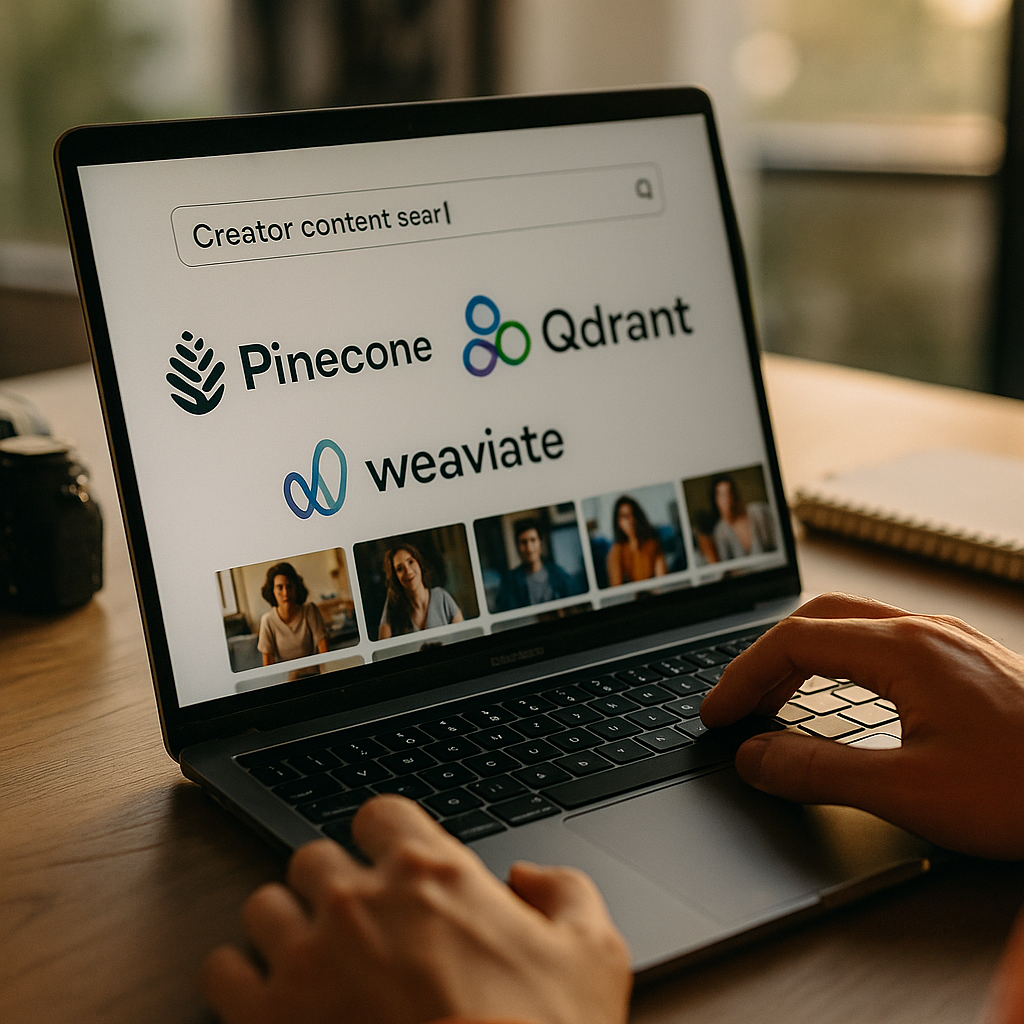
Your creator content library has 40,000 assets, three years of campaign history, and zero way to ask it a question. That’s the gap vector databases are built to close, and marketing teams are adopting them faster than most CMOs realize. Vector database adoption in the martech stack isn’t a data-science curiosity anymore — it’s becoming the backbone of how brands search, match, and repurpose creator content at scale.
The problem is that “just pick a vector database” is bad advice. Pinecone, Weaviate, and Qdrant solve overlapping problems in very different ways, and the wrong choice costs you either budget or engineering hours you don’t have.
Why Marketing Teams Suddenly Care About Vector Databases
Traditional keyword search fails creator content because creator content isn’t keyword-shaped. A brand manager searching “UGC that feels like a friend recommending a product, not an ad” won’t find anything useful in a filename-based DMS. Vector databases store content as embeddings, numerical representations of meaning, so a search for “authentic unboxing energy” can retrieve visually and tonally similar clips even if no caption mentions those words.
This matters for three concrete marketing use cases: creator-brand matching (finding creators whose past content style fits a new campaign brief), content repurposing (surfacing old UGC that matches a new product angle), and semantic asset search across a growing digital asset management pile. Agencies running hundreds of creator relationships are already stitching this into their stacks, often alongside creator roster platforms that were never built for semantic retrieval.
Vector search doesn’t replace your CRM or your CDP — it sits underneath them, making unstructured creator content queryable in ways relational databases never could.
The Three Contenders, Briefly
Pinecone, Weaviate, and Qdrant all do the same core job: store embeddings, index them efficiently, and return nearest-neighbor matches fast. But they diverge sharply on deployment model, cost structure, and how much engineering lift they demand from a marketing-adjacent data team.
- Pinecone is fully managed, serverless-first, and optimized for teams that want zero infrastructure ownership.
- Weaviate is open-source with a managed cloud option, and it ships with built-in hybrid search (keyword + vector) that’s genuinely useful for marketing metadata.
- Qdrant is open-source, written in Rust, and leans toward teams that want performance control without paying premium managed-service margins.
None of these are marketing tools out of the box. All three require an engineering layer, an embedding model (often OpenAI’s or an open-source alternative), and integration work before a brand strategist ever touches a search bar.
Pinecone: The Low-Maintenance Default
Pinecone’s pitch is simple: you don’t manage infrastructure, you manage an API key. For marketing orgs without a dedicated ML platform team, that’s the whole appeal. Pinecone handles sharding, scaling, and index optimization behind the curtain.
The tradeoff is cost at scale. Pinecone’s serverless pricing charges for storage and query volume, and for a creator content library with millions of embeddings (think: every frame-level clip index across a multi-year influencer program), costs climb quickly compared to self-hosted alternatives. It’s the right call for teams prioritizing speed-to-launch over long-term unit economics — similar to the buy-versus-build tradeoff brands face when evaluating AI-native CDPs against legacy platforms.
Pinecone also integrates cleanly with popular embedding and orchestration frameworks, which matters if your team is already building retrieval-augmented generation (RAG) pipelines for content briefs or creator matching copilots.
Weaviate: Hybrid Search That Marketing Metadata Actually Needs
Creator content rarely lives as pure unstructured data. It has captions, engagement metrics, brand tags, usage rights windows, platform origin, and campaign IDs. Weaviate’s native hybrid search — combining vector similarity with traditional filtering — means a query like “high-engagement TikTok UGC from Q3, similar in tone to our top-performing skincare video” is actually executable without bolting on a separate filtering layer.
Weaviate also supports modular embedding providers, so teams aren’t locked into one model vendor. That flexibility matters for compliance-conscious brands, especially as scrutiny around AI vendor transparency grows. If your legal or brand safety team is already asking vendors to show their work on AI models, Weaviate’s open architecture makes those audits easier than a black-box managed service.
The cost of that flexibility is operational complexity. Self-managing Weaviate means someone owns uptime, backups, and version upgrades. Weaviate Cloud removes some of that burden but narrows the cost gap with Pinecone.
Qdrant: Performance-First, Budget-Conscious
Qdrant has built a reputation for raw query speed and efficient memory use, largely because it’s written in Rust rather than Go or Python. For marketing teams running high-frequency retrieval — think real-time creator matching during a live campaign brief session — that latency advantage is tangible.
Qdrant’s open-source core and permissive licensing make it attractive for agencies managing multiple client instances who don’t want per-seat or per-query fees multiplying across accounts. Qdrant Cloud offers a managed tier, but the self-hosted path remains genuinely viable for teams with even modest DevOps capacity.
Where Qdrant lags slightly is ecosystem maturity. Pinecone and Weaviate both have larger integration libraries and more established patterns for RAG-style marketing applications. Qdrant is catching up fast, but “catching up” still means more custom glue code today.
The real cost of a vector database isn’t the license fee — it’s the embedding pipeline, the re-indexing cadence, and the engineer who has to babysit it. Budget for that before you budget for the platform.
What Actually Determines Fit for Creator Content Retrieval
Forget generic benchmark charts. The decision criteria that matter for marketing teams look different than they do for a typical AI product team.
- Metadata filtering needs. If your creator library requires heavy filtering (usage rights, platform, geography, campaign tags), Weaviate’s hybrid model saves engineering time versus bolting filters onto Pinecone or Qdrant.
- Scale and refresh rate. Brands ingesting thousands of new creator assets daily need to weigh re-indexing costs. Pinecone’s serverless model scales gracefully but at a price; Qdrant’s efficiency shines at high volume if you can self-host.
- Team capacity. No in-house ML engineer? Pinecone or a managed Weaviate/Qdrant Cloud tier is the realistic path. Agencies with platform engineers can extract more value per dollar from self-hosted Qdrant.
- Compliance and data residency. Creator contracts increasingly specify data handling terms. Self-hosted options (Weaviate, Qdrant) give more control over where embeddings and source content actually live, which matters under evolving data protection guidance in the UK and EU.
- Integration with existing AI tooling. If your team is already deep into agentic workflows or MCP-based tool orchestration, check vendor support carefully — the same diligence outlined in guidance on verifying real MarTech vendor claims applies directly here.
The ROI Question Nobody’s Answering Honestly
Here’s the uncomfortable truth: most marketing teams evaluating vector databases haven’t quantified what “better creator content retrieval” is worth. Faster search matters, but faster search that doesn’t reduce campaign turnaround time or cut redundant content production spend is just a nicer UI.
The honest ROI case rests on three levers: reduced content production waste (reusing existing assets instead of commissioning new ones), faster creator-brief matching (cutting agency hours spent manually scrolling portfolios), and improved brand safety review (semantic search surfaces problematic historical content faster than manual audits). None of these show up on a vendor’s pricing page, but they’re the only numbers that justify the infrastructure spend to a CFO.
According to eMarketer’s ongoing coverage of AI adoption in marketing organizations, budget owners are increasingly demanding operational efficiency metrics before approving AI infrastructure tools, not just capability demos. Vector databases fall squarely into that scrutiny zone because they’re infrastructure, not a shiny front-end feature.
Teams already running fraud detection or vetting tools on influencer rosters should note the overlap: the same embedding techniques powering semantic content search are showing up in AI fraud detection vendors for influencer vetting, which means a vector database investment can serve double duty across content ops and risk management if architected well.
A Realistic Adoption Path
Don’t rip out your DAM. Layer a vector database on top of it. Most successful marketing implementations treat the vector store as an index, not a system of record — source content and rights data stay in existing systems, embeddings live in Pinecone, Weaviate, or Qdrant, and a retrieval layer connects the two.
Start with a narrow pilot: one campaign category, a few thousand assets, one embedding model. Measure search relevance against manual retrieval time before scaling. Teams that skip the pilot and go straight to full-library migration tend to discover cost and quality problems only after they’re expensive to fix.
For most mid-market marketing orgs without dedicated ML infrastructure, Pinecone remains the pragmatic starting point. Enterprise teams with metadata-heavy libraries and compliance requirements should lean toward Weaviate. Agencies optimizing for margin across many client accounts should give Qdrant a serious look before assuming managed services are the only path.
Frequently Asked Questions
FAQs
What is a vector database used for in marketing?
A vector database stores content as numerical embeddings so marketing teams can search creator content, campaign assets, or audience data by meaning and similarity rather than exact keyword matches.
Is Pinecone better than Weaviate for creator content search?
Pinecone is easier to deploy with less engineering overhead, while Weaviate offers stronger native hybrid search for filtering creator content by metadata like platform, rights window, or campaign tag. The better choice depends on your team’s technical capacity and metadata complexity.
Do I need an in-house engineer to use Qdrant?
Self-hosted Qdrant benefits from DevOps capacity, but Qdrant Cloud offers a managed tier that reduces the operational burden significantly for smaller teams.
How does vector search improve influencer content management?
It enables semantic search across large creator content libraries, helping teams find similar-tone UGC, repurpose past assets, and speed up creator-brief matching without manually reviewing thousands of files.
What’s the biggest hidden cost of vector database adoption?
The embedding pipeline and ongoing re-indexing work, not the platform licensing fee, typically consume the most engineering time and budget.
Can vector databases help with brand safety reviews?
Yes. Semantic search can surface potentially problematic historical creator content faster than manual keyword-based audits, supporting quicker brand safety and compliance reviews.
Next step: before evaluating vendors further, audit your existing creator content library for volume, metadata richness, and refresh rate — that inventory, not a feature comparison chart, should drive whether Pinecone, Weaviate, or Qdrant fits your stack.
Top Influencer Marketing Agencies
The leading agencies shaping influencer marketing in 2026
Agencies ranked by campaign performance, client diversity, platform expertise, proven ROI, industry recognition, and client satisfaction. Assessed through verified case studies, reviews, and industry consultations.
Moburst

-
2

The Shelf
Boutique Beauty & Lifestyle Influencer AgencyA data-driven boutique agency specializing exclusively in beauty, wellness, and lifestyle influencer campaigns on Instagram and TikTok. Best for brands already focused on the beauty/personal care space that need curated, aesthetic-driven content.Clients: Pepsi, The Honest Company, Hims, Elf Cosmetics, Pure LeafVisit The Shelf → -
3

Audiencly
Niche Gaming & Esports Influencer AgencyA specialized agency focused exclusively on gaming and esports creators on YouTube, Twitch, and TikTok. Ideal if your campaign is 100% gaming-focused — from game launches to hardware and esports events.Clients: Epic Games, NordVPN, Ubisoft, Wargaming, Tencent GamesVisit Audiencly → -
4

Viral Nation
Global Influencer Marketing & Talent AgencyA dual talent management and marketing agency with proprietary brand safety tools and a global creator network spanning nano-influencers to celebrities across all major platforms.Clients: Meta, Activision Blizzard, Energizer, Aston Martin, WalmartVisit Viral Nation → -
5

The Influencer Marketing Factory
TikTok, Instagram & YouTube CampaignsA full-service agency with strong TikTok expertise, offering end-to-end campaign management from influencer discovery through performance reporting with a focus on platform-native content.Clients: Google, Snapchat, Universal Music, Bumble, YelpVisit TIMF → -
6

NeoReach
Enterprise Analytics & Influencer CampaignsAn enterprise-focused agency combining managed campaigns with a powerful self-service data platform for influencer search, audience analytics, and attribution modeling.Clients: Amazon, Airbnb, Netflix, Honda, The New York TimesVisit NeoReach → -
7

Ubiquitous
Creator-First Marketing PlatformA tech-driven platform combining self-service tools with managed campaign options, emphasizing speed and scalability for brands managing multiple influencer relationships.Clients: Lyft, Disney, Target, American Eagle, NetflixVisit Ubiquitous → -
8

Obviously
Scalable Enterprise Influencer CampaignsA tech-enabled agency built for high-volume campaigns, coordinating hundreds of creators simultaneously with end-to-end logistics, content rights management, and product seeding.Clients: Google, Ulta Beauty, Converse, AmazonVisit Obviously →