


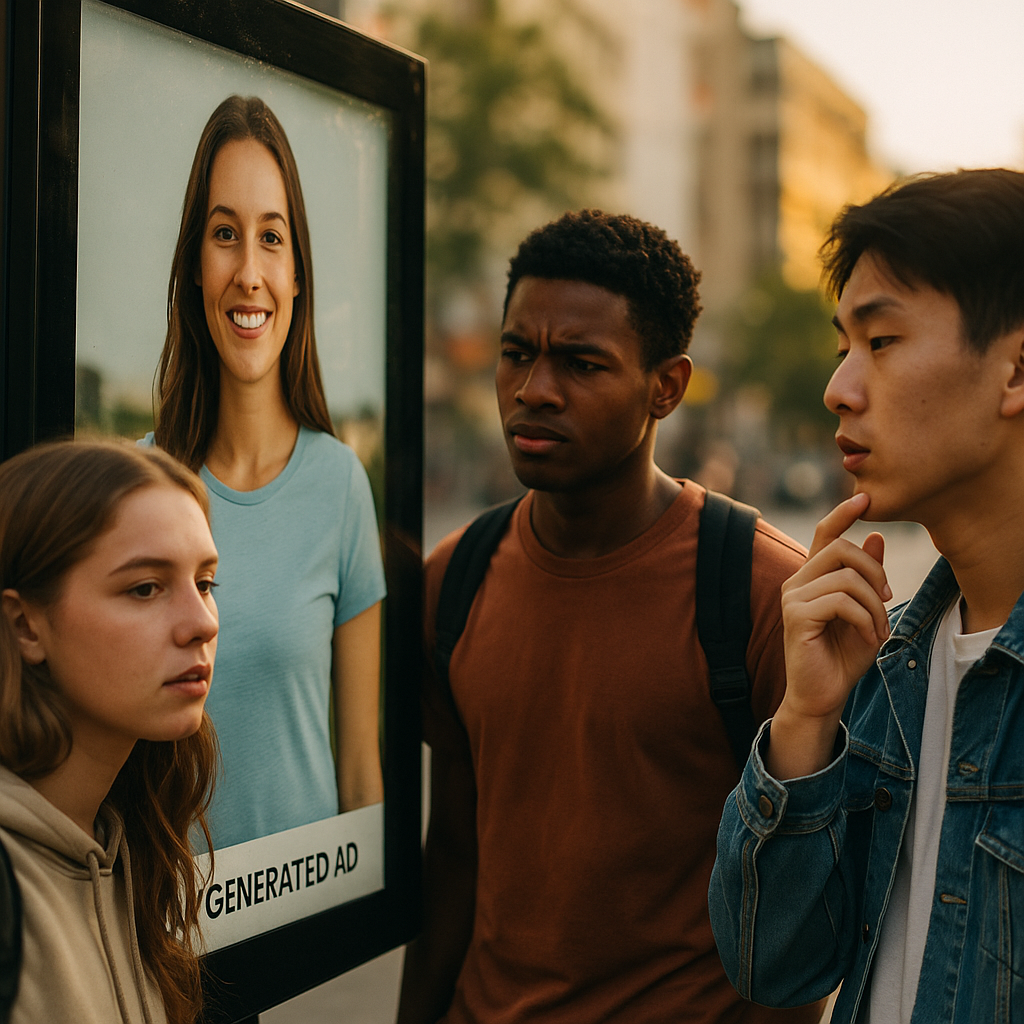
Would you trust an ad you knew was written by AI? Roughly six in ten Gen Z respondents in a recent cross-market study said no, not without a human byline attached. That’s the uncomfortable backdrop for anyone budgeting AI-generated advertising spend heading into next year. The gap between what brands assume and what young consumers actually believe is wide, and it varies dramatically by region.
The Headline Number Brands Keep Misreading
Most trend decks flatten “youth attitudes toward AI” into a single global sentiment score. That’s lazy, and it’s costing brands money. A synthetic-media disclosure isn’t a universal signal — it reads as reassuring in Seoul, suspicious in São Paulo, and largely irrelevant in parts of Sub-Saharan Africa where mobile data costs shape ad tolerance more than authenticity debates do.
The new wave of 2026 survey data (pooled from consumer panels run by regional research firms, plus platform-level sentiment tracking) shows three consistent patterns worth building into planning cycles:
- Trust in AI-generated ads correlates more with platform context than with the ad’s actual production method.
- Disclosure labels reduce backlash in North America and Western Europe but barely move sentiment in Southeast Asia, where synthetic content is already normalized.
- Youth in emerging markets are more tolerant of AI ad content overall, but far less tolerant of AI-generated influencer endorsements specifically — a nuance most global brand guidelines miss entirely.
Nearly 70% of surveyed 18-24 year-olds in the US and UK said they could usually tell when an ad was AI-generated — and said that detection itself lowered their intent to purchase, independent of disclosure.
That last stat should worry anyone leaning hard on generative creative to cut production costs. Detection, not disclosure, is driving the trust penalty in mature markets.
North America: Skepticism Is the Default Setting
US and Canadian Gen Z audiences have been burned enough by deepfake scandals and AI-washing controversies that skepticism is now baseline, not exceptional. Survey data shows younger respondents assume any polished, hyper-personalized ad creative is at least partially AI-assisted — and they’re usually right.
The interesting wrinkle: distrust of the medium hasn’t translated into distrust of the platform. TikTok and Instagram users still engage heavily with algorithmically surfaced content even as they distrust the ads embedded in it. That disconnect mirrors what we’ve covered before — AI-curated feeds keep boosting engagement while trust keeps eroding, and advertising is simply inheriting that same paradox.
For brands, the operational takeaway is blunt: pairing AI-generated ad creative with a human creator’s face or voice measurably recovers trust in this region. It’s why the creator middle class has outgrown macro influencers on ROI — mid-tier creators provide the human authentication layer that pure AI creative can’t fake convincingly, at least not yet.
Western Europe: Regulation Is Shaping Sentiment Before Products Even Launch
European youth attitudes toward AI advertising are inseparable from the regulatory conversation happening around them. The EU AI Act’s transparency requirements have primed consumers, especially those under 30, to expect labeling — and to punish brands that skip it.
Survey respondents in Germany and France showed markedly higher trust when AI-generated content carried explicit “AI-assisted” tags compared to unlabeled equivalents, even when the visual quality was identical. UK respondents tracked similarly, likely influenced by ongoing ICO guidance on automated content transparency shaping public discourse.
This is a market where compliance and brand trust have merged into the same KPI. Brands still treating AI disclosure as a legal checkbox rather than a trust-building asset are leaving conversion rate on the table. Worth reading alongside this: how sovereign AI rules are fragmenting cross-border creator campaigns, because ad disclosure standards are becoming just as regionally splintered as data governance.
Asia-Pacific: Normalization, Not Suspicion
Here’s where the global narrative breaks down completely. In South Korea, Japan, and increasingly Indonesia and Vietnam, AI-generated advertising isn’t a novelty or a red flag — it’s expected. Virtual influencers have run mainstream campaigns in South Korea for years. Survey respondents under 25 in these markets rated AI-generated ad content as “acceptable” or “unremarkable” at nearly double the rate of their US counterparts.
That doesn’t mean anything goes. Chinese and South Korean youth respondents drew a sharp line between AI-generated product content (acceptable) and AI-generated testimonial or review content pretending to be organic (a major trust violation). The line isn’t about the tech — it’s about deception dressed as authenticity.
This regional comfort with synthetic media partly explains why AI has cut creator discovery costs without replacing vetting — brands operating in APAC still need human review layers, just applied differently than in the West. Vetting for authenticity claims matters more here than vetting for “is this AI” full stop.
Latin America and MENA: Tolerance With Conditions
Youth in Brazil, Mexico, and the UAE showed some of the highest overall tolerance for AI-generated ad creative in the entire dataset — but tolerance dropped sharply the moment AI content touched culturally or religiously sensitive themes. Generic product ads generated warm reception; AI-generated lifestyle or aspirational content aimed at family, faith, or national identity triggered noticeably colder responses.
In MENA markets, AI-generated ad tolerance sat above 65% for standard product marketing but fell below 30% when the creative simulated personal or family testimonials.
Brands running pan-regional campaigns need to stop treating “AI-generated content” as a single risk category. It’s a spectrum, and the danger zones shift by cultural context, not by production budget. This is exactly the kind of nuance that gets lost when global creative gets localized through translation alone rather than through genuine regional strategy — a gap we flagged in how trust-weighting is forcing brands to rethink TikTok-first strategy.
What This Means for Budget and Governance, Not Just Creative
This isn’t only a creative-team problem. Regional trust variance has direct implications for measurement, compliance, and vendor selection.
- Attribution models need a trust variable. If detection lowers purchase intent in North America but not APAC, your conversion benchmarks by region should already reflect that, not average it away. See how strong attribution infrastructure drives more efficient martech spend for the operational case.
- Disclosure policy should be regional, not global. A single “always label AI content” rule undersells trust gains in Europe and creates unnecessary friction in markets where it’s a non-issue.
- Vendor and platform risk needs review. Ad-tech consolidation is already reshaping how AI creative gets built and distributed — see Trade Desk and AppLovin’s consolidation signals — and governance frameworks need to keep pace with which vendors actually support region-specific labeling.
- Creative governance can’t be an afterthought. The trust gap around AI ads is now a board-level risk conversation in some categories. Our earlier breakdown of what the AI ad trust gap means for creative governance is worth revisiting with this regional data layered in.
Industry benchmarking bodies are starting to catch up too. eMarketer’s ongoing consumer trust tracking and Statista’s regional ad-sentiment datasets are both useful for triangulating against your own first-party survey work, especially if you’re building a board deck that needs external validation.
Don’t Skip Platform-Level Signals
Regional survey data tells you sentiment. Platform data tells you behavior. The two don’t always agree, and that mismatch is where a lot of brands get burned. Meta’s own guidance on branded content and AI disclosure policy and TikTok’s creative disclosure tools are both evolving quickly, and platform policy changes tend to outpace survey cycles. If you’re only checking annual survey data, you’re already behind on enforcement changes that happen quarterly.
One more thing worth flagging: youth attitudes toward AI advertising are shifting faster than any other sentiment metric marketers track. A cohort surveyed eighteen months ago answering the same questions today would likely show meaningfully different numbers, particularly in markets where generative tools have become mainstream creative software rather than novelty tech.
The Next Move
Stop applying one global AI-disclosure policy and start building a regional trust matrix — mapping which markets punish detection, which punish non-disclosure, and which simply don’t care — then route creative production and compliance review through that matrix before the next campaign cycle, not after a backlash forces it.
FAQs
Do young consumers actually notice when an ad is AI-generated?
Yes, particularly in North America and Western Europe. Survey data shows majorities of 18-24 year-olds in these regions report they can usually identify AI-generated ad creative, and detection itself — independent of disclosure — tends to lower purchase intent.
Which regions are most accepting of AI-generated advertising?
South Korea, Japan, and parts of Southeast Asia show the highest tolerance, largely due to years of mainstream exposure to virtual influencers and synthetic media in advertising. Acceptance drops sharply, though, when AI content mimics personal testimonials rather than straightforward product marketing.
Does labeling AI-generated content actually improve trust?
It depends on the market. Labeling meaningfully improves trust in the US, UK, and EU, where regulatory expectations have primed consumers to look for disclosure. In markets like South Korea or Indonesia, labeling has far less impact because AI content is already normalized.
Should global brands use one AI disclosure policy across all markets?
No. Regional data shows trust drivers vary too much for a single global policy to work well everywhere. Brands get better results building a regional trust framework that adjusts disclosure practices, creative themes, and vetting processes by market.
What’s the biggest risk in AI-generated influencer content specifically?
Across nearly every region surveyed, AI-generated content posing as an organic personal testimonial or endorsement draws the sharpest trust penalty, far more than AI-generated product or lifestyle content. Brands should treat synthetic “endorsements” as a distinct, higher-risk category in creative governance.
Top Influencer Marketing Agencies
The leading agencies shaping influencer marketing in 2026
Agencies ranked by campaign performance, client diversity, platform expertise, proven ROI, industry recognition, and client satisfaction. Assessed through verified case studies, reviews, and industry consultations.
Moburst

-
2

The Shelf
Boutique Beauty & Lifestyle Influencer AgencyA data-driven boutique agency specializing exclusively in beauty, wellness, and lifestyle influencer campaigns on Instagram and TikTok. Best for brands already focused on the beauty/personal care space that need curated, aesthetic-driven content.Clients: Pepsi, The Honest Company, Hims, Elf Cosmetics, Pure LeafVisit The Shelf → -
3

Audiencly
Niche Gaming & Esports Influencer AgencyA specialized agency focused exclusively on gaming and esports creators on YouTube, Twitch, and TikTok. Ideal if your campaign is 100% gaming-focused — from game launches to hardware and esports events.Clients: Epic Games, NordVPN, Ubisoft, Wargaming, Tencent GamesVisit Audiencly → -
4

Viral Nation
Global Influencer Marketing & Talent AgencyA dual talent management and marketing agency with proprietary brand safety tools and a global creator network spanning nano-influencers to celebrities across all major platforms.Clients: Meta, Activision Blizzard, Energizer, Aston Martin, WalmartVisit Viral Nation → -
5

The Influencer Marketing Factory
TikTok, Instagram & YouTube CampaignsA full-service agency with strong TikTok expertise, offering end-to-end campaign management from influencer discovery through performance reporting with a focus on platform-native content.Clients: Google, Snapchat, Universal Music, Bumble, YelpVisit TIMF → -
6

NeoReach
Enterprise Analytics & Influencer CampaignsAn enterprise-focused agency combining managed campaigns with a powerful self-service data platform for influencer search, audience analytics, and attribution modeling.Clients: Amazon, Airbnb, Netflix, Honda, The New York TimesVisit NeoReach → -
7

Ubiquitous
Creator-First Marketing PlatformA tech-driven platform combining self-service tools with managed campaign options, emphasizing speed and scalability for brands managing multiple influencer relationships.Clients: Lyft, Disney, Target, American Eagle, NetflixVisit Ubiquitous → -
8

Obviously
Scalable Enterprise Influencer CampaignsA tech-enabled agency built for high-volume campaigns, coordinating hundreds of creators simultaneously with end-to-end logistics, content rights management, and product seeding.Clients: Google, Ulta Beauty, Converse, AmazonVisit Obviously →