


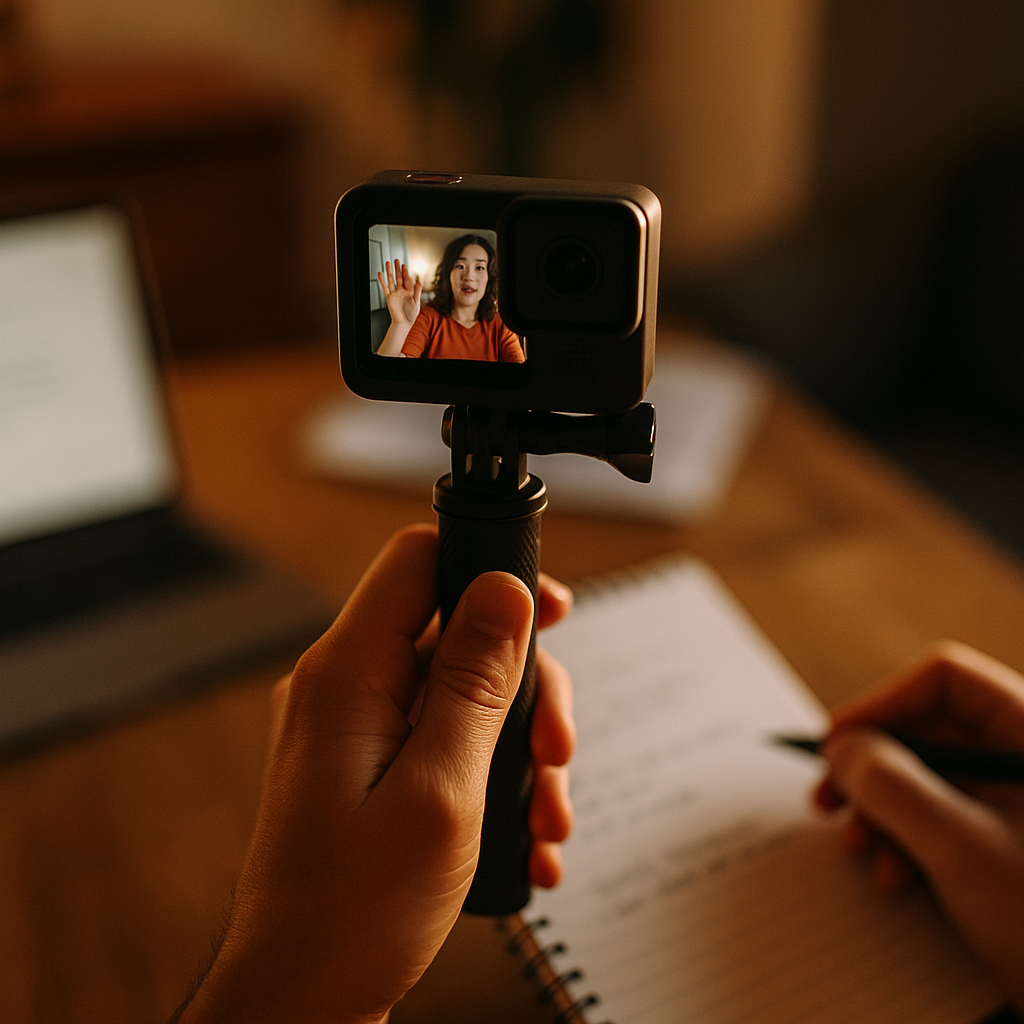
Only 12% of consumers say they trust traditional advertising, yet they’ll happily watch a stranger talk into a phone camera for 45 seconds and buy whatever she’s holding. That’s the gap POV format storytelling exploits. When a creator scripts content in first person, framing the camera as their own eyes rather than a lens pointed at a product, viewers stop watching an ad and start living a moment. For brands chasing conversion, not just views, that distinction is everything.
Why POV Outperforms Third-Person Ads
Third-person creator content says “look at this product.” POV format storytelling says “this happened to me, and here’s what I noticed.” The second framing bypasses the skepticism reflex that fires the instant someone smells a pitch. It’s the same psychological mechanism behind word-of-mouth recommendations: we trust experience over assertion.
TikTok and Instagram algorithms reward this too. Retention curves on POV content tend to hold flatter because the viewer is oriented as a participant, not a spectator. There’s a reason “GRWM,” “day in my life,” and “what I wish I knew before” formats dominate branded content leaderboards. They’re all POV scripts wearing different outfits.
POV content doesn’t sell a product. It documents a decision, and lets the viewer arrive at the same one on their own.
The Anatomy of a Converting POV Script
Most brands brief creators on talking points and hope for the best. That’s backwards. A POV script needs structural beats, the same way a short film does, even if the final cut looks unscripted.
- The trigger: What situation put the camera in the creator’s hand? A bad skin flare-up, a broken suitcase zipper, a 2 a.m. grocery run. Specificity sells authenticity.
- The internal monologue: This is the part brands skip and shouldn’t. The creator narrates what they’re thinking, not just what they’re doing. “I almost didn’t buy this because…” does more conversion work than any feature list.
- The friction point: A moment of doubt, comparison, or hesitation. Frictionless POV content reads as scripted. A little resistance builds credibility.
- The resolution beat: Not a hard sell. A quiet, first-person conclusion, “this is just what I use now.”
Notice what’s missing: a call to action shouted at the camera. POV format storytelling converts precisely because it doesn’t ask for anything. The product placement inside a genuine narrative does the asking.
Scripting the Hook, First Three Seconds Rule
Retention data from platforms like TikTok consistently shows the first three seconds determine whether 50% or more of viewers bail. POV hooks work best when they drop the viewer mid-scene rather than setting one up. Compare “I want to show you my new skincare routine” against “okay, my dermatologist just said something that changed everything.” The second is a POV in-media-res hook. It borrows techniques similar to what we’ve covered in short-form retention scripting, where the opening frame has to earn the next five seconds before it earns anything else.
Brief creators to write their hook line last, after the full script is drafted. It sounds counterintuitive, but the strongest hooks usually get lifted from the middle of the story, the moment of highest tension, then moved to the front.
Where Brands Get POV Wrong
Here’s the uncomfortable truth: most brand-supplied “POV scripts” are just third-person ad copy with “I” swapped in for “you.” That’s not POV, that’s a costume. Real POV format storytelling requires the creator’s actual voice, actual insecurities, actual vocabulary. A 45-year-old dad talking about a mattress should not sound like a 22-year-old skincare creator.
Another common mistake: over-editing away the imperfection that makes POV believable. A shaky frame, an unfinished sentence, a “wait, let me start over” left in the cut, these aren’t production failures. They’re trust signals. Brands obsessed with polish often strip out the very thing that made the format work in the first place. This same tension shows up across other raw-feeling formats, as we detailed in messy content briefing frameworks built for niche audiences that reward imperfection over gloss.
The moment a POV script sounds rehearsed, the format collapses into the very thing it was built to avoid: an ad.
There’s also a briefing failure worth naming directly. Marketers hand creators a list of product benefits and expect a narrative to emerge. It won’t. Benefits belong in the resolution beat, not scattered through the whole script. If you want format inspiration for structuring reactive, first-person framing, the approach used in reaction-style creator briefs applies almost directly to POV, since both rely on real-time emotional response rather than scripted selling.
Disclosure Doesn’t Kill the Format, Sloppy Disclosure Does
Because POV content is designed to feel personal, brands sometimes get nervous about disclosure language breaking the spell. It won’t, if it’s placed correctly. The FTC’s endorsement guidance requires clear and conspicuous disclosure regardless of format, and burying “#ad” in a caption wall doesn’t meet that bar. Build the disclosure into the opening seconds verbally or as an on-screen tag, before the emotional hook lands. Viewers who feel misled by a POV format after the fact don’t just distrust the ad, they distrust the creator, which is a much more expensive problem to fix. Review current guidance directly at ftc.gov before finalizing any creator contract language, and if you’re operating in UK markets, cross-check requirements with ico.org.uk as well.
Measuring What Matters
Views are the wrong scoreboard for this format. POV content should be measured against completion rate, saves, and comment sentiment quality, not just volume of comments. According to benchmarks tracked by Sprout Social, content that triggers personal identification (comments like “this is literally me”) correlates more strongly with downstream conversion than raw engagement counts. If your analytics dashboard treats a POV video the same as a product demo, you’re measuring the wrong thing entirely.
Track click-through separately by placement too. A POV hook that gets swiped away before the resolution beat is a scripting failure, not a targeting failure. Data from eMarketer shows first-person creator formats often underperform on impulse click-through but outperform on multi-touch attribution, meaning the viewer doesn’t click immediately, they remember the creator’s story and convert later through search or direct visit. If your attribution model only credits last-click, you’ll systematically undervalue every POV asset in your program.
For brands testing format variations, it’s worth pairing POV scripts against adjacent formats to isolate what’s actually driving lift. Some teams run POV against caption-first structures, similar to comparisons made in text-driven format testing, to see whether narration or on-screen text carries more retention weight for a given audience segment.
A Quick Scripting Checklist Before You Brief a Creator
- Does the script open mid-scene rather than with a setup line?
- Is there at least one moment of hesitation or doubt written in?
- Does the disclosure appear in the first few seconds, spoken or tagged?
- Is the resolution beat understated rather than a hard sell?
- Would this sound natural coming out of this specific creator’s mouth, not a generic one?
If any answer is no, send it back before it goes into production. Fixing a POV script after filming almost never works, because the authenticity is baked into delivery, not just words on a page.
FAQs
What makes POV format storytelling different from a standard creator testimonial?
A testimonial reviews a product after the fact. POV format storytelling places the viewer inside a live moment, narrated in real time, so the product appears as part of an unfolding decision rather than a summary judgment.
How long should a POV creator script be?
Most converting POV scripts run 30 to 60 seconds. Longer formats risk losing the intimacy that makes first-person framing work, since sustained monologue starts to feel performed rather than lived.
Can POV content work for B2B or high-consideration purchases?
Yes, though the trigger and friction beats need to reflect professional decision-making rather than impulse. A POV script about choosing a software vendor still needs a moment of doubt to feel credible.
Do brands need to script every line, or should creators improvise?
Brief the structural beats (trigger, monologue, friction, resolution) and let creators write or improvise the actual language. Scripting every word tends to flatten the natural cadence that makes POV believable.
How do I disclose partnerships without breaking the POV illusion?
Place disclosure in the first few seconds, spoken naturally or shown as an on-screen tag, before the emotional hook lands. Done early, it reads as transparency rather than interruption.
Next step: Pull your three best-performing creator videos from the last quarter, strip them down to their four narrative beats, and use that breakdown as the actual creative brief for your next POV batch instead of a bullet list of product features.
FAQs
What makes POV format storytelling different from a standard creator testimonial?
A testimonial reviews a product after the fact. POV format storytelling places the viewer inside a live moment, narrated in real time, so the product appears as part of an unfolding decision rather than a summary judgment.
How long should a POV creator script be?
Most converting POV scripts run 30 to 60 seconds. Longer formats risk losing the intimacy that makes first-person framing work, since sustained monologue starts to feel performed rather than lived.
Can POV content work for B2B or high-consideration purchases?
Yes, though the trigger and friction beats need to reflect professional decision-making rather than impulse. A POV script about choosing a software vendor still needs a moment of doubt to feel credible.
Do brands need to script every line, or should creators improvise?
Brief the structural beats (trigger, monologue, friction, resolution) and let creators write or improvise the actual language. Scripting every word tends to flatten the natural cadence that makes POV believable.
How do I disclose partnerships without breaking the POV illusion?
Place disclosure in the first few seconds, spoken naturally or shown as an on-screen tag, before the emotional hook lands. Done early, it reads as transparency rather than interruption.
Top Influencer Marketing Agencies
The leading agencies shaping influencer marketing in 2026
Agencies ranked by campaign performance, client diversity, platform expertise, proven ROI, industry recognition, and client satisfaction. Assessed through verified case studies, reviews, and industry consultations.
Moburst

-
2

The Shelf
Boutique Beauty & Lifestyle Influencer AgencyA data-driven boutique agency specializing exclusively in beauty, wellness, and lifestyle influencer campaigns on Instagram and TikTok. Best for brands already focused on the beauty/personal care space that need curated, aesthetic-driven content.Clients: Pepsi, The Honest Company, Hims, Elf Cosmetics, Pure LeafVisit The Shelf → -
3

Audiencly
Niche Gaming & Esports Influencer AgencyA specialized agency focused exclusively on gaming and esports creators on YouTube, Twitch, and TikTok. Ideal if your campaign is 100% gaming-focused — from game launches to hardware and esports events.Clients: Epic Games, NordVPN, Ubisoft, Wargaming, Tencent GamesVisit Audiencly → -
4

Viral Nation
Global Influencer Marketing & Talent AgencyA dual talent management and marketing agency with proprietary brand safety tools and a global creator network spanning nano-influencers to celebrities across all major platforms.Clients: Meta, Activision Blizzard, Energizer, Aston Martin, WalmartVisit Viral Nation → -
5

The Influencer Marketing Factory
TikTok, Instagram & YouTube CampaignsA full-service agency with strong TikTok expertise, offering end-to-end campaign management from influencer discovery through performance reporting with a focus on platform-native content.Clients: Google, Snapchat, Universal Music, Bumble, YelpVisit TIMF → -
6

NeoReach
Enterprise Analytics & Influencer CampaignsAn enterprise-focused agency combining managed campaigns with a powerful self-service data platform for influencer search, audience analytics, and attribution modeling.Clients: Amazon, Airbnb, Netflix, Honda, The New York TimesVisit NeoReach → -
7

Ubiquitous
Creator-First Marketing PlatformA tech-driven platform combining self-service tools with managed campaign options, emphasizing speed and scalability for brands managing multiple influencer relationships.Clients: Lyft, Disney, Target, American Eagle, NetflixVisit Ubiquitous → -
8

Obviously
Scalable Enterprise Influencer CampaignsA tech-enabled agency built for high-volume campaigns, coordinating hundreds of creators simultaneously with end-to-end logistics, content rights management, and product seeding.Clients: Google, Ulta Beauty, Converse, AmazonVisit Obviously →