


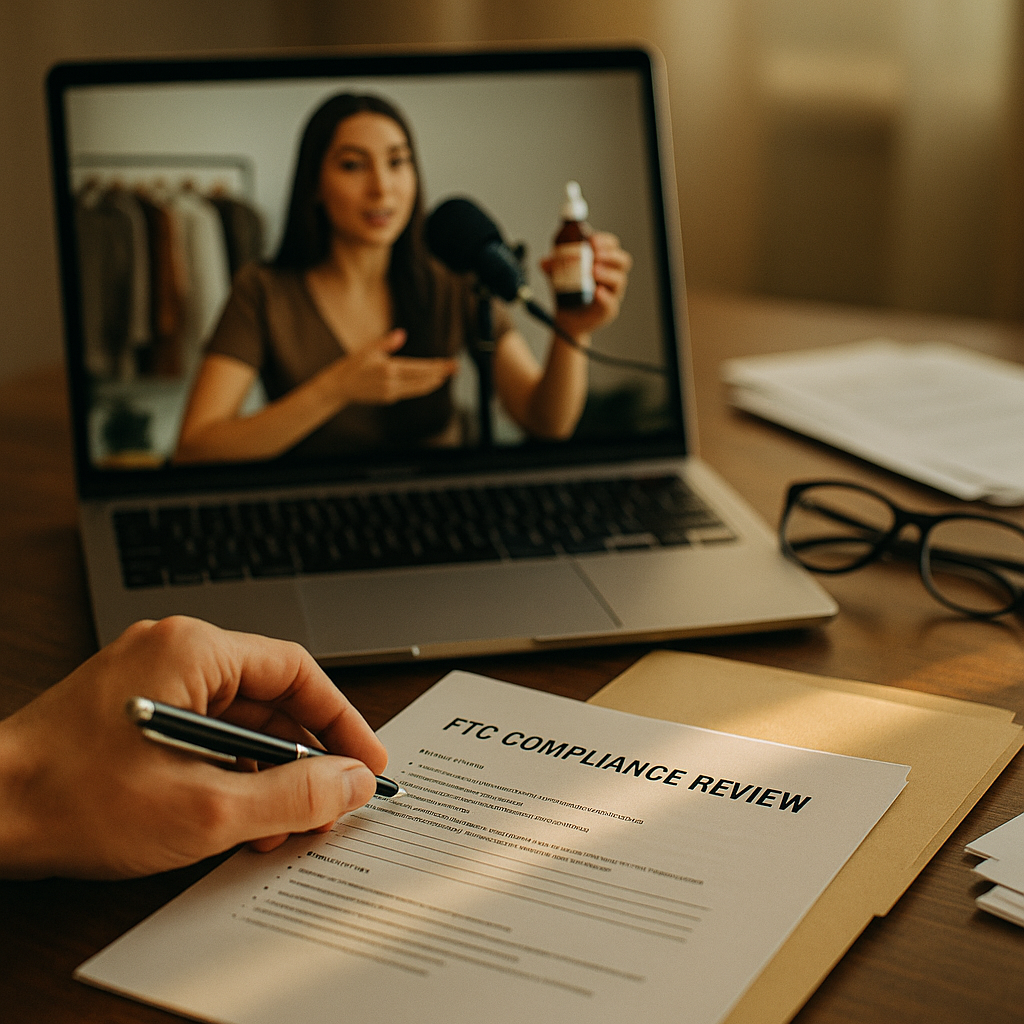
The FTC brought in over $324 million in refunds from deceptive marketing cases last year alone. Now ask yourself: has anyone actually read your livestream shopping scripts line by line for price-claim risk? If the answer is “we’ll get to it,” Q4 is about to expose that gap in front of your biggest audience of the year.
Livestream shopping is where impulse meets legal exposure. Hosts talk fast, prices flash on screen, countdown graphics tick down, and “was/now” comparisons fly by in seconds. Every one of those moments is a claim. And under FTC substantiation rules, claims need proof, not vibes. This checklist exists so your legal and marketing teams stop treating livestream scripts as informal chatter and start treating them as what they are: regulated commercial speech.
Why Livestream Price Claims Draw More Scrutiny Than Static Ads
A banner ad sits still. Someone can screenshot it, compare it, fact-check it at leisure. A livestream doesn’t wait for anyone. That speed is exactly why regulators view it as higher risk, not lower. The FTC’s guidance on deceptive pricing practices doesn’t carve out an exception for “but it was said live.” If anything, enforcement teams treat unscripted-sounding claims as more dangerous, because hosts improvise, and improvisation is where “lowest price ever” slips out without a shred of backup data.
Add countdown timers and limited-stock graphics into the mix, and you’ve got a second layer of exposure. We’ve covered how countdown timers create state scarcity law risks during Q4, and the pattern holds here too: urgency cues plus unverified pricing claims is a compliance double jeopardy.
If a host says “lowest price of the year” and nobody on your team can produce twelve months of pricing data to back it up, that claim doesn’t belong in the script — full stop.
The Core Substantiation Standard, In Plain Terms
FTC substantiation doctrine boils down to one question: do you have a reasonable basis for the claim before you make it, not after? “Reasonable basis” isn’t a vague gut check. For pricing claims specifically, that typically means:
- Documented price history covering a meaningful comparison period (the FTC has historically looked at whether a “regular price” was genuinely offered for a substantial time)
- Contemporaneous records showing the compared price was actually charged, not a manufactured reference point
- Consistency between the on-screen graphic, the verbal claim, and the actual checkout price
- A clear basis for superlatives like “best deal,” “lowest ever,” or “biggest discount”
Notice what’s missing from that list: intent. You don’t need to intend to deceive anyone. A sloppy script that overstates a discount is still a violation if the substantiation isn’t there. That’s the uncomfortable part for marketing teams used to thinking about “misleading” as a moral judgment rather than a documentation gap.
The Pre-Q4 Script Audit Checklist
Run every livestream shopping script through this list before it goes live. Not after a complaint. Before.
- Flag every numeric claim. Pull out every dollar figure, percentage discount, and comparison phrase (“was $80, now $40,” “60% off,” “cheapest we’ve offered”). Build a claims log, not a vague read-through.
- Match each claim to a substantiation file. For every flagged claim, there should be a corresponding record: pricing history, invoice data, or a documented reference price. No file, no claim.
- Check comparison price legitimacy. Was the “original” price actually charged to real customers for a real stretch of time? A price set high for one day just to mark it down doesn’t hold up.
- Audit host ad-libs against approved talking points. Scripts are one thing; live delivery is another. Hosts often add color commentary (“this is literally the best deal you’ll see all year”) that was never in the approved doc. That’s scripting risk hiding in plain sight, and we’ve broken down how brand talking points become FTC scripting risk in more detail.
- Reconcile on-screen graphics with spoken claims. If the graphic says “30% off” but the host says “half price,” that inconsistency alone can trigger scrutiny, regardless of which number is accurate.
- Verify checkout price matches the promoted price. Sounds obvious. It’s the single most common failure point when platform fees, shipping surcharges, or bundling change the final number.
- Confirm countdown and scarcity claims are true, not decorative. “Only 12 left” needs to reflect actual inventory, not a UX template default. Our livestream countdown timer compliance audit covers this exact failure mode in depth.
- Review disclosure placement for sponsored segments. Price claims inside paid partnership content carry the added burden of clear, unavoidable disclosure under endorsement guidelines.
- Log approval sign-off with a timestamp. If a claim goes out without a documented internal approval, that’s a gap the FTC will notice during any investigation.
This isn’t busywork. It’s the difference between a claim you can defend in an FTC inquiry and one that gets your brand a consent decree.
Where Most Brands Actually Fail
It’s rarely the written script that causes trouble. It’s the improvisation layer. Hosts get comfortable, chase engagement, and start narrating urgency that isn’t backed by anything: “this is selling out, I’ve never seen a deal this good, my team told me this price won’t last.” None of that is in the approved doc. All of it is a claim.
Brands that outsource hosting to creators face a compounding problem: contractual control. If your creator agreements don’t explicitly require pre-approval of price claims and prohibit ad-lib pricing language, you have no enforcement mechanism when a host goes off-script. This is exactly the gap addressed in our creator contract audit framework for FTC script control risk. If the contract doesn’t require it, don’t expect the host to volunteer it.
There’s also a technology layer worth watching. More brands are testing AI-generated hosts and avatar-led livestreams for Q4 volume. That introduces a separate compliance track entirely, since the FTC’s expanded testimonial rule now covers AI avatars directly. If your Q4 plan includes synthetic hosts reading pricing scripts, that script needs the same substantiation rigor as a human host, arguably more, since there’s no human judgment layer to catch an obviously false claim before it airs.
Building the Audit Into Your Q4 Production Calendar
Legal review can’t be a bottleneck bolted onto the end of production. It has to sit inside the calendar the same way creative approval does. Here’s a workable structure:
- T-minus 6 weeks: Pricing team finalizes promotional price points and compiles substantiation files for each.
- T-minus 4 weeks: Script drafts go through the claims log process above. Legal flags unsupported language.
- T-minus 2 weeks: Host rehearsal with recorded run-through, reviewed specifically for ad-lib pricing language.
- T-minus 1 week: Final graphics-to-script reconciliation. Confirm checkout pricing matches every promoted figure.
- Live day: A designated compliance monitor watching the stream in real time, empowered to flag and correct claims mid-broadcast if needed.
That last point matters more than teams expect. Q4 events run long, hosts get tired, and tired hosts improvise more. A live monitor isn’t overkill, it’s the last line of defense before a clip gets screenshotted and forwarded to a regulator or a competitor’s legal team.
Q4 volume means more streams, more hosts, more improvisation — and more chances for one unsupported “lowest price ever” to end up as Exhibit A.
What About Multi-Platform and Cross-Border Streams?
If your Q4 strategy spans TikTok Shop, Instagram Live, and Amazon Live simultaneously, each platform has its own disclosure mechanics layered on top of FTC baseline rules. TikTok’s countdown timer and pricing disclosure requirements, for instance, are distinct enough that we’ve dedicated separate coverage to TikTok Shop’s countdown timer disclosure rules. Don’t assume a script cleared for one platform automatically clears for another.
Cross-border streams add currency and regional pricing regulation questions too. A “lowest price” claim valid in the U.S. market might not hold up against EU consumer protection standards for the same SKU. If your Q4 event includes international audiences, loop in whoever handles your cross-border compliance matrix before finalizing global pricing scripts. Platforms like TikTok Shop’s seller resources and Meta’s commerce guidelines both publish region-specific requirements worth cross-referencing during script review, not after launch.
The Real Cost of Skipping This
Marketing teams sometimes treat legal review as friction that slows down a launch. Flip that framing for Q4. An FTC inquiry doesn’t just cost fines, it costs weeks of executive time, platform trust, and often a public settlement that outlives the sale it was meant to protect. Compare that to a two-week audit cycle. The math isn’t close.
Data from eMarketer continues to show livestream commerce as one of the fastest-growing retail channels heading into peak season, which means volume, and scrutiny, both scale together. More streams mean more scripts, more hosts, more chances for a single unsupported claim to surface at the worst possible moment: during your highest-traffic week of the year.
Next Step
Pull your Q4 livestream calendar today and run the first three streams through the claims-log exercise above, before scripts get locked. If your team can’t produce a substantiation file for every price claim within an hour, that script isn’t ready for air.
FAQs
What counts as a “price claim” in a livestream shopping script?
Any statement comparing prices, referencing discounts, or using superlatives about value, including verbal claims, on-screen graphics, and countdown or scarcity messaging tied to price.
Do FTC substantiation rules apply to unscripted host commentary?
Yes. Ad-libbed claims made during a live broadcast carry the same substantiation requirement as scripted lines. Intent doesn’t matter; the lack of a documented basis for the claim does.
How long should we retain price history to support a “was/now” comparison?
The FTC has generally looked at whether a reference price was genuinely offered for a substantial, recent period, not manufactured briefly to justify a markdown. Retain documented pricing records covering at least several months prior to the promotion.
Are AI-hosted livestreams held to the same standard as human hosts?
Yes, and arguably with less room for error since there’s no human judgment to catch an obviously unsupported claim. The FTC’s expanded testimonial rule now explicitly addresses AI avatars making endorsement or pricing claims.
Who should own the pre-stream compliance audit internally?
A joint process between legal and marketing works best: legal owns substantiation standards, marketing owns script production, and a designated compliance monitor owns real-time oversight during the actual broadcast.
FAQs
Visible FAQ content is included above. JSON-LD version follows immediately below.
Top Influencer Marketing Agencies
The leading agencies shaping influencer marketing in 2026
Agencies ranked by campaign performance, client diversity, platform expertise, proven ROI, industry recognition, and client satisfaction. Assessed through verified case studies, reviews, and industry consultations.
Moburst

-
2

The Shelf
Boutique Beauty & Lifestyle Influencer AgencyA data-driven boutique agency specializing exclusively in beauty, wellness, and lifestyle influencer campaigns on Instagram and TikTok. Best for brands already focused on the beauty/personal care space that need curated, aesthetic-driven content.Clients: Pepsi, The Honest Company, Hims, Elf Cosmetics, Pure LeafVisit The Shelf → -
3

Audiencly
Niche Gaming & Esports Influencer AgencyA specialized agency focused exclusively on gaming and esports creators on YouTube, Twitch, and TikTok. Ideal if your campaign is 100% gaming-focused — from game launches to hardware and esports events.Clients: Epic Games, NordVPN, Ubisoft, Wargaming, Tencent GamesVisit Audiencly → -
4

Viral Nation
Global Influencer Marketing & Talent AgencyA dual talent management and marketing agency with proprietary brand safety tools and a global creator network spanning nano-influencers to celebrities across all major platforms.Clients: Meta, Activision Blizzard, Energizer, Aston Martin, WalmartVisit Viral Nation → -
5

The Influencer Marketing Factory
TikTok, Instagram & YouTube CampaignsA full-service agency with strong TikTok expertise, offering end-to-end campaign management from influencer discovery through performance reporting with a focus on platform-native content.Clients: Google, Snapchat, Universal Music, Bumble, YelpVisit TIMF → -
6

NeoReach
Enterprise Analytics & Influencer CampaignsAn enterprise-focused agency combining managed campaigns with a powerful self-service data platform for influencer search, audience analytics, and attribution modeling.Clients: Amazon, Airbnb, Netflix, Honda, The New York TimesVisit NeoReach → -
7

Ubiquitous
Creator-First Marketing PlatformA tech-driven platform combining self-service tools with managed campaign options, emphasizing speed and scalability for brands managing multiple influencer relationships.Clients: Lyft, Disney, Target, American Eagle, NetflixVisit Ubiquitous → -
8

Obviously
Scalable Enterprise Influencer CampaignsA tech-enabled agency built for high-volume campaigns, coordinating hundreds of creators simultaneously with end-to-end logistics, content rights management, and product seeding.Clients: Google, Ulta Beauty, Converse, AmazonVisit Obviously →