


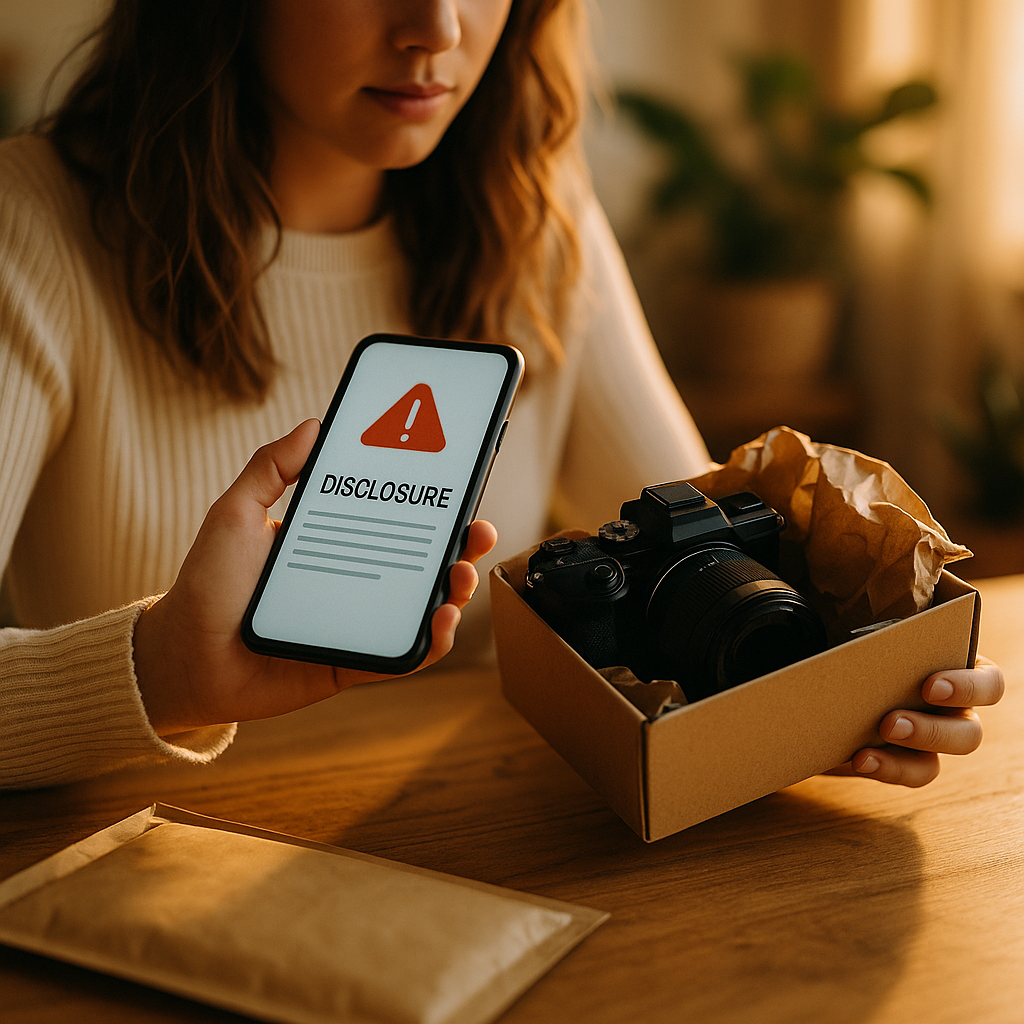
A pair of sneakers is a gift. A car on loan for six months? That’s a relationship — and the FTC treats it like one. Most brands lump “free product” into a single disclosure bucket, and that mistake is exactly what’s showing up in FTC rules on creator content enforcement actions this year. The distinction between a one-time freebie and a long-term product loan isn’t legal trivia. It’s the difference between a clean campaign and a five-figure settlement.
Why the Gift-Versus-Loan Distinction Actually Matters
The FTC’s Endorsement Guides don’t care what you call the arrangement internally. They care about “material connection” — anything that could affect how much weight an audience gives to a creator’s opinion. A single gifted candle sent unsolicited creates a weaker material connection than, say, a $4,000 e-bike a creator keeps using (and can keep) for a year of content.
Duration changes the math. A one-time gift is transactional: creator posts once, relationship ends. A long-term loan is ongoing: the brand retains leverage, the creator has incentive to keep the content favorable, and audiences have no way to know the product isn’t the creator’s own unless it’s disclosed. The FTC has said as much explicitly in its endorsement guidance, available directly from the FTC’s official guidance library.
If a creator has an ongoing incentive to keep a brand happy — because the product isn’t theirs to keep, or because more free product is coming — that’s a material connection requiring disclosure, regardless of whether cash changed hands.
What Counts as a “Loan” in Practice?
Brands get tripped up here because “loan” sounds formal, like a contract with a due date. In FTC terms, it’s much broader. Consider these common scenarios:
- Extended product trials: A skincare brand sends a 90-day supply “to properly test results.” That’s a loan-adjacent arrangement if the brand expects content throughout.
- Loaner equipment: Camera gear, appliances, furniture sent “for review” with an expectation of return — or with the tacit understanding the creator keeps it if content performs well.
- Fleet or vehicle programs: Auto and outdoor brands loaning vehicles for a season of content. This is one of the clearest, highest-risk categories because the dollar value is so high.
- Subscription or software access: Ongoing free access to a paid tool, extended indefinitely as long as the creator keeps posting.
Notice the pattern? Duration and ongoing expectation are the triggers, not whether the brand used the word “loan” in the outreach email.
One-Time Gifts: Still Not a Free Pass
Here’s where marketers oversimplify in the other direction. Even a single unsolicited gift can require disclosure if it has meaningful value and the creator posts about it. The FTC’s guidance doesn’t set a hard dollar threshold, but its enforcement pattern (and years of guidance to advertisers) suggests anything beyond trivial value — think free samples versus a $300 skincare bundle — needs a clear “#ad” or “#gifted” tag if it influences content.
The nuance: a genuinely unsolicited, no-strings gift where the brand has zero expectation of content is lower risk. The moment you send a follow-up asking “did you get a chance to post?” you’ve converted an ambiguous gift into a material connection with expectations attached — and the disclosure obligation follows.
Practically, most legal teams now recommend treating any brand-initiated product send as disclosure-worthy by default, regardless of duration. It’s simpler for creators to follow and it removes the guesswork that gets brands in trouble. For a deeper look at how programs get audited after the fact, see our whistleblower protocol breakdown — a growing share of FTC complaints originate from tipsters, not routine monitoring.
The Duration Threshold Nobody Talks About
There’s no bright-line number of days that converts a “gift” into a “loan” in FTC guidance. But industry legal counsel has converged on a rough operating principle: if the product is retained by the creator for longer than a typical review cycle (roughly 30 days) or if the brand communicates any expectation of ongoing content, treat it as a loan-tier disclosure obligation.
That means:
- Recurring posts referencing the same product should each carry disclosure, not just the first one.
- Stories, unboxings, and long-form reviews spread across weeks all need consistent tagging.
- “Loaner” arrangements where the brand can recall the product anytime should be disclosed for the entire duration of possession, not just the initial post.
This mirrors how the FTC has approached other ambiguous disclosure categories — auto-renewing offers, recurring affiliate codes, and subscription mechanics all get the same “ongoing relationship, ongoing disclosure” treatment. If you’re building broader policy documentation, our auto-renewing discount code framework uses a similar recurring-disclosure logic that maps cleanly onto product loan programs.
Building a Brand-Side Compliance Framework
Legal risk aside, this is fundamentally an operational problem. Most disclosure failures don’t come from bad intent — they come from sloppy handoffs between brand teams, agencies, and creators who don’t fully understand the rules. Fix the process and the compliance mostly follows.
Here’s a framework that’s worked for brands managing high-volume seeding and loan programs:
- Classify every product send at the point of shipment. Build a simple internal tag: one-time gift, extended loan, or recurring send. This determines the disclosure language required and how long it must persist across content.
- Bake disclosure language into the brief, not the follow-up email. Creators should see required hashtags and placement rules before they ever unbox the product. Retroactively asking for a disclosure add is a compliance red flag in itself.
- Track duration, not just delivery. If a product is on loan, your system needs a return-or-retain date. That date should trigger a compliance check-in with the creator.
- Audit content after publication. Automated tools and manual spot-checks catch missed hashtags before regulators do. Programs at scale, especially UGC clipping and affiliate networks, need this built into standard operations — our disclosure audit framework for clipping networks covers the mechanics in detail.
- Document everything. Contracts, briefs, and shipment logs are your paper trail if the FTC ever comes knocking. This is the same logic behind maintaining an AI tool usage paper trail for AI-assisted content — regulators reward brands who can show their work.
The single biggest predictor of an FTC complaint isn’t the value of the product — it’s the absence of a documented process showing the brand tried to get disclosure right.
Where Escalation Policies Come In
Even with a good framework, gaps happen. A creator forgets a hashtag. An agency onboards a new influencer without briefing them properly. What separates brands that get a warning letter from brands that get a consent decree is often the speed and clarity of their internal escalation response.
Every influencer program running product seeding or loan arrangements at scale should have a documented escalation trigger policy that spells out who gets notified, how fast content gets flagged for correction, and when legal counsel needs to be looped in. Pair that with a broader escalation protocol for sponsorships generally, and you’ve got a defensible operational stance even when individual creators slip up.
Data backs up why this matters. Influencer marketing spend keeps climbing — eMarketer’s creator economy tracking shows continued double-digit growth in brand allocations to influencer budgets — which means more product is moving through more hands, and more surface area for disclosure slip-ups. Meanwhile, platforms like Meta’s brand partnership tools and TikTok’s Creator Marketplace have built in native disclosure tagging, but native tools only work if brands enforce their use contractually. A tag that exists on the platform but isn’t required in the contract is a tag creators will skip half the time.
A Quick Gut-Check for Marketing Teams
Before your next seeding campaign goes out, run this checklist:
- Does the product get returned, or does the creator keep it indefinitely?
- Is there any expectation — stated or implied — of repeat content?
- Does the brief specify disclosure placement and wording, or leave it to the creator’s judgment?
- Is there a system tracking which creators currently hold loaned product?
- Would your disclosure language survive a plain reading by someone unfamiliar with your brand?
If you hesitated on any of these, that’s your next fix — not a hypothetical.
Get the Next Step Right
Stop treating “free product” as a single compliance category. Split your seeding and loan programs into distinct tracks with their own disclosure rules, duration tracking, and escalation paths — then audit both tracks quarterly, because the FTC increasingly is.
FAQs
Does a one-time gift always require an FTC disclosure?
Not always, but the FTC’s guidance leans toward requiring disclosure whenever a gift has meaningful value and the creator posts about it after receiving it from a brand. Low-value, genuinely unsolicited items with zero content expectation carry lower risk, but most legal teams now recommend disclosing by default.
How long does a product loan need to last before disclosure rules apply for the full duration?
There’s no official FTC day-count threshold, but common practice treats anything beyond a standard 30-day review period, or any arrangement with an ongoing content expectation, as requiring disclosure across the entire possession period, not just the first post.
What’s the difference between a “gift” and a “loan” if the creator ends up keeping the product either way?
The distinction lies in intent and duration at the time of the arrangement. If the brand expected the product back, tracked a return date, or communicated ongoing content expectations during the loan period, disclosure obligations apply for that entire window even if the creator ultimately keeps the item.
Can platform-native disclosure tags (like TikTok’s Branded Content Toggle) satisfy FTC requirements on their own?
Native tags help but don’t automatically satisfy FTC requirements. The FTC still expects clear, unavoidable disclosure language, and brands should contractually require creators to use both platform tools and plain-language hashtags like #ad or #gifted.
Who is liable if a creator forgets to disclose a product loan, the brand or the creator?
Both can be held liable. The FTC has pursued brands directly for failing to establish adequate monitoring and creator education, even when the creator was the one who omitted the disclosure.
Should agencies handle disclosure compliance, or does the brand need its own process?
Agencies can manage day-to-day execution, but brands remain ultimately responsible in FTC enforcement actions. Brands should maintain their own documentation, escalation policy, and audit cadence regardless of agency involvement.
Top Influencer Marketing Agencies
The leading agencies shaping influencer marketing in 2026
Agencies ranked by campaign performance, client diversity, platform expertise, proven ROI, industry recognition, and client satisfaction. Assessed through verified case studies, reviews, and industry consultations.
Moburst

-
2

The Shelf
Boutique Beauty & Lifestyle Influencer AgencyA data-driven boutique agency specializing exclusively in beauty, wellness, and lifestyle influencer campaigns on Instagram and TikTok. Best for brands already focused on the beauty/personal care space that need curated, aesthetic-driven content.Clients: Pepsi, The Honest Company, Hims, Elf Cosmetics, Pure LeafVisit The Shelf → -
3

Audiencly
Niche Gaming & Esports Influencer AgencyA specialized agency focused exclusively on gaming and esports creators on YouTube, Twitch, and TikTok. Ideal if your campaign is 100% gaming-focused — from game launches to hardware and esports events.Clients: Epic Games, NordVPN, Ubisoft, Wargaming, Tencent GamesVisit Audiencly → -
4

Viral Nation
Global Influencer Marketing & Talent AgencyA dual talent management and marketing agency with proprietary brand safety tools and a global creator network spanning nano-influencers to celebrities across all major platforms.Clients: Meta, Activision Blizzard, Energizer, Aston Martin, WalmartVisit Viral Nation → -
5

The Influencer Marketing Factory
TikTok, Instagram & YouTube CampaignsA full-service agency with strong TikTok expertise, offering end-to-end campaign management from influencer discovery through performance reporting with a focus on platform-native content.Clients: Google, Snapchat, Universal Music, Bumble, YelpVisit TIMF → -
6

NeoReach
Enterprise Analytics & Influencer CampaignsAn enterprise-focused agency combining managed campaigns with a powerful self-service data platform for influencer search, audience analytics, and attribution modeling.Clients: Amazon, Airbnb, Netflix, Honda, The New York TimesVisit NeoReach → -
7

Ubiquitous
Creator-First Marketing PlatformA tech-driven platform combining self-service tools with managed campaign options, emphasizing speed and scalability for brands managing multiple influencer relationships.Clients: Lyft, Disney, Target, American Eagle, NetflixVisit Ubiquitous → -
8

Obviously
Scalable Enterprise Influencer CampaignsA tech-enabled agency built for high-volume campaigns, coordinating hundreds of creators simultaneously with end-to-end logistics, content rights management, and product seeding.Clients: Google, Ulta Beauty, Converse, AmazonVisit Obviously →