


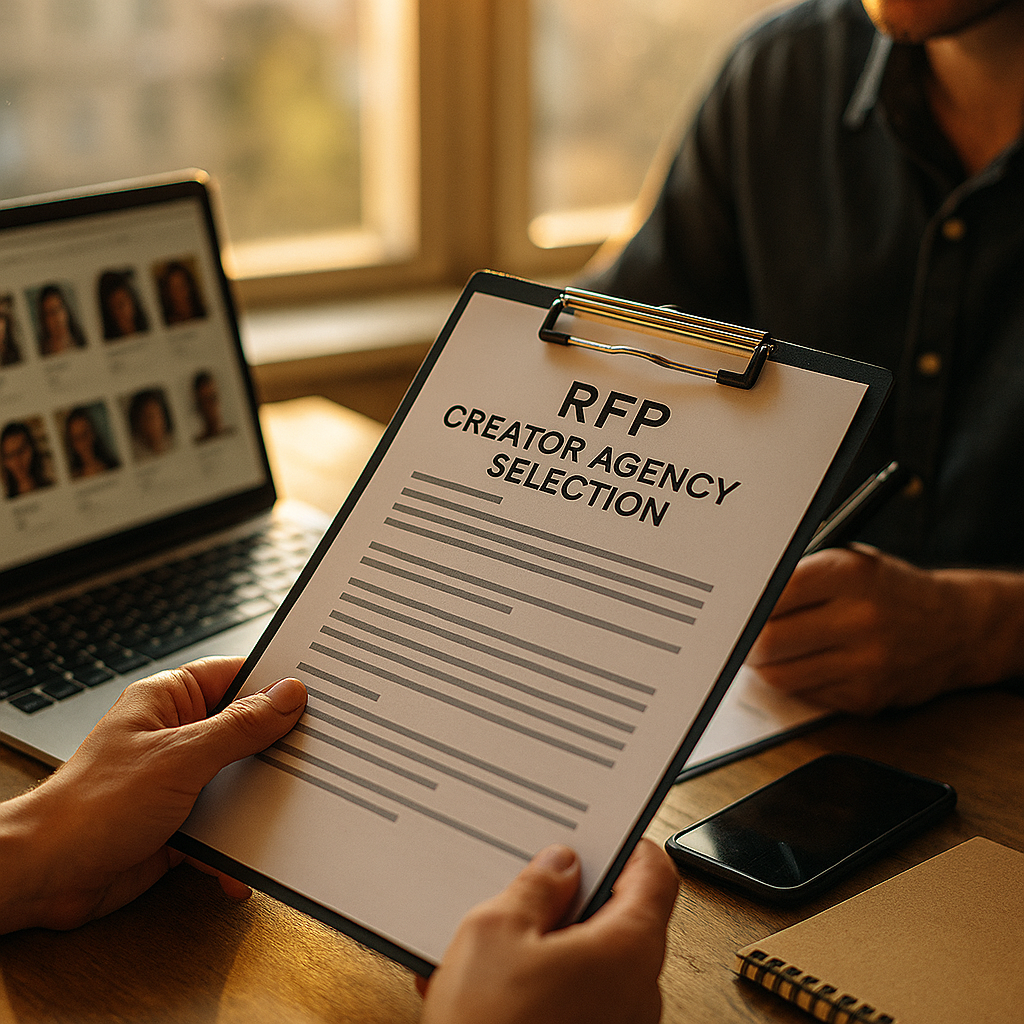
Only a third of brands say their last creator agency pitch process actually surfaced the right partner, according to industry surveys on marketing procurement. The rest settled, or worse, picked based on the slickest deck. Writing a rigorous RFP for creator agency selection is the single highest-leverage document a marketing team produces all year, because it determines who controls your creator budget, your brand reputation, and your data for the next 12 to 24 months.
Most brands treat this process like hiring a vendor. It is not. You are selecting a partner who will negotiate on your behalf, represent your brand voice to thousands of creators, and sit on sensitive performance data. Get the RFP wrong and you inherit their blind spots.
Why Most Creator Agency RFPs Fail Before They’re Sent
The typical procurement-led RFP asks about headcount, case studies, and day rates. None of that tells you whether an agency can actually run a modern creator program. They ask the wrong questions because they are templated from influencer marketing’s earlier, simpler era, when the job was booking Instagram posts and tracking reach.
Today’s creator agencies need to manage multi-platform content strategy, FTC disclosure compliance, affiliate attribution, crisis response, and increasingly, AI-assisted content workflows. An RFP that doesn’t probe these areas will produce a shortlist of agencies who all look identical on paper and behave very differently once the contract is signed.
An RFP is not a formality to satisfy procurement. It is the only leverage point where you can force agencies to show their actual methodology before you’re financially committed.
There’s a second failure mode: brands write RFPs that are too long and generic, so agencies respond with boilerplate. A sharp RFP is specific to your category, your current program maturity, and your stated goals. If you’re early stage, your questions should look different than a brand running an established creator program at scale.
Start With Scope, Not With Vendors
Before you write a single question, define what you’re actually buying. Are you hiring an agency of record to run the entire creator function, or a specialist to handle sourcing while your in-house team manages relationships? This distinction changes everything about the RFP, from the questions you ask to the pricing model you request.
If you’re unsure whether you need an agency at all versus building internal capacity, that’s worth settling first. The comparison between building in-house versus buying a platform is a useful gut-check before you spend weeks running a formal procurement process for something you might not need.
Write a one-page scope brief before the RFP goes out. It should cover:
- Which functions the agency owns: sourcing, negotiation, content review, payment, reporting, crisis management.
- Platform priorities (TikTok, Instagram, YouTube, emerging channels).
- Budget range and expected creator tier mix (nano through celebrity).
- Whether this replaces an existing vendor or is net-new spend.
- Your current program maturity stage, since a pilot program and a media-channel-level program need very different agency capabilities, as outlined in the creator program maturity model.
The Core Sections Every RFP Template Needs
Here is the skeleton. Adapt the weighting to your category, but don’t skip sections, even ones that feel like box-checking. The sections agencies try to rush through are usually the ones that matter most.
1. Company Background and Fit
Ask for client roster by vertical, not total client count. An agency with 40 clients across unrelated categories is not the same as one with 8 clients in your specific vertical. Request two reference calls with current clients, not past ones. Past clients leave for a reason, and that reason is usually the thing you want to know.
2. Sourcing Methodology
This is where generic RFPs fall apart. Ask specifically: how do they vet creators for fraud, bot followers, and brand safety history? What tools do they use for audience verification? Do they have proprietary creator databases or do they rely entirely on platform-native discovery tools? Agencies vetting from massive, loosely curated networks carry real procurement risk, and it’s worth reviewing a procurement risk framework for creator networks before you accept vague answers here.
3. Compensation and Contract Structuring
Ask the agency to walk through exactly how they structure creator payouts: flat fee, performance-based, or hybrid. Their answer reveals a lot about how they think about risk allocation. If they can’t articulate the tradeoffs between a flat fee versus earned percentage model, that’s a red flag. Also require them to disclose their own fee structure clearly: retainer, percentage of media spend, or performance fee, since the comparison matters when you’re structuring the actual contract terms.
4. Reporting and Attribution
Ask which metrics they report by default, and which ones require custom dashboards. Do they report EMV, CPE, CPA, ROAS, or some blend? A sophisticated agency should be comfortable discussing a multi-tier ROI framework rather than leaning on a single vanity metric. If affiliate or promo-code attribution is part of your program, ask directly how they’d resolve disputes between sales and finance teams, because attribution disagreements are one of the most common sources of agency-brand friction after onboarding.
5. Compliance and Risk Management
This section gets skipped constantly, and it shouldn’t. Ask how they handle FTC disclosure compliance, how they’d respond to a creator-caused PR incident, and whether they have a documented crisis SLA. Reference the FTC’s endorsement guidelines directly in your RFP question, and ask the agency to confirm their process aligns with them. If you’re UK-based or run UK campaigns, ask the same about ICO data handling guidance, since creator contracts often involve personal data processing. A capable agency should already have a tiered response plan; you want to see their version of a crisis response SLA before you sign anything.
Scoring Matrix: How to Compare Apples to Apples
Don’t score proposals on gut feel. Build a weighted matrix before the RFP goes out, not after responses arrive, or you’ll unconsciously weight toward whichever proposal reads best. A reasonable starting split:
- Category expertise and references: 20%
- Sourcing methodology and fraud prevention: 20%
- Reporting and attribution capability: 20%
- Compliance and crisis readiness: 15%
- Pricing and contract flexibility: 15%
- Cultural fit and communication style: 10%
Score each vendor independently before discussing as a team. Groupthink kills objectivity in these processes faster than almost anything else. If your organization is deciding between keeping creator work centralized or distributing it across regional teams, factor that into your weighting too, since the right agency fit changes depending on whether you’re running a centralized or decentralized creator operation.
What Agency Proposals Try to Hide
Every proposal has a weak spot, and most agencies are skilled at burying it in a confident narrative. Watch for a few specific patterns.
Vague pricing that avoids stating all-in costs per creator tier. Case studies that show reach and impressions but skip conversion or retention metrics. Reference clients who are suspiciously enthusiastic, which sometimes means they haven’t worked together long enough to hit friction points. And an inability to answer how they’d handle losing a single high-performing creator, which matters more than brands realize, especially if your program risks single-creator dependency without a succession plan.
Ask every finalist directly: “What’s the biggest failure you’ve had with a client in the last year, and what changed afterward?” Agencies that can’t answer this honestly are agencies that haven’t been pushed hard enough by previous clients, or ones unwilling to admit fault to you now.
Timeline: Don’t Rush a Multi-Year Decision Into a Six-Week Sprint
A realistic RFP timeline runs 8 to 12 weeks: two weeks to finalize scope and distribute, three to four weeks for agency responses, two weeks for presentations and reference calls, and two weeks for contract negotiation. Compressing this timeline is the single most common reason brands end up locked into underperforming agency relationships, because corners get cut exactly where due diligence matters most.
Build in a 90-day performance check-in clause regardless of contract length. This gives you an exit ramp if the agency’s actual execution doesn’t match what they pitched, without forcing you into a full annual commitment before you’ve seen real results. Pair this with clear KPIs tied to business outcomes from day one, not just vanity engagement numbers, something covered well in frameworks for tying creator partnership OKRs to sales attribution.
It also helps to benchmark pricing against current category data before negotiations start. Review spend benchmarks by vertical so you’re not negotiating blind, and check broader industry spend data through resources like eMarketer’s influencer marketing research or Statista’s creator economy data to validate what agencies are proposing against market norms.
FAQs
Frequently Asked Questions
How long should an RFP for creator agency selection take from start to signed contract?
Plan for 8 to 12 weeks. Shorter timelines increase the risk of skipping reference checks and compliance review, which are the two areas most likely to cause problems after onboarding.
Should we require agencies to disclose their fee structure in the RFP?
Yes, always. Ask for all-in cost per creator tier, not just a blended retainer number, so you can compare proposals on true cost rather than headline pricing.
What’s the biggest mistake brands make when writing a creator agency RFP?
Copying a generic procurement template without adapting questions to creator-specific risks like fraud vetting, FTC compliance, and attribution methodology. Generic RFPs produce generic answers.
How many agencies should we include in the RFP process?
Three to five is typical. Fewer than three limits comparison, and more than five creates review fatigue that leads to rushed, lower-quality evaluation.
Should smaller or early-stage brands still run a formal RFP?
Yes, but scaled down. Even a lightweight two-week RFP with five core questions beats selecting an agency purely on referral or pitch charisma.
Next step: Pull your current scope brief, build the weighted scoring matrix before you send a single question, and require every finalist to answer the crisis and attribution sections in writing, not just verbally in a pitch meeting.
Top Influencer Marketing Agencies
The leading agencies shaping influencer marketing in 2026
Agencies ranked by campaign performance, client diversity, platform expertise, proven ROI, industry recognition, and client satisfaction. Assessed through verified case studies, reviews, and industry consultations.
Moburst

-
2

The Shelf
Boutique Beauty & Lifestyle Influencer AgencyA data-driven boutique agency specializing exclusively in beauty, wellness, and lifestyle influencer campaigns on Instagram and TikTok. Best for brands already focused on the beauty/personal care space that need curated, aesthetic-driven content.Clients: Pepsi, The Honest Company, Hims, Elf Cosmetics, Pure LeafVisit The Shelf → -
3

Audiencly
Niche Gaming & Esports Influencer AgencyA specialized agency focused exclusively on gaming and esports creators on YouTube, Twitch, and TikTok. Ideal if your campaign is 100% gaming-focused — from game launches to hardware and esports events.Clients: Epic Games, NordVPN, Ubisoft, Wargaming, Tencent GamesVisit Audiencly → -
4

Viral Nation
Global Influencer Marketing & Talent AgencyA dual talent management and marketing agency with proprietary brand safety tools and a global creator network spanning nano-influencers to celebrities across all major platforms.Clients: Meta, Activision Blizzard, Energizer, Aston Martin, WalmartVisit Viral Nation → -
5

The Influencer Marketing Factory
TikTok, Instagram & YouTube CampaignsA full-service agency with strong TikTok expertise, offering end-to-end campaign management from influencer discovery through performance reporting with a focus on platform-native content.Clients: Google, Snapchat, Universal Music, Bumble, YelpVisit TIMF → -
6

NeoReach
Enterprise Analytics & Influencer CampaignsAn enterprise-focused agency combining managed campaigns with a powerful self-service data platform for influencer search, audience analytics, and attribution modeling.Clients: Amazon, Airbnb, Netflix, Honda, The New York TimesVisit NeoReach → -
7

Ubiquitous
Creator-First Marketing PlatformA tech-driven platform combining self-service tools with managed campaign options, emphasizing speed and scalability for brands managing multiple influencer relationships.Clients: Lyft, Disney, Target, American Eagle, NetflixVisit Ubiquitous → -
8

Obviously
Scalable Enterprise Influencer CampaignsA tech-enabled agency built for high-volume campaigns, coordinating hundreds of creators simultaneously with end-to-end logistics, content rights management, and product seeding.Clients: Google, Ulta Beauty, Converse, AmazonVisit Obviously →