


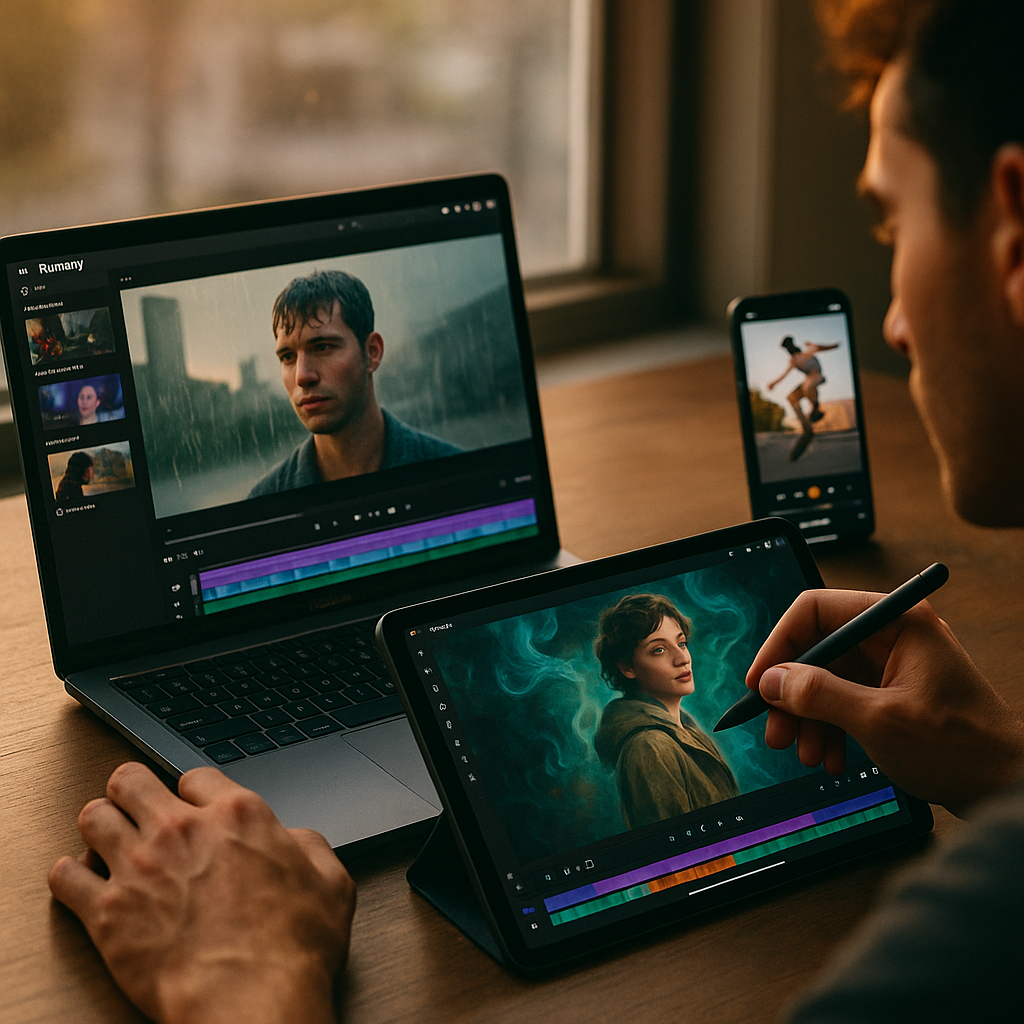
Seventy percent of marketers say they’ll increase AI video spend this year, according to eMarketer data on generative media adoption. Yet most brand teams still can’t answer a simple question: which model does what, and why are you paying for three of them? A multimodal AI production stack built around Runway, Veo, and Sora isn’t a luxury anymore. It’s becoming the default toolkit for creator content that needs to ship fast and still look premium.
Why One Model Was Never Going to Be Enough
Early adopters treated generative video like a single-vendor decision. Pick a tool, learn its quirks, build your whole pipeline around it. That approach is already outdated. Runway, Google’s Veo, and OpenAI’s Sora each solve different problems, and forcing one model to do all three jobs wastes budget and time.
Runway remains the workhorse for granular editing control: motion brushes, inpainting, camera control, and a mature API that plugs into existing post-production workflows. Veo, tightly integrated with Google’s ecosystem, produces strong physics and lighting consistency, which matters for product-focused UGC and anything that needs to look physically plausible. Sora leans into narrative coherence across longer clips and stylistic range, useful for concept spots and hero content where storytelling carries the brand message.
Treating Runway, Veo, and Sora as interchangeable tools is the fastest way to overpay for underwhelming output. Each model has a lane, and stacking them deliberately is where the ROI shows up.
Brands that understand this are building routing logic into their creative ops: quick social cutdowns go through one model, hero brand films through another, and rapid A/B variant testing through whichever tool has the cheapest per-second render cost that week. Pricing shifts fast in this category, so the “best” model for a given task can change quarterly.
Mapping the Stack to the Creator Content Funnel
Not every asset in a creator campaign deserves the same production budget or the same model. A useful way to think about it: match model capability to content function.
- Top-of-funnel awareness clips: Sora-style narrative generation for concept spots that need emotional range and scene variety.
- Mid-funnel product demos: Veo for physics-accurate product handling, texture, and lighting that survives close scrutiny.
- Bottom-funnel performance creative: Runway for rapid iteration, quick edits, and format resizing across placements.
- Creator-style UGC simulation: A blend, often Runway for the editing layer on top of raw AI-generated base footage.
This isn’t theoretical. Agencies running high-volume paid social programs are already building briefs that specify which model handles which shot type, the same way a traditional shoot brief specifies which lens a DP uses for close-ups versus wide establishing shots. It’s a workflow discipline problem, not just a tooling problem.
What This Actually Costs (And Where the Hidden Fees Hide)
Per-second generation pricing looks cheap in isolation. Multiply it by iteration cycles, and it stops looking cheap. A single 15-second hero clip might require a dozen regenerations to nail character consistency or brand color accuracy. That’s before you factor in the editing layer, voice synthesis, and licensing review.
Enterprise tiers from Runway and comparable platforms often bundle seats, storage, and commercial usage rights differently, which makes apples-to-apples cost comparison genuinely hard. Teams evaluating vendor contracts should read our breakdown on evaluating AI stack bundles before signing anything with a multi-year commitment baked in.
Here’s the part finance teams tend to miss: the real cost driver isn’t generation, it’s revision cycles. A brand that skips a solid creative brief process ends up paying for the same clip five times because nobody specified brand voice, pacing, or color palette upfront. That’s not an AI problem. That’s a process problem AI just makes more visible, faster.
Rights, Likeness, and the Compliance Question Nobody Wants to Own
If a creator’s likeness, voice, or style gets referenced in a generated clip, who owns liability if it goes wrong? Right now, the honest answer is: it depends on your contract language, and most standard influencer agreements weren’t written with generative video in mind.
Brands running AI-augmented creator content should be updating contracts to explicitly cover synthetic media usage, training data consent, and disclosure requirements. The FTC has already signaled that AI-generated endorsement content falls under existing disclosure rules, meaning “made with AI” labeling isn’t optional cover, it’s a compliance requirement in many cases. Teams building governance frameworks around this should look at how AI governance checklists are being adapted for creator data and synthetic content risk.
This is also where working with a specialized AI consulting partner earns its fee. Legal review of generative content workflows isn’t glamorous, but it’s cheaper than a takedown notice or a creator dispute after a campaign is already live.
Building the Actual Workflow: A Practical Sequence
Skip the theory for a second. Here’s roughly how a mid-size brand team might structure a multimodal pipeline for a quarterly creator campaign:
- Brief development with explicit model assignment per shot type, not just a general creative brief.
- Base generation in the assigned model (Veo for product accuracy, Sora for narrative range).
- Refinement pass in Runway for edits, resizing, and platform-specific cutdowns.
- Compliance review checking disclosure labeling and rights documentation against the updated creator agreement.
- Performance tagging so results feed back into always-on analytics for the next cycle.
Step five is the one teams skip most often, and it’s the one that determines whether the whole multimodal investment pays off. Without a feedback loop tying generated creative variants back to actual conversion or engagement data, you’re just guessing which model combination works best for your audience.
Some teams are also layering in matching algorithms to pair AI-generated base content with the right creator voice and audience segment, rather than treating generation and distribution as separate problems solved by separate teams.
The Skills Gap Is Real, and It’s Not Going Away Fast
Prompt engineering for video is a different skill than prompt engineering for text or static images. Motion consistency, temporal coherence, and camera behavior require an almost cinematographic vocabulary that most marketing teams don’t have in-house yet. HubSpot’s research on marketing technology adoption consistently shows skills gaps as the top barrier to scaling new AI tools, and generative video is no exception.
This is pushing some brands toward hybrid teams: a creative director who understands brand voice, paired with a technical operator fluent in each model’s prompt syntax and limitations. That pairing is expensive to build but far cheaper than the alternative, which is generating hundreds of unusable clips because nobody on the team understood why Veo kept warping hands or why Sora’s pacing didn’t match the brand’s editing rhythm.
Training budgets for this should not be an afterthought. Teams that treat generative video literacy as a one-off workshop instead of an ongoing capability will fall behind teams that treat it as core creative infrastructure.
Where This Is Headed
Expect tighter API integration between these platforms and existing creator management tools over the next few quarters. The direction is clear: fewer manual handoffs, more automated routing between models based on content type, and closer integration with rights management and attribution systems. Brands already testing unified dashboard platforms for briefing and payment are the ones best positioned to absorb multimodal generation as just another node in the stack, rather than a bolt-on experiment.
The brands winning here aren’t the ones with access to the newest model first. They’re the ones who built the process discipline to use three models well, instead of one model badly.
Frequently Asked Questions
What is a multimodal AI production stack in creator marketing?
It refers to combining multiple generative AI video tools, such as Runway, Veo, and Sora, within a single content pipeline so each model handles the content type it performs best on, rather than relying on one platform for every asset.
Is Runway, Veo, or Sora better for creator content?
None is universally better. Runway is strongest for editing control and iteration speed, Veo tends to excel at physically accurate product visuals, and Sora is often used for narrative-driven concept content. Most mature workflows use a combination based on the specific asset.
Do brands need to disclose AI-generated creator content?
Yes, in most cases. Regulatory guidance from the FTC treats AI-generated endorsement or promotional content under the same disclosure rules as traditional sponsored content, so labeling requirements typically still apply.
How much does an AI video production stack cost compared to traditional production?
Per-asset costs are often lower, but total cost depends heavily on revision cycles, licensing tiers, and compliance review time. Teams that skip proper briefing tend to spend more on regenerations than they saved on the initial production.
What skills does a team need to run this kind of stack effectively?
Prompt engineering specific to video (motion, pacing, camera behavior), a working understanding of each model’s strengths and failure points, and someone owning compliance review for rights and disclosure requirements.
Frequently Asked Questions
Start small: pick one campaign, assign Runway, Veo, and Sora to distinct shot types based on their actual strengths, and track cost-per-usable-asset instead of cost-per-generation. That single metric will tell you faster than any vendor pitch which model combination actually earns a permanent place in your stack.
Top Influencer Marketing Agencies
The leading agencies shaping influencer marketing in 2026
Agencies ranked by campaign performance, client diversity, platform expertise, proven ROI, industry recognition, and client satisfaction. Assessed through verified case studies, reviews, and industry consultations.
Moburst

-
2

The Shelf
Boutique Beauty & Lifestyle Influencer AgencyA data-driven boutique agency specializing exclusively in beauty, wellness, and lifestyle influencer campaigns on Instagram and TikTok. Best for brands already focused on the beauty/personal care space that need curated, aesthetic-driven content.Clients: Pepsi, The Honest Company, Hims, Elf Cosmetics, Pure LeafVisit The Shelf → -
3

Audiencly
Niche Gaming & Esports Influencer AgencyA specialized agency focused exclusively on gaming and esports creators on YouTube, Twitch, and TikTok. Ideal if your campaign is 100% gaming-focused — from game launches to hardware and esports events.Clients: Epic Games, NordVPN, Ubisoft, Wargaming, Tencent GamesVisit Audiencly → -
4

Viral Nation
Global Influencer Marketing & Talent AgencyA dual talent management and marketing agency with proprietary brand safety tools and a global creator network spanning nano-influencers to celebrities across all major platforms.Clients: Meta, Activision Blizzard, Energizer, Aston Martin, WalmartVisit Viral Nation → -
5

The Influencer Marketing Factory
TikTok, Instagram & YouTube CampaignsA full-service agency with strong TikTok expertise, offering end-to-end campaign management from influencer discovery through performance reporting with a focus on platform-native content.Clients: Google, Snapchat, Universal Music, Bumble, YelpVisit TIMF → -
6

NeoReach
Enterprise Analytics & Influencer CampaignsAn enterprise-focused agency combining managed campaigns with a powerful self-service data platform for influencer search, audience analytics, and attribution modeling.Clients: Amazon, Airbnb, Netflix, Honda, The New York TimesVisit NeoReach → -
7

Ubiquitous
Creator-First Marketing PlatformA tech-driven platform combining self-service tools with managed campaign options, emphasizing speed and scalability for brands managing multiple influencer relationships.Clients: Lyft, Disney, Target, American Eagle, NetflixVisit Ubiquitous → -
8

Obviously
Scalable Enterprise Influencer CampaignsA tech-enabled agency built for high-volume campaigns, coordinating hundreds of creators simultaneously with end-to-end logistics, content rights management, and product seeding.Clients: Google, Ulta Beauty, Converse, AmazonVisit Obviously →