


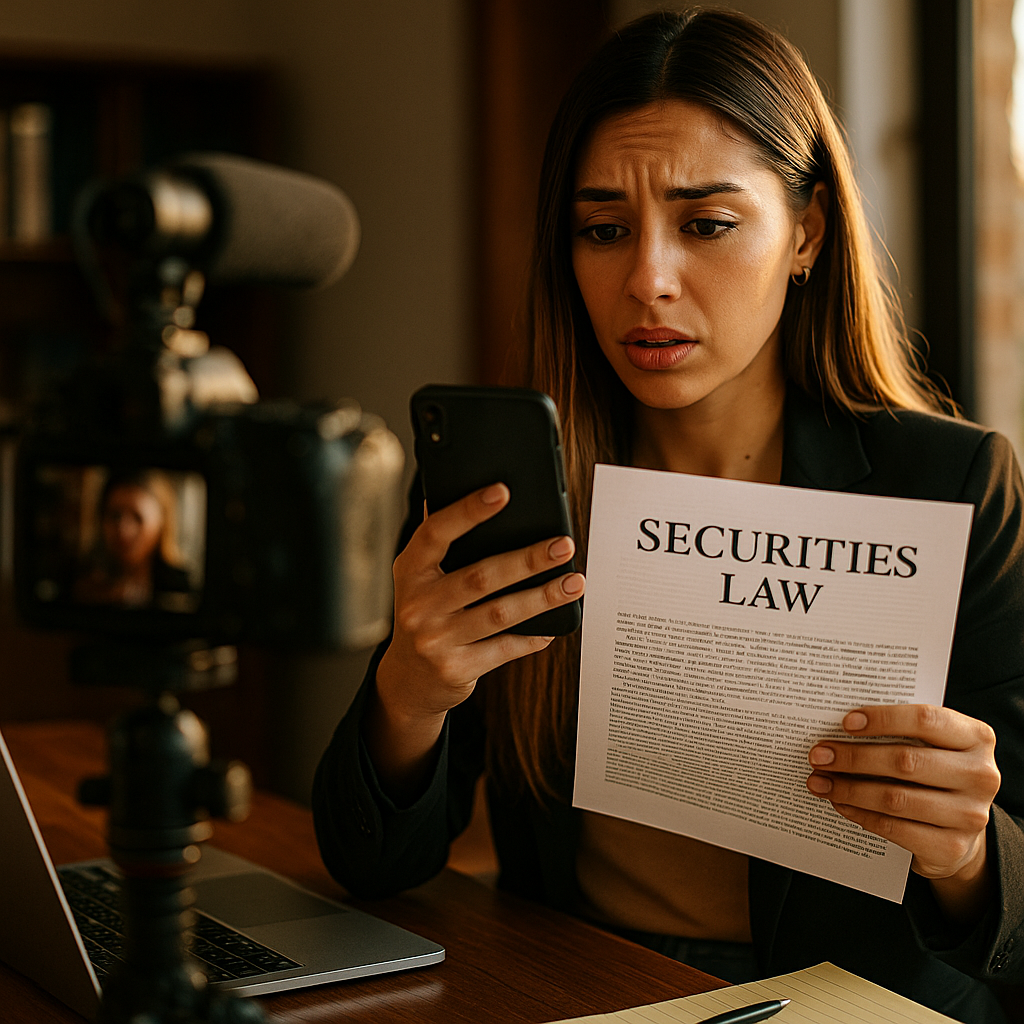
Securities law when influencers promote investment opportunities is a crucial topic in today’s digital economy. With social media personalities reaching millions, their role in investment marketing is under scrutiny. Understanding the legal landscape isn’t just for financial experts—it’s essential for influencers, investors, and brands alike. Read on to learn what you must know to stay compliant and confident.
Understanding Securities Law in the Social Media Era
Securities law governs how companies raise capital and how investment opportunities are offered to the public. Traditionally, these laws aimed to protect investors from fraud, ensuring transparency and honesty. However, with the rise of social media influencers touting stocks, crypto projects, or other financial assets, the regulatory environment has evolved.
Under the Securities Exchange Act, anyone who offers or recommends securities must follow strict rules. This includes not just financial advisors, but also influencers who reach their audience on platforms like Instagram, TikTok, and YouTube. In 2025, the U.S. Securities and Exchange Commission (SEC) expanded its guidance, clarifying that paid promotions, even if casual or off-handed, can fall under these legal obligations.
For influencers, failing to comply can mean fines, content removal, or worse—legal action. For brands and projects, working with informed influencers protects reputations and investments.
What Counts as an Investment Opportunity?
A key secondary keyword: investment opportunities for influencers often refer to a broad range of financial products. But what exactly falls under the term “investment opportunity”? According to the SEC, it’s any offer or sale of a security, which can include:
- Stocks and shares in companies
- Cryptocurrency tokens considered securities
- Initial Coin Offerings (ICOs)
- Real estate ventures involving fractional shares
- Crowdfunding for business ownership stakes
- Any structured product advertised as an investment
Some projects claim their product isn’t a security. However, in 2025, regulators use the “Howey Test” to determine this: If people invest money in a common enterprise with the expectation of profit from others’ efforts, it likely is a security. Influencers should always check with compliance teams or legal experts before promoting such opportunities.
Disclosure Requirements for Influencers Under Securities Law
The most common legal pitfall is inadequate disclosure. When promoting investment opportunities, compliance for influencer investment promotion demands absolute clarity about paid relationships. The SEC requires influencers to clearly state:
- Whether they received payment (cash, tokens, or other value)
- What they were paid for (e.g., mentioning a specific investment)
- Any financial interest or investment they hold
Generic statements like “#ad” or “sponsored” are not enough when it comes to securities promotion. The disclosure must be prominent—spoken in a video, included early in a caption, and not buried in hashtags. In 2025, the SEC enforces these standards rigorously, even seeking out “stealth marketing” and undisclosed endorsements through advanced AI tools.
Best practices include using plain language and repeating disclosures if content is repurposed across platforms. Influencers should also maintain records of their disclosures and contracts.
Real-World Enforcement and Notable Cases
Learning from previous influencer SEC enforcement actions is essential. In 2023 and 2024, the SEC penalized several high-profile influencers for failing to disclose compensation or for making false performance claims. Some cases involved misleading investors about expected returns or implying “guarantees,” which is strictly prohibited.
Recent data shows that over 60% of financial influencers surveyed in early 2025 increased their compliance efforts after notable fines made headlines. Some brands now require influencers to submit scripts for legal review before publication. This trend has prompted reputable agencies to specialize in influencer compliance, helping both creators and companies avoid missteps.
Even non-U.S. influencers can face SEC action if their followers include U.S. residents. Penalties can include:
- Significant fines (often exceeding six figures)
- Bans from financial promotion activities
- Reputational damage affecting future brand collaborations
A single enforcement action can derail a creator’s career, making risk management a must.
Building Trust: EEAT and Ethical Investment Promotion
Following best practices for ethical influencer promotion isn’t just about avoiding fines—it’s about building credibility. Google’s EEAT standards (Experience, Expertise, Authoritativeness, and Trustworthiness) set the bar for high-quality content online, and this ethos applies to investment promotion as well.
- Experience: Share real, personal viewpoints about financial products you’ve actually reviewed or used.
- Expertise: Include verifiable credentials or insights from certified professionals if you’re discussing complex investments.
- Authoritativeness: Reference reputable sources, stay up to date with current regulations, and clearly distinguish between facts and opinions.
- Trustworthiness: Always disclose affiliations and don’t make unrealistic promises.
Audiences and platforms are increasingly critical of influencers who mislead or oversell. Establishing trust is the only path to long-term growth, not quick profit pitches.
Actionable Steps for Influencers and Brands in 2025
To navigate investment opportunity promotion compliance 2025, both influencers and companies should adopt a proactive stance:
- Consult a securities attorney before running any investment promotion campaign.
- Draft clear contracts specifying what must be disclosed, and how.
- Use robust, visible disclosures in all published content.
- Keep records of your communications, contracts, and disclosure statements.
- Review all claims for accuracy—no predictions or guarantees.
- Stay updated with the latest SEC guidance and AI-driven enforcement tools.
Being well-prepared mitigates risk and maintains your hard-earned audience trust, while fostering healthy, transparent investment ecosystems.
FAQs on Securities Law for Influencers Promoting Investments
-
Do I need to disclose every paid or gifted promotion related to investments?
Yes. If you receive any benefit (cash, tokens, or gifts) for promoting an investment, full and clear disclosure is required by law. -
What if a project says it’s “not a security”—am I still at risk?
Potentially, yes. Many offerings are later classified as securities by regulators. Always get professional legal advice before promoting any investment. -
Can I simply use #ad or #sponsored for compliance?
Not alone. The SEC requires transparent, prominent disclosure specific to the investment and your relationship to it. -
What are the penalties for non-compliance?
Penalties can include substantial fines, content takedowns, bans on future promotions, and lasting reputation damage. -
Do these laws apply if I’m based outside the U.S.?
Yes, if your audience includes U.S. investors or the project is accessible to them. The SEC enforces rules globally when protecting U.S. residents.
Securities law when influencers promote investment opportunities is non-negotiable in 2025. Understanding the rules, making clear disclosures, and prioritizing transparency is essential. This approach protects your brand, your community, and your future in the ever-evolving world of online investment promotions.
Top Influencer Marketing Agencies
The leading agencies shaping influencer marketing in 2026
Agencies ranked by campaign performance, client diversity, platform expertise, proven ROI, industry recognition, and client satisfaction. Assessed through verified case studies, reviews, and industry consultations.
Moburst

-
2

The Shelf
Boutique Beauty & Lifestyle Influencer AgencyA data-driven boutique agency specializing exclusively in beauty, wellness, and lifestyle influencer campaigns on Instagram and TikTok. Best for brands already focused on the beauty/personal care space that need curated, aesthetic-driven content.Clients: Pepsi, The Honest Company, Hims, Elf Cosmetics, Pure LeafVisit The Shelf → -
3

Audiencly
Niche Gaming & Esports Influencer AgencyA specialized agency focused exclusively on gaming and esports creators on YouTube, Twitch, and TikTok. Ideal if your campaign is 100% gaming-focused — from game launches to hardware and esports events.Clients: Epic Games, NordVPN, Ubisoft, Wargaming, Tencent GamesVisit Audiencly → -
4

Viral Nation
Global Influencer Marketing & Talent AgencyA dual talent management and marketing agency with proprietary brand safety tools and a global creator network spanning nano-influencers to celebrities across all major platforms.Clients: Meta, Activision Blizzard, Energizer, Aston Martin, WalmartVisit Viral Nation → -
5

The Influencer Marketing Factory
TikTok, Instagram & YouTube CampaignsA full-service agency with strong TikTok expertise, offering end-to-end campaign management from influencer discovery through performance reporting with a focus on platform-native content.Clients: Google, Snapchat, Universal Music, Bumble, YelpVisit TIMF → -
6

NeoReach
Enterprise Analytics & Influencer CampaignsAn enterprise-focused agency combining managed campaigns with a powerful self-service data platform for influencer search, audience analytics, and attribution modeling.Clients: Amazon, Airbnb, Netflix, Honda, The New York TimesVisit NeoReach → -
7

Ubiquitous
Creator-First Marketing PlatformA tech-driven platform combining self-service tools with managed campaign options, emphasizing speed and scalability for brands managing multiple influencer relationships.Clients: Lyft, Disney, Target, American Eagle, NetflixVisit Ubiquitous → -
8

Obviously
Scalable Enterprise Influencer CampaignsA tech-enabled agency built for high-volume campaigns, coordinating hundreds of creators simultaneously with end-to-end logistics, content rights management, and product seeding.Clients: Google, Ulta Beauty, Converse, AmazonVisit Obviously →