


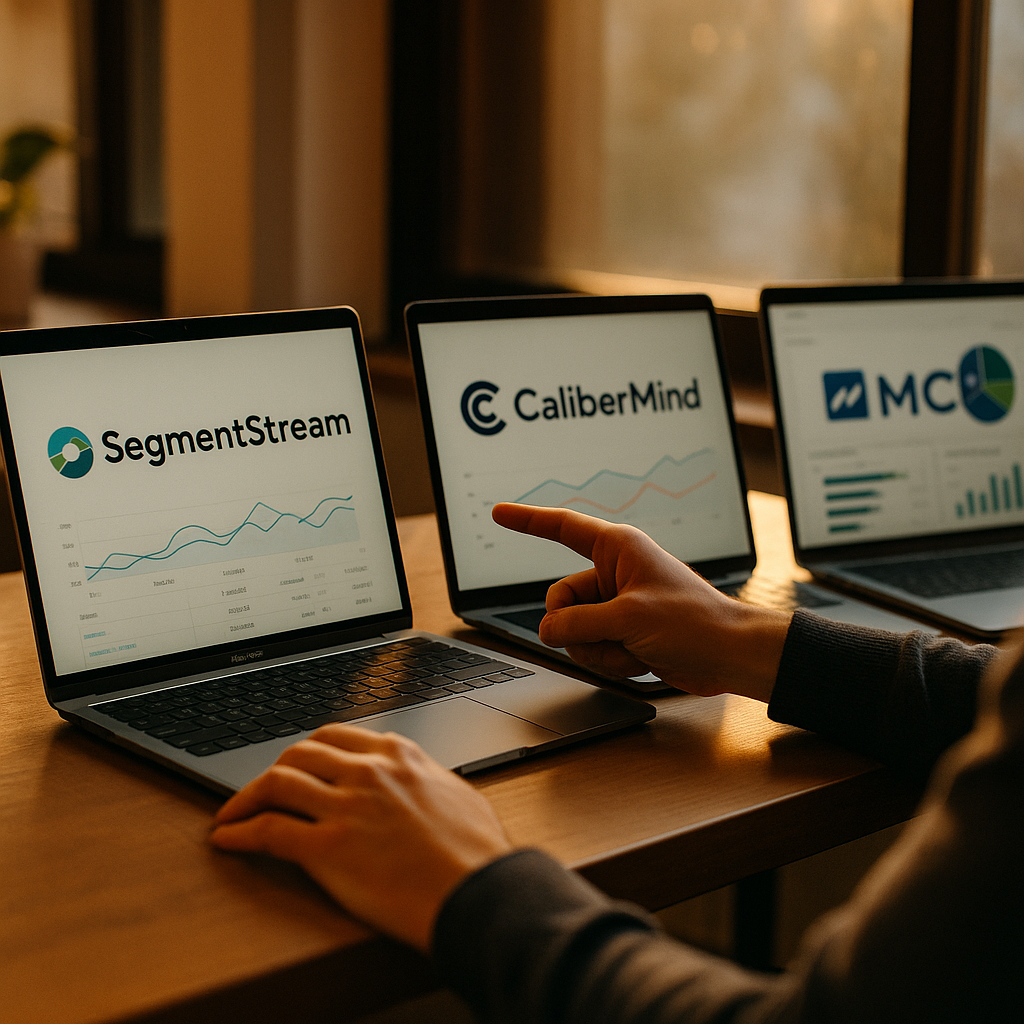
Marketers spent 15 years chasing “last click” and still can’t tell finance which campaign actually closed the deal. Now a new category of AI-native attribution engines claims to solve it in real time, using machine learning models that update hourly instead of quarterly. The pitch is seductive. The reality, as usual, depends on your data stack, your sales cycle, and how much you trust a black box to explain itself.
This piece compares two established players, SegmentStream and CaliberMind, against the emerging wave of MCP-server-enabled measurement tools that are rewiring how attribution data gets requested, processed, and acted on. If you’re evaluating a rebuild of your measurement stack this year, here’s what actually matters.
Why Attribution Broke in the First Place
Cookie deprecation gets the headlines, but it’s not really why multi-touch attribution stopped working. It broke because B2B and B2C buying journeys got longer, more fragmented, and increasingly invisible to any single platform. A buyer sees a creator’s TikTok, reads a comparison post, gets retargeted on LinkedIn, then converts three weeks later after a Google search for the brand name. Which touch gets credit? Under legacy rules-based models, usually the wrong one.
Machine-learning-driven attribution promised to fix this by modeling probability instead of applying fixed rules. Google’s data-driven attribution in Google Ads was an early mainstream version. But the AI-native engines built for B2B and hybrid funnels go further, ingesting CRM stage changes, product usage data, and even sales rep notes to build a genuinely dynamic model of what’s driving revenue.
The real shift isn’t from rules-based to AI-based attribution. It’s from static reporting to live, queryable measurement systems that agents and humans can both interrogate on demand.
SegmentStream: Predictive Modeling for the Marketing-Led Funnel
SegmentStream built its reputation on predictive customer journey analytics, specifically for e-commerce and lead-gen brands running heavy paid media. Its core differentiator: it doesn’t just attribute past conversions, it predicts the incremental value of each channel and feeds that back into bid management in near real time.
For a DTC brand running Meta, Google, and affiliate simultaneously, that’s a genuinely useful loop. SegmentStream’s model recalculates channel contribution as spend shifts, which means the attribution isn’t a static snapshot, it’s a living forecast. That matters because marketing teams don’t just want to know what happened last quarter. They want to know what to do with next week’s budget.
The tradeoff is that SegmentStream leans hard into marketing-touch data and is less built for long, multi-stakeholder B2B sales cycles where a deal touches six people over four months. It’s a strong fit for performance marketing teams optimizing spend allocation, and a weaker fit for enterprise B2B teams trying to prove pipeline influence to a CFO.
CaliberMind: Built for the B2B Revenue Defense Conversation
CaliberMind takes the opposite bet. It’s designed for B2B marketers who need to walk into a pipeline review and defend every dollar of spend against a skeptical finance team. Its attribution model ties directly into CRM opportunity data, weighting touches by their proximity to pipeline creation and closed revenue, not just conversion volume.
This is the tool for the marketer who’s tired of saying “brand awareness is hard to measure” and needs an actual number. CaliberMind’s account-based attribution model can show, for example, that a specific webinar touch correlated with a 22% lift in opportunity-to-close rate for accounts in a target segment. That’s the kind of stat that survives a budget review.
We covered this dynamic in detail in CaliberMind vs Traditional MTA: Defending Spend to Finance, and the core finding holds: traditional multi-touch attribution models systematically undercount long-cycle, multi-stakeholder B2B deals because they weren’t built for account-based buying committees. CaliberMind’s strength is that it was.
Where CaliberMind gets tricky is implementation. It requires clean CRM hygiene and a real commitment to opportunity-stage tracking. Garbage stage data in, garbage attribution out. Teams that haven’t done the unglamorous work of standardizing their Salesforce pipeline stages will find CaliberMind’s output about as reliable as the spreadsheet it replaced.
Enter MCP: The Protocol Layer Nobody Saw Coming
Here’s where 2026 gets interesting. Model Context Protocol (MCP), originally an Anthropic-driven standard for letting AI models query external tools and data sources, has quietly become the connective tissue for a new generation of measurement platforms. Instead of attribution living inside one vendor’s dashboard, MCP servers let an AI agent pull live attribution context from your CDP, ad platforms, and CRM simultaneously, then reason across all of it in one query.
Practically, this means a marketing ops lead can ask an AI assistant, “which creator partnerships drove pipeline in the healthcare vertical last quarter,” and get an answer synthesized across Meta Ads data, HubSpot opportunity records, and a creator platform’s engagement metrics, without anyone building a custom ETL pipeline first. We broke down the mechanics of this shift in MCP and A2A protocols for martech buyers, and the implication for attribution specifically is significant: measurement stops being a report you generate and becomes a question you ask.
MCP-enabled measurement doesn’t replace attribution models like SegmentStream’s or CaliberMind’s. It changes how you access and combine them, turning siloed dashboards into queryable, agent-readable data layers.
Vendors like 6sense have started building agentic layers on top of their existing RevOps data (see 6sense’s recent RevOps recognition), and Salesforce’s Agentforce is pushing similar territory from the CRM side, discussed in our Agentforce comparison. None of these are pure-play attribution tools yet. But the direction is unmistakable: attribution is becoming a queryable service, not a monthly PDF.
What This Means for Identity Resolution
None of this works without solid identity resolution underneath it. An AI agent reasoning across five data sources is only as good as the identity graph stitching those sources together. If your CDP can’t reliably match an anonymous ad click to a known CRM contact, your MCP-enabled attribution query returns confident-sounding nonsense.
This is the unglamorous prerequisite everyone skips. We’ve written before about how identity resolution accuracy, not feature count, wins the CDP budget battle, and that logic applies doubly here. Before you evaluate any AI-native attribution engine, audit your identity graph. According to eMarketer research on martech stack complexity, most mid-market brands run six or more disconnected data sources feeding their attribution models, and identity mismatches compound errors at every hop.
Vector-based matching is increasingly part of the answer, using embeddings rather than exact-match rules to resolve identity across fuzzy data. If you’re unfamiliar with how this works under the hood, our vector databases buyer’s guide is a useful primer before you sit through another vendor demo promising “AI-powered” matching without explaining the mechanism.
Picking a Lane: A Practical Framework
Stop asking “which tool has better AI.” Ask these instead:
- How long is your sales cycle? Under 30 days and largely self-serve, SegmentStream-style predictive channel modeling probably serves you better. Over 90 days with multiple stakeholders, CaliberMind’s opportunity-weighted approach will hold up better under finance scrutiny.
- How clean is your CRM data? Be honest. If your opportunity stages are inconsistent or reps skip fields, no attribution engine will save you. Fix the input before buying the output.
- Do you need live queryability or scheduled reporting? If your team is already experimenting with AI agents for other workflows, an MCP-compatible stack future-proofs you. If you just need a defensible quarterly report, a traditional platform may be simpler and cheaper.
- Who’s the audience for the output? A CMO defending budget to a CFO needs revenue-tied numbers (CaliberMind’s lane). A performance marketing team optimizing daily spend needs predictive channel scoring (SegmentStream’s lane).
Most enterprise teams will end up running a hybrid: an MCP-server layer sitting on top of CaliberMind or SegmentStream data, letting both humans and AI agents query it flexibly. That’s not a compromise, that’s just where the category is heading. According to HubSpot’s state of marketing research, teams using integrated attribution and CRM data report meaningfully higher confidence in reported ROI than those relying on platform-native reporting alone.
The Compliance Angle Nobody’s Pricing In
One more thing worth flagging before you sign a contract: AI-native attribution engines that pull cross-platform identity data need to be evaluated against the same privacy scrutiny as any other data processor. The FTC has increased attention on data-sharing practices between martech vendors, and UK-based teams should keep an eye on ICO guidance on automated decision-making, since attribution models that influence budget allocation can arguably fall under that scrutiny depending on how they’re used.
Ask any vendor, plainly, where the identity data lives, how long it’s retained, and whether the MCP server has read-only or read-write access to your CRM. That last one matters more than it sounds. A misconfigured agent with write access to your Salesforce pipeline is a very bad Tuesday.
Next Step
Don’t buy an attribution platform because it says “AI-native” on the landing page. Audit your identity resolution and CRM data hygiene first, map your sales cycle length against SegmentStream’s predictive model versus CaliberMind’s opportunity-weighted approach, then decide whether an MCP layer is worth adding on top. The tool matters less than the sequence you evaluate it in.
FAQs
What makes an attribution engine “AI-native” versus just AI-enhanced?
An AI-native engine builds machine learning into its core modeling logic from the start, recalculating channel contribution dynamically as new data arrives. AI-enhanced tools typically bolt predictive scoring onto a legacy rules-based attribution model, which limits how responsive the output can be to real-time changes.
Is CaliberMind better than SegmentStream for B2B companies?
Generally yes, because CaliberMind ties attribution directly to CRM opportunity and pipeline data, which holds up better in finance-facing budget conversations. SegmentStream is stronger for shorter, marketing-led funnels where predictive channel optimization matters more than opportunity-stage weighting.
What is an MCP server and why does it matter for measurement?
Model Context Protocol is a standard that lets AI agents query external data sources and tools directly, in real time. For attribution, this means measurement data from your CDP, ad platforms, and CRM can be queried together by an AI assistant instead of requiring a custom integration for every reporting question.
Do we need to replace our current attribution tool to use MCP?
No. Most MCP-enabled setups sit on top of existing platforms like CaliberMind or SegmentStream, acting as a query layer rather than a replacement. The bigger prerequisite is clean identity resolution and CRM data, since MCP just changes how you access data, not the quality of the data itself.
What’s the biggest risk with AI-native attribution models?
Poor identity resolution and dirty CRM data. If the underlying identity graph can’t accurately match touchpoints to the same buyer, the AI model will produce confident-looking numbers that don’t hold up to scrutiny, which is a bigger risk in an automated, real-time system than in a manual quarterly report.
FAQs
What makes an attribution engine “AI-native” versus just AI-enhanced?
An AI-native engine builds machine learning into its core modeling logic from the start, recalculating channel contribution dynamically as new data arrives. AI-enhanced tools typically bolt predictive scoring onto a legacy rules-based attribution model, which limits how responsive the output can be to real-time changes.
Is CaliberMind better than SegmentStream for B2B companies?
Generally yes, because CaliberMind ties attribution directly to CRM opportunity and pipeline data, which holds up better in finance-facing budget conversations. SegmentStream is stronger for shorter, marketing-led funnels where predictive channel optimization matters more than opportunity-stage weighting.
What is an MCP server and why does it matter for measurement?
Model Context Protocol is a standard that lets AI agents query external data sources and tools directly, in real time. For attribution, this means measurement data from your CDP, ad platforms, and CRM can be queried together by an AI assistant instead of requiring a custom integration for every reporting question.
Do we need to replace our current attribution tool to use MCP?
No. Most MCP-enabled setups sit on top of existing platforms like CaliberMind or SegmentStream, acting as a query layer rather than a replacement. The bigger prerequisite is clean identity resolution and CRM data, since MCP just changes how you access data, not the quality of the data itself.
What’s the biggest risk with AI-native attribution models?
Poor identity resolution and dirty CRM data. If the underlying identity graph can’t accurately match touchpoints to the same buyer, the AI model will produce confident-looking numbers that don’t hold up to scrutiny, which is a bigger risk in an automated, real-time system than in a manual quarterly report.
Top Influencer Marketing Agencies
The leading agencies shaping influencer marketing in 2026
Agencies ranked by campaign performance, client diversity, platform expertise, proven ROI, industry recognition, and client satisfaction. Assessed through verified case studies, reviews, and industry consultations.
Moburst

-
2

The Shelf
Boutique Beauty & Lifestyle Influencer AgencyA data-driven boutique agency specializing exclusively in beauty, wellness, and lifestyle influencer campaigns on Instagram and TikTok. Best for brands already focused on the beauty/personal care space that need curated, aesthetic-driven content.Clients: Pepsi, The Honest Company, Hims, Elf Cosmetics, Pure LeafVisit The Shelf → -
3

Audiencly
Niche Gaming & Esports Influencer AgencyA specialized agency focused exclusively on gaming and esports creators on YouTube, Twitch, and TikTok. Ideal if your campaign is 100% gaming-focused — from game launches to hardware and esports events.Clients: Epic Games, NordVPN, Ubisoft, Wargaming, Tencent GamesVisit Audiencly → -
4

Viral Nation
Global Influencer Marketing & Talent AgencyA dual talent management and marketing agency with proprietary brand safety tools and a global creator network spanning nano-influencers to celebrities across all major platforms.Clients: Meta, Activision Blizzard, Energizer, Aston Martin, WalmartVisit Viral Nation → -
5

The Influencer Marketing Factory
TikTok, Instagram & YouTube CampaignsA full-service agency with strong TikTok expertise, offering end-to-end campaign management from influencer discovery through performance reporting with a focus on platform-native content.Clients: Google, Snapchat, Universal Music, Bumble, YelpVisit TIMF → -
6

NeoReach
Enterprise Analytics & Influencer CampaignsAn enterprise-focused agency combining managed campaigns with a powerful self-service data platform for influencer search, audience analytics, and attribution modeling.Clients: Amazon, Airbnb, Netflix, Honda, The New York TimesVisit NeoReach → -
7

Ubiquitous
Creator-First Marketing PlatformA tech-driven platform combining self-service tools with managed campaign options, emphasizing speed and scalability for brands managing multiple influencer relationships.Clients: Lyft, Disney, Target, American Eagle, NetflixVisit Ubiquitous → -
8

Obviously
Scalable Enterprise Influencer CampaignsA tech-enabled agency built for high-volume campaigns, coordinating hundreds of creators simultaneously with end-to-end logistics, content rights management, and product seeding.Clients: Google, Ulta Beauty, Converse, AmazonVisit Obviously →