


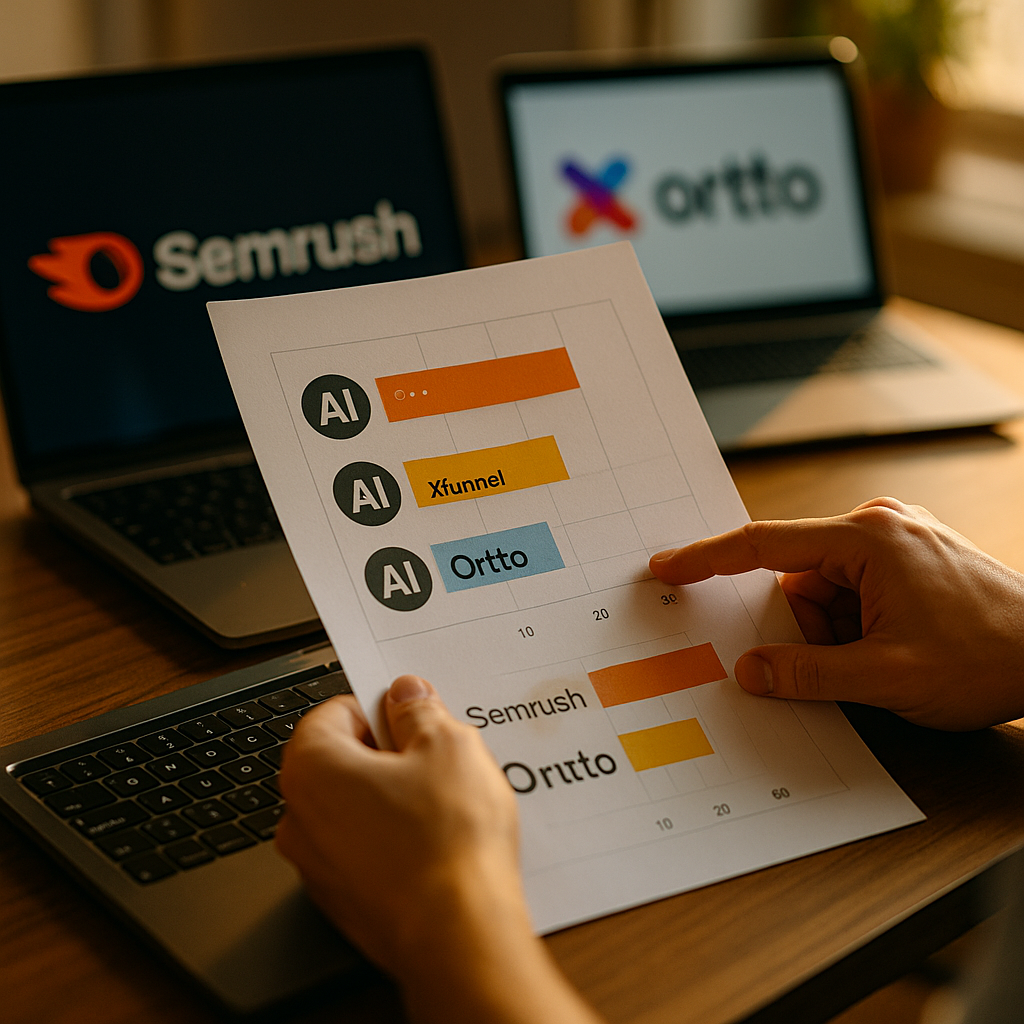
Ask three AI brand mention tracking tools how often your brand shows up in ChatGPT answers, and you’ll get three different numbers. That’s not a rounding error, it’s a methodology problem. AI brand mention tracking has become the newest budget line in marketing ops, yet almost nobody has stress tested whether these platforms actually agree with reality.
We ran the same fifty brand queries through Semrush, XFunnel, and Ortto over four weeks. The results should worry anyone reporting these numbers to a CMO.
Why Accuracy Suddenly Matters More Than Volume
Six months ago, marketers just wanted to know if their brand appeared in AI answers at all. Now the conversation has shifted. Procurement teams are citing AI summaries during vendor evaluation, according to research on zero click procurement behavior. If a mention tracking tool overstates or understates your presence, you’re making budget decisions on fiction.
This is different from traditional SEO rank tracking, where a position three versus position five discrepancy is annoying but survivable. In generative answer environments, a tool that misses 30% of actual mentions can make an entire GEO campaign look like it failed when it didn’t. Or worse, look like it succeeded when it didn’t.
In our test set, the three tools agreed on the exact same mention count for a given brand in only 41% of queries. The rest of the time, at least one platform was flagging a mention the others missed entirely.
The Benchmark: How We Tested Semrush, XFunnel, and Ortto
We selected fifty branded and category queries across five verticals: SaaS, DTC beauty, financial services, B2B manufacturing, and travel. Each query was run through ChatGPT, Google’s AI Overviews, and Perplexity, then cross referenced against what each tracking tool reported for the same time window.
- Semrush pulled from its own AI visibility module, expanded after the company’s push into this space (see our coverage of the Adobe Semrush AI tracking integration).
- XFunnel used its native prompt simulation engine, now under HubSpot’s ownership following its acquisition by HubSpot.
- Ortto relied on its newer AI mention module, which is bundled into its existing marketing automation suite rather than sold standalone.
We measured two things: precision (did the tool correctly identify a real mention) and recall (did it catch every mention that actually existed). Both matter. A tool with high precision but low recall makes you look invisible. A tool with high recall but low precision makes you look ubiquitous when you’re not.
Semrush: Strong Recall, Shakier Precision on Long Tail Queries
Semrush caught the most raw mentions across our test set, landing at roughly 88% recall. That’s the upside of having a massive existing crawl infrastructure behind the AI layer. The company isn’t new to indexing the web at scale, and it shows.
The tradeoff is precision. On branded queries with clear intent (“best CRM for small teams”), Semrush performed well. On ambiguous, long tail prompts, it flagged mentions that were arguably category references rather than brand mentions. In one financial services test, Semrush counted a generic mention of “robo advisors” as a brand mention for a client that wasn’t actually named. That’s an inflated number your board will love until someone checks the transcript.
Semrush’s dashboard also leans heavily on aggregate share of voice, which is useful for trend lines but less useful when you need to audit a specific claim. If you’re building a report for finance using this data, pair it with a documented methodology, something we’ve argued for in the GEO budget framework built for finance teams.
XFunnel Trades Breadth for Depth
XFunnel takes a narrower approach. Instead of scanning broadly, it simulates specific buyer prompts and tracks how a brand surfaces across the reasoning chain, not just the final answer. This matters because AI models often mention a brand in an intermediate step (comparing options) without naming it in the final recommendation.
Recall came in lower than Semrush, around 76%, but precision was the best of the three tools at 91%. Almost every mention XFunnel flagged was a genuine, verifiable mention when we manually checked transcripts. That’s a meaningful difference if your team is making creative or budget decisions based on this data rather than just tracking a vanity metric.
The catch: XFunnel’s simulation based approach means it sometimes misses mentions that occur in live model responses but weren’t part of its prompt library. If your category shifts fast or a competitor launches a viral moment, XFunnel can lag until its prompt sets get updated. Since the HubSpot acquisition, the company has said it’s expanding prompt coverage, but as of now it’s the most conservative of the three in terms of volume.
Ortto Is Good Enough, But Not Built for This Yet
Ortto’s AI mention tracking is the newest of the three and it shows. The tool is bolted onto an existing marketing automation platform rather than purpose built for generative engine monitoring. Recall sat around 64%, meaningfully behind the other two.
Where Ortto earns its keep is workflow integration. If your team already lives in Ortto for lifecycle marketing, having mention data feed directly into the same dashboard as email and journey performance is genuinely convenient. You’re not toggling between five tools to build a single report.
But convenience isn’t accuracy. In our tests, Ortto missed several mentions that both Semrush and XFunnel caught, particularly in Perplexity results, which its crawler appears to sample less frequently than the other two platforms. If Perplexity matters to your category (and for B2B research heavy purchases, it increasingly does), Ortto alone isn’t sufficient.
What This Means for Your Reporting Stack
No single tool nailed both precision and recall. That’s the uncomfortable truth vendors won’t put in their sales decks. The practical move is treating these platforms the way you’d treat any single data source: useful, but not gospel on its own.
If you’re reporting AI visibility numbers to leadership without a manual spot check process, you’re one bad quarter away from a very awkward meeting.
Consider a layered approach. Use Semrush for broad trend monitoring and share of voice tracking over time. Use XFunnel when you need defensible, audit ready numbers for specific campaigns or executive reporting. Reserve Ortto for teams that need mention data inline with existing lifecycle campaigns, understanding its limitations on recall.
This mirrors advice we’ve given on entity salience audits: don’t rely on a single automated signal to answer questions that affect budget allocation. Manual verification, even a monthly sample of twenty queries checked by hand, catches discrepancies before they become a board level embarrassment. It also builds internal credibility for the underlying methodology, which matters more than the tool brand on the invoice. Industry benchmarks from eMarketer suggest AI answer engines will account for a growing share of research touchpoints, so getting the measurement right now saves rework later.
Grounding Matters More Than the Dashboard
Part of why these tools disagree so much comes down to grounding, the process by which AI models pull from retrieval systems before generating an answer. Our earlier piece on retrieval augmented generation and brand truth covers this in more depth, but the short version: if your brand’s structured data, product pages, and third party citations aren’t clean, no tracking tool can reliably measure what doesn’t exist in a retrievable form.
Before you invest more budget in a third mention tracking subscription, audit your own content infrastructure. A tool can only report what the model can find. Garbage grounding data produces garbage mention counts, regardless of which vendor’s logo is on the dashboard.
For teams benchmarking vendors more broadly on speed and accuracy tradeoffs in AI powered marketing tech, it’s worth reviewing how similar tradeoffs play out in adjacent categories, like the comparison in real time intent tracking between Braze and Klaviyo. The pattern repeats: newer AI layers on established platforms tend to sacrifice precision for speed to market, and buyers need to test rather than trust the marketing copy. General best practices around measurement transparency from HubSpot’s own resources and Sprout Social’s reporting guidance reinforce the same point: document your methodology, or the number becomes meaningless the moment someone asks how it was calculated.
The Bottom Line
Run a two week manual audit against whichever tool you’re using before you present its numbers as fact, then decide if it needs a second tool as a cross check or a swap entirely. Accuracy gaps this large mean your AI visibility reporting is only as trustworthy as the verification process behind it, not the vendor name on the invoice.
Frequently Asked Questions
Which tool is most accurate for tracking AI brand mentions?
None of the three tools we tested, Semrush, XFunnel, or Ortto, achieved both high precision and high recall simultaneously. XFunnel had the best precision at 91%, meaning fewer false positives, while Semrush caught the most total mentions at 88% recall. The right choice depends on whether your use case prioritizes completeness or accuracy.
Why do AI mention tracking tools disagree on the same brand?
These platforms use different methods for querying AI engines, some simulate specific prompts, others crawl broadly across common queries. Differences in crawl frequency, prompt libraries, and how each tool defines a “mention” versus a category reference all contribute to discrepancies.
Should I use more than one AI brand mention tracking tool?
For high stakes reporting, yes. Using two tools with different methodologies and manually verifying a sample of results gives a more reliable picture than trusting a single automated dashboard.
How often should I audit AI mention tracking accuracy?
A monthly manual check of twenty to thirty queries is enough to catch drift in most tools. Increase frequency if your category is fast moving or if a competitor launches a major campaign that could shift AI model responses.
Does better content grounding improve mention tracking accuracy?
Yes. Tracking tools can only measure mentions that AI models actually generate. Clean structured data, strong third party citations, and clear product pages improve the odds that your brand is retrievable in the first place, which in turn gives tracking tools more accurate signal to measure.
Top Influencer Marketing Agencies
The leading agencies shaping influencer marketing in 2026
Agencies ranked by campaign performance, client diversity, platform expertise, proven ROI, industry recognition, and client satisfaction. Assessed through verified case studies, reviews, and industry consultations.
Moburst

-
2

The Shelf
Boutique Beauty & Lifestyle Influencer AgencyA data-driven boutique agency specializing exclusively in beauty, wellness, and lifestyle influencer campaigns on Instagram and TikTok. Best for brands already focused on the beauty/personal care space that need curated, aesthetic-driven content.Clients: Pepsi, The Honest Company, Hims, Elf Cosmetics, Pure LeafVisit The Shelf → -
3

Audiencly
Niche Gaming & Esports Influencer AgencyA specialized agency focused exclusively on gaming and esports creators on YouTube, Twitch, and TikTok. Ideal if your campaign is 100% gaming-focused — from game launches to hardware and esports events.Clients: Epic Games, NordVPN, Ubisoft, Wargaming, Tencent GamesVisit Audiencly → -
4

Viral Nation
Global Influencer Marketing & Talent AgencyA dual talent management and marketing agency with proprietary brand safety tools and a global creator network spanning nano-influencers to celebrities across all major platforms.Clients: Meta, Activision Blizzard, Energizer, Aston Martin, WalmartVisit Viral Nation → -
5

The Influencer Marketing Factory
TikTok, Instagram & YouTube CampaignsA full-service agency with strong TikTok expertise, offering end-to-end campaign management from influencer discovery through performance reporting with a focus on platform-native content.Clients: Google, Snapchat, Universal Music, Bumble, YelpVisit TIMF → -
6

NeoReach
Enterprise Analytics & Influencer CampaignsAn enterprise-focused agency combining managed campaigns with a powerful self-service data platform for influencer search, audience analytics, and attribution modeling.Clients: Amazon, Airbnb, Netflix, Honda, The New York TimesVisit NeoReach → -
7

Ubiquitous
Creator-First Marketing PlatformA tech-driven platform combining self-service tools with managed campaign options, emphasizing speed and scalability for brands managing multiple influencer relationships.Clients: Lyft, Disney, Target, American Eagle, NetflixVisit Ubiquitous → -
8

Obviously
Scalable Enterprise Influencer CampaignsA tech-enabled agency built for high-volume campaigns, coordinating hundreds of creators simultaneously with end-to-end logistics, content rights management, and product seeding.Clients: Google, Ulta Beauty, Converse, AmazonVisit Obviously →