


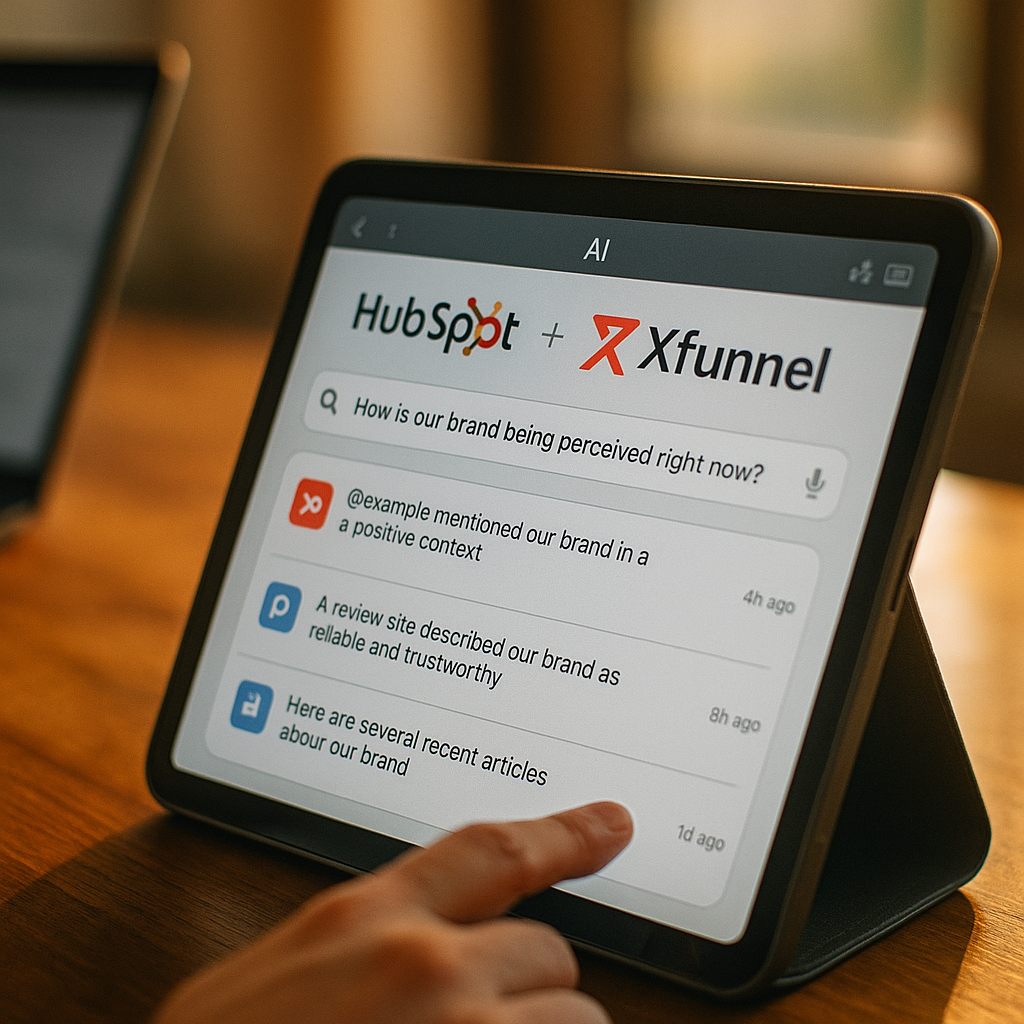
Only 34% of marketers say they can reliably tie AI search visibility to pipeline, according to recent Gartner survey data cited across industry channels. That gap just got smaller. HubSpot’s move to acquire XFunnel brand mention tracking technology signals something bigger than a feature bolt on: it’s the CRM giant admitting that creator attribution now runs through large language models, not just click paths.
If you run influencer programs and you’ve been squinting at ChatGPT referral traffic wondering where it fits your reporting stack, this acquisition is about to change your dashboard.
What XFunnel Actually Tracks
XFunnel built its name monitoring how brands get mentioned inside AI answer engines: ChatGPT, Perplexity, Gemini, and the growing list of assistants people now query instead of Google. It’s not keyword rank tracking dressed up in new language. It’s a purpose built system for catching when a creator’s content, a review, or a branded campaign asset gets cited or paraphrased by a model answering a user’s question.
That distinction matters for anyone running influencer campaigns. A creator’s TikTok review might never show up in a traditional web crawl, yet the same content can get scraped, summarized, and surfaced when someone asks an AI assistant “what’s the best running shoe for flat feet.” XFunnel was one of the few tools built specifically to catch that moment.
Brand mentions inside AI answers are the new backlinks. Nobody clicks through the way they used to, but the citation still shapes the buying decision.
Why HubSpot Wanted It
HubSpot has spent the past cycle stitching AI signals into its CRM. The deep research connector pulled CRM context into ad decisioning. The OpenAI ad pilot shifted budget logic away from clicks toward revenue signals sitting inside the CRM itself. Acquiring XFunnel brand mention tracking is the missing piece: it gives HubSpot a native way to detect when creator generated content is influencing buyers before they ever fill out a form.
Think about what that solves operationally. Right now, most brand teams run three disconnected systems: a social listening tool for sentiment, a creator platform for campaign management, and a CRM for pipeline. None of them talk to each other about AI search visibility. HubSpot folding XFunnel’s detection layer directly into the CRM means brand mention data can sit next to deal stage, next to lifecycle stage, next to actual revenue.
That’s a meaningfully different proposition than another listening dashboard. It’s attribution infrastructure, and it lands right as the agent CRM rewrite is already forcing finance teams to rethink how creator spend gets justified.
The Creator Attribution Gap This Was Built to Close
Here’s the uncomfortable truth most influencer marketing teams have been sitting on quietly: last touch and even multi touch attribution models were designed for a world where humans click links. AI search doesn’t work that way. A user asks a question, gets a synthesized answer, and often never visits the source at all. Industry estimates from eMarketer suggest AI powered search interactions are growing faster than any other query category, yet most attribution stacks still treat that traffic as “direct” or worse, as noise to be filtered out.
That’s exactly the blind spot covered in recent reporting on AI referral conversion rates, which found AI driven traffic converting at 4.4x the rate of standard organic search, while remaining almost invisible to legacy tracking. XFunnel brand mention tracking, now inside HubSpot, is a direct answer to that problem. It doesn’t just tell you a mention happened. It ties the mention to a domain, a time window, and increasingly, a downstream CRM event.
For creator programs specifically, this closes a loop that’s been open for years. Brands could never prove that a creator’s product review, published eighteen months ago, was still quietly feeding answers into ChatGPT and influencing purchase decisions today. Now there’s a path to actually measure that decay curve, or lack of one.
Why This Matters More for Long Tail Creator Content Than Viral Hits
Viral creator content gets attention. Evergreen creator content, the stuff that sits around and keeps getting cited by AI models months after publication, has always been the harder thing to defend budget for. XFunnel style tracking gives brand teams a genuine argument for keeping evergreen creator assets alive in reporting, rather than writing them off after the campaign window closes. That’s a shift worth flagging to anyone still running predictive LTV scoring models based purely on click and conversion history.
What Changes for Brand and Agency Teams
A few practical shifts are already visible for teams running influencer programs through HubSpot’s ecosystem:
- Mention level attribution enters the CRM natively. No more exporting listening data into a spreadsheet and manually matching it to deal records.
- Creator content gets a decay timeline. Brands can start seeing how long a piece of creator content keeps generating AI citations before it drops off.
- Reporting language changes. Expect “AI mention share” and “citation frequency” to start showing up in quarterly creator program reviews next to engagement rate and CPM.
- Procurement conversations get sharper. Agencies pitching creator programs will need to speak to AI visibility, not just reach and engagement, or risk sounding a generation behind.
None of this replaces the fundamentals. Engagement rate, audience quality, and campaign lift still matter. But brand mention tracking inside AI answers is quickly becoming table stakes reporting, the same way social listening became non negotiable a decade ago. Teams that ignore it now will be explaining a data gap to finance later, and that conversation tends to go badly, as anyone who’s read up on real time budget governance pressure already knows.
Risks Nobody’s Talking About Yet
Acquisitions like this always create integration risk, and this one has a few specific wrinkles worth flagging before you rebuild your reporting around it.
First, data provenance. If HubSpot’s system flags a brand mention inside an AI answer, can it reliably trace that back to a specific creator asset, or does it just detect brand presence generally? Early integration phases for acquired tools rarely nail this on day one. Second, there’s a governance question that echoes what’s already playing out with attribution agents needing governance before automation: who owns the decision when AI mention data conflicts with traditional attribution models? Marketing and finance are going to disagree on which number to trust, and that fight needs rules before it happens, not after.
The tool solving your attribution gap can create a governance gap just as fast, if nobody defines which data source wins when the numbers disagree.
Third, and this one’s underrated: AI mention tracking is only as good as the model access it has. Perplexity, Gemini, and OpenAI’s products don’t expose their internals for easy scraping, and terms of service change without much warning. Brands relying heavily on this data should treat it as directional intelligence, not gospel, at least for the next few reporting cycles. That’s the same caution worth applying to any creator ROI reporting built on fragile data schemas.
How to Prepare Your Reporting Stack Now
You don’t need to wait for full HubSpot integration to start adjusting. A few moves worth making this quarter:
- Audit your current creator content library and flag which pieces are still likely to be indexed or cited by AI search tools, particularly long form reviews and comparison content.
- Ask your agency or in house team whether they’re already tracking AI mention frequency manually, even through basic prompt testing, so you have a baseline before the automated tooling lands.
- Build a simple governance rule now: which team owns the call when AI citation data and CRM revenue data tell different stories about a creator’s performance.
- Revisit your event taxonomy to make sure it can absorb a new data type without breaking existing reports.
Marketing teams that treat this as an incremental listening upgrade will miss the point. This is HubSpot rebuilding attribution around a search behavior that’s already happening, whether your dashboard accounts for it or not. Data from Statista and repeated HubSpot product announcements over the past two years point the same direction: CRM platforms are absorbing AI visibility data because customers are demanding it, not because it’s a nice to have.
Next Step
Pull your top ten performing creator assets from the last twelve months and manually prompt ChatGPT, Perplexity, and Gemini with buyer intent questions in your category. If your brand or creator content shows up unprompted, you already have proof this matters, well before HubSpot’s integration finishes rolling out.
Frequently Asked Questions
What is XFunnel brand mention tracking?
XFunnel brand mention tracking is a monitoring system built to detect when a brand, product, or piece of creator content gets cited, paraphrased, or referenced inside AI answer engines such as ChatGPT, Perplexity, and Gemini. It differs from traditional listening tools because it focuses specifically on AI generated answers rather than search rankings or social feeds.
Why did HubSpot acquire XFunnel?
HubSpot acquired XFunnel to close a growing attribution gap between CRM data and AI search visibility. The acquisition follows a pattern of HubSpot integrating AI signals into its CRM, including deep research connectors and agent driven ad tools, so that brand mention data can sit alongside actual revenue and deal stage information.
How does this affect creator attribution reporting?
It gives brand and agency teams a way to measure whether creator content is still influencing buyers through AI answers long after a campaign ends. Previously, this kind of long tail influence was almost impossible to prove, since AI search rarely generates a traceable click.
Is AI mention tracking reliable enough to replace existing attribution models?
Not yet. AI mention tracking should be treated as directional intelligence layered on top of existing attribution models, not a replacement. Access to AI model internals is limited and terms of service can shift, so brands should validate findings against CRM revenue data rather than relying on mention data alone.
What should brand teams do now, before the integration is complete?
Start by auditing existing creator content for AI citation potential, manually testing key buyer intent prompts across major AI assistants, and setting internal governance rules for how AI mention data will be weighed against traditional CRM attribution once the tooling is fully live.
Top Influencer Marketing Agencies
The leading agencies shaping influencer marketing in 2026
Agencies ranked by campaign performance, client diversity, platform expertise, proven ROI, industry recognition, and client satisfaction. Assessed through verified case studies, reviews, and industry consultations.
Moburst

-
2

The Shelf
Boutique Beauty & Lifestyle Influencer AgencyA data-driven boutique agency specializing exclusively in beauty, wellness, and lifestyle influencer campaigns on Instagram and TikTok. Best for brands already focused on the beauty/personal care space that need curated, aesthetic-driven content.Clients: Pepsi, The Honest Company, Hims, Elf Cosmetics, Pure LeafVisit The Shelf → -
3

Audiencly
Niche Gaming & Esports Influencer AgencyA specialized agency focused exclusively on gaming and esports creators on YouTube, Twitch, and TikTok. Ideal if your campaign is 100% gaming-focused — from game launches to hardware and esports events.Clients: Epic Games, NordVPN, Ubisoft, Wargaming, Tencent GamesVisit Audiencly → -
4

Viral Nation
Global Influencer Marketing & Talent AgencyA dual talent management and marketing agency with proprietary brand safety tools and a global creator network spanning nano-influencers to celebrities across all major platforms.Clients: Meta, Activision Blizzard, Energizer, Aston Martin, WalmartVisit Viral Nation → -
5

The Influencer Marketing Factory
TikTok, Instagram & YouTube CampaignsA full-service agency with strong TikTok expertise, offering end-to-end campaign management from influencer discovery through performance reporting with a focus on platform-native content.Clients: Google, Snapchat, Universal Music, Bumble, YelpVisit TIMF → -
6

NeoReach
Enterprise Analytics & Influencer CampaignsAn enterprise-focused agency combining managed campaigns with a powerful self-service data platform for influencer search, audience analytics, and attribution modeling.Clients: Amazon, Airbnb, Netflix, Honda, The New York TimesVisit NeoReach → -
7

Ubiquitous
Creator-First Marketing PlatformA tech-driven platform combining self-service tools with managed campaign options, emphasizing speed and scalability for brands managing multiple influencer relationships.Clients: Lyft, Disney, Target, American Eagle, NetflixVisit Ubiquitous → -
8

Obviously
Scalable Enterprise Influencer CampaignsA tech-enabled agency built for high-volume campaigns, coordinating hundreds of creators simultaneously with end-to-end logistics, content rights management, and product seeding.Clients: Google, Ulta Beauty, Converse, AmazonVisit Obviously →