


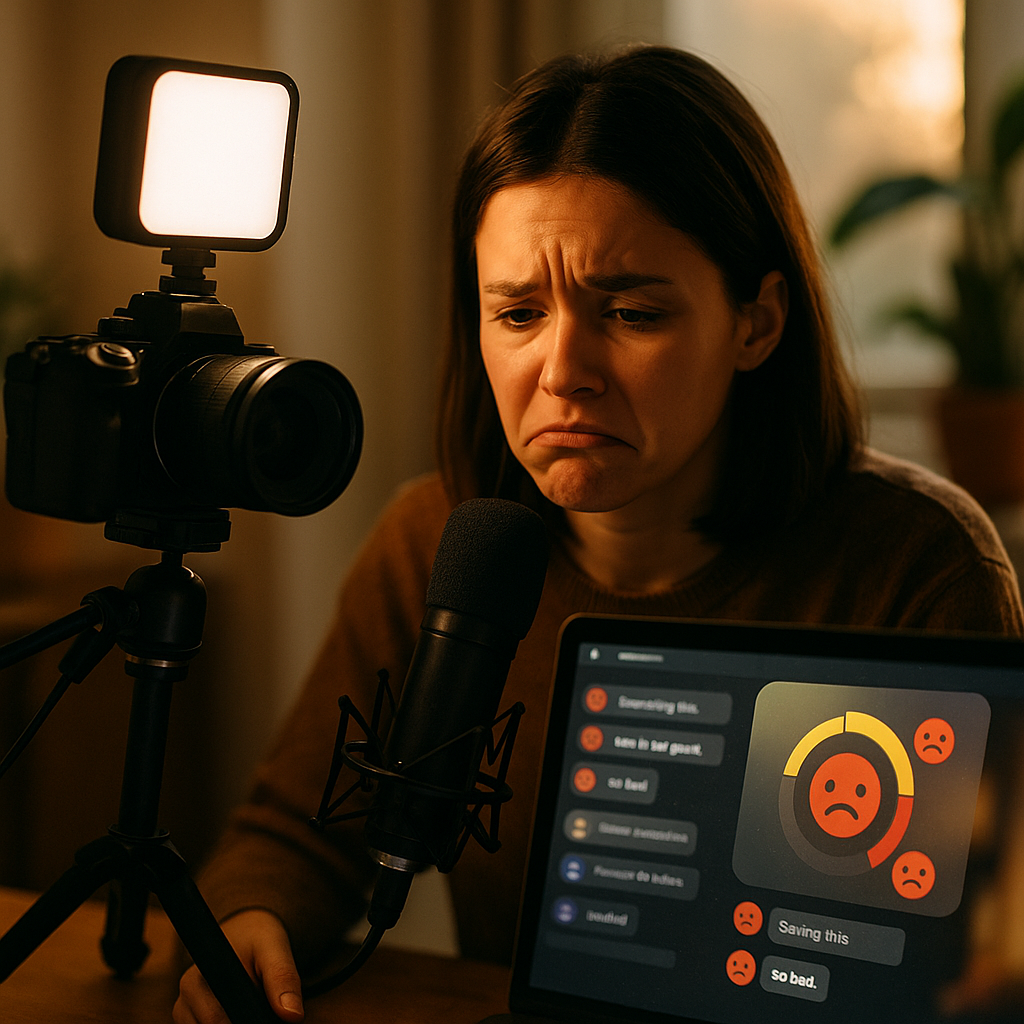
A livestream shopping host can lose a room in under ninety seconds, and most brands find out only after the conversion rate has already cratered. AI powered sentiment scoring is starting to change that math, giving brand teams a live read on audience reaction instead of a post mortem. If you are still judging host performance by GMV alone, you are flying blind on the thing that actually drives GMV: how people feel while they watch.
Why Gut Feel Isn’t Good Enough Anymore
Livestream shopping has quietly become a real revenue channel for brands outside of China’s mature market. TikTok Shop, Amazon Live, and Whatnot have all pushed brands to treat live selling as a repeatable program rather than a one off stunt. But repeatable programs need measurement systems, and “the host seemed energetic” is not a metric.
Most brand teams still evaluate hosts through a mix of vibes, post stream GMV, and maybe a comment skim by an intern. That worked when livestream shopping was experimental. It does not work when you are running twenty streams a week across multiple hosts, multiple SKUs, and multiple time zones. You need something that scales, and human judgment does not scale past a handful of concurrent streams.
Sentiment scoring turns “the stream felt off” into a timestamped, quantified signal that a producer can act on while the stream is still live, not three days later in a debrief nobody reads.
What AI Powered Sentiment Scoring Actually Measures
Strip away the vendor marketing and sentiment scoring for live commerce is really three data streams fused into one score: chat text, voice tone, and behavioral signals like viewer drop off and click through on product cards. Natural language processing models parse comments in real time for positivity, confusion, or frustration. Audio models score the host’s vocal energy, pacing, and pitch variation, because a monotone delivery reading a script kills conversion just as fast as a rude comment thread does. Behavioral data ties it together: are people leaving right after the host mentions price? Are add to cart clicks spiking during a specific demo segment?
Put those three together and you get a rolling sentiment score, often updated every 15 to 30 seconds, that a producer or brand manager can watch on a dashboard during the stream. Some platforms plot it alongside a GMV curve so you can see, almost in real time, when sentiment dips precede a sales slowdown.
- Chat and comment sentiment: NLP classification of live text for tone, sarcasm, and product specific complaints.
- Voice and delivery analysis: vocal energy, speech rate, filler word frequency, and pauses that signal a host losing the room.
- Behavioral correlation: viewer retention curves, add to cart timing, and repeat viewer rate mapped against sentiment dips.
- Composite trust score: a single number brand teams can benchmark across hosts, categories, and time slots.
The ROI Case Brand Teams Actually Care About
None of this matters if it does not move revenue or cut cost, so here is the honest ROI argument. Sentiment scoring lets you catch a bad host performance while the stream is live, not after the budget is spent. A producer watching a real time dip can cue the host to change pace, address a comment directly, or bring in a co host, all of which are cheaper interventions than discovering post stream that engagement collapsed at minute twelve and nobody noticed.
It also solves a real hiring and retention problem. Brands running livestream programs at scale are constantly auditioning and rotating hosts, and “gut feel” reviews are notoriously biased toward whoever is most charismatic in a highlight reel. A sentiment score gives you a consistent, comparable metric across dozens of hosts and hundreds of hours of stream time. That is the same logic behind predictive fit scoring in creator selection: you replace a subjective impression with a number that correlates to outcomes.
There is a risk mitigation angle too. Sentiment dashboards flag hosts who go off script in ways that create compliance exposure, think exaggerated claims or tone that could read as deceptive under FTC guidance. Catching that live, rather than after a viewer screenshots it, is the difference between a coaching conversation and a public relations problem. For more on how AI tools are catching risk before it becomes a contract or compliance issue, see our coverage of internal AI audit functions.
Where the Data Actually Comes From
Sentiment scoring platforms for live commerce typically plug into three sources: the platform’s own comment API (TikTok Shop, Amazon Live, and Whatnot all expose some version of this), a speech to text and audio analysis layer, and your own commerce backend for real time sales and click data. Vendors in this space range from established social listening players extending into video, to newer live commerce specific startups building purpose built models trained on shopping stream language rather than generic social chatter.
That distinction matters more than it sounds. A generic sentiment model trained on Twitter data will misread livestream shopping chat constantly, because shorthand like “pull it up,” “link,” or spam style repetition of a product name is actually a positive buying signal in commerce chat, not noise to be filtered out. Vendors who understand this vertical language nuance produce dramatically more accurate scores. If you are evaluating tools, ask specifically what corpus their model was trained on. Generic social listening tools dressed up as “commerce AI” are a common trap, similar to the vertical model pricing questions brands should be asking, as covered in our piece on vertical AI marketing models.
A Quick Reality Check on Accuracy
Sentiment models are good, not perfect. Sarcasm, regional slang, and multilingual chat still trip up even well trained systems. Data from eMarketer and industry surveys from Sprout Social consistently show that brands treating AI sentiment scores as directional signals, not gospel, get better outcomes than teams that automate decisions entirely off the score. Use it to flag where a human should look, not to replace the human.
Building the Feedback Loop: From Score to Coaching
A sentiment score sitting in a dashboard nobody reviews is worthless. The value shows up when the score feeds a coaching loop. Leading brand teams are structuring this in three steps.
- Live intervention. Producers get an alert when sentiment or vocal energy drops below a threshold, prompting a mid stream nudge, script adjustment, or product swap.
- Post stream debrief. Hosts review their own sentiment curve alongside the stream recording, seeing exactly which moments spiked or tanked engagement. This is far more persuasive than a manager’s opinion.
- Longitudinal benchmarking. Scores get aggregated across weeks to identify which hosts consistently perform well with which product categories, informing future scheduling and even contract renewals.
This mirrors a trend across the broader creator economy: replacing anecdotal review with structured, data backed evaluation. It is the same instinct behind confidence scoring dashboards used in creator matching, just applied to live performance instead of pre campaign selection.
What Could Go Wrong
Sentiment scoring is not a plug and play miracle, and brands should walk in with eyes open. A few failure modes worth planning for:
- Over indexing on the score. A host who dips in sentiment while handling a tough question honestly might be building more long term trust than one who stays artificially upbeat while dodging it.
- Bot and spam skew. Coordinated comment spam, positive or negative, can distort chat sentiment if the model does not filter for it. Ask vendors how they detect inauthentic engagement.
- Privacy and disclosure questions. Analyzing viewer comments and behavior at scale raises data handling questions worth reviewing against platform terms and, where relevant, guidance from the FTC.
- Host morale. Real time scoring can feel like surveillance if introduced without context. Frame it as a coaching tool, not a scorecard used for punitive decisions, or you will see host churn instead of improvement.
None of these are reasons to skip sentiment scoring. They are reasons to pilot it with a clear governance framework, similar to how brands are learning to evaluate agentic platforms before committing budget rather than adopting on hype alone.
Next Step
Start small: run sentiment scoring on your next five livestreams as a diagnostic layer, not a decision maker, and compare the flagged moments against your actual GMV curve before you build coaching or contract policy around it.
Frequently Asked Questions
What is AI powered sentiment scoring for livestream shopping hosts?
It is a system that analyzes live chat text, host vocal tone, and viewer behavior in real time to produce a rolling score of audience sentiment during a shopping livestream, helping brands identify when a host is losing engagement.
How accurate is sentiment scoring for live commerce?
Accuracy varies by vendor and depends heavily on whether the model was trained on live commerce chat rather than generic social media data. Most practitioners treat scores as directional signals that should prompt human review, not fully automated decisions.
Can sentiment scoring replace manual host reviews?
No. It should supplement human review by flagging specific moments and patterns for producers and managers to examine, combining quantified data with human judgment on context and intent.
What platforms support this kind of data?
Most major live commerce platforms, including TikTok Shop, Amazon Live, and Whatnot, expose some level of comment and engagement data through APIs that sentiment scoring tools can integrate with, though depth of access varies.
Does sentiment scoring raise privacy concerns?
Analyzing viewer comments and behavior at scale does raise data handling questions. Brands should review vendor data practices against platform terms of service and relevant regulatory guidance before deployment.
Top Influencer Marketing Agencies
The leading agencies shaping influencer marketing in 2026
Agencies ranked by campaign performance, client diversity, platform expertise, proven ROI, industry recognition, and client satisfaction. Assessed through verified case studies, reviews, and industry consultations.
Moburst

-
2

The Shelf
Boutique Beauty & Lifestyle Influencer AgencyA data-driven boutique agency specializing exclusively in beauty, wellness, and lifestyle influencer campaigns on Instagram and TikTok. Best for brands already focused on the beauty/personal care space that need curated, aesthetic-driven content.Clients: Pepsi, The Honest Company, Hims, Elf Cosmetics, Pure LeafVisit The Shelf → -
3

Audiencly
Niche Gaming & Esports Influencer AgencyA specialized agency focused exclusively on gaming and esports creators on YouTube, Twitch, and TikTok. Ideal if your campaign is 100% gaming-focused — from game launches to hardware and esports events.Clients: Epic Games, NordVPN, Ubisoft, Wargaming, Tencent GamesVisit Audiencly → -
4

Viral Nation
Global Influencer Marketing & Talent AgencyA dual talent management and marketing agency with proprietary brand safety tools and a global creator network spanning nano-influencers to celebrities across all major platforms.Clients: Meta, Activision Blizzard, Energizer, Aston Martin, WalmartVisit Viral Nation → -
5

The Influencer Marketing Factory
TikTok, Instagram & YouTube CampaignsA full-service agency with strong TikTok expertise, offering end-to-end campaign management from influencer discovery through performance reporting with a focus on platform-native content.Clients: Google, Snapchat, Universal Music, Bumble, YelpVisit TIMF → -
6

NeoReach
Enterprise Analytics & Influencer CampaignsAn enterprise-focused agency combining managed campaigns with a powerful self-service data platform for influencer search, audience analytics, and attribution modeling.Clients: Amazon, Airbnb, Netflix, Honda, The New York TimesVisit NeoReach → -
7

Ubiquitous
Creator-First Marketing PlatformA tech-driven platform combining self-service tools with managed campaign options, emphasizing speed and scalability for brands managing multiple influencer relationships.Clients: Lyft, Disney, Target, American Eagle, NetflixVisit Ubiquitous → -
8

Obviously
Scalable Enterprise Influencer CampaignsA tech-enabled agency built for high-volume campaigns, coordinating hundreds of creators simultaneously with end-to-end logistics, content rights management, and product seeding.Clients: Google, Ulta Beauty, Converse, AmazonVisit Obviously →