


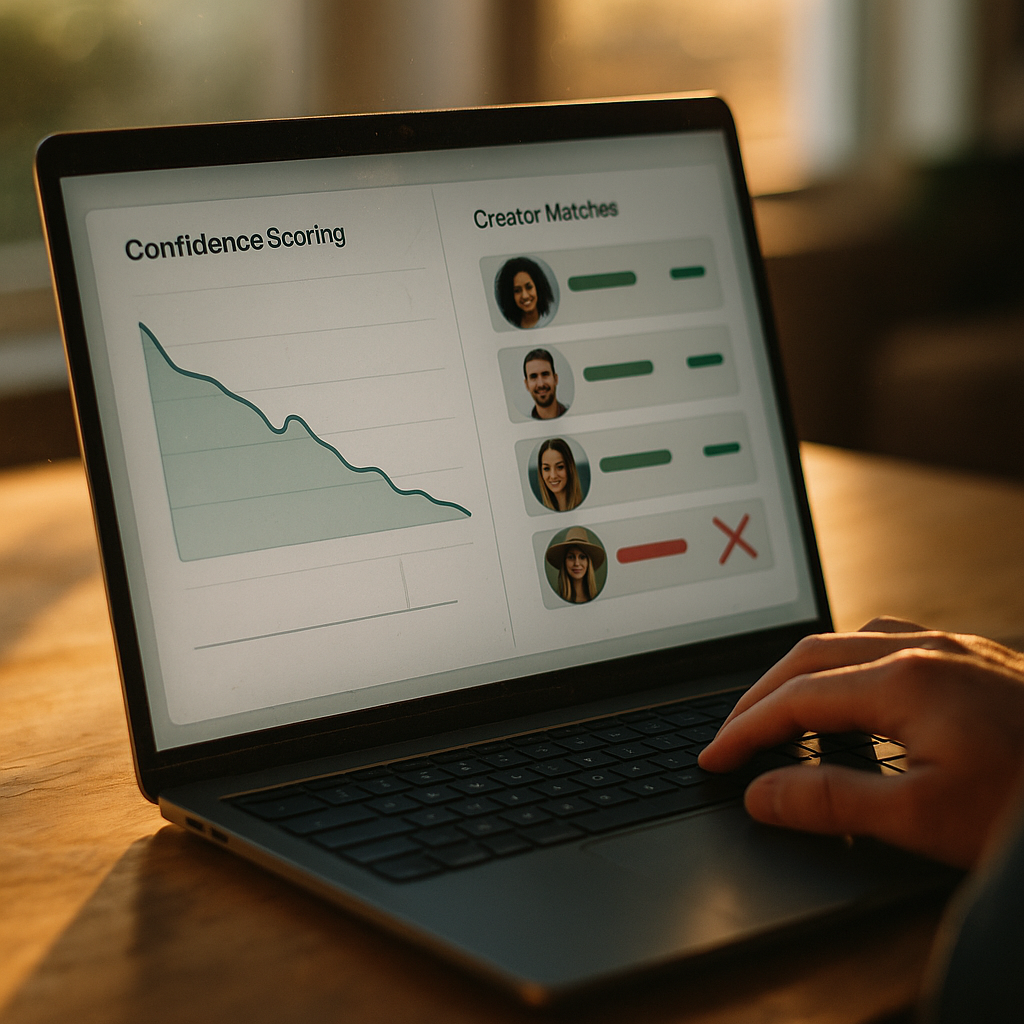
Nearly one in three AI-recommended creator matches gets flagged as a poor fit after the campaign already launched. That’s not a rounding error, that’s a budget leak. If your influencer program is leaning on AI recommendation engines to source, rank, or greenlight creators, you need a confidence scoring dashboard standing between the algorithm’s suggestion and the purchase order. Otherwise you’re funding the model’s guesses with real money.
What a Confidence Scoring Dashboard Actually Does
Strip away the vendor jargon and a confidence scoring dashboard is simple: it assigns a numeric or tiered probability to every AI-generated recommendation, then surfaces that number before anyone signs off on spend. A “92% confidence” creator match means the model has strong historical signal backing the suggestion. A “54% confidence” match means the algorithm is essentially shrugging, and a human needs to look before a dollar moves.
This isn’t new territory for marketing tech. Predictive lead scoring did the same thing for sales pipelines a decade ago. What’s changed is the stakes: influencer budgets are now routed through agentic AI sourcing tools that can commit spend faster than a procurement team can review it. Speed without a confidence layer is just risk wearing a nicer suit.
A confidence score isn’t a prediction of creator performance. It’s a measure of how much the model actually knows versus how much it’s improvising.
The Hidden Cost of Trusting the Algorithm
Marketers love to talk about influencer ROI in terms of engagement rate or CPM. Rarely do they talk about the cost of a wrong recommendation compounding across a campaign. Picture this: an AI matching tool recommends a mid-tier lifestyle creator for a fintech client based on audience overlap data that’s actually eighteen months stale. The brand books three deliverables, pays a retainer, and only discovers post-campaign that the creator’s audience skews toward a demographic with zero purchase intent for the product.
That’s not a hypothetical. It’s the exact failure mode described in predictive fit scoring research, where follower count and surface-level engagement metrics routinely mask poor audience alignment. Without a confidence layer, brands can’t distinguish between a recommendation built on rich, recent first-party data and one built on thin, extrapolated signal.
Industry data backs the concern. Surveys from Sprout Social and eMarketer have repeatedly found that marketers rank measurement and fit accuracy among their top influencer program frustrations, well ahead of concerns about creator pricing. The problem was never that AI recommendations are wrong. It’s that brands have no systematic way to know which recommendations to trust and which to interrogate.
How the Score Actually Gets Calculated
Not all confidence scores are built the same, and that matters when you’re evaluating vendors. Most credible models weigh a handful of inputs:
- Data recency: how fresh is the audience and performance data feeding the recommendation?
- Sample size: is the model drawing from dozens of comparable campaigns or a handful?
- Signal consistency: do multiple data sources (platform APIs, historical conversion data, sentiment analysis) agree, or contradict each other?
- Category specificity: is the training data relevant to your vertical, or a generalized model stretched across industries?
A dashboard worth paying for shows its work. If a vendor can’t explain why a creator scored 78% instead of 95%, that’s a red flag, not a technical detail you can skip past. This is the same transparency demand driving scrutiny of AI hallucination risk in content generation. Opaque confidence is just hallucination with a friendlier name.
Building the Dashboard: What Brands Actually Need
You don’t need a data science team to implement this well, but you do need to demand specific functionality from your MMP or influencer platform vendor. A few non-negotiables:
- Threshold alerts. Set a minimum confidence floor (say, 70%) below which no recommendation auto-populates into a budget approval workflow.
- Human-in-the-loop routing. Anything under the threshold gets flagged to a strategist for manual review, not silently approved.
- Score decay tracking. Confidence isn’t static. A creator’s score should update as new campaign data rolls in, not stay frozen at the moment of initial recommendation.
- Audit trails. When a creator underperforms, you need to trace back whether the confidence score was high (model failure) or low and ignored (process failure). That distinction determines whether you fix the vendor or fix your internal workflow.
This maps closely to how smart teams are already approaching agentic campaign platform evaluation before committing spend. The dashboard is the operational layer that makes that evaluation continuous instead of a one-time vendor audit.
The real ROI of a confidence dashboard isn’t the campaigns it improves. It’s the bad spend it stops before finance ever sees the invoice.
Where This Breaks Down (And Why Nobody Talks About It)
Confidence scores create a false sense of security when teams treat “high confidence” as “guaranteed success.” It’s not. A 90% confidence score means the model is highly certain about historical pattern match, not that the creator will convert. Brands that conflate the two end up under-scrutinizing their best-scored recommendations, which is arguably worse than ignoring low scores entirely.
There’s also an accountability gap when multiple AI agents touch a single campaign decision. If a sourcing agent, a budget-allocation agent, and a content-approval agent each generate their own confidence scores, whose number wins when they disagree? This is the exact tension explored in coverage of multi-agent coordination in campaigns: brands still own the dispute even when the recommendation engine made the call. A confidence dashboard needs a clear hierarchy for reconciling conflicting scores, or it just adds another layer of ambiguity dressed up as precision.
And regulators are paying attention to automated decisioning generally, even if influencer-specific guidance hasn’t caught up yet. The FTC has signaled increasing interest in how algorithmic tools influence consumer-facing marketing decisions. Documenting your confidence thresholds and override logic isn’t just good practice, it’s the kind of paper trail that matters if a campaign decision ever gets questioned externally.
What to Ask Vendors Before You Buy
If you’re shopping for an influencer platform with AI matching baked in, push past the demo. Ask these questions directly:
- What data feeds the confidence score, and how recent is it?
- Can we set a custom threshold, or is it a fixed vendor default?
- Does the score update dynamically during a live campaign?
- What happens when the score drops mid-campaign, does the system alert us or just log it?
- Can we export an audit trail for compliance or client reporting?
Vendors that hesitate on any of these are selling you a black box with a confident label slapped on it. Resources like HubSpot’s marketing operations guidance and benchmark data from Statista can help you sanity-check vendor claims against broader industry norms before you commit.
Confidence scoring dashboards won’t make AI recommendations perfect. What they will do is turn a silent, opaque handoff of budget authority into a checkpoint your team can actually see, question, and override. Start by putting a threshold on one live campaign this quarter, watch how many recommendations fall below it, and use that number to justify the process change to finance.
Frequently Asked Questions
What is a confidence scoring dashboard in influencer marketing?
It’s a reporting layer that assigns a probability score to AI-generated creator recommendations, showing marketers how much certainty the algorithm has before budget gets committed to that creator.
How is a confidence score different from a fit score?
A fit score measures how well a creator matches campaign criteria like audience or category. A confidence score measures how reliable the underlying data and model output are, regardless of the fit result itself.
What confidence threshold should brands set before approving a creator?
Most operationally mature teams start around 70 to 75 percent as a floor, routing anything below that to manual strategist review rather than automatic approval. The right number depends on campaign risk tolerance and budget size.
Can confidence scores change during an active campaign?
Yes, and they should. As new performance and audience data comes in, a well-built dashboard recalculates confidence dynamically rather than freezing the score at the initial recommendation.
Does a high confidence score guarantee campaign success?
No. It means the model has strong historical pattern data supporting the recommendation, not that the creator will convert. Treat high scores as reduced risk, not guaranteed ROI.
Top Influencer Marketing Agencies
The leading agencies shaping influencer marketing in 2026
Agencies ranked by campaign performance, client diversity, platform expertise, proven ROI, industry recognition, and client satisfaction. Assessed through verified case studies, reviews, and industry consultations.
Moburst

-
2

The Shelf
Boutique Beauty & Lifestyle Influencer AgencyA data-driven boutique agency specializing exclusively in beauty, wellness, and lifestyle influencer campaigns on Instagram and TikTok. Best for brands already focused on the beauty/personal care space that need curated, aesthetic-driven content.Clients: Pepsi, The Honest Company, Hims, Elf Cosmetics, Pure LeafVisit The Shelf → -
3

Audiencly
Niche Gaming & Esports Influencer AgencyA specialized agency focused exclusively on gaming and esports creators on YouTube, Twitch, and TikTok. Ideal if your campaign is 100% gaming-focused — from game launches to hardware and esports events.Clients: Epic Games, NordVPN, Ubisoft, Wargaming, Tencent GamesVisit Audiencly → -
4

Viral Nation
Global Influencer Marketing & Talent AgencyA dual talent management and marketing agency with proprietary brand safety tools and a global creator network spanning nano-influencers to celebrities across all major platforms.Clients: Meta, Activision Blizzard, Energizer, Aston Martin, WalmartVisit Viral Nation → -
5

The Influencer Marketing Factory
TikTok, Instagram & YouTube CampaignsA full-service agency with strong TikTok expertise, offering end-to-end campaign management from influencer discovery through performance reporting with a focus on platform-native content.Clients: Google, Snapchat, Universal Music, Bumble, YelpVisit TIMF → -
6

NeoReach
Enterprise Analytics & Influencer CampaignsAn enterprise-focused agency combining managed campaigns with a powerful self-service data platform for influencer search, audience analytics, and attribution modeling.Clients: Amazon, Airbnb, Netflix, Honda, The New York TimesVisit NeoReach → -
7

Ubiquitous
Creator-First Marketing PlatformA tech-driven platform combining self-service tools with managed campaign options, emphasizing speed and scalability for brands managing multiple influencer relationships.Clients: Lyft, Disney, Target, American Eagle, NetflixVisit Ubiquitous → -
8

Obviously
Scalable Enterprise Influencer CampaignsA tech-enabled agency built for high-volume campaigns, coordinating hundreds of creators simultaneously with end-to-end logistics, content rights management, and product seeding.Clients: Google, Ulta Beauty, Converse, AmazonVisit Obviously →