


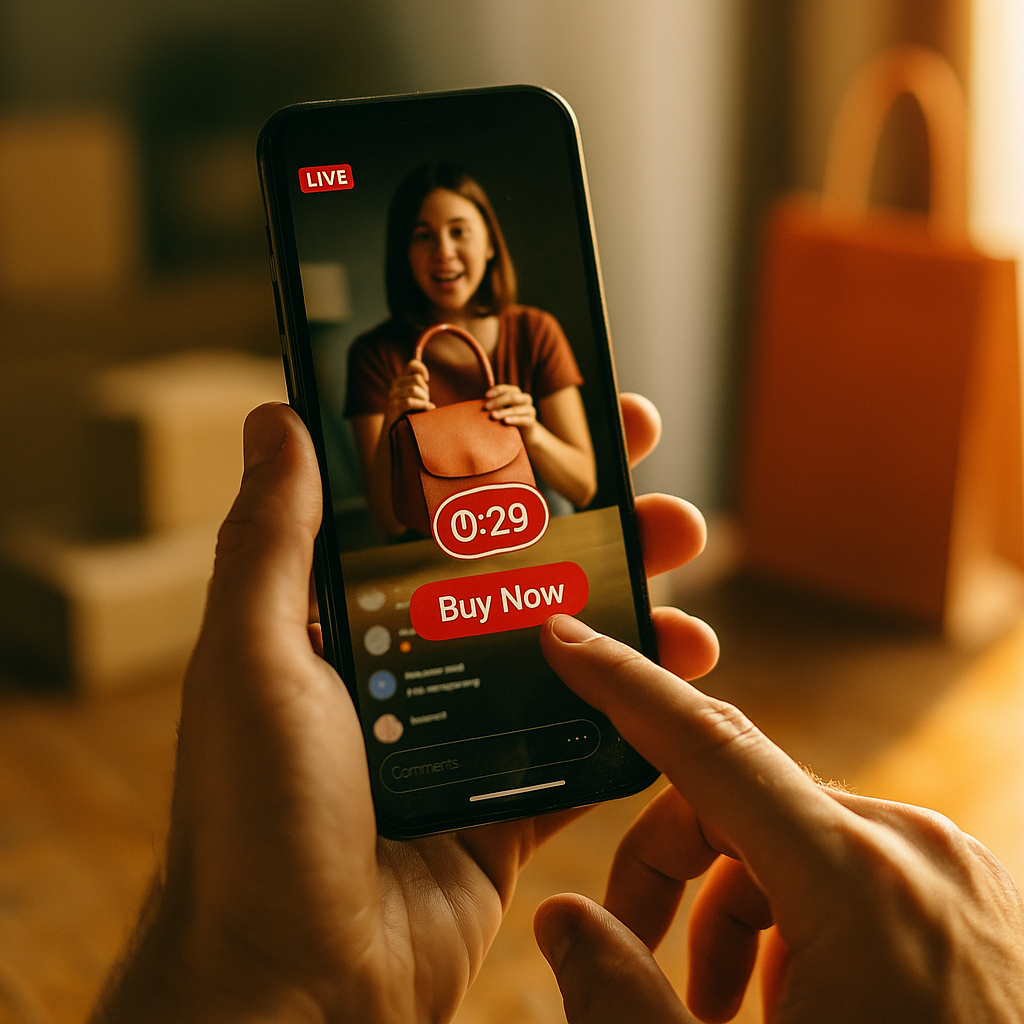
Brands running shoppable countdown lives see conversion spikes of 20% or more in the final five minutes before a drop closes, according to platform data shared by TikTok Shop sellers. That spike isn’t luck. It’s a script. Most teams treat the countdown clock as a prop instead of a scripting tool, and they leave revenue on the table because of it.
Why Urgency Cues Work (and Where They Break)
Scarcity triggers a well-documented psychological response: when supply feels limited, perceived value climbs. That’s not new. What’s new is doing it live, in real time, with inventory counters that viewers can watch tick down while a host talks. The format compresses the entire purchase decision into minutes instead of days.
But urgency cues break fast when they’re inconsistent. If a host says “only 12 left” and the on-screen counter still reads 40, trust evaporates. Viewers in shoppable live chats are sharp, they screenshot discrepancies, and they post them. One mismatched number can undo a whole campaign’s credibility.
The fastest way to kill urgency is to fake it. Audiences forgive a sellout. They don’t forgive a lie about one.
The Anatomy of a Countdown Live Script
A limited drop live isn’t improvised, even when it feels spontaneous. The best-performing scripts follow a loose but deliberate structure:
- Cold open (0 to 90 seconds): State the drop size, the price, and the clock. No small talk. Viewers who click in during a live are there for the product, not the preamble.
- Proof stack (minutes 2 to 8): Demos, fit checks, or side-by-side comparisons that justify the price before urgency kicks in. Urgency without proof just reads as pressure.
- First urgency pulse (around the 10 minute mark): A real inventory update. “We started with 500, we’re at 310.”
- Mid-live restock or bundle reveal: Optional, but it resets attention for viewers who joined late.
- Final countdown (last 5 to 10 minutes): Stacked urgency cues, rapid host pacing, visible counter, repeated calls to the link in bio or pinned comment.
This structure mirrors how live event run of show scripting works for larger activations: you build a timeline, assign beats to minutes, and leave room for the host to riff inside guardrails.
Scripting the Urgency Cues Themselves
Generic phrases like “don’t miss out” have lost all power. They’re wallpaper now. Specific, numeric, verifiable language performs better because it reads as information, not marketing copy.
- Instead of “selling fast,” say “we’ve moved 60% of stock in the last 20 minutes.”
- Instead of “limited time,” say “this closes when the counter hits zero, not when I feel like it.”
- Instead of “hurry,” say “last restock of the night, confirmed with the warehouse team.”
Notice the pattern: specificity plus a credible source. Hosts who can point to a real number, a real team, or a real system build urgency that holds up under scrutiny. This is the same principle behind dupe comparison videos that survive FTC review: vague superlatives get flagged, specific and substantiated claims don’t.
Inventory Math Is the Script’s Backbone
Here’s the part most briefs skip. You cannot script urgency cues until you know your actual drop math: total units, expected sell-through rate per minute, and how many “urgency pulses” the inventory can support without running dry too early or dragging too long.
A 200-unit drop running over a 45-minute live needs a different pacing script than a 2,000-unit drop running over 20 minutes. If you script five urgency beats for a small drop, you’ll sell out before beat three and leave viewers staring at a “sold out” screen mid-promise. That’s a worse outcome than no urgency script at all, because it breaks the implicit contract with the audience.
Build a simple pacing table before the script, not after:
- Total units divided by live duration equals expected sell-through pace per minute.
- Mark checkpoints at 25%, 50%, 75%, and 90% sold, not at arbitrary time stamps.
- Script urgency language to trigger off inventory checkpoints, not clock time. Clocks lie when a restock happens or a payment processor lags.
This approach pairs well with how brands structure second screen content around a primary broadcast: the countdown live is the main event, but a synced short-form clip teasing “last 50 units” on another platform extends the urgency window without duplicating risk.
What Compliance Teams Need to See Before the Drop Goes Live
Urgency marketing sits close to a regulatory line, and the FTC has been explicit about scarcity and countdown claims that aren’t genuine. If a counter resets, if “sold out” items reappear, or if a host claims limited stock that isn’t actually limited, that’s a deceptive practice issue, not a gray area.
Before any countdown live script gets approved, legal and compliance should confirm:
- The inventory number stated on camera matches the backend system in real time, or close to it.
- Any “while supplies last” language is tied to an actual, finite SKU count documented somewhere internal.
- Discount stacking claims (percent off plus bundle plus “today only”) are each independently true, not compounded for effect.
- The host has a disclosure script ready if the brand is gifting product or paying a flat fee, consistent with FTC endorsement guidance.
Review platform-specific rules too. TikTok’s advertising policies and Meta’s commerce guidelines both restrict misleading scarcity claims in live and shoppable formats, and enforcement has tightened as livestream shopping volume has grown. Teams that treat these as creative constraints instead of legal checkboxes end up with scripts that are both safer and more persuasive, because real constraints force real specificity.
Casting the Right Host for Urgency Delivery
Not every creator can sell urgency convincingly. Some hosts read a countdown script like they’re reading a grocery list, flat and unconvincing. Others oversell it and come across as desperate, which repels the exact shoppers you’re trying to convert.
The best live shopping hosts treat the countdown like a sports commentator treats a close game: they narrate the stakes without manufacturing panic. That’s a skill, and it’s worth casting for specifically rather than assuming any creator with a large following can carry a 30-minute urgency-driven broadcast.
If you’re running multiple hosts across a single drop event, coordinate handoffs carefully so urgency momentum doesn’t reset every time a new person takes the mic. The same handoff logic used in multi creator relay challenges applies here: each host should pick up the inventory count and energy level exactly where the last one left off, not start a fresh pitch from zero.
Measuring What Actually Matters
Views and concurrent viewers are vanity metrics for a shoppable live. The numbers that tell you whether your urgency scripting worked are narrower:
- Sell-through velocity by minute marker, mapped against when each urgency cue fired.
- Cart abandonment rate in the final 10 minutes, which tells you whether urgency converted or just stressed people out.
- Repeat viewer rate on future drops, the clearest signal that your urgency tactics didn’t burn trust.
Run a quick postmortem after every drop and compare urgency cue timing to sales spikes in your platform analytics. Over three or four drops, you’ll have a reliable pacing model specific to your audience and category, something closer to a science than a vibe. Industry benchmarks from eMarketer and Sprout Social are useful starting points, but your own drop history will always outperform a generic benchmark once you have enough data.
And don’t let creative go stale. Scripts that worked for three drops in a row will start underperforming by the fourth or fifth, the same fatigue pattern covered in the 36 day creative refresh calendar. Rotate urgency phrasing, host pairings, and visual counter styles on a schedule, not just when performance dips.
If your drop also feeds AI-assisted shopping surfaces, make sure the urgency language in your script is structured in a way discovery tools can parse. Guidance on this is covered in detail in AI shopping assistant scripts, and it’s increasingly relevant as more purchase research happens through conversational interfaces before a shopper ever clicks into your live.
Frequently Asked Questions
How long should a shoppable countdown live run for a limited drop?
Most high-converting limited drop lives run between 20 and 45 minutes. Shorter sessions compress urgency effectively for small inventory drops, while longer sessions work better for larger stock counts that need multiple urgency pulses spaced further apart.
What’s the biggest mistake brands make scripting urgency cues?
Using vague, repeated phrases like “almost gone” without a real number behind them. Audiences have become skeptical of unsubstantiated scarcity claims, and mismatched or exaggerated urgency language is also a direct compliance risk under FTC guidance.
Should the inventory counter be automated or host-narrated?
Ideally both, synced in real time. An on-screen automated counter paired with a host who references the same number verbally reinforces credibility. A counter that contradicts the host’s claims is worse than having no counter at all.
How many urgency cues should a script include?
Plan for three to five, tied to inventory checkpoints rather than fixed time stamps. Too few and momentum stalls, too many and viewers tune out the pressure entirely.
Do shoppable countdown lives need FTC disclosure language?
Yes, if the host is compensated or gifted product, standard endorsement disclosure rules apply throughout the live, not just in the opening seconds. Compliance teams should script disclosure language alongside urgency cues, not as an afterthought.
Build your next countdown live script around real inventory math and checkpoint-triggered urgency cues, not a generic clock. Run one drop, measure sell-through against your urgency pulses, and refine before the next launch.
Top Influencer Marketing Agencies
The leading agencies shaping influencer marketing in 2026
Agencies ranked by campaign performance, client diversity, platform expertise, proven ROI, industry recognition, and client satisfaction. Assessed through verified case studies, reviews, and industry consultations.
Moburst

-
2

The Shelf
Boutique Beauty & Lifestyle Influencer AgencyA data-driven boutique agency specializing exclusively in beauty, wellness, and lifestyle influencer campaigns on Instagram and TikTok. Best for brands already focused on the beauty/personal care space that need curated, aesthetic-driven content.Clients: Pepsi, The Honest Company, Hims, Elf Cosmetics, Pure LeafVisit The Shelf → -
3

Audiencly
Niche Gaming & Esports Influencer AgencyA specialized agency focused exclusively on gaming and esports creators on YouTube, Twitch, and TikTok. Ideal if your campaign is 100% gaming-focused — from game launches to hardware and esports events.Clients: Epic Games, NordVPN, Ubisoft, Wargaming, Tencent GamesVisit Audiencly → -
4

Viral Nation
Global Influencer Marketing & Talent AgencyA dual talent management and marketing agency with proprietary brand safety tools and a global creator network spanning nano-influencers to celebrities across all major platforms.Clients: Meta, Activision Blizzard, Energizer, Aston Martin, WalmartVisit Viral Nation → -
5

The Influencer Marketing Factory
TikTok, Instagram & YouTube CampaignsA full-service agency with strong TikTok expertise, offering end-to-end campaign management from influencer discovery through performance reporting with a focus on platform-native content.Clients: Google, Snapchat, Universal Music, Bumble, YelpVisit TIMF → -
6

NeoReach
Enterprise Analytics & Influencer CampaignsAn enterprise-focused agency combining managed campaigns with a powerful self-service data platform for influencer search, audience analytics, and attribution modeling.Clients: Amazon, Airbnb, Netflix, Honda, The New York TimesVisit NeoReach → -
7

Ubiquitous
Creator-First Marketing PlatformA tech-driven platform combining self-service tools with managed campaign options, emphasizing speed and scalability for brands managing multiple influencer relationships.Clients: Lyft, Disney, Target, American Eagle, NetflixVisit Ubiquitous → -
8

Obviously
Scalable Enterprise Influencer CampaignsA tech-enabled agency built for high-volume campaigns, coordinating hundreds of creators simultaneously with end-to-end logistics, content rights management, and product seeding.Clients: Google, Ulta Beauty, Converse, AmazonVisit Obviously →