


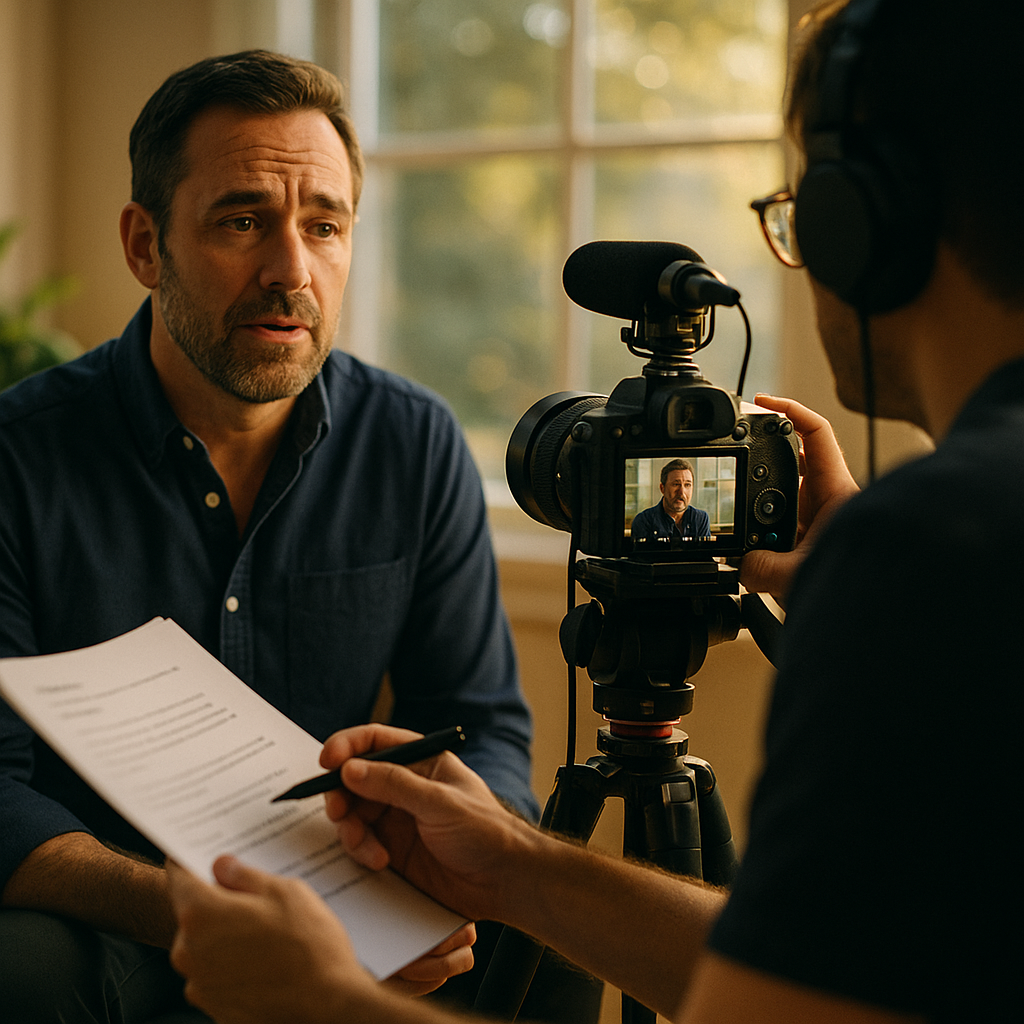
68% of consumers say they trust a brand less after watching a polished founder story that feels scripted. That’s the trap most founder origin mini-documentaries fall into: they optimize for cinematic gloss and lose the one thing that actually converts skeptics, which is a story that sounds like it could be checked. If you’re building a founder origin mini-documentary for a brand launch, rebrand, or funding push, the script matters more than the lighting kit.
This format has quietly become one of the highest-leverage assets in a brand’s content stack. It’s not a testimonial. It’s not an ad. It’s closer to a mini case study with a human face attached, and when it’s scripted correctly, it does something few brand assets can: it survives scrutiny.
Why Skeptics Tune Out Most Founder Stories
Marketers love the founder origin story because it feels authentic by default. Wrong. Authenticity isn’t a genre, it’s a byproduct of specificity. A founder saying “I started this because I was frustrated with the industry” is not a story, it’s a cliché that every DTC brand from mattresses to supplement powders has recycled since 2015.
Skeptical viewers, especially the ones your brand actually needs to convert (the ones who’ve been burned by a bad purchase before), have a finely tuned detector for vague, unverifiable claims. They’ve seen enough Kickstarter pitches and Shark Tank pitches to know the formula: struggle, epiphany, triumph. The formula itself isn’t the problem. The lack of receipts is.
A founder origin mini-documentary converts skeptics only when it includes at least one detail the viewer could independently verify, a date, a location, a named supplier, a dollar figure, or a public failure.
Compare this to the mini documentary brand film approach already working for product-led storytelling. The same logic applies to founders: specificity is the currency, not polish.
The Three-Act Structure That Actually Holds Up
Most founder documentaries borrow a three-act structure from film school: setup, confrontation, resolution. Fine in theory. In practice, brands skip the confrontation act because it feels risky to show the brand (or the founder) failing. That’s exactly backward. The confrontation act is where trust gets built.
- Act one (the ordinary world): Ground the founder in a specific, checkable context. Not “I was working a corporate job,” but “I was a supply chain analyst at a mid-size apparel company in Charlotte for six years.”
- Act two (the break): Show the actual failure or friction, with numbers if possible. A failed first batch, a blown budget, a rejected pitch. This is the part skeptics are waiting for, because it’s the part most brands cut.
- Act three (the proof): Resolution isn’t “we built a great company.” It’s a measurable, current-state fact: unit count shipped, retention rate, a named retail partner, a third-party certification.
Notice what’s missing from this structure: inspiration for its own sake. Skeptics don’t convert on inspiration. They convert on evidence wrapped in a narrative they can follow.
Scripting the Lore: Where Most Teams Get It Wrong
“Brand lore” sounds like a soft, almost mythological term, and that’s part of the problem. Teams treat it like worldbuilding for a video game instead of a documented, fact-checkable account of how a company came to exist. Lore that converts is lore that’s been through a legal and comms review, not lore that’s been through a creative brainstorm.
Here’s a working script skeleton that holds up under scrutiny:
- Cold open with a specific moment, not a mission statement. “It was 2 a.m. in a rented warehouse in Phoenix” beats “We believe in better skincare.”
- One sentence of stakes. What happens if this fails? Money lost, a job quit, a family member’s savings on the line. State it plainly.
- The friction beat. A named obstacle: a supplier who ghosted, a formulation that failed FDA testing, a investor who passed twice.
- The pivot, with a cause. Not “then we found our way.” Instead: “A customer complaint on a return form changed the formula entirely.”
- Present-tense proof. Current numbers, a named retail or distribution partner, a specific customer outcome.
- A forward-looking stake, not a closing platitude. What’s the brand still trying to prove?
This is structurally similar to how customer interview clips are scripted for believability, except the founder is both the narrator and the subject, which raises the burden of proof considerably.
The Compliance Layer Nobody Scripts For
Here’s where this gets genuinely tricky for brand and legal teams. A founder origin documentary often includes implicit or explicit performance claims: revenue figures, customer satisfaction numbers, before-and-after business metrics. If any of that language touches advertising claims about the product itself (not just the company), it falls under the same disclosure scrutiny as influencer content.
The FTC’s endorsement guidance doesn’t carve out an exception for founders just because they’re telling their own story. If the founder appears in paid media making claims about efficacy, growth, or results, those claims need substantiation on file. Legal teams should review founder scripts with the same rigor applied to comparison video claims, because a skeptical viewer who later becomes a skeptical regulator is a realistic scenario for any brand doing six or seven figures in paid founder content.
Practical move: build a claims log alongside the script. Every stat, every “first in the industry” line, every customer count gets a source attached before it goes to camera.
Format Choices That Change Conversion
Not every founder story should be a five-minute hero film. The format decision shapes how skeptics receive the content, and most brands default to long-form when a shorter, scaffolded structure would convert better on paid social.
Long-form (3 to 7 minutes): Best for owned channels, investor decks, and landing pages where the viewer has already opted in. Works well when paired with clip-ready shoot structures so the same footage can be cut into shorter assets later without a reshoot.
Short-form (30 to 90 seconds): Better for cold traffic on TikTok and Reels, where the hook has to land in the first two seconds. Treat the founder’s face and voice the same way you’d treat founder UGC scaffolds, with a tight hook, a single proof point, and a clear CTA.
Brands that run both formats in sequence tend to see the strongest skeptic-to-customer movement: short-form for discovery, long-form for the close. According to eMarketer, video content that pairs short discovery clips with longer-form proof assets consistently outperforms single-format campaigns on both click-through and down-funnel conversion.
A founder documentary that only exists as a single five-minute cut is a missed distribution opportunity. Script it in beats from the start so it can be re-cut into three or four standalone proof points.
Casting the Skeptic’s Internal Monologue
One underused scripting technique: write the viewer’s objections directly into the voiceover or on-screen text, then answer them in sequence. “You’re probably thinking this sounds like every other founder story. Here’s the part that’s different.” It’s a small structural move, but it disarms the exact defense mechanism that makes most founder content feel like an ad.
This works especially well when paired with a street interview cutaway, where real customers or even skeptical strangers respond to the claim on camera before the founder gets the final word. It’s a credibility transfer technique borrowed from vox pop social proof formats, applied to a longer narrative arc.
Measuring Whether the Lore Actually Converts
Views and watch time tell you whether the story is engaging. They don’t tell you whether it converted a skeptic. Track these instead:
- Branded search lift in the two weeks following a founder documentary launch, which signals curiosity-driven trust building.
- On-page conversion rate for traffic that watched more than 75% of the video versus traffic that didn’t, isolated via UTM or pixel segmentation.
- Comment sentiment shift, specifically the ratio of skeptical comments (“sounds fake,” “sure”) to validating comments (“checked this out, it’s real”) over the first 72 hours.
- Return visitor rate to the founder story page, which often predicts purchase intent better than first-visit conversion.
Platforms like Sprout Social make the comment sentiment tracking reasonably straightforward, but the branded search and conversion lift numbers need to come from your own analytics stack, not platform-native metrics alone.
If you’re testing multiple founder story cuts, treat it the same way you’d treat a creative refresh cycle: rotate proof points, not just hooks, since skeptics respond to which fact you lead with as much as how you say it.
What to Do Next
Before your next founder documentary goes into production, build a one-page claims log with every verifiable fact, number, and named entity the founder will reference on camera, and have legal sign off before the shoot. That single step separates a founder origin mini-documentary that converts skeptics from one that just confirms their suspicions.
Frequently Asked Questions
How long should a founder origin mini-documentary be?
Most effective versions run between 90 seconds and 5 minutes, depending on the channel. Cold social traffic needs the short version, while owned landing pages and investor contexts can support the longer cut with more proof beats.
Do founder claims in these videos need FTC-level disclosure?
If the founder makes claims about product performance, revenue, or customer outcomes in paid or sponsored media, those claims need substantiation on file, the same standard applied to influencer endorsements under FTC guidance.
What’s the biggest scripting mistake brands make with founder stories?
Skipping the failure or friction beat. Brands tend to smooth over setbacks to protect the brand image, but that’s precisely the section skeptical viewers are watching for to judge whether the story is real.
Can a founder origin documentary be reused across multiple platforms?
Yes, if it’s scripted in modular beats from the start. A single long-form shoot can be cut into three or four short-form proof clips for paid social without needing a reshoot.
How do you measure if a founder documentary is actually converting skeptics, not just getting views?
Track branded search lift, conversion rate differences between viewers who watched over 75% of the video versus those who didn’t, and shifts in comment sentiment from skeptical to validating over the first few days post-launch.
Top Influencer Marketing Agencies
The leading agencies shaping influencer marketing in 2026
Agencies ranked by campaign performance, client diversity, platform expertise, proven ROI, industry recognition, and client satisfaction. Assessed through verified case studies, reviews, and industry consultations.
Moburst

-
2

The Shelf
Boutique Beauty & Lifestyle Influencer AgencyA data-driven boutique agency specializing exclusively in beauty, wellness, and lifestyle influencer campaigns on Instagram and TikTok. Best for brands already focused on the beauty/personal care space that need curated, aesthetic-driven content.Clients: Pepsi, The Honest Company, Hims, Elf Cosmetics, Pure LeafVisit The Shelf → -
3

Audiencly
Niche Gaming & Esports Influencer AgencyA specialized agency focused exclusively on gaming and esports creators on YouTube, Twitch, and TikTok. Ideal if your campaign is 100% gaming-focused — from game launches to hardware and esports events.Clients: Epic Games, NordVPN, Ubisoft, Wargaming, Tencent GamesVisit Audiencly → -
4

Viral Nation
Global Influencer Marketing & Talent AgencyA dual talent management and marketing agency with proprietary brand safety tools and a global creator network spanning nano-influencers to celebrities across all major platforms.Clients: Meta, Activision Blizzard, Energizer, Aston Martin, WalmartVisit Viral Nation → -
5

The Influencer Marketing Factory
TikTok, Instagram & YouTube CampaignsA full-service agency with strong TikTok expertise, offering end-to-end campaign management from influencer discovery through performance reporting with a focus on platform-native content.Clients: Google, Snapchat, Universal Music, Bumble, YelpVisit TIMF → -
6

NeoReach
Enterprise Analytics & Influencer CampaignsAn enterprise-focused agency combining managed campaigns with a powerful self-service data platform for influencer search, audience analytics, and attribution modeling.Clients: Amazon, Airbnb, Netflix, Honda, The New York TimesVisit NeoReach → -
7

Ubiquitous
Creator-First Marketing PlatformA tech-driven platform combining self-service tools with managed campaign options, emphasizing speed and scalability for brands managing multiple influencer relationships.Clients: Lyft, Disney, Target, American Eagle, NetflixVisit Ubiquitous → -
8

Obviously
Scalable Enterprise Influencer CampaignsA tech-enabled agency built for high-volume campaigns, coordinating hundreds of creators simultaneously with end-to-end logistics, content rights management, and product seeding.Clients: Google, Ulta Beauty, Converse, AmazonVisit Obviously →