


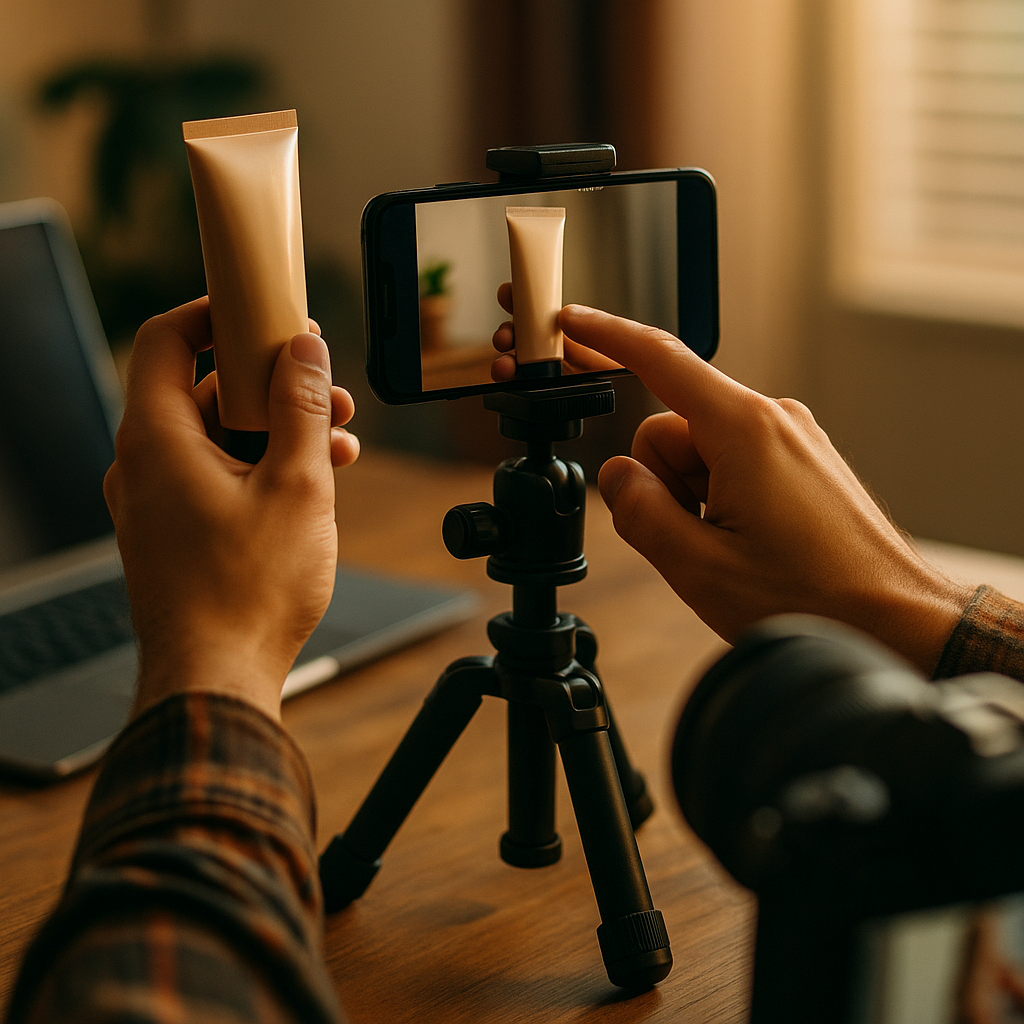
Roughly 85% of Facebook video is watched without sound, and TikTok’s own creative guidance pushes captions and visual clarity precisely because so many viewers scroll muted on trains, in offices, in bed next to a sleeping partner. Yet most creator briefs still treat voiceover as the load-bearing wall of a product demo. Flip that assumption and you unlock what’s quietly becoming one of the highest-converting formats in the creator toolkit: the silent product demo.
Why Sound-Off Is the Default, Not the Exception
Marketers love to talk about “sound-on” as the gold standard and treat muted viewing as a compromise. That’s backwards. Sound-off is the baseline behavior on every major short-form platform. Meta has cited that most Facebook and Instagram video plays happen without audio. TikTok users increasingly watch with captions in public settings, during commutes, at work. Even YouTube Shorts sees massive muted consumption on mobile.
If your creator content only makes sense with a voiceover explaining the product, you’re losing the majority of your audience before the hook even lands. The silent demo format flips the brief: assume no audio, then build the sale entirely through visual sequencing, on-screen text, and physical demonstration.
A demo that only works with sound isn’t a demo — it’s a lecture with a video attached. Silent-first briefs force creators to prove the product’s value visually, which is a harder but far more transferable skill across platforms.
What “Directing for Silence” Actually Means in a Brief
This isn’t just “add captions.” Captions are a patch, not a strategy. A true silent demo is storyboarded shot-by-shot so that a viewer with the volume at zero understands the problem, the product, the mechanism, and the payoff without reading a single word of dialogue transcription.
That means your brief needs to specify:
- Visual problem framing: the first 2-3 seconds must show a relatable pain point through action, not narration. Think: a tangled cord, a stained shirt, a cluttered desk. No words needed.
- Hand-first demonstration: close-up shots of hands using the product do more selling than a talking-head explaining features. Direct creators to slow down key motions — the twist, the click, the before/after wipe.
- Text overlays as dialogue replacement: short, punchy on-screen text that carries the narrative beats a voiceover would normally carry. Think 3-5 word phrases, not paragraphs.
- Visual proof over claims: instead of a creator saying “this holds 10 hours of charge,” show a battery icon graphic or a literal time-lapse. Show, don’t tell, has never been more literal.
- Payoff clarity: the final 3 seconds need an unambiguous visual resolution — the stain is gone, the box is packed, the skin looks different. If a muted viewer can’t tell what happened, the demo failed.
This level of detail matters because creators, left to their own devices, default to what’s fast to shoot: talking into the camera. Silent-first demos require more planning and more takes. Your brief has to make that trade-off explicit and worth their time.
The Hook Still Has to Work Muted
Every brief in this format lives or dies on the first three seconds, same as any short-form content. But the muted-first hook has different rules than a sound-on hook. You can’t rely on a startling sound effect or a punchy opening line delivered to camera. The visual itself has to stop the scroll.
This is where a lot of briefs fall short, treating the hook instruction as an afterthought instead of the centerpiece. Brands running performance-driven creator programs already understand this obsession with the opening beats — it’s the same logic covered in hook-focused briefs for app install ads, just applied to physical product demonstration instead of software UI. The instinct transfers directly: make the visual conflict or curiosity gap obvious before any text or product appears.
Good silent hooks tend to fall into a few repeatable patterns: an unexpected transformation mid-frame, a close-up that withholds context, or a familiar frustration shown without commentary. None require sound to register instantly.
Captions Aren’t Optional, But They’re Not the Strategy
Let’s be clear about the hierarchy here. Captions matter for accessibility and for the segment of your audience that reads along even with sound on. But if your visual sequence only makes sense once someone reads the caption, you’ve built a sound-on demo with subtitles bolted on, not a genuinely silent-first piece of content.
Test this in your own review process: mute the draft, cover the caption bar with your hand, and watch the full clip. Can you still follow what the product does and why it matters? If not, send it back. This single QA step catches more weak briefs than any amount of upfront instruction.
Where This Format Wins (and Where It Doesn’t)
Silent demos aren’t universally superior. They’re a tool for a specific job. Physical, visually demonstrable products — beauty, home goods, gadgets, fashion, food prep tools — are naturally suited to this format because the value proposition is inherently visual. A serum absorbing into skin, a stain lifting off fabric, a gadget folding flat: these sell themselves on sight.
Complex B2B software or services with abstract value propositions struggle here. You can’t visually demonstrate “improved team alignment” the way you can demonstrate a self-cleaning water bottle. For those categories, a hybrid approach — visual-first with optional voiceover layered for sound-on viewers — tends to perform better than a pure silent mandate.
It’s also worth noting this format pairs unusually well with unboxing-style content, since unboxings are already visually driven by nature. Brands running unboxing briefs built around impulse buys often find the silent-demo principles slot in with minimal rework: the reveal, the texture, the first use, all visually legible without narration.
Briefing for Skill, Not Just Instruction
Here’s the uncomfortable truth: not every creator is good at this. Silent-first demo work rewards visual storytellers, people with an eye for framing, pacing, and physical demonstration. It doesn’t reward creators whose strength is charismatic talking-to-camera delivery. Casting matters as much as the brief itself.
When vetting creators for this format, look at their existing content with the sound off. Does it still hold attention? Does their editing rhythm carry a narrative on its own? That’s a far better predictor of silent-demo success than follower count or even average engagement rate.
Brands that get this right build a short visual glossary into the brief itself: examples of shot types (macro texture shots, hand-motion close-ups, split-screen before/afters), reference clips from other silent-first content, and a simple storyboard template creators fill in before shooting. This front-loads the thinking so creators aren’t improvising visual sequencing on set, which is where most silent demos fall apart.
The same discipline shows up in briefs built around ingredient callout overlays for livestream selling, where visual proof points do the persuasive work that a host’s voice would otherwise carry. The overlap between these formats is real: both rely on graphic text and visual sequencing to compensate for reduced or absent audio attention.
Measuring Success Without the Usual Audio-Dependent Metrics
Standard video metrics can mislead you here. Average watch time still matters, but you should also be tracking completion rate specifically among muted views if your ad platform segments that data. Meta’s ad reporting and TikTok’s analytics both offer some visibility into sound-on versus sound-off performance at the campaign level, even if creator-level breakdowns are limited.
More practically, track whether click-through or conversion rates differ meaningfully between placements known to skew muted (Feed, in-office scrolling contexts) versus placements with higher sound-on likelihood (Stories with headphones-in behavior, YouTube on TV screens). If your silent demo converts comparably across both, you’ve built genuinely platform-agnostic content — which is the real prize.
This is the same logic behind building one hero asset that scales across platforms: content that doesn’t depend on a single consumption context travels further and gets more mileage out of the same production spend.
For deeper platform-specific creative guidance, TikTok’s ad creative resources and Meta’s business creative guidelines both offer updated specs on caption placement, safe zones, and sound-off best practices worth cross-referencing against your own brief templates. Industry benchmarking from eMarketer also regularly tracks shifts in muted video consumption that are worth revisiting quarterly, since behavior does shift as platforms evolve default playback settings.
Compliance Doesn’t Disappear Just Because the Sound Does
One risk brands overlook: disclosure requirements don’t relax for silent content. If a creator is promoting a paid partnership, the disclosure needs to be visually unmistakable, not buried in a spoken aside that never gets recorded because there’s no voiceover. Text-based disclosure (#ad, “Paid partnership” tags) becomes even more critical here, and it needs to appear early and stay legible, not flash for half a second in a corner. Review the FTC’s endorsement guidelines with this format specifically in mind — a muted, fast-cut demo is exactly the kind of content where a clear, static disclosure overlay protects both the creator and the brand.
Next Step
Don’t retrofit existing voiceover-heavy briefs with a caption requirement and call it done. Rebuild the storyboard around visual sequencing first, cast creators who prove they can carry a narrative through editing alone, and QA every draft with the sound off before it ever reaches a client review.
FAQs
What is a silent product demo format?
It’s a creator content approach that communicates a product’s value entirely through visual sequencing, text overlays, and physical demonstration, designed to work fully on mute for sound-off feeds like Facebook, Instagram, and much of TikTok.
Why does sound-off viewing matter so much for creator briefs?
Meta has reported that the large majority of video views on its platforms happen without sound. If a demo relies on narration to make sense, it fails to convert the majority of viewers who never turn the volume on.
Are captions enough to make a demo work without sound?
No. Captions support accessibility, but if the visual sequence only makes sense once someone reads the caption text, the content is still sound-on content with subtitles added, not a true silent-first demo.
Which product categories work best with silent demos?
Physically demonstrable products — beauty, home goods, fashion, gadgets, food prep tools — translate well because their value is visible. Abstract or service-based offerings usually need a hybrid approach with optional voiceover layered in.
How should brands vet creators for this format?
Review a creator’s existing content with the sound muted. If it still holds attention and tells a clear story through editing and framing alone, that’s a stronger signal of silent-demo skill than follower count or general engagement rate.
Does disclosure compliance change for silent content?
The requirement doesn’t change, but the execution does. Disclosures need to be clear, static, and visually prominent since there’s no spoken disclaimer to rely on. Refer to FTC endorsement guidelines when reviewing overlay placement and duration.
FAQs
What is a silent product demo format?
It’s a creator content approach that communicates a product’s value entirely through visual sequencing, text overlays, and physical demonstration, designed to work fully on mute for sound-off feeds like Facebook, Instagram, and much of TikTok.
Why does sound-off viewing matter so much for creator briefs?
Meta has reported that the large majority of video views on its platforms happen without sound. If a demo relies on narration to make sense, it fails to convert the majority of viewers who never turn the volume on.
Are captions enough to make a demo work without sound?
No. Captions support accessibility, but if the visual sequence only makes sense once someone reads the caption text, the content is still sound-on content with subtitles added, not a true silent-first demo.
Which product categories work best with silent demos?
Physically demonstrable products — beauty, home goods, fashion, gadgets, food prep tools — translate well because their value is visible. Abstract or service-based offerings usually need a hybrid approach with optional voiceover layered in.
How should brands vet creators for this format?
Review a creator’s existing content with the sound muted. If it still holds attention and tells a clear story through editing and framing alone, that’s a stronger signal of silent-demo skill than follower count or general engagement rate.
Does disclosure compliance change for silent content?
The requirement doesn’t change, but the execution does. Disclosures need to be clear, static, and visually prominent since there’s no spoken disclaimer to rely on. Refer to FTC endorsement guidelines when reviewing overlay placement and duration.
Top Influencer Marketing Agencies
The leading agencies shaping influencer marketing in 2026
Agencies ranked by campaign performance, client diversity, platform expertise, proven ROI, industry recognition, and client satisfaction. Assessed through verified case studies, reviews, and industry consultations.
Moburst

-
2

The Shelf
Boutique Beauty & Lifestyle Influencer AgencyA data-driven boutique agency specializing exclusively in beauty, wellness, and lifestyle influencer campaigns on Instagram and TikTok. Best for brands already focused on the beauty/personal care space that need curated, aesthetic-driven content.Clients: Pepsi, The Honest Company, Hims, Elf Cosmetics, Pure LeafVisit The Shelf → -
3

Audiencly
Niche Gaming & Esports Influencer AgencyA specialized agency focused exclusively on gaming and esports creators on YouTube, Twitch, and TikTok. Ideal if your campaign is 100% gaming-focused — from game launches to hardware and esports events.Clients: Epic Games, NordVPN, Ubisoft, Wargaming, Tencent GamesVisit Audiencly → -
4

Viral Nation
Global Influencer Marketing & Talent AgencyA dual talent management and marketing agency with proprietary brand safety tools and a global creator network spanning nano-influencers to celebrities across all major platforms.Clients: Meta, Activision Blizzard, Energizer, Aston Martin, WalmartVisit Viral Nation → -
5

The Influencer Marketing Factory
TikTok, Instagram & YouTube CampaignsA full-service agency with strong TikTok expertise, offering end-to-end campaign management from influencer discovery through performance reporting with a focus on platform-native content.Clients: Google, Snapchat, Universal Music, Bumble, YelpVisit TIMF → -
6

NeoReach
Enterprise Analytics & Influencer CampaignsAn enterprise-focused agency combining managed campaigns with a powerful self-service data platform for influencer search, audience analytics, and attribution modeling.Clients: Amazon, Airbnb, Netflix, Honda, The New York TimesVisit NeoReach → -
7

Ubiquitous
Creator-First Marketing PlatformA tech-driven platform combining self-service tools with managed campaign options, emphasizing speed and scalability for brands managing multiple influencer relationships.Clients: Lyft, Disney, Target, American Eagle, NetflixVisit Ubiquitous → -
8

Obviously
Scalable Enterprise Influencer CampaignsA tech-enabled agency built for high-volume campaigns, coordinating hundreds of creators simultaneously with end-to-end logistics, content rights management, and product seeding.Clients: Google, Ulta Beauty, Converse, AmazonVisit Obviously →