


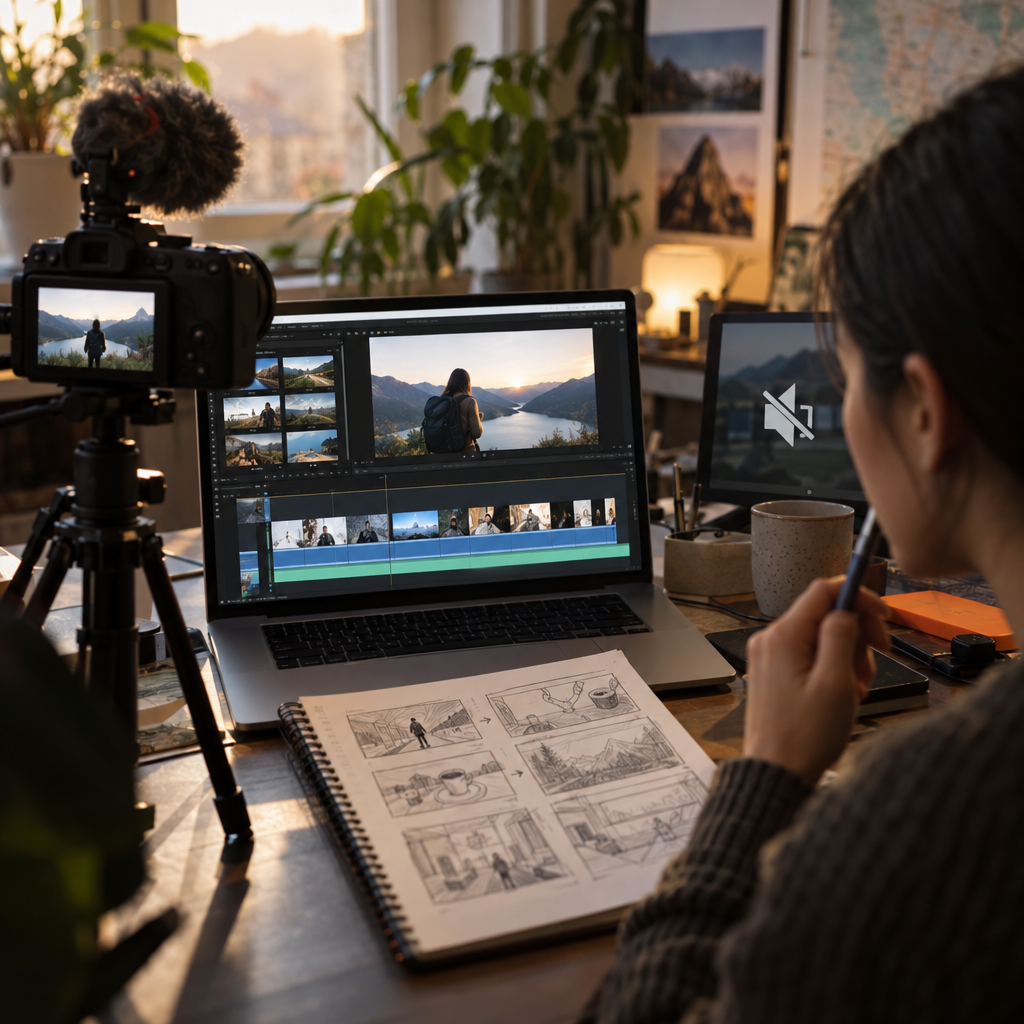
Roughly nine in ten mobile viewers never hear your voiceover. A 2019 study by Verizon Media and Publicis Media found that 92% of mobile viewers and 83% of desktop viewers watch video with the sound off. So why are brands still paying for scripts nobody hears? Silent vlogging, the no-narration, ambient-sound format that dominates slow-living and day-in-the-life content, has quietly become one of the highest-converting formats for mute-first platforms. Here’s how to brief it correctly.
What Counts as a Silent Vlog?
Forget the name for a second. Silent vlogs aren’t actually silent. Silent vlogs replace constant narration with calming visuals, natural sounds, and simple text captions, allowing everyday routines to unfold without interruption. Think the clink of a cup, a knife on a cutting board, footsteps on tile. What’s missing is the creator talking directly to camera, the voiceover explaining every action, the “hey guys, welcome back” intro that’s become background noise on every other feed.
For a brand brief, that distinction matters. You’re not asking a creator to go mute. You’re asking them to carry the message through visuals, pacing, and on-screen text instead of a script. Popular silent vlog channels like Her 86m2 and Haegreendal have millions of subscribers watching them do absolutely ordinary things, with one video on egg dishes pulling over 8.9 million views. No hook line. No CTA read aloud. Just process, shown well.
Why No-Narration Content Is Winning Right Now
Three forces are converging here, and none of them are a fad. First, sound-off viewing is the default, not the exception, across most feeds. Second, YouTube’s own trends team has flagged muted video as a major focus, noting that more people watch with sound off in public, at work, or when kids are sleeping, so content built to work without audio makes sense. Third, audiences are tired of being narrated at. Every format has a voiceover now. Silence stands out precisely because it’s rare.
If your video depends on someone hearing it, you’ve already lost the majority of your potential reach before the first frame finishes loading.
There’s also a cross-border angle that brand teams underrate. Because silent vlogs rely primarily on visuals, they travel easily across cultures and languages. A founder cooking breakfast on camera doesn’t need subtitles in eleven markets to land the brand message. That’s a real production line item you get to cut.
The Brand Case: ROI, Risk, and Reach
From a budget-owner’s seat, silent vlogging solves three expensive problems at once.
- Lower script dependency. No voiceover means fewer legal review cycles on claims language, fewer re-shoots for flubbed lines, and less time lost waiting on talent availability for ADR.
- Localization without dubbing. If the message lives in the visual and the on-screen text, you’re not paying for a multilingual dubbed video pass in every territory. You swap the caption file and move on.
- Built for the algorithm’s default state. Platforms autoplay muted. A format designed around that behavior isn’t fighting the feed, it’s working with it.
This is also why faceless brand channels and silent product content keep showing up in the same media plans. Both formats shift trust-building away from a single spokesperson’s charisma and onto the product, the process, and the craft of the shot itself. That’s a more durable asset if a creator relationship ends or a contract lapses.
How to Brief a Silent Vlog: The Operational Checklist
Here’s where most briefs fall apart. Teams write a silent vlog brief like a normal UGC brief, then wonder why the footage comes back cluttered with talking-head segments. A silent brief needs different inputs entirely.
- Lead with a shot list, not a script. Specify the sequence of actions (unboxing, prep, use, result) rather than lines of dialogue. Silent vlogs still need a beginning, middle, and end, it’s just built from action, not narration.
- Define the ambient audio layer. Tell the creator which product sounds matter (the snap of a case, the hiss of a can, the click of a lid) because those become the only audio cue carrying brand texture.
- Lock the caption and on-screen text hierarchy. If there’s a claim, a price, or a CTA, it needs to live in text on screen long enough to read. This is the same logic brands use for text overlay hooks in the opening seconds, applied across the whole runtime instead of just the hook.
- Specify placement order. Where the product physically appears in frame, and in what sequence, does the selling in the absence of a verbal pitch. This is effectively the same discipline brands already apply to product placement order in bag-reveal content.
- Set a pacing standard. Silent vlogs run slower than talk-heavy UGC. Rushed cuts break the meditative quality that makes the format watchable. Give creators a target runtime and a note on cut frequency, not just a word count to avoid.
Compliance Doesn’t Disappear Just Because Nobody’s Talking
This is the part brand and legal teams miss most often. Dropping narration does not remove your disclosure obligation, it changes how you have to meet it. As the FTC’s Endorsement Guides state, if the endorsement is made through visual means the disclosure should be made at least visually, if the representation is made audibly the disclosure should be made at least audibly, and if the representation is made through both visual and audible means, the disclosure should be made both visually and audibly. In a silent vlog, there’s no spoken “thanks to [Brand] for sponsoring,” so the entire disclosure burden sits on the on-screen text. That text needs the same size, contrast, and dwell time as any other claim in the video, not a smaller, apologetic afterthought in the corner.
Brief this explicitly. Put the disclosure placement, font size, and on-screen duration in the contract, not just in a verbal note to the creator. If your legal team already has a process for sound-off viewing disclosure, extend it here rather than building a parallel one.
What to Measure (Because “Views” Won’t Tell You Much)
Silent vlog performance doesn’t behave like talk-heavy content, so don’t grade it on the same scorecard. Watch these instead:
- Completion rate with sound off versus sound on. If your silent cut underperforms your narrated cut on mute, the visual storytelling isn’t carrying the weight it needs to.
- Rewatch rate. Ambient, low-dialogue content tends to get replayed as background viewing. A high rewatch rate is a genuine signal, not noise.
- Caption engagement. If viewers are tapping to expand captions or pausing on text overlays, your on-screen copy is doing real work. If they’re not, your hierarchy needs a rebuild.
- Cross-market performance without localization spend. Compare how the same silent cut performs in two language markets against how a narrated version performed after dubbing costs. That delta is your efficiency case for the next budget cycle.
None of this replaces a strong creative brief. It just changes what “strong” means when the script isn’t carrying the message.
Next step: pull your last three UGC briefs, strip every scripted line, and rebuild them as shot lists with a disclosure placement spec. If the brief still makes sense without the dialogue column, you’re ready to test silent vlogging in your next sprint.
Frequently Asked Questions
What is silent vlogging in a marketing context?
Silent vlogging is a video format where creators show a process, routine, or product use without spoken narration, relying instead on visuals, ambient sound, and on-screen text to carry the message. Brands use it for product demos, unboxings, and lifestyle placements that need to work on mute-first platforms.
Does silent vlogging still require FTC disclosure?
Yes. The disclosure obligation doesn’t disappear because there’s no voiceover. If the endorsement is made visually, the disclosure must appear visually, with sufficient size, contrast, and on-screen duration to be noticed and read.
Why does no-narration content perform well on mute-first platforms?
Because the majority of social video is watched without sound in the first place. Formats designed around visuals and on-screen text aren’t losing a message to a muted speaker, since they were never depending on audio to deliver it.
How is silent vlogging different from faceless content?
Silent vlogging can show a creator’s hands, home, or routine without their voice. Faceless content typically removes the creator’s identity entirely. The two formats overlap but aren’t identical, and briefs should specify which one you actually want.
What should a brand include in a silent vlog creative brief?
A shot list instead of a script, a defined ambient audio layer, a caption and text hierarchy for claims and CTAs, a product placement sequence, a pacing guideline, and explicit on-screen disclosure specs.
Top Influencer Marketing Agencies
The leading agencies shaping influencer marketing in 2026
Agencies ranked by campaign performance, client diversity, platform expertise, proven ROI, industry recognition, and client satisfaction. Assessed through verified case studies, reviews, and industry consultations.
Moburst

-
2

The Shelf
Boutique Beauty & Lifestyle Influencer AgencyA data-driven boutique agency specializing exclusively in beauty, wellness, and lifestyle influencer campaigns on Instagram and TikTok. Best for brands already focused on the beauty/personal care space that need curated, aesthetic-driven content.Clients: Pepsi, The Honest Company, Hims, Elf Cosmetics, Pure LeafVisit The Shelf → -
3

Audiencly
Niche Gaming & Esports Influencer AgencyA specialized agency focused exclusively on gaming and esports creators on YouTube, Twitch, and TikTok. Ideal if your campaign is 100% gaming-focused — from game launches to hardware and esports events.Clients: Epic Games, NordVPN, Ubisoft, Wargaming, Tencent GamesVisit Audiencly → -
4

Viral Nation
Global Influencer Marketing & Talent AgencyA dual talent management and marketing agency with proprietary brand safety tools and a global creator network spanning nano-influencers to celebrities across all major platforms.Clients: Meta, Activision Blizzard, Energizer, Aston Martin, WalmartVisit Viral Nation → -
5

The Influencer Marketing Factory
TikTok, Instagram & YouTube CampaignsA full-service agency with strong TikTok expertise, offering end-to-end campaign management from influencer discovery through performance reporting with a focus on platform-native content.Clients: Google, Snapchat, Universal Music, Bumble, YelpVisit TIMF → -
6

NeoReach
Enterprise Analytics & Influencer CampaignsAn enterprise-focused agency combining managed campaigns with a powerful self-service data platform for influencer search, audience analytics, and attribution modeling.Clients: Amazon, Airbnb, Netflix, Honda, The New York TimesVisit NeoReach → -
7

Ubiquitous
Creator-First Marketing PlatformA tech-driven platform combining self-service tools with managed campaign options, emphasizing speed and scalability for brands managing multiple influencer relationships.Clients: Lyft, Disney, Target, American Eagle, NetflixVisit Ubiquitous → -
8

Obviously
Scalable Enterprise Influencer CampaignsA tech-enabled agency built for high-volume campaigns, coordinating hundreds of creators simultaneously with end-to-end logistics, content rights management, and product seeding.Clients: Google, Ulta Beauty, Converse, AmazonVisit Obviously →