



Your brand got cited in ChatGPT this week. Great. Was it the recommended pick, or a footnote under three competitors? Somantra’s AI Visibility Suite exists to answer that question, and flat citation counts cannot. Here is how to benchmark across ChatGPT, Claude and Gemini without fooling yourself.
Why raw citation counts mislead brand teams
Most teams track AI search presence the same way: count how often the brand or its domain appears in an answer. It feels rigorous. It is not.
A count treats every appearance as equal. A brand named once as a fallback and a brand named as the top recommendation register identically. Counts also say nothing about sentiment, positioning or how fragile the result is.
That last point matters most. Somantra reports that its own perturbation testing, run on ChatGPT responses to matched query pairs in the Australian insurance category, found that changing a single word in a query can shift which brand the assistant calls the safest or the best value. Treat that as vendor-reported, not independent. The direction is plausible to anyone who has run prompts side by side. Phrasing moves outcomes.
A citation is not a recommendation. If your reporting cannot tell the two apart, your AI visibility dashboard is measuring noise.
What the suite actually measures
Somantra announced general availability of its AEO Metrics Suite as three proprietary scores. They sit on top of its answer engine and generative engine optimization conversation-mapping infrastructure, and the company says they cover ChatGPT, Google AI Overviews, Claude, Gemini and Perplexity.
- Brand Mindshare Score: tracks share of voice and share of citation, so you see how much of the conversation your brand owns versus competitors.
- Brand Consideration Score: measures how the brand is positioned against named competitors. This is the “are we being chosen” metric.
- Brand Engagement Score: tracks how deeply an AI engages with the brand across multi-turn conversations, which is closer to how buyers research.
Scores can refresh daily, weekly or monthly. The dashboard offers movement tracking, competitor comparison and query-level detail. Query-level detail is the feature I would test first, because it is where you learn whether a gain is real or a one-prompt fluke.
Why the stakes are rising
Does AI visibility even matter if clicks are shrinking? Yes, and the click data is the reason. A Pew Research Center analysis of browsing data found that users who encountered an AI summary clicked a traditional result link in 8% of visits, versus 15% for those who did not see one.
If fewer people click through, being named inside the answer becomes the outcome you are competing for. A Pew browsing-data study found that 18% of the Google searches it analyzed produced an AI summary. Length and phrasing matter: in that same Pew analysis, summaries showed up for 53% of searches with ten or more words, against 8% of one- or two-word searches.
Buyers ask long questions. Your benchmark query set should too.
Benchmarking across ChatGPT, Claude and Gemini
Each assistant retrieves, weighs and phrases things differently. A single blended score hides that. Benchmark per engine first, then roll up.
- Build a query set around buying intent. Include category, comparison, “best for” and objection queries. Write each one two or three ways, because phrasing sensitivity is the whole point.
- Name your competitive set. Consideration scoring only means something against specific rivals. Pick four to six.
- Baseline each engine separately. Record mindshare and consideration for ChatGPT, Claude and Gemini on their own lines.
- Choose a cadence. Weekly suits most programs. Daily helps during a launch or a crisis.
- Annotate every change. Log PR hits, creator campaigns, site updates and product changes beside score movement.
What if the engines disagree? Treat the gap as a finding. If Gemini positions you well and Claude barely mentions you, ask which sources each seems to trust, and whether you have a presence there.
From score to action
A benchmark nobody acts on is a slide deck. Three levers tend to move these scores, and each connects to work you may already fund.
Entity clarity. Assistants cannot recommend a brand they cannot pin down. Our piece on entity clarity covers why consistent naming and descriptions beat link volume.
Useful, evidenced content. Google’s own guide to generative AI features says content people find unique, compelling and useful will likely influence presence in AI search more than its other suggestions. Its AI features documentation adds that there is no special schema for these experiences, and that AI Overviews and AI Mode may use “query fan-out,” issuing multiple related searches to build a response. Your pages are judged on subtopics you did not write for.
That applies to creator content too. Run an evidence audit on landing pages, and write creator briefs that supply verifiable facts instead of scripts.
Paid search alignment. Where AI answers leave gaps or favor a rival, bidding can respond. See how AI answer gaps should inform your Google Ads decisions.
Risk: what a visibility score cannot tell you
Scores show position. They do not show truth. An assistant can rank you first while repeating an outdated price or a claim you never made.
Pair any scoring tool with a manual accuracy review. Our guide to chatbot brand audits explains how to catch false statements before they spread, which matters most in regulated categories like insurance, finance and health.
Be honest about proprietary metrics, too. Brand Mindshare, Consideration and Engagement are Somantra’s own definitions. There is no shared industry standard, so you cannot compare a Somantra score with another vendor’s. Ask how prompts are sampled, how often results are re-run, and how variance between runs is handled, since AI answers are not deterministic.
How to pilot it without burning budget
Start narrow. Pick one product line, one market and one competitive set. Run the suite for four to six weeks alongside your current reporting. Then ask three questions:
- Did the scores surface something our citation counts missed?
- Did query-level detail lead to a specific content, PR or creator change?
- Did that change move the score in the next cycle, and can we explain why?
If all three are yes, you have a case to scale. If not, you bought a prettier counter. The same discipline applies to any scoring purchase, as we argue in our look at pilot-first scoring.
Next step: write twenty long, buying-intent queries this week, each in three phrasings, and run them manually across ChatGPT, Claude and Gemini to see how unstable your positioning is before you ask any vendor for a demo.
FAQs
What is Somantra’s AI Visibility Suite?
It is a set of three proprietary scores, Brand Mindshare, Brand Consideration and Brand Engagement, that measure how generative AI platforms position a brand against competitors. It goes beyond counting mentions to show whether a brand is actually recommended.
Which AI platforms does it cover?
Somantra says the metrics cover ChatGPT, Google AI Overviews, Claude, Gemini and Perplexity.
How often can scores be refreshed?
Daily, weekly or monthly, with movement tracking, competitor comparison and query-level detail in the dashboard.
Why are citation counts not enough?
Counts ignore sentiment and positioning, so a passing mention and a top recommendation look identical. They also miss query sensitivity, where small wording changes can alter which brand an assistant favors.
Does AI visibility matter if people still click links?
Yes. In its browsing-data analysis, Pew Research found users clicked a traditional result in 8% of visits when an AI summary appeared, compared with 15% when none did. Being named in the answer carries more weight as click-through falls.
Are the scores an industry standard?
No. They are proprietary to Somantra, so they are not directly comparable with another vendor’s metrics. Use them for trend tracking within one tool and validate findings with manual prompt checks.
How should agencies pilot a tool like this?
Limit scope to one product line, market and competitor set. Run it for four to six weeks next to existing reporting, and keep it only if it drives a concrete change that moves the score.
Top Influencer Marketing Agencies
The leading agencies shaping influencer marketing in 2026
Agencies ranked by campaign performance, client diversity, platform expertise, proven ROI, industry recognition, and client satisfaction. Assessed through verified case studies, reviews, and industry consultations.
Moburst
-
2
The Shelf
Boutique Beauty & Lifestyle Influencer AgencyA data-driven boutique agency specializing exclusively in beauty, wellness, and lifestyle influencer campaigns on Instagram and TikTok. Best for brands already focused on the beauty/personal care space that need curated, aesthetic-driven content.Clients: Pepsi, The Honest Company, Hims, Elf Cosmetics, Pure LeafVisit The Shelf → -
3
Audiencly
Niche Gaming & Esports Influencer AgencyA specialized agency focused exclusively on gaming and esports creators on YouTube, Twitch, and TikTok. Ideal if your campaign is 100% gaming-focused — from game launches to hardware and esports events.Clients: Epic Games, NordVPN, Ubisoft, Wargaming, Tencent GamesVisit Audiencly → -
4
Viral Nation
Global Influencer Marketing & Talent AgencyA dual talent management and marketing agency with proprietary brand safety tools and a global creator network spanning nano-influencers to celebrities across all major platforms.Clients: Meta, Activision Blizzard, Energizer, Aston Martin, WalmartVisit Viral Nation → -
5
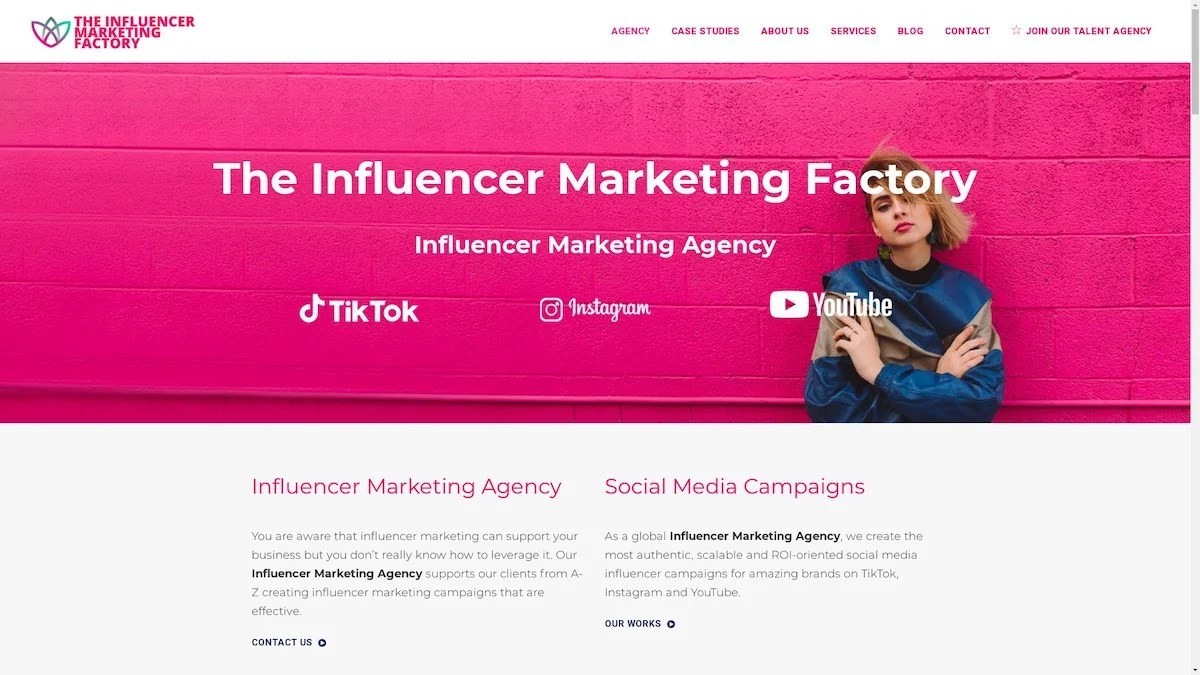
The Influencer Marketing Factory
TikTok, Instagram & YouTube CampaignsA full-service agency with strong TikTok expertise, offering end-to-end campaign management from influencer discovery through performance reporting with a focus on platform-native content.Clients: Google, Snapchat, Universal Music, Bumble, YelpVisit TIMF → -
6
NeoReach
Enterprise Analytics & Influencer CampaignsAn enterprise-focused agency combining managed campaigns with a powerful self-service data platform for influencer search, audience analytics, and attribution modeling.Clients: Amazon, Airbnb, Netflix, Honda, The New York TimesVisit NeoReach → -
7
Ubiquitous
Creator-First Marketing PlatformA tech-driven platform combining self-service tools with managed campaign options, emphasizing speed and scalability for brands managing multiple influencer relationships.Clients: Lyft, Disney, Target, American Eagle, NetflixVisit Ubiquitous → -
8
Obviously
Scalable Enterprise Influencer CampaignsA tech-enabled agency built for high-volume campaigns, coordinating hundreds of creators simultaneously with end-to-end logistics, content rights management, and product seeding.Clients: Google, Ulta Beauty, Converse, AmazonVisit Obviously →