


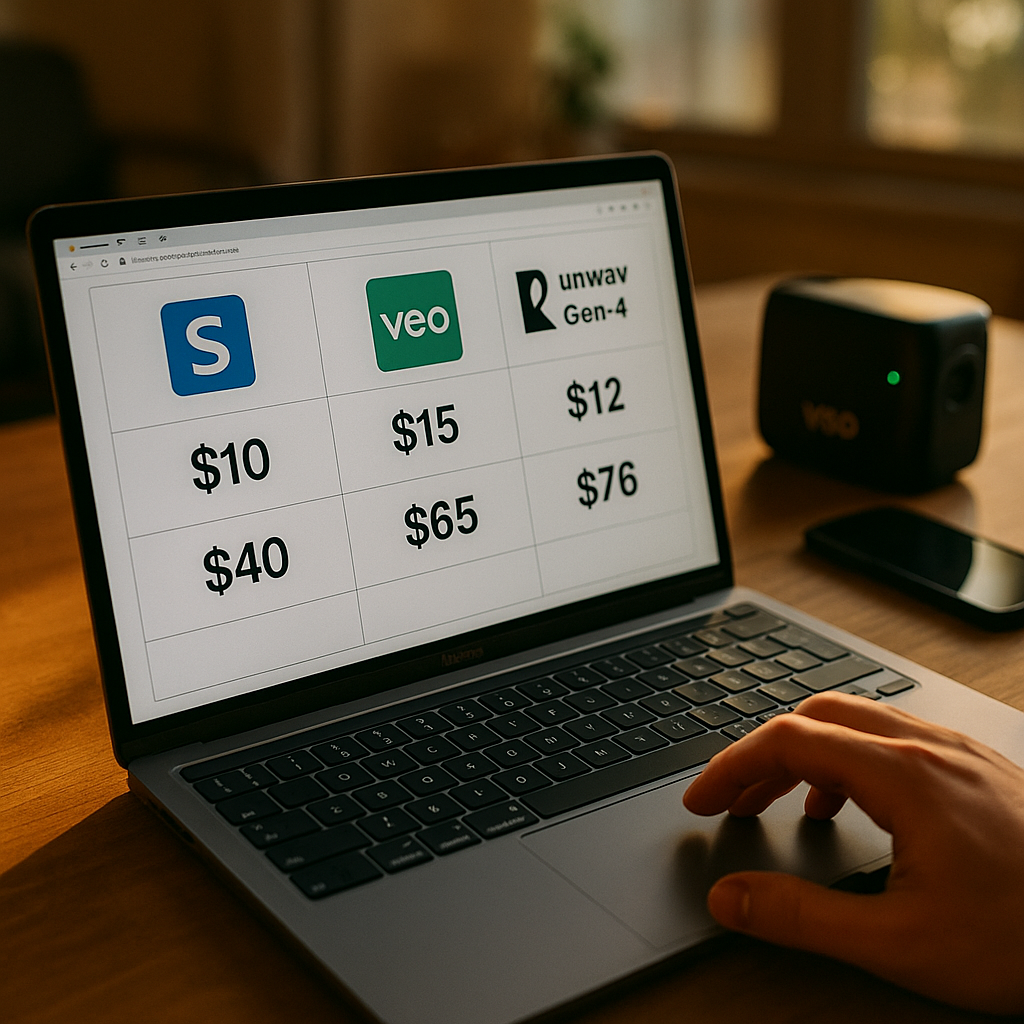
Generate 500 video variants for a single campaign, and the render bill alone can rival a mid-size media buy. That’s the uncomfortable math brand teams are running right now as they weigh AI video generation suites for always-on content production. Sora, Veo 3, and Runway Gen-4 all promise scale. Only one framework actually tells you what scale costs: cost-per-variant.
Marketing leaders love a demo. A slick six-second clip of a product spinning against a synthetic backdrop, generated in ninety seconds, feels like proof the future arrived. But a demo isn’t a production pipeline. If you’re running hundreds of creative variants for paid social testing, localization, or retail media, the question isn’t “can it generate video?” It’s “what does the thousandth variant cost, and can legal sign off on it?”
Why Cost-Per-Variant Beats Cost-Per-Minute
Most vendor pricing pages quote cost-per-minute or cost-per-generation-credit. That’s the wrong unit for brand teams doing iterative creative testing. You’re not buying finished films. You’re buying variants: same core asset, different hooks, different aspect ratios, different CTAs, sometimes different languages.
Cost-per-variant accounts for the real workflow: prompt iteration, failed generations you throw away, upscaling passes, and the compliance review layer that sits on top of every asset before it touches a media buy. A tool that looks cheap per-minute can get expensive fast if it needs five regenerations to hit brand-safe output.
The real cost of AI video isn’t the render. It’s the regeneration loop, the human review, and the rights clearance stacked on top of every usable variant.
Sora: Strong Fidelity, Uneven Unit Economics
OpenAI’s Sora produces some of the most cinematically consistent output on the market. For hero content, brand films, or a single flagship spot, that fidelity matters. The problem for brand teams is variance in generation success rate. Complex prompts involving specific product placement or brand-mandated framing often need multiple passes before output is usable in a paid campaign.
Run the math across a hundred-variant test: if your usable-output rate sits around 60-70% on brand-specific prompts (a range several production teams have reported informally in the current release cycle), your effective cost-per-variant climbs well past the sticker price. Sora also currently leans toward shorter-duration clips as the default sweet spot, which works for social-first campaigns but adds friction if you need 15- or 30-second broadcast-adjacent cuts.
Where Sora earns its keep: top-of-funnel social variants where visual novelty drives engagement more than pixel-perfect brand compliance. Where it strains budgets: high-volume, brand-locked asset production where every frame needs sign-off.
Veo 3: Built for Google’s Ecosystem, Priced Like It
Google’s Veo 3 integrates tightly with YouTube Shorts and Google Ads infrastructure, which is a real operational advantage if your media mix already leans Google-heavy. Native audio generation is a genuine differentiator: Veo 3 produces synchronized dialogue and ambient sound without a separate post-production pass, which shaves time (and vendor fees) off the variant pipeline.
The cost-per-variant story here is more predictable than Sora’s, mainly because Veo 3’s output tends to require fewer regeneration cycles for straightforward product-in-scene prompts. That consistency is worth real money at scale. But predictability comes at a premium: Veo 3 access sits inside Google’s broader AI subscription tiers, and heavy usage can push teams into enterprise pricing brackets faster than expected.
For brand teams already running Performance Max or YouTube-first strategies, Veo 3’s ecosystem lock-in isn’t a bug, it’s the whole pitch. For teams with a fragmented media mix across TikTok, Meta, and CTV, that lock-in adds friction when you need format flexibility.
Runway Gen-4: The Workhorse for Volume Testing
Runway has spent years building for production workflows, not just novelty demos, and Gen-4 shows it. The interface assumes you’re doing iterative variant generation: batch prompting, reference-image consistency across a set, and asset version control are all built in rather than bolted on.
That production-first design shows up directly in cost-per-variant. Runway’s credit-based pricing is granular enough that teams can model spend per campaign with real precision, and its character/object consistency features cut down on wasted regenerations when you need the same product hero across fifty variant permutations.
Gen-4 isn’t the most cinematically stunning of the three. If you’re chasing awards-reel visuals, Sora or Veo 3 may edge it out. But for brand teams running structured A/B and multivariate creative tests, where the goal is statistical signal across many similar-but-distinct assets rather than one perfect hero film, Runway’s economics are the most scale-friendly of the three right now.
The Real Cost Stack Nobody Puts on the Pricing Page
Vendor pricing pages show you the render cost. They don’t show you the rest of the stack:
- Prompt engineering labor: someone on your team (or an agency) is spending hours refining prompts to hit brand voice and visual guidelines.
- Legal and rights review: synthetic actors, voice clones, and likeness questions all need a compliance pass before anything ships, especially with FTC disclosure rules and platform-specific AI-content labeling requirements tightening. Check current guidance at the FTC’s official site before finalizing disclosure language.
- Regeneration waste: the delta between generations attempted and generations approved.
- Post-production cleanup: color grading, brand-safe overlays, captioning for accessibility and platform compliance.
Add those four line items to any vendor’s sticker price and the “cheap” option can flip to the most expensive one in your stack. This is the same trap brand teams fall into with AI creative testing tools broadly: the platform fee is rarely the real cost driver. The workflow around it is.
A Simple Framework for Modeling Cost-Per-Variant
Before you sign an enterprise contract with any of these three, run this math on a pilot batch of at least 50 variants:
- Total spend (platform fees + labor hours × loaded rate) ÷ usable variants shipped = true cost-per-variant.
- Track regeneration rate separately. If it’s above 30%, your prompt library needs work, or the tool isn’t matched to your use case.
- Segment by asset type. Hero content, UGC-style social cuts, and localized variants often have wildly different cost-per-variant even within the same tool.
- Factor in review-cycle time. A tool that’s cheap per-render but slow through legal and brand review isn’t actually saving you money, it’s shifting the cost to your approval pipeline.
That last point matters more than most procurement teams realize. Slow approval loops are a hidden tax on any AI tool, video or otherwise. If you haven’t audited how AI-generated assets move through sign-off, the patterns in AI budget approval workflows are worth reviewing before you scale video generation specifically, since the same bottlenecks apply.
A tool that’s 20% cheaper per render but doubles your regeneration rate isn’t a deal. It’s a slower, costlier pipeline wearing a discount sticker.
Governance Isn’t Optional at Scale
Once you’re generating hundreds of variants a month, governance stops being a legal afterthought and becomes an operational requirement. Who approves synthetic voice usage? How do you track which variants used a real creator’s likeness versus a fully synthetic model? What’s your policy when a platform like TikTok or Meta updates its AI-content disclosure rules mid-quarter?
These aren’t hypotheticals. Platforms are actively tightening labeling requirements for AI-generated and AI-assisted content, and enforcement is inconsistent enough across networks that brand teams need their own internal standard rather than relying on platform defaults. The governance questions here mirror what teams are already navigating with automated ad platforms, and the comparative approach in TikTok Symphony Agent vs Meta Advantage+ governance is a useful model for building an internal AI-video policy, even though it’s written for a different tool category.
Industry data backs up the urgency here. Spend on AI-assisted content creation is climbing fast, and eMarketer’s tracking of AI ad tools shows adoption outpacing internal governance maturity at most brands, meaning a lot of teams are generating first and building policy later. That’s backwards, and it’s exactly the gap regulators and platforms are starting to fill on their own terms.
So Which One Wins on Cost-Per-Variant?
There’s no universal winner, and any vendor comparison claiming one is selling you something. What the math shows:
- Runway Gen-4 currently offers the most predictable, scale-friendly economics for high-volume multivariate testing, largely due to lower regeneration waste and granular credit pricing.
- Veo 3 makes sense if your media mix is Google/YouTube-heavy and you can absorb ecosystem pricing for the audio-generation and consistency gains.
- Sora is strongest for hero-content fidelity but currently carries the highest regeneration risk for brand-locked, compliance-heavy prompts, which drives real cost-per-variant higher than the sticker suggests.
The right call depends on what you’re actually producing. Teams doing rapid-fire social variant testing should weight Runway’s economics heavily. Teams producing fewer, higher-stakes hero assets can justify Sora’s premium. Teams already deep in Google’s ad ecosystem get outsized value from Veo 3’s integration, even at a higher unit cost.
Next Step
Run a 50-variant pilot on your actual brand assets, not vendor demo content, and calculate true cost-per-variant including labor and review time before you commit budget. The vendor that wins your demo rarely wins your P&L.
FAQs
What does “cost-per-variant” mean for AI video generation?
It’s the total cost of producing one usable, approved video asset, including platform fees, prompt engineering labor, failed regenerations, and legal/brand review time, divided by the number of variants that actually ship in a campaign.
Is Runway Gen-4 cheaper than Sora and Veo 3 at scale?
On raw platform pricing it depends on usage tier, but Runway Gen-4 tends to produce a lower effective cost-per-variant for high-volume multivariate testing because of lower regeneration waste and more granular credit-based pricing.
Do I need to disclose AI-generated video in ads?
Increasingly, yes. Platform policies and regulatory guidance around synthetic media disclosure are tightening. Check current FTC guidance and each platform’s ad policy before launching AI-generated creative at scale.
How many variants should a pilot test include before committing budget?
At least 50 variants across your actual brand asset library, not vendor demo content, gives you a reliable enough sample to calculate true cost-per-variant and regeneration rates.
Which tool is best for hero content versus high-volume testing?
Sora currently leads on cinematic fidelity for hero/flagship content. Runway Gen-4 is better suited to high-volume, multivariate testing where consistency and cost predictability matter more than peak visual polish. Veo 3 fits teams already invested in Google’s ad ecosystem.
FAQs
What does “cost-per-variant” mean for AI video generation?
It’s the total cost of producing one usable, approved video asset, including platform fees, prompt engineering labor, failed regenerations, and legal/brand review time, divided by the number of variants that actually ship in a campaign.
Is Runway Gen-4 cheaper than Sora and Veo 3 at scale?
On raw platform pricing it depends on usage tier, but Runway Gen-4 tends to produce a lower effective cost-per-variant for high-volume multivariate testing because of lower regeneration waste and more granular credit-based pricing.
Do I need to disclose AI-generated video in ads?
Increasingly, yes. Platform policies and regulatory guidance around synthetic media disclosure are tightening. Check current FTC guidance and each platform’s ad policy before launching AI-generated creative at scale.
How many variants should a pilot test include before committing budget?
At least 50 variants across your actual brand asset library, not vendor demo content, gives you a reliable enough sample to calculate true cost-per-variant and regeneration rates.
Which tool is best for hero content versus high-volume testing?
Sora currently leads on cinematic fidelity for hero/flagship content. Runway Gen-4 is better suited to high-volume, multivariate testing where consistency and cost predictability matter more than peak visual polish. Veo 3 fits teams already invested in Google’s ad ecosystem.
Top Influencer Marketing Agencies
The leading agencies shaping influencer marketing in 2026
Agencies ranked by campaign performance, client diversity, platform expertise, proven ROI, industry recognition, and client satisfaction. Assessed through verified case studies, reviews, and industry consultations.
Moburst

-
2

The Shelf
Boutique Beauty & Lifestyle Influencer AgencyA data-driven boutique agency specializing exclusively in beauty, wellness, and lifestyle influencer campaigns on Instagram and TikTok. Best for brands already focused on the beauty/personal care space that need curated, aesthetic-driven content.Clients: Pepsi, The Honest Company, Hims, Elf Cosmetics, Pure LeafVisit The Shelf → -
3

Audiencly
Niche Gaming & Esports Influencer AgencyA specialized agency focused exclusively on gaming and esports creators on YouTube, Twitch, and TikTok. Ideal if your campaign is 100% gaming-focused — from game launches to hardware and esports events.Clients: Epic Games, NordVPN, Ubisoft, Wargaming, Tencent GamesVisit Audiencly → -
4

Viral Nation
Global Influencer Marketing & Talent AgencyA dual talent management and marketing agency with proprietary brand safety tools and a global creator network spanning nano-influencers to celebrities across all major platforms.Clients: Meta, Activision Blizzard, Energizer, Aston Martin, WalmartVisit Viral Nation → -
5

The Influencer Marketing Factory
TikTok, Instagram & YouTube CampaignsA full-service agency with strong TikTok expertise, offering end-to-end campaign management from influencer discovery through performance reporting with a focus on platform-native content.Clients: Google, Snapchat, Universal Music, Bumble, YelpVisit TIMF → -
6

NeoReach
Enterprise Analytics & Influencer CampaignsAn enterprise-focused agency combining managed campaigns with a powerful self-service data platform for influencer search, audience analytics, and attribution modeling.Clients: Amazon, Airbnb, Netflix, Honda, The New York TimesVisit NeoReach → -
7

Ubiquitous
Creator-First Marketing PlatformA tech-driven platform combining self-service tools with managed campaign options, emphasizing speed and scalability for brands managing multiple influencer relationships.Clients: Lyft, Disney, Target, American Eagle, NetflixVisit Ubiquitous → -
8

Obviously
Scalable Enterprise Influencer CampaignsA tech-enabled agency built for high-volume campaigns, coordinating hundreds of creators simultaneously with end-to-end logistics, content rights management, and product seeding.Clients: Google, Ulta Beauty, Converse, AmazonVisit Obviously →