


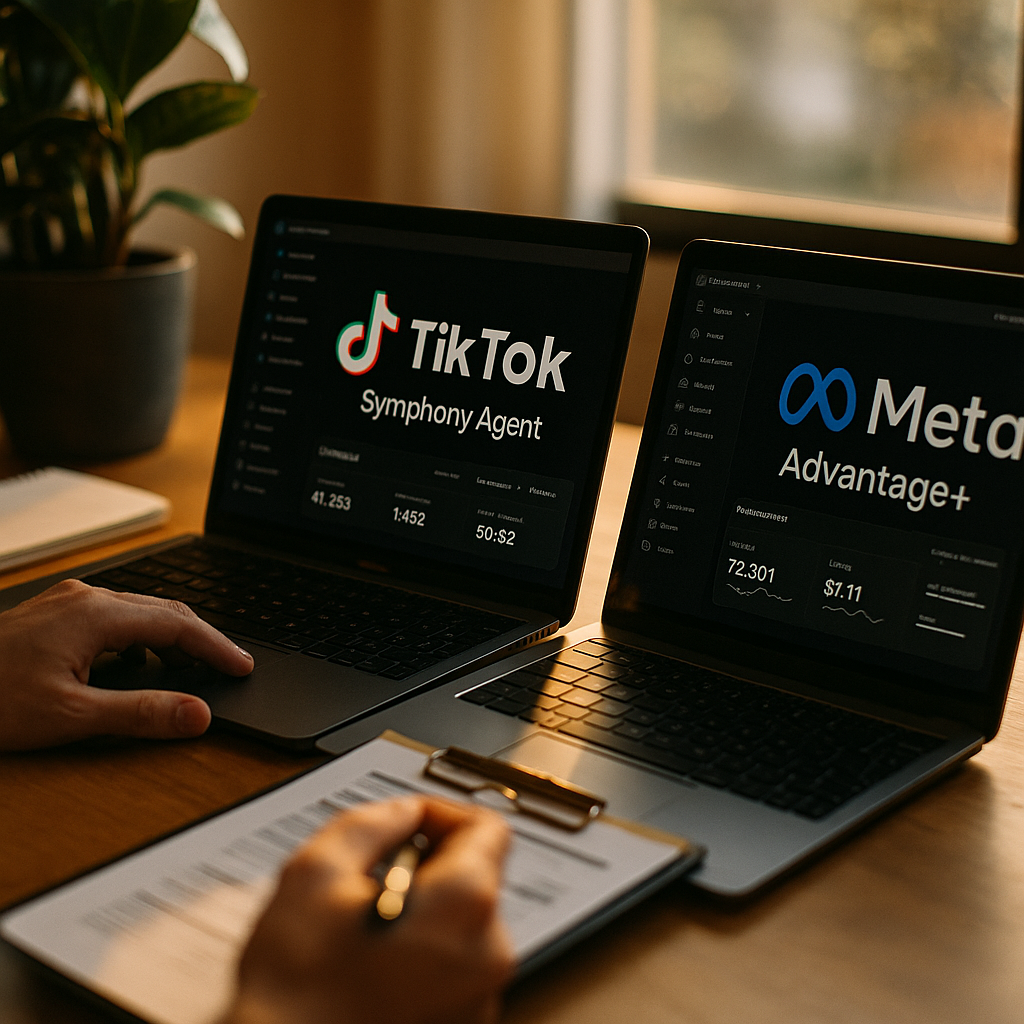
Two of the biggest walled gardens now let AI agents pick your creators, write your briefs, and optimize your spend with minimal human sign-off. That should terrify anyone who owns brand safety. The TikTok Symphony Agent vs Meta Advantage+ question isn’t academic — it’s a live budget decision facing marketers right now, and most teams are approving these tools faster than they’re building governance around them.
Both platforms promise the same thing: less manual work, more automated matching between brands and creator-adjacent content. But the mechanics, the guardrails, and the failure modes are different enough that treating them as interchangeable is a mistake. Let’s break down what each actually does, where the risk sits, and how a brand buyer should structure approval before signing off on either.
What Each Platform Actually Automates
TikTok Symphony Agent is TikTok’s generative AI suite, expanded well beyond its original video-editing roots. It now handles script generation, creator-style content variations, automated dubbing, and — critically for this comparison — creative matching that pulls stylistic cues from top-performing creator content to inform ad creative. It doesn’t hire creators directly in the way a marketplace does, but it increasingly blurs the line between “creator content” and “AI-generated content styled like a creator.”
Meta Advantage+ takes a different route. It’s fundamentally a media-buying and creative-optimization engine that spans Instagram and Facebook, automating audience targeting, budget allocation, and creative combination testing. Its creator-adjacent function shows up mainly through Partnership Ads, where brands feed in creator-produced assets and let Advantage+ decide which combinations of creator content, copy, and audience get the spend. Meta isn’t generating creator-style content from scratch the way Symphony can — it’s optimizing distribution of content creators already made.
That distinction matters more than it sounds. One platform is generating synthetic creative influenced by creator aesthetics. The other is algorithmically amplifying real creator-made assets. The governance questions for each are not the same.
Governance: Where the Real Difference Lives
Ask any procurement or legal team what worries them about AI-driven creative tools, and you’ll hear some version of: who approved this, and can we prove it? That’s the governance gap both platforms leave open, just in different places.
Symphony Agent’s risk sits upstream, at generation. If the tool is drawing stylistic inspiration from trending creator content to build ad variations, brands need clarity on rights and attribution. TikTok has stated its tools are designed to avoid direct replication of individual creator likeness or copyrighted material, but “stylistic inspiration” is a gray zone that hasn’t been fully tested legally. Brand and agency legal teams should treat any Symphony-generated asset that resembles an identifiable creator style as a flag for manual review, not an automatic green light.
The platforms with the fastest automation often have the thinnest audit trail — and audit trail is exactly what compliance teams ask for first when a campaign gets flagged.
Advantage+’s risk sits downstream, at distribution. Because it’s optimizing real creator content across audiences, the governance question becomes: does the creator’s original disclosure and usage agreement cover algorithmic redistribution at this scale? A creator who agreed to a single sponsored post didn’t necessarily agree to their likeness being tested across dozens of audience segments and creative permutations by an automated system. This is an FTC disclosure question as much as a contractual one — the FTC’s endorsement guidance doesn’t distinguish between human-placed media and algorithmically distributed media. Disclosure obligations travel with the content, not the buying mechanism.
Feature Comparison, Side by Side
- Creative origination: Symphony Agent generates and edits creative, including creator-style scripts and voiceovers. Advantage+ optimizes creative combinations but doesn’t generate original creator-style content.
- Targeting logic: Advantage+ has the deeper audience automation, pulling from Meta’s broader ad-targeting stack. Symphony’s targeting is comparatively newer and more tied to TikTok’s content-recommendation signals than classic demographic targeting.
- Human-in-the-loop controls: Both allow manual override, but default settings on both platforms favor full automation unless a buyer actively restricts it. Read that twice — the defaults are not conservative.
- Creator consent handling: Neither platform has a robust native system for tracking whether a specific creator’s usage rights extend to AI-remixed or algorithmically amplified versions of their content. This still lives in brand-side contract management.
- Reporting granularity: Advantage+ reporting is generally more mature, given Meta’s longer runway with automated campaign tools. Symphony’s reporting is improving but lags on creator-level attribution specificity.
None of this means one platform is “safer” than the other in absolute terms. It means the risk profile is different, and your governance checklist needs to reflect that difference rather than applying a single generic AI-vendor questionnaire to both.
Budget Approval Is Where This Gets Real
Here’s the uncomfortable part. Most brands are approving budget for these tools through the same fast-track process used for standard media buys, without a distinct risk review for the AI layer. That’s backwards. A platform that can autonomously generate creative or reallocate spend across creator-adjacent content needs a different sign-off path than a standard media insertion order.
Teams that have built structured AI budget approval workflows are catching this earlier — flagging when a tool’s automation level crosses from “optimization” into “unsupervised creative decision-making” and routing those cases to legal or brand safety review before spend goes live. If your approval chain doesn’t distinguish between the two, you’re not actually managing the risk, you’re just hoping it doesn’t surface. Our AI budget approval workflows breakdown covers how to structure that gate without adding weeks to campaign timelines.
Brand Adjacency: The Question Nobody’s Asking Loudly Enough
Both platforms place your brand next to content you didn’t personally vet — that’s the entire premise of creator-adjacent buying. Symphony Agent’s creative-matching function pulls stylistic cues from trending content categories, some of which may sit near creators or topics your brand safety policy would otherwise exclude. Advantage+’s Partnership Ads distribute creator content across placements your team may not individually review before it goes live at scale.
This is where third-party adjacency scoring earns its keep. Tools like Zefr, DoubleVerify, and IAS exist precisely because platform-native safety controls weren’t built with AI-driven creative matching in mind — they were built for static placement decisions. If you’re running Symphony or Advantage+ at meaningful scale, pairing it with independent adjacency measurement isn’t optional anymore, it’s table stakes. Our brand adjacency scoring comparison walks through how these tools differ on creator-content coverage specifically.
Attribution and CRM Sync: The Part Buyers Underestimate
Automated creative testing generates a lot of variants fast. That’s the selling point. But if your CRM or attribution stack can’t tie a specific Symphony-generated variant or an Advantage+ creative combination back to a conversion event at the creator level, you’re optimizing blind on the metric that actually justifies the spend to finance.
This is less a TikTok-versus-Meta problem and more a martech integration problem. Teams running creator-to-CRM attribution setups tend to catch mismatches early — a Symphony-generated ad performing well on platform-reported metrics but showing weak CRM-verified conversion, for example. Advantage+’s reporting integrates more cleanly with Meta’s own attribution tools, but that’s exactly the trap: platform-reported success and business-verified success aren’t always the same number, and Meta has every incentive to report the former favorably.
So Which One Should You Actually Use?
Wrong question, honestly. These platforms serve different functions well enough that most mid-to-large brands running creator-adjacent programs will end up using both, just for different jobs.
Use Symphony Agent when you need fast creative iteration, especially for markets or verticals where hiring dozens of individual creators isn’t cost-effective, and where AI-styled creative can plausibly substitute for a broader creator roster. Keep manual review on anything that resembles a specific known creator’s style or voice, and get legal sign-off on your usage rights language before scaling it.
Use Advantage+ when you already have creator-produced assets and need to find the highest-performing combination of that content across Meta’s audience base without manually building a hundred ad sets. Lock down your creator contracts to explicitly cover algorithmic redistribution before you turn Partnership Ads loose at scale, and don’t skip the adjacency and attribution layers just because Meta’s dashboard looks tidy.
The platforms aren’t the risk. Unmanaged defaults are.
Frequently Asked Questions
Does TikTok Symphony Agent replace the need for human creators?
No. It generates creative variations and can style content to resemble creator aesthetics, but brands running serious creator programs still need real creators for authenticity, community trust, and platform algorithm favor toward organic-feeling content. Symphony is a supplement for speed and scale, not a replacement for creator relationships.
Can Meta Advantage+ run campaigns using creator content without the creator’s ongoing approval?
Once a creator grants usage rights through Partnership Ads, Advantage+ can algorithmically test and distribute that content across audiences without further per-placement creator approval. This is exactly why usage rights language in creator contracts needs to explicitly address algorithmic redistribution, not just standard sponsored placement.
How do brand safety teams monitor content they didn’t manually approve?
Most rely on third-party adjacency and brand safety scoring tools that sit outside the ad platform, scanning placements and flagging risk in near real time. Native platform controls typically aren’t granular enough for creator-adjacent automated campaigns at scale.
Is there a legal risk in using AI-generated content styled after a specific creator’s aesthetic?
It’s an evolving area. Direct replication of a specific creator’s likeness or copyrighted material carries clear risk. Broader stylistic inspiration is murkier and hasn’t been fully tested in court, so conservative brands are applying manual review to anything that could plausibly be mistaken for a specific creator’s work.
How should budget approval differ for AI-driven creative tools versus standard media buys?
AI tools that autonomously generate creative or reallocate spend without human review at each step should route through a distinct approval gate involving legal and brand safety, not just the standard media insertion order process. The distinguishing factor is whether the tool is making unsupervised creative or targeting decisions.
The Next Step
Don’t approve either platform through your standard media-buy workflow. Build a separate governance gate — legal review for usage rights, adjacency scoring for placement risk, and CRM-verified attribution for actual ROI proof — before scaling spend on either Symphony Agent or Advantage+.
Frequently Asked Questions
Does TikTok Symphony Agent replace the need for human creators?
No. It generates creative variations and can style content to resemble creator aesthetics, but brands running serious creator programs still need real creators for authenticity, community trust, and platform algorithm favor toward organic-feeling content. Symphony is a supplement for speed and scale, not a replacement for creator relationships.
Can Meta Advantage+ run campaigns using creator content without the creator’s ongoing approval?
Once a creator grants usage rights through Partnership Ads, Advantage+ can algorithmically test and distribute that content across audiences without further per-placement creator approval. This is exactly why usage rights language in creator contracts needs to explicitly address algorithmic redistribution, not just standard sponsored placement.
How do brand safety teams monitor content they didn’t manually approve?
Most rely on third-party adjacency and brand safety scoring tools that sit outside the ad platform, scanning placements and flagging risk in near real time. Native platform controls typically aren’t granular enough for creator-adjacent automated campaigns at scale.
Is there a legal risk in using AI-generated content styled after a specific creator’s aesthetic?
It’s an evolving area. Direct replication of a specific creator’s likeness or copyrighted material carries clear risk. Broader stylistic inspiration is murkier and hasn’t been fully tested in court, so conservative brands are applying manual review to anything that could plausibly be mistaken for a specific creator’s work.
How should budget approval differ for AI-driven creative tools versus standard media buys?
AI tools that autonomously generate creative or reallocate spend without human review at each step should route through a distinct approval gate involving legal and brand safety, not just the standard media insertion order process. The distinguishing factor is whether the tool is making unsupervised creative or targeting decisions.
Top Influencer Marketing Agencies
The leading agencies shaping influencer marketing in 2026
Agencies ranked by campaign performance, client diversity, platform expertise, proven ROI, industry recognition, and client satisfaction. Assessed through verified case studies, reviews, and industry consultations.
Moburst

-
2

The Shelf
Boutique Beauty & Lifestyle Influencer AgencyA data-driven boutique agency specializing exclusively in beauty, wellness, and lifestyle influencer campaigns on Instagram and TikTok. Best for brands already focused on the beauty/personal care space that need curated, aesthetic-driven content.Clients: Pepsi, The Honest Company, Hims, Elf Cosmetics, Pure LeafVisit The Shelf → -
3

Audiencly
Niche Gaming & Esports Influencer AgencyA specialized agency focused exclusively on gaming and esports creators on YouTube, Twitch, and TikTok. Ideal if your campaign is 100% gaming-focused — from game launches to hardware and esports events.Clients: Epic Games, NordVPN, Ubisoft, Wargaming, Tencent GamesVisit Audiencly → -
4

Viral Nation
Global Influencer Marketing & Talent AgencyA dual talent management and marketing agency with proprietary brand safety tools and a global creator network spanning nano-influencers to celebrities across all major platforms.Clients: Meta, Activision Blizzard, Energizer, Aston Martin, WalmartVisit Viral Nation → -
5

The Influencer Marketing Factory
TikTok, Instagram & YouTube CampaignsA full-service agency with strong TikTok expertise, offering end-to-end campaign management from influencer discovery through performance reporting with a focus on platform-native content.Clients: Google, Snapchat, Universal Music, Bumble, YelpVisit TIMF → -
6

NeoReach
Enterprise Analytics & Influencer CampaignsAn enterprise-focused agency combining managed campaigns with a powerful self-service data platform for influencer search, audience analytics, and attribution modeling.Clients: Amazon, Airbnb, Netflix, Honda, The New York TimesVisit NeoReach → -
7

Ubiquitous
Creator-First Marketing PlatformA tech-driven platform combining self-service tools with managed campaign options, emphasizing speed and scalability for brands managing multiple influencer relationships.Clients: Lyft, Disney, Target, American Eagle, NetflixVisit Ubiquitous → -
8

Obviously
Scalable Enterprise Influencer CampaignsA tech-enabled agency built for high-volume campaigns, coordinating hundreds of creators simultaneously with end-to-end logistics, content rights management, and product seeding.Clients: Google, Ulta Beauty, Converse, AmazonVisit Obviously →