


Generate 50 video ad variants overnight for less than the cost of one traditional shoot? That’s the pitch behind every generative video ad platform on the market right now. But the marketing decks never mention render failures, regeneration costs, or the hours your creative team spends fixing a hand that turns into a claw mid-scan. Let’s talk real numbers.
E-commerce brands running dynamic creative at scale don’t care which tool makes the prettiest demo reel. They care about cost per usable variant, turnaround time, and whether the output survives a platform’s ad review process. So we ran the math on Sora, Veo 3, and Runway Gen-4 the way a media buyer would: dollars per deployable asset, not dollars per generation.
Why Cost-Per-Variant Beats Cost-Per-Generation
Every platform advertises a price per second or per clip. That number is almost useless on its own. A $2 generation that gets rejected by TikTok’s ad policy team, or that renders a product label with garbled text, costs you nothing in cash but plenty in time. The real metric is cost per usable variant: total spend divided by the number of clips that actually go live in an ad set.
This matters more for e-commerce than almost any other vertical. Product-focused brands need SKU-level accuracy, consistent packaging, and no hallucinated claims about ingredients or specs. A stunning generative clip that shows the wrong bottle cap isn’t an asset. It’s a liability, and potentially a compliance problem if the ad ships before someone catches it. If you haven’t audited your creative pipeline for this kind of drift, the AI hallucination audit framework is a good starting point before you scale any of these tools.
The platform with the lowest sticker price often has the highest cost per usable variant once you factor in regeneration rates and manual QA time.
Sora: Strong on Realism, Expensive on Iteration
OpenAI’s Sora produces some of the most photorealistic motion available in generative video right now. Lighting, reflections, fabric movement — it handles the physics of a product shot better than most competitors. For lifestyle-style e-commerce ads (someone unboxing a skincare set, a shoe walking through rain), Sora’s output often needs the least retouching.
The catch is regeneration cost. Sora’s pricing tiers scale with resolution and duration, and getting a clean 15-second clip with accurate product placement frequently takes three to five attempts. Teams running high-volume SKU testing report effective costs landing around $4 to $7 per usable variant once failed generations are priced in, higher if brand guidelines require strict logo and label fidelity. That’s workable for hero creative. It’s expensive if you’re trying to generate 200 variants for a dynamic creative optimization test.
Sora also still struggles with dense on-screen text, which matters for e-commerce ads that lean on price callouts or limited-time offers. Expect to composite text overlays in post rather than trusting native generation, which adds a production step most cost comparisons conveniently leave out.
Veo 3: Google’s Speed Play
Veo 3 is built for volume. Google has clearly optimized for throughput and integration with its own ad ecosystem, and it shows in generation speed: clips render noticeably faster than Sora’s, and batch generation across multiple product angles is smoother. For brands already running Performance Max or Demand Gen campaigns, Veo 3’s native compatibility with Google’s ad tools cuts a meaningful chunk of the production-to-deployment pipeline.
Cost per usable variant tends to land lower than Sora’s, typically in the $2 to $4 range for standard e-commerce formats like product-in-use demos or short vertical ads. The tradeoff is visual polish. Veo 3 output can look slightly more synthetic under close inspection, especially with reflective surfaces or complex textures like knit fabric. For top-of-funnel prospecting ads where scroll-stopping matters more than pixel-perfect realism, that’s a fair trade. For premium or luxury e-commerce brands where visual craft is the entire value proposition, it’s a harder sell.
Veo 3 also integrates reasonably well with Google’s broader AI ad tooling, which is worth considering if your team is already deep into automated media buying. That said, automation doesn’t remove the need for human review. The findings in Google’s Ask Ad Manager retrospective apply just as much to generative video approvals as they do to bidding decisions.
Runway Gen-4: The Control Freak’s Choice
Runway has built its reputation on granular creative control, and Gen-4 continues that pattern. Motion brushes, camera path controls, reference-image conditioning — it’s the platform most likely to let your creative team dial in an exact look rather than accepting whatever the model decides. For brands with strict brand guidelines (exact product colorways, specific camera angles matching existing catalog photography), that control translates into fewer wasted generations.
The pricing structure runs on credits, and heavy users report the most predictable cost-per-variant of the three platforms once workflows are dialed in, often in the $3 to $5 range. The learning curve is steeper, though. Teams new to Gen-4’s tooling burn through credits during the ramp-up period before efficiency kicks in. Budget for a slower first month.
Runway also holds an edge for brands doing SKU-level testing across large catalogs, since its conditioning tools make it easier to swap a single product into a consistent scene template. That pairs naturally with SKU-level dynamic creative optimization strategies where you need dozens of near-identical variants differing only in product.
The Numbers, Side by Side
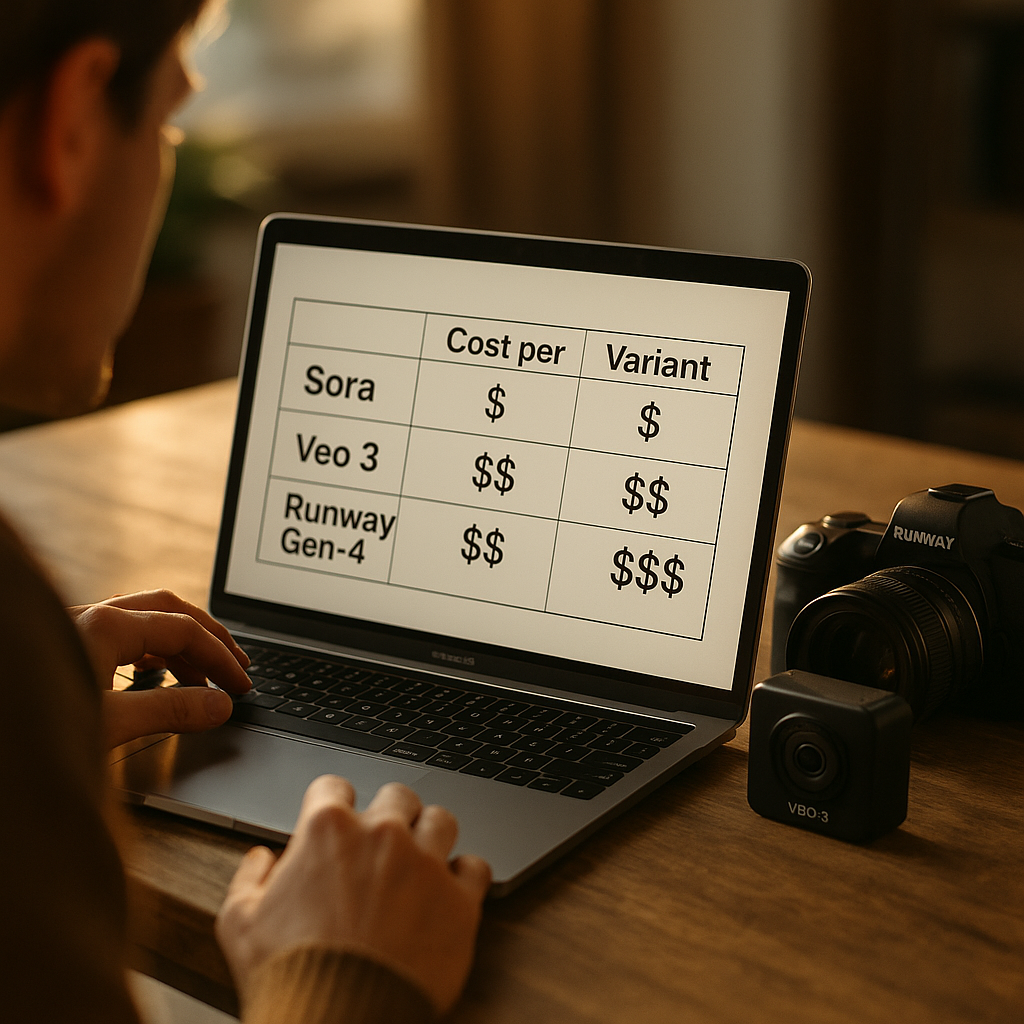
- Sora: highest realism, highest cost per usable variant ($4-$7), best for hero/brand campaigns, weak on text overlays.
- Veo 3: fastest turnaround, lowest cost per variant ($2-$4), best for prospecting volume, native Google Ads integration.
- Runway Gen-4: most creative control, mid-range cost ($3-$5), best for SKU-level catalog testing, steepest learning curve.
None of these numbers account for the human layer: someone still has to review every clip for brand safety, factual accuracy, and platform policy compliance before it ships. Skip that step and you’re one hallucinated product claim away from a takedown, or worse, an FTC inquiry. The FTC’s guidance on advertising substantiation doesn’t carve out exceptions for AI-generated content, and it shouldn’t.
Budgeting the Real Rollout
Say you’re testing 100 variants a month across three product lines. On paper, Veo 3 looks like the clear winner on cost. But if your brand sells premium goods where visual fidelity drives conversion, the cheaper variant that underperforms on click-through rate isn’t actually cheaper. Run the math on cost per acquired customer, not just cost per clip.
A practical approach: use Veo 3 or a similar fast, low-cost tool for top-of-funnel volume testing where you’re hunting for a winning hook or angle. Once you find a concept that performs, migrate it to Runway Gen-4 or Sora for a polished version to run at scale in retargeting and conversion campaigns. This tiered approach mirrors how smart teams are already reallocating generative video ad budgets away from one-tool-does-everything thinking.
Treat cheap generative tools as your testing layer and premium tools as your scaling layer. Blending both stages typically cuts total campaign creative spend by 30-40% compared to producing everything in one platform.
Don’t forget the compliance layer either. Platforms like TikTok and Meta are tightening disclosure requirements around AI-generated ad content, and generative video that features synthetic people or voices may trigger additional labeling requirements. Cross-reference your creative workflow against your TikTok Ads policies and Meta’s ad standards before scaling any single tool company-wide.
What About Synthetic Presenters?
If your e-commerce ads lean on a talking-head format, none of these three platforms are purpose-built for that use case the way dedicated synthetic presenter tools are. Sora, Veo 3, and Gen-4 are strongest for product-in-scene and lifestyle b-roll, not lip-synced spokesperson content. If avatar-led ads are part of your mix, it’s worth reviewing the enterprise vetting guide for synthetic presenter platforms separately, since the vendor landscape and risk profile differ substantially.
Industry data backs up the shift toward blended workflows. Recent eMarketer research on generative ad tooling shows brands increasingly running multi-platform creative stacks rather than standardizing on one generative video vendor, largely because no single tool wins on cost, quality, and compliance simultaneously. That tracks with what we’re seeing in cost-per-variant testing across all three platforms covered here.
Where This Leaves Your Team
There’s no universal winner. Sora wins on polish, Veo 3 wins on speed and cost, Runway Gen-4 wins on control. The right stack depends on your funnel stage, product category, and how much creative review capacity your team actually has. Building that review capacity matters as much as picking a platform: check out how other teams are sequencing AI tools into existing marketing workflows without creating governance gaps.
Run a two-week pilot with all three on a single product line before committing budget anywhere. Track cost per usable variant, not cost per generation, and you’ll know within 50 clips which platform actually earns a place in your stack.
FAQs
What is cost per usable variant and why does it matter more than list pricing?
Cost per usable variant is total generation spend divided by the number of clips that pass brand and compliance review and actually get deployed in a live ad set. It matters more than list pricing because failed generations, regenerations, and manual fixes add hidden costs that per-second pricing doesn’t reflect.
Which platform is cheapest for high-volume e-commerce testing?
Veo 3 generally produces the lowest cost per usable variant for high-volume, top-of-funnel testing, typically in the $2 to $4 range, thanks to faster render times and fewer regenerations needed for simpler product-in-use clips.
Is Sora worth the higher cost for e-commerce brands?
Sora’s higher cost per variant is justified for hero and brand campaigns where visual realism directly affects conversion, such as premium product or lifestyle ads. It’s harder to justify for high-volume prospecting where speed and iteration matter more than polish.
Do generative video ads need AI disclosure labels?
Increasingly, yes. Major ad platforms are tightening policies around AI-generated and synthetic content disclosure. Brands should review current TikTok and Meta ad policies before scaling generative video campaigns to avoid compliance issues.
Can these platforms handle SKU-level product accuracy at scale?
Runway Gen-4 currently has the strongest tooling for consistent SKU-level accuracy across large product catalogs, thanks to reference-image conditioning. Sora and Veo 3 can handle it but typically require more regeneration attempts to maintain label and color accuracy.
Should a brand pick one generative video platform or use multiple?
Most brands running serious volume benefit from a tiered approach: cheaper, faster tools for testing concepts, and higher-fidelity tools for scaling winning creative. Standardizing on a single platform rarely optimizes for both cost and quality simultaneously.
Top Influencer Marketing Agencies
The leading agencies shaping influencer marketing in 2026
Agencies ranked by campaign performance, client diversity, platform expertise, proven ROI, industry recognition, and client satisfaction. Assessed through verified case studies, reviews, and industry consultations.
Moburst

-
2

The Shelf
Boutique Beauty & Lifestyle Influencer AgencyA data-driven boutique agency specializing exclusively in beauty, wellness, and lifestyle influencer campaigns on Instagram and TikTok. Best for brands already focused on the beauty/personal care space that need curated, aesthetic-driven content.Clients: Pepsi, The Honest Company, Hims, Elf Cosmetics, Pure LeafVisit The Shelf → -
3

Audiencly
Niche Gaming & Esports Influencer AgencyA specialized agency focused exclusively on gaming and esports creators on YouTube, Twitch, and TikTok. Ideal if your campaign is 100% gaming-focused — from game launches to hardware and esports events.Clients: Epic Games, NordVPN, Ubisoft, Wargaming, Tencent GamesVisit Audiencly → -
4

Viral Nation
Global Influencer Marketing & Talent AgencyA dual talent management and marketing agency with proprietary brand safety tools and a global creator network spanning nano-influencers to celebrities across all major platforms.Clients: Meta, Activision Blizzard, Energizer, Aston Martin, WalmartVisit Viral Nation → -
5

The Influencer Marketing Factory
TikTok, Instagram & YouTube CampaignsA full-service agency with strong TikTok expertise, offering end-to-end campaign management from influencer discovery through performance reporting with a focus on platform-native content.Clients: Google, Snapchat, Universal Music, Bumble, YelpVisit TIMF → -
6

NeoReach
Enterprise Analytics & Influencer CampaignsAn enterprise-focused agency combining managed campaigns with a powerful self-service data platform for influencer search, audience analytics, and attribution modeling.Clients: Amazon, Airbnb, Netflix, Honda, The New York TimesVisit NeoReach → -
7

Ubiquitous
Creator-First Marketing PlatformA tech-driven platform combining self-service tools with managed campaign options, emphasizing speed and scalability for brands managing multiple influencer relationships.Clients: Lyft, Disney, Target, American Eagle, NetflixVisit Ubiquitous → -
8

Obviously
Scalable Enterprise Influencer CampaignsA tech-enabled agency built for high-volume campaigns, coordinating hundreds of creators simultaneously with end-to-end logistics, content rights management, and product seeding.Clients: Google, Ulta Beauty, Converse, AmazonVisit Obviously →