


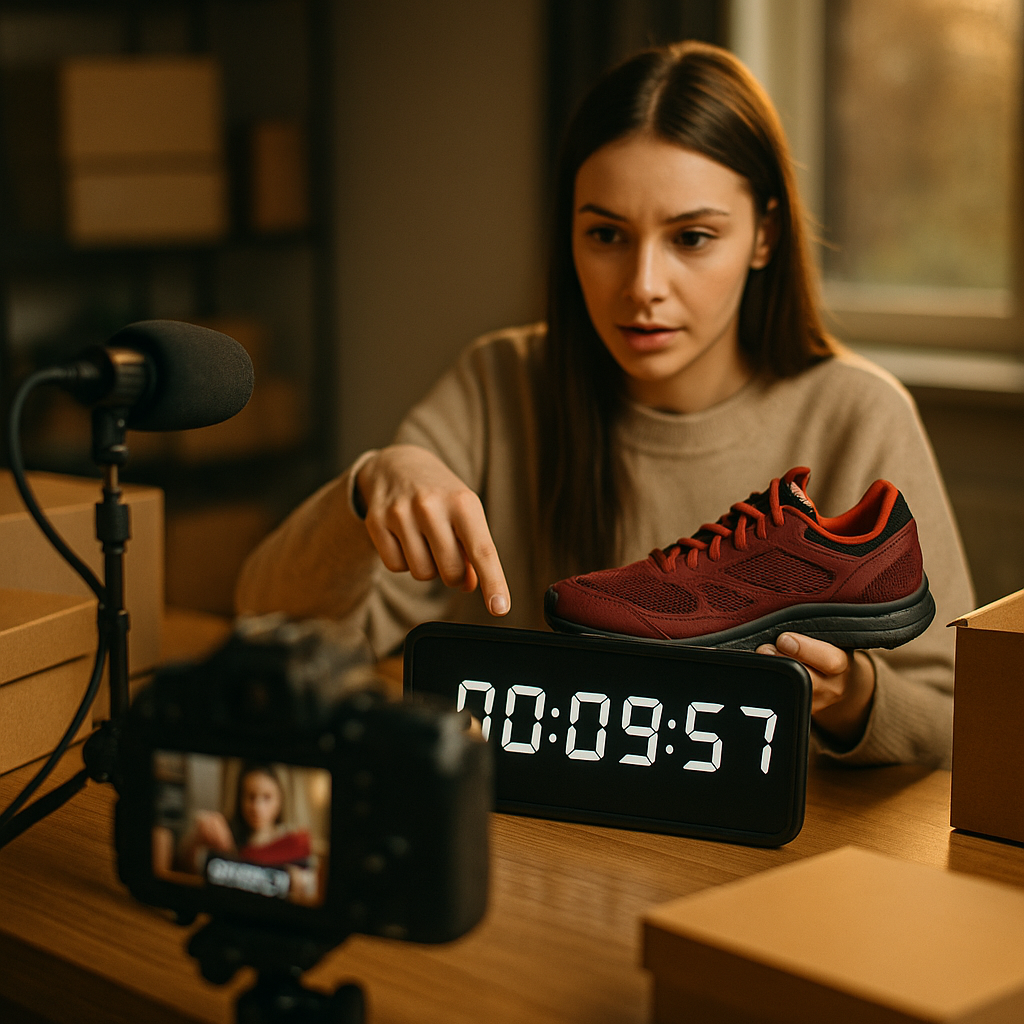
Forty-three states now have some version of a deceptive-scarcity or false-advertising statute on the books, and most livestream shopping teams have never read a single one. That’s a problem, because the restock-countdown livestream format, the one built on ticking clocks and “only 12 left” banners, is exactly the kind of urgency messaging regulators are watching. Done right, it converts. Done carelessly, it’s a demand letter waiting to happen.
What Counts as Deceptive Scarcity Under State Law?
Scarcity claims aren’t illegal. Fake scarcity claims are. The legal line, across states like California, New York, and Texas, generally comes down to one question: is the urgency signal true at the moment it’s displayed? If a countdown timer says “sale ends in 10 minutes” and the same discount reappears an hour later, that’s a textbook violation under most state unfair-and-deceptive-practices statutes. Same goes for inventory counters that reset without an actual restock event.
The FTC’s guidance on dark patterns has increasingly influenced how state attorneys general interpret livestream urgency tactics, even though most enforcement still happens at the state level. That means a format that’s fine in one jurisdiction can trigger a cease-and-desist in another, depending on how aggressively that state’s consumer protection office reads “material misrepresentation.”
If your countdown timer, stock counter, or “selling fast” badge isn’t tied to a real, verifiable data feed, you’re not building urgency, you’re building a liability file.
The Restock Countdown Format, Explained
The format itself is simple, and that’s why it works. A creator goes live minutes before a known restock window. Viewers watch a real inventory number tick down as orders come in. The host narrates the drop in real time: unboxing the new batch, confirming SKU counts, answering questions about shipping. When stock hits zero, the stream ends or pivots to a waitlist capture.
It’s the livestream cousin of the format covered in our piece on restock countdown creator campaigns, except the real-time nature raises the compliance stakes. A recorded video with a scarcity claim is a static risk. A live broadcast with a moving counter is a dynamic one, because the brand has to keep every number accurate for the full duration of the stream, not just at publish time.
Where Brands Get This Wrong
Three mistakes show up constantly in livestream urgency campaigns, and none of them are exotic.
- Manually operated counters. A producer typing numbers into an overlay based on “vibes” rather than a live inventory API. The second an auditor or plaintiff’s attorney pulls warehouse logs against stream footage, the mismatch is obvious.
- Recycled urgency language across streams. “Last chance” said three times a week isn’t last chance. Courts and regulators look at pattern, not just a single instance.
- Vague inventory claims with no unit specificity. “Almost sold out” without a number is safer legally in some readings but weaker for conversion. Brands often overcorrect into vague language that kills performance instead of fixing the underlying data problem.
None of these are creative failures. They’re operational ones. The fix isn’t softer copy, it’s better plumbing between your commerce stack and your stream overlay.
A Compliance-First Structure That Still Converts
Here’s the structure we’ve seen hold up both legally and commercially, across DTC brands running weekly restock drops.
- Pre-stream inventory lock. Confirm the exact restock unit count at least 30 minutes before going live. Document it with a timestamp.
- Live API-fed counter. The on-screen number should pull directly from your order management system, not a manually updated graphic. Shopify, Salesforce Commerce Cloud, and most modern OMS platforms support this via webhook.
- Disclosed restock cadence. Tell viewers this is a recurring weekly drop if it is. Framing it as a one-time event when it recurs is one of the most common triggers for state scarcity complaints.
- Neutral fallback language. Have a scripted line ready for when stock runs low but before it hits zero, something like “we’re down to the final units from this batch,” verified against the live count.
- Post-stream archive accuracy. If the VOD gets repurposed, strip or update any countdown graphics that no longer reflect reality. This is where our guide on repurposing livestream content becomes a compliance document, not just a content one.
This structure doesn’t slow down the format. If anything, real numbers create sharper urgency than invented ones, because viewers can sense when a counter feels scripted. Authenticity and legal defensibility point in the same direction here, which isn’t always the case in marketing.
Does Platform Choice Change the Legal Exposure?
Somewhat. TikTok Shop, Amazon Live, and Instagram Live each have different data infrastructure for real-time inventory display, and that affects how easy compliance is to operationalize. TikTok’s commerce tools increasingly support live inventory sync for shop-enabled accounts, which makes an accurate counter far easier to build than on platforms where the overlay is a manually inserted graphic layered by a producer.
Amazon Live ties directly into seller inventory data, which is arguably the safest environment for this format because the platform itself enforces some accuracy. Independent stream setups on YouTube or a brand’s own site carry more risk precisely because there’s no platform-level check on the numbers a brand chooses to display.
Measuring Urgency Without Overselling It
Marketers tend to treat urgency as a binary: either the campaign converts or it doesn’t. But the more useful metric is decay rate, how conversion changes minute by minute as the counter drops. According to eMarketer’s livestream commerce research, urgency-driven conversion lifts are strongest in the final 20% of visible inventory, which means brands don’t need dramatic scarcity language for the whole stream, just precise accuracy at the moment it matters most.
That’s a lighter compliance lift than most legal teams assume. You don’t need airtight real-time data for the entire 45-minute stream. You need it locked down for the closing window, when viewers are actually watching the number and deciding to buy.
The riskiest ten minutes of any restock stream are also the highest-converting ten minutes. That’s exactly why they need the tightest data controls, not looser ones.
For attribution, treat the livestream as one input in a broader funnel rather than an isolated event. Our framework on the discovery to conversion content ladder applies well here: the countdown stream drives the conversion moment, but the creator relationship and pre-stream teaser content are what built the audience willing to show up and buy under pressure in the first place.
Legal Review Doesn’t Have to Slow Production
The instinct at a lot of brands is to route every livestream script through legal, which creates bottlenecks that kill the spontaneity the format depends on. A better model: get legal to approve the system, not the script. Once counsel signs off on how the inventory feed connects to the on-screen counter and what disclosure language covers recurring drops, individual streams don’t need a new review cycle every week.
This mirrors the approach brands use for repeatable creator formats generally. The three-episode test arc model works on the same logic: validate the structure once, then scale execution without re-litigating the framework every time. Apply that thinking to restock streams and you get speed without recklessness.
Worth tracking too: zero-party data capture during the waitlist moment, when stock hits zero and viewers opt in for the next drop. That data point, covered in our piece on zero-party data capture, turns a compliance-safe scarcity event into a retention asset instead of a one-off sales spike.
Key Takeaway
Build the counter off real inventory data, lock the language 30 minutes before going live, and let legal approve the system once instead of the script every week. That’s the difference between a restock stream that converts safely and one that becomes a case file.
FAQs
What is a restock-countdown livestream?
It’s a live shopping format where a host broadcasts during an actual product restock, showing a real-time inventory counter that decreases as viewers purchase, creating urgency without relying on scripted or fake scarcity claims.
Which states have the strictest deceptive-scarcity laws?
California, New York, and Texas have some of the most actively enforced unfair-and-deceptive-practices statutes affecting scarcity marketing, though most states have comparable consumer protection language that can apply to false urgency claims.
Can a brand reuse the same “last chance” messaging across multiple livestreams?
Not safely. Regulators look at patterns over time, and repeated “last chance” or “final units” claims that don’t reflect a genuine one-time event can be read as a material misrepresentation even if each individual stream seems minor.
Does an automated inventory counter fully eliminate legal risk?
It significantly reduces risk by removing manual error, but brands still need accurate disclosure about restock frequency and honest framing of whether an event is recurring or truly limited.
How does platform choice affect compliance for this format?
Platforms with native commerce integrations, like Amazon Live or TikTok Shop, make it easier to sync real inventory data to on-screen counters, while independently produced streams carry more risk because accuracy depends entirely on the brand’s internal systems.
Top Influencer Marketing Agencies
The leading agencies shaping influencer marketing in 2026
Agencies ranked by campaign performance, client diversity, platform expertise, proven ROI, industry recognition, and client satisfaction. Assessed through verified case studies, reviews, and industry consultations.
Moburst

-
2

The Shelf
Boutique Beauty & Lifestyle Influencer AgencyA data-driven boutique agency specializing exclusively in beauty, wellness, and lifestyle influencer campaigns on Instagram and TikTok. Best for brands already focused on the beauty/personal care space that need curated, aesthetic-driven content.Clients: Pepsi, The Honest Company, Hims, Elf Cosmetics, Pure LeafVisit The Shelf → -
3

Audiencly
Niche Gaming & Esports Influencer AgencyA specialized agency focused exclusively on gaming and esports creators on YouTube, Twitch, and TikTok. Ideal if your campaign is 100% gaming-focused — from game launches to hardware and esports events.Clients: Epic Games, NordVPN, Ubisoft, Wargaming, Tencent GamesVisit Audiencly → -
4

Viral Nation
Global Influencer Marketing & Talent AgencyA dual talent management and marketing agency with proprietary brand safety tools and a global creator network spanning nano-influencers to celebrities across all major platforms.Clients: Meta, Activision Blizzard, Energizer, Aston Martin, WalmartVisit Viral Nation → -
5

The Influencer Marketing Factory
TikTok, Instagram & YouTube CampaignsA full-service agency with strong TikTok expertise, offering end-to-end campaign management from influencer discovery through performance reporting with a focus on platform-native content.Clients: Google, Snapchat, Universal Music, Bumble, YelpVisit TIMF → -
6

NeoReach
Enterprise Analytics & Influencer CampaignsAn enterprise-focused agency combining managed campaigns with a powerful self-service data platform for influencer search, audience analytics, and attribution modeling.Clients: Amazon, Airbnb, Netflix, Honda, The New York TimesVisit NeoReach → -
7

Ubiquitous
Creator-First Marketing PlatformA tech-driven platform combining self-service tools with managed campaign options, emphasizing speed and scalability for brands managing multiple influencer relationships.Clients: Lyft, Disney, Target, American Eagle, NetflixVisit Ubiquitous → -
8

Obviously
Scalable Enterprise Influencer CampaignsA tech-enabled agency built for high-volume campaigns, coordinating hundreds of creators simultaneously with end-to-end logistics, content rights management, and product seeding.Clients: Google, Ulta Beauty, Converse, AmazonVisit Obviously →