


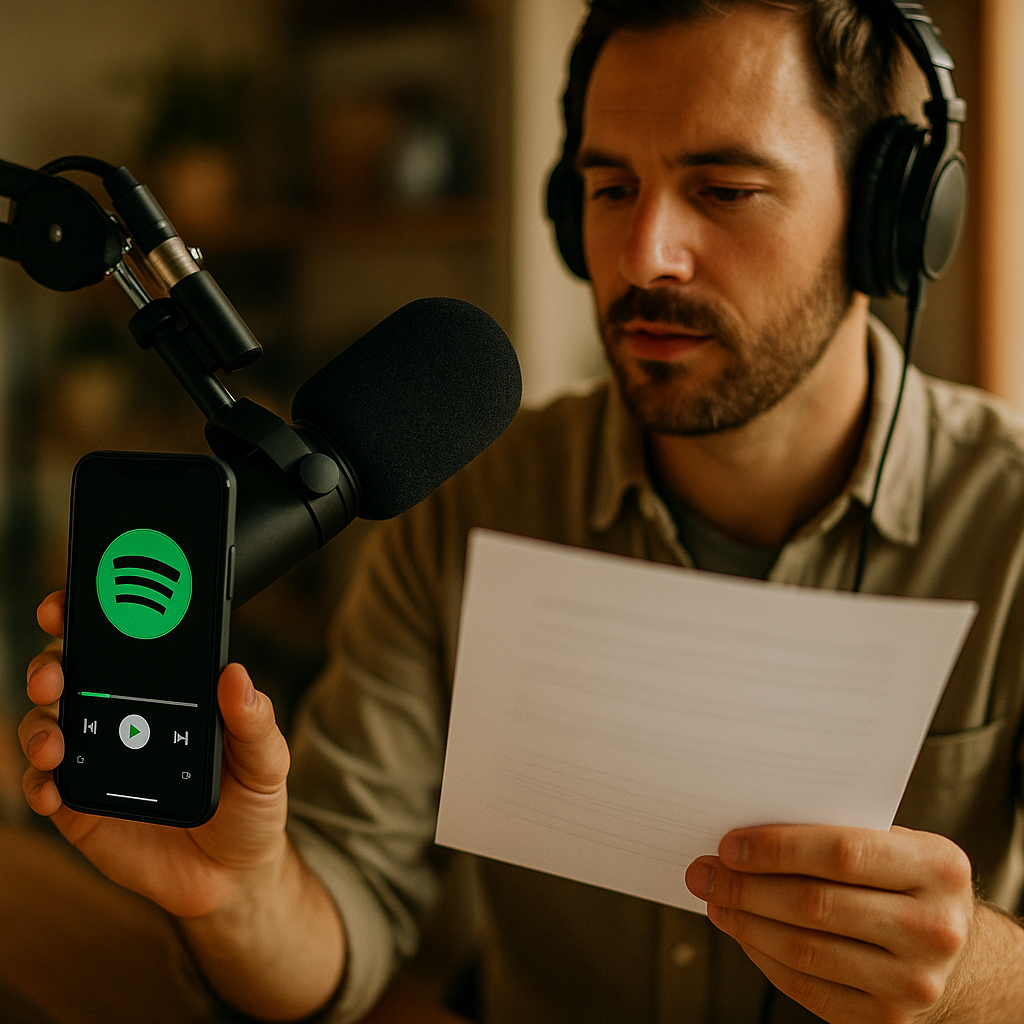
Spotify’s ad-supported tier now reaches more than 300 million listeners, and podcast ad-reads convert at rates display ads can only dream about. Yet most brands still hand creators a bullet list of talking points and hope for the best. That’s not a briefing strategy. That’s a coin flip with your media budget.
A proper Spotify podcast ad-read playbook treats the host like a performance channel, not a megaphone. Get the brief right and you get an endorsement that sounds native, drives measurable action, and survives compliance review. Get it wrong and you get a stilted read that listeners skip, or worse, one that trips FTC disclosure rules.
Why Host Reads Still Outperform Programmatic Audio
Programmatic audio ads on Spotify are cheap and scalable. Host-read endorsements are neither. So why do brands keep paying a premium for them?
Because trust transfers. Listeners have opted into a relationship with that host, often for years. When a host says “I actually use this,” the endorsement borrows credibility that no pre-roll spot can buy. Nielsen and IAB research has repeatedly shown podcast listeners take action after hearing a trusted host mention a product, whether that’s visiting a site, using a promo code, or searching a brand name later. Spotify’s own advertiser data points to lift in brand favorability specifically tied to host-read formats over static audio creative.
The endorsement isn’t the product pitch. It’s the transfer of trust from host to listener, and that trust is the actual asset you’re renting.
That’s the entire premise of this format. If your brief strips out the host’s voice and forces a script, you’ve paid for trust and delivered an ad. Waste of budget.
The Brief Is the Product
Most brands over-invest in creator selection and under-invest in the brief. That’s backwards. A mediocre host with a sharp brief will outperform a great host handed a vague one.
Your brief needs five components, no more, no fewer:
- The one thing: a single core message, not three competing ones.
- Proof point: one stat, feature, or personal-use anecdote the host can lean on.
- The ask: exact CTA, whether that’s a promo code, URL, or “search us.”
- Guardrails: claims that can’t be made, competitor mentions to avoid, legal language that must appear verbatim.
- Tone anchor: two or three example reads from the host’s own back catalog that you’d want this ad to sound like.
Notice what’s missing: a script. You are briefing an outcome, not dictating a monologue. Hosts know their audience’s cadence better than your copywriter does. Let them write it in their own words within your guardrails.
Structuring the Ask Without Killing Authenticity
Here’s the tension every brand manager feels: you need a trackable CTA, but a promo code recited like a phone number kills the natural flow of the read. The fix isn’t removing the ask, it’s placing it correctly.
The strongest host-read structure follows a simple arc: personal hook, problem framing, product mention, proof point, then the ask repeated twice (once mid-read, once at the close). Repetition matters more than polish here. Spotify’s advertising guidance consistently notes that reads with a repeated, simple CTA outperform single-mention reads on both recall and conversion.
Keep the promo code short and speakable. “Save20” beats “INFLUENCERTIME2026PODCAST” every time. If a host stumbles over your code mid-read, that’s a briefing failure, not a talent problem.
Live-Read vs. Baked-In: Choosing the Right Format
Spotify offers both dynamically inserted (baked-in, pre-recorded) and true live-read ad formats, and the choice affects your entire briefing approach.
Dynamic insertion gives you scale and easier tracking through Spotify’s Streaming Ad Insertion (SAI) tech, since the same read can rotate across episodes and be swapped without re-editing the show. But it sacrifices some spontaneity: listeners can sometimes tell when a read was recorded separately from the episode’s natural flow.
True live-reads, recorded in the same session as the episode, sound more organic and typically perform better on trust metrics, but they’re harder to scale and nearly impossible to update once live. If you’re running a promo code that expires, that’s a real operational risk. Match your format choice to your campaign timeline: evergreen offers suit baked-in reads, urgent time-boxed promos need the live-read’s authenticity but demand faster creative turnaround from your team.
Compliance Isn’t Optional: FTC Rules for Audio Endorsements
Audio has no on-screen disclosure banner. That makes compliance trickier than it looks, and it’s the single most overlooked risk in podcast ad-read briefs.
The FTC’s endorsement guidelines require that sponsorship be disclosed clearly and understandably, and “clearly” in audio means spoken disclosure, not a rushed legal mumble buried at the end. Best practice: have the host state “this episode is sponsored by [brand]” near the top of the read, in plain language, not legal jargon. Waiting until the outro to disclose, or relying on a generic “thanks to our sponsors” rollup at the top of the show, doesn’t meet the bar for a dedicated endorsement segment.
Brands running programs across multiple platforms should treat this as a system, not a one-off checklist. If you’re already managing disclosure workflows for Instagram disclosure compliance or dealing with automatic flagging on TikTok, extend that same rigor to audio. Document every brief, keep a record of the final aired read (not just the approved script), and audit a sample of episodes quarterly. Regulators have shown increasing interest in audio and podcast disclosure specifically, and “the host said it, not us” is not a defense that holds up.
Measurement: The Part Most Briefs Skip Entirely
You can’t optimize what you don’t track, and podcast attribution has historically been the industry’s weak spot. That’s improving, but only if you build measurement into the brief from day one.
Practical tactics that actually work:
- Unique promo codes per host: non-negotiable, even for hosts who resist “sounding like an infomercial.”
- Vanity URLs: a dedicated landing page path per creator makes traffic attribution cleaner than code redemption alone.
- Post-episode surveys: Spotify’s advertiser tools support brand lift surveys tied to specific ad exposure, useful for awareness-stage campaigns where direct response isn’t the primary goal.
- Search lift monitoring: track branded search volume in the 48 hours following an episode’s release. Delayed listening means delayed action, so don’t judge performance on launch-day numbers alone.
If you’re pulling snippets from these ad-reads to repurpose into short-form video, the measurement discipline should carry over. The same hook-testing logic used in podcast snippets to shorts strategies applies directly here: test which proof point or CTA phrasing drives the most action, then feed that data back into your next round of briefs.
Budgeting and Negotiation Realities
Spotify podcast ad-read rates vary wildly by show size and category, but a rough industry benchmark from eMarketer puts host-read CPMs meaningfully above standard programmatic audio, reflecting the trust premium discussed earlier. Negotiate based on downloads-per-episode and average listen-through rate, not just subscriber counts, since podcast audiences skew toward high completion rates compared to video.
If you’re buying through a marketplace rather than direct, apply the same vetting rigor covered in our creator marketplace buying playbook: verify listener demographics, request recent read examples, and confirm whether pricing includes dynamic ad insertion refresh rights or a single fixed placement. Also worth checking a host’s back catalog for how they’ve handled prior sponsors; a host who’s read for a dozen competing categories back to back may dilute your endorsement’s impact regardless of audience size.
Building the Reusable Template
Once you’ve run three or four campaigns, stop reinventing the brief each time. Build a template with fixed fields (core message, proof point, CTA, guardrails, tone anchor) and a variable field for show-specific tone notes. This turns your Spotify ad-read program into a repeatable operation instead of a one-off creative project, and it’s the same operational maturity brands are applying across formats, from TikTok editing briefing templates to structured negotiation frameworks like the IAB CreatorFronts negotiation guide.
Track which template fields correlate with better performance over time. You’ll likely find that specificity in the proof point field, not the tone anchor, drives most of the lift. Let the data tell you where to spend your editing time on future briefs.
Frequently Asked Questions
How long should a Spotify podcast ad-read be?
Most effective host-read endorsements run 60 to 90 seconds. Shorter reads often skip the proof point that makes the endorsement credible, while longer reads risk listener drop-off, especially on baked-in ads inserted mid-episode.
Should brands write the exact script for the host?
No. Provide a structured brief with required elements (message, proof point, CTA, disclosure, guardrails) and let the host write the read in their own voice. Fully scripted reads tend to underperform because listeners can detect the shift in cadence.
What’s the minimum disclosure required for a Spotify sponsored segment?
The host should verbally state the segment is sponsored or paid, in plain language, near the start of the read. A generic sponsor rollup at the top of the episode does not satisfy dedicated endorsement disclosure expectations under FTC guidance.
How do brands track ROI on host-read podcast ads?
Use unique promo codes and dedicated vanity URLs per host, monitor branded search lift in the days following release, and where available, run Spotify’s brand lift surveys for awareness-focused campaigns.
Is live-read or baked-in ad insertion better for a limited-time promo?
Baked-in dynamic insertion is generally safer for time-sensitive promos since it can be swapped or pulled without re-recording the episode. Live-reads sound more authentic but are difficult to update once published.
Frequently Asked Questions
How long should a Spotify podcast ad-read be?
Most effective host-read endorsements run 60 to 90 seconds. Shorter reads often skip the proof point that makes the endorsement credible, while longer reads risk listener drop-off, especially on baked-in ads inserted mid-episode.
Should brands write the exact script for the host?
No. Provide a structured brief with required elements (message, proof point, CTA, disclosure, guardrails) and let the host write the read in their own voice. Fully scripted reads tend to underperform because listeners can detect the shift in cadence.
What’s the minimum disclosure required for a Spotify sponsored segment?
The host should verbally state the segment is sponsored or paid, in plain language, near the start of the read. A generic sponsor rollup at the top of the episode does not satisfy dedicated endorsement disclosure expectations under FTC guidance.
How do brands track ROI on host-read podcast ads?
Use unique promo codes and dedicated vanity URLs per host, monitor branded search lift in the days following release, and where available, run Spotify’s brand lift surveys for awareness-focused campaigns.
Is live-read or baked-in ad insertion better for a limited-time promo?
Baked-in dynamic insertion is generally safer for time-sensitive promos since it can be swapped or pulled without re-recording the episode. Live-reads sound more authentic but are difficult to update once published.
Stop briefing podcast hosts like they’re voiceover actors reading copy. Build a five-element brief, lock in disclosure language up front, and put a unique code or URL on every single read so you’re negotiating your next buy with data instead of gut feel.
Top Influencer Marketing Agencies
The leading agencies shaping influencer marketing in 2026
Agencies ranked by campaign performance, client diversity, platform expertise, proven ROI, industry recognition, and client satisfaction. Assessed through verified case studies, reviews, and industry consultations.
Moburst

-
2

The Shelf
Boutique Beauty & Lifestyle Influencer AgencyA data-driven boutique agency specializing exclusively in beauty, wellness, and lifestyle influencer campaigns on Instagram and TikTok. Best for brands already focused on the beauty/personal care space that need curated, aesthetic-driven content.Clients: Pepsi, The Honest Company, Hims, Elf Cosmetics, Pure LeafVisit The Shelf → -
3

Audiencly
Niche Gaming & Esports Influencer AgencyA specialized agency focused exclusively on gaming and esports creators on YouTube, Twitch, and TikTok. Ideal if your campaign is 100% gaming-focused — from game launches to hardware and esports events.Clients: Epic Games, NordVPN, Ubisoft, Wargaming, Tencent GamesVisit Audiencly → -
4

Viral Nation
Global Influencer Marketing & Talent AgencyA dual talent management and marketing agency with proprietary brand safety tools and a global creator network spanning nano-influencers to celebrities across all major platforms.Clients: Meta, Activision Blizzard, Energizer, Aston Martin, WalmartVisit Viral Nation → -
5

The Influencer Marketing Factory
TikTok, Instagram & YouTube CampaignsA full-service agency with strong TikTok expertise, offering end-to-end campaign management from influencer discovery through performance reporting with a focus on platform-native content.Clients: Google, Snapchat, Universal Music, Bumble, YelpVisit TIMF → -
6

NeoReach
Enterprise Analytics & Influencer CampaignsAn enterprise-focused agency combining managed campaigns with a powerful self-service data platform for influencer search, audience analytics, and attribution modeling.Clients: Amazon, Airbnb, Netflix, Honda, The New York TimesVisit NeoReach → -
7

Ubiquitous
Creator-First Marketing PlatformA tech-driven platform combining self-service tools with managed campaign options, emphasizing speed and scalability for brands managing multiple influencer relationships.Clients: Lyft, Disney, Target, American Eagle, NetflixVisit Ubiquitous → -
8

Obviously
Scalable Enterprise Influencer CampaignsA tech-enabled agency built for high-volume campaigns, coordinating hundreds of creators simultaneously with end-to-end logistics, content rights management, and product seeding.Clients: Google, Ulta Beauty, Converse, AmazonVisit Obviously →