


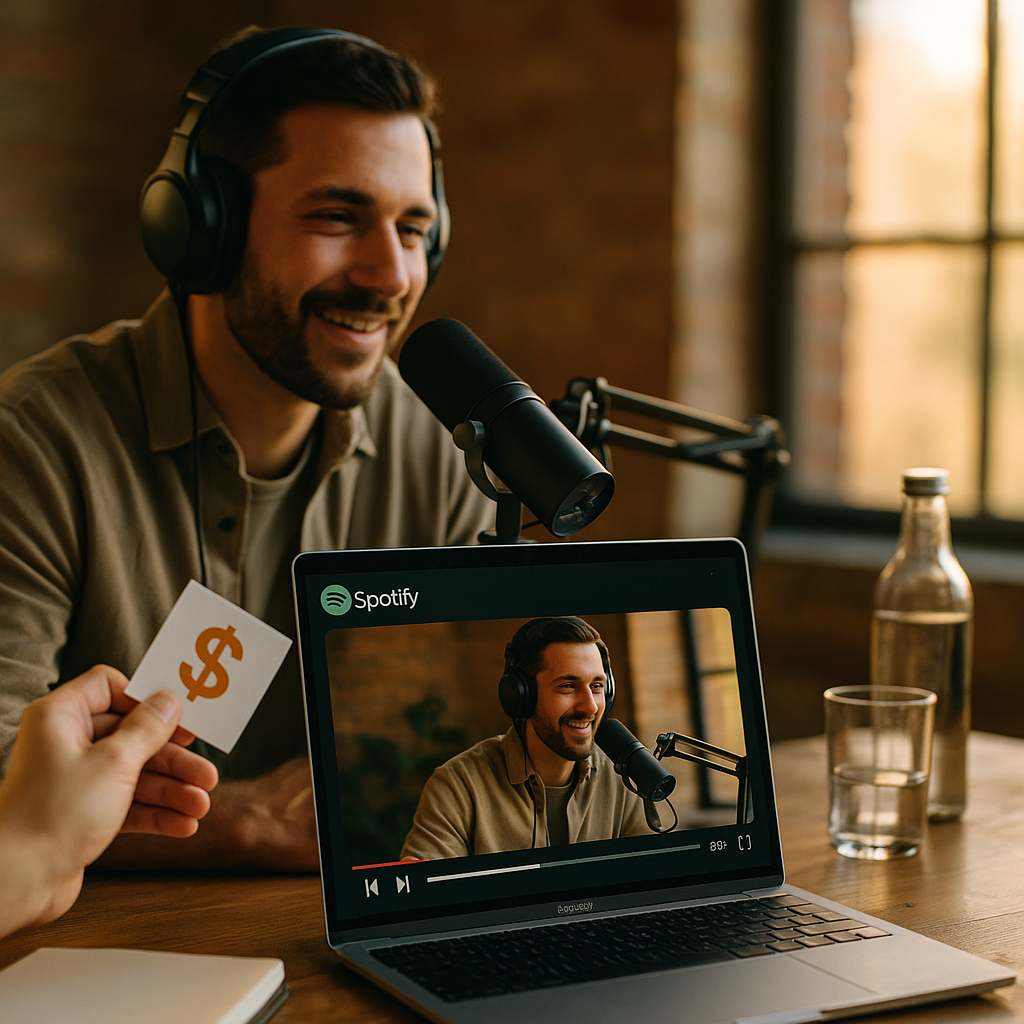
Spotify now hosts over 400,000 video podcasts, and the platform quietly pushed video plays past four billion in a single quarter. If your media plan still treats Spotify as “audio-only,” you’re bidding on last year’s inventory. The Spotify video podcast playbook brands need in 2026 looks nothing like the pre-roll buys of 2021 — it’s closer to YouTube creator sponsorship with better completion rates and a lot less scroll competition.
Why Spotify’s Video Layer Suddenly Matters to Brands
Spotify spent years positioning itself purely as an audio platform. That’s changed. Video podcasting is now central to the company’s creator monetization strategy, and Spotify has been aggressively courting hosts away from YouTube and standalone RSS feeds with better rev-share terms and a unified Partner Program. The pitch to creators: keep your audio audience, add video, get paid from both.
For brands, this matters because the audience behavior on Spotify video skews differently than YouTube. Listeners often start a show in audio mode during a commute, then finish the episode in video mode later on a phone or smart TV. That means your creative needs to work as a voiceover and a visual — a subtlety a lot of media buyers are still missing.
Spotify’s own data suggests video podcast consumers watch longer per session than typical short-form viewers, which changes how you should think about mid-roll placement versus host-read integrations.
What “Sponsoring a Show” Actually Means Now
There are three distinct buy types on Spotify’s expanding video layer, and conflating them is the single most common mistake brands make.
- Programmatic/Streaming Ad Insertion (SAI): Dynamic audio-video ads inserted automatically, sold through Spotify Ad Exchange or Spotify Ad Studio. Low control, low cost, scalable.
- Direct host-read sponsorships: Negotiated directly with the creator or their talent agency. The host scripts and delivers the read in their own voice, on camera, integrated into the episode.
- Full episode takeovers or branded segments: Rarer, pricier, usually reserved for launch moments — think a dedicated segment or a full episode built around a product category.
Most brand dollars should go toward the second category. Host-read video integrations convert better because the audience trusts the messenger, and Spotify’s video format lets you show the product, not just describe it. That’s a meaningful upgrade from pure audio reads, where you’re relying entirely on imagination and repetition.
Picking the Right Shows: A Filter, Not a Vibe Check
Don’t pick shows based on subscriber count alone. Spotify’s for Podcasters dashboard gives creators (and, if shared, brands) access to completion rate, average consumption time, and audience demographics by episode — use them. A show with 80,000 monthly listeners and a 65% video completion rate will usually outperform a show with 300,000 listeners and a 20% completion rate.
Ask creators for these numbers before you negotiate rate. If they won’t share them, that’s a signal in itself.
- Average video watch-through percentage over the last 10 episodes
- Audio-to-video listener ratio (tells you how much of the audience actually sees your product)
- Age/gender/geo breakdown from Spotify’s built-in analytics
- Whether the show has run brand integrations before, and how they were disclosed
Vertical fit still matters more than raw reach. A mid-size business or career-advice show with a 40,000-download average and high video engagement can outperform a general pop-culture show for B2B or fintech offers. This is the same logic that applies across creator ecosystems — see how it plays out in B2B creator sponsorship strategy, where niche relevance consistently beats scale.
Pricing: What Should You Actually Pay?
Spotify doesn’t publish a rate card for creator-hosted video sponsorships, and pricing varies wildly depending on show category, host reputation, and whether the deal runs through Spotify’s Partner Program or direct-to-creator. As a rough working range for 2026, expect:
- $15–$35 CPM for 60-second host-read video integrations on mid-tier shows (20,000–150,000 monthly listeners)
- $40–$75 CPM for top 1,000 chart shows with strong video completion metrics
- Flat fees, not CPM, for full-episode branded takeovers — typically $8,000–$50,000 depending on show tier
These numbers track reasonably close to YouTube mid-roll integration pricing, according to industry benchmarking from eMarketer. The difference is inventory scarcity. Fewer brands are currently bidding on Spotify video slots than on YouTube, which means you can often negotiate better terms right now — a window that won’t stay open indefinitely as more advertisers catch on.
Disclosure and Compliance: Don’t Improvise This Part
Video podcast sponsorships fall squarely under the same disclosure rules as any other endorsement content. The FTC’s endorsement guidelines require clear, conspicuous disclosure whenever a material connection exists between a brand and a creator — and “I’ll mention it verbally at minute 14” doesn’t cut it if there’s no visual or on-screen disclosure to match.
Spotify’s video format actually makes compliance easier than pure audio, if you use it right. Require creators to:
- Include an on-screen disclosure graphic (“Paid Partnership” or “Ad”) for the duration of the sponsored segment, not just a flash at the start
- State the disclosure verbally near the start of the read, not buried after the pitch
- Use Spotify’s episode description tagging where available, so disclosure persists even if someone skips to a mid-episode timestamp
UK brands need to layer in ICO guidance on data handling if you’re running any listener data capture through affiliate links or promo codes embedded in the episode. This is the same discipline we’ve flagged in FTC disclosure compliance for shoppable content — the platform changes, the legal exposure doesn’t.
A single non-compliant host-read across a syndicated show can trigger FTC scrutiny across every episode it appears in — build disclosure checks into your contract, not just your creative brief.
Briefing Creators for Video, Not Just Audio
Here’s where a lot of brands undercook the brief. A script written for an audio-only read doesn’t automatically work on camera. You need to think about:
- Product visibility: If you want the host holding the product or showing packaging, say so explicitly — Spotify’s video podcast player supports on-screen product callouts in some formats, but only if the creator sets them up.
- B-roll and cutaways: Higher-tier shows often insert supplementary footage during the ad read. Ask what’s possible before assuming a static talking-head shot.
- Thumbnail and chapter marking: Sponsored segments can get their own chapter marker in Spotify’s video timeline. This is free real estate for brand visibility — make sure it’s part of the deal, not an afterthought.
- Cross-posting rights: Many hosts also publish to YouTube. Negotiate whether your sponsorship covers Spotify exclusively or cross-platform distribution, because the value proposition changes significantly.
This briefing discipline mirrors what’s already standard practice in other creator-video contexts — the same structured thinking behind YouTube Shorts creator briefs applies here, just adapted for long-form conversational formats.
Measurement: What Good Actually Looks Like
Attribution on podcast sponsorships has always been messy, and video doesn’t fully solve it. But it does give you more signal than pure audio ever did.
- Use unique promo codes per show, not per network, so you can compare performance show-by-show
- Track branded search lift in the 48 hours following an episode drop — Spotify episodes often release on a schedule, making before/after comparison cleaner than always-on ad formats
- Request view-through data from Spotify’s Ad Analytics or Megaphone (Spotify’s ad tech backbone) if you’re running through Partner Program deals
- Compare audio-only completion versus video completion for the same episode — a growing video-to-audio ratio over time tells you the show’s format shift is working, and your placement is getting more valuable
Don’t expect perfect last-click attribution. Treat Spotify video sponsorships the way you’d treat upper-funnel podcast buys generally: strong for brand lift and consideration, supplementary for direct response. Tools like Sprout Social and HubSpot can help you tie campaign codes back into broader funnel reporting if you’re running podcast sponsorships alongside other creator channels.
Where This Fits in a Broader Creator Budget
Spotify video podcast sponsorships shouldn’t sit in isolation. Treat them as one lane in a multi-platform creator strategy, alongside short-form video, community-driven platforms, and owned-channel activations. The brands getting the best returns right now are the ones diversifying deliberately, not chasing whichever platform had the loudest keynote this quarter.
Start small: pick two or three shows with strong video completion metrics in your category, negotiate a single host-read integration each, and measure branded search lift before you scale spend. That test will tell you more about Spotify’s video layer than any platform deck ever will.
FAQs
How is Spotify video podcast sponsorship different from YouTube podcast sponsorship?
Spotify video sponsorships typically reach an audience that splits between audio-only and video consumption, so your creative needs to work both ways. YouTube skews more heavily toward pure video consumption. Spotify also currently has less advertiser competition for video inventory, which can mean better rates for now.
What’s a realistic budget to start testing Spotify video podcast ads?
Most brands can run a meaningful test with $10,000–$25,000 spread across two or three mid-tier shows with strong completion rates, using host-read integrations rather than programmatic buys.
Do I need separate disclosure for the video and audio versions of the same episode?
Yes. FTC guidance requires disclosure to be clear and conspicuous in whatever format the audience actually consumes. If a show publishes both audio and video versions, both need their own compliant disclosure, not just one carried over.
Can I negotiate directly with podcast hosts, or do I have to go through Spotify?
Most host-read sponsorships are negotiated directly with the creator or their talent representation. Spotify’s Partner Program and Ad Exchange offer more programmatic, platform-managed options if you want scale over customization.
How do I know if a show’s audience actually watches the video version?
Ask the creator for their audio-to-video listener ratio from Spotify’s for Podcasters dashboard. A show with a high ratio of video viewers justifies paying a premium for visual product placement; a mostly-audio audience means a standard host-read is fine.
FAQs
How is Spotify video podcast sponsorship different from YouTube podcast sponsorship?
Spotify video sponsorships typically reach an audience that splits between audio-only and video consumption, so your creative needs to work both ways. YouTube skews more heavily toward pure video consumption. Spotify also currently has less advertiser competition for video inventory, which can mean better rates for now.
What’s a realistic budget to start testing Spotify video podcast ads?
Most brands can run a meaningful test with $10,000–$25,000 spread across two or three mid-tier shows with strong completion rates, using host-read integrations rather than programmatic buys.
Do I need separate disclosure for the video and audio versions of the same episode?
Yes. FTC guidance requires disclosure to be clear and conspicuous in whatever format the audience actually consumes. If a show publishes both audio and video versions, both need their own compliant disclosure, not just one carried over.
Can I negotiate directly with podcast hosts, or do I have to go through Spotify?
Most host-read sponsorships are negotiated directly with the creator or their talent representation. Spotify’s Partner Program and Ad Exchange offer more programmatic, platform-managed options if you want scale over customization.
How do I know if a show’s audience actually watches the video version?
Ask the creator for their audio-to-video listener ratio from Spotify’s for Podcasters dashboard. A show with a high ratio of video viewers justifies paying a premium for visual product placement; a mostly-audio audience means a standard host-read is fine.
Top Influencer Marketing Agencies
The leading agencies shaping influencer marketing in 2026
Agencies ranked by campaign performance, client diversity, platform expertise, proven ROI, industry recognition, and client satisfaction. Assessed through verified case studies, reviews, and industry consultations.
Moburst

-
2

The Shelf
Boutique Beauty & Lifestyle Influencer AgencyA data-driven boutique agency specializing exclusively in beauty, wellness, and lifestyle influencer campaigns on Instagram and TikTok. Best for brands already focused on the beauty/personal care space that need curated, aesthetic-driven content.Clients: Pepsi, The Honest Company, Hims, Elf Cosmetics, Pure LeafVisit The Shelf → -
3

Audiencly
Niche Gaming & Esports Influencer AgencyA specialized agency focused exclusively on gaming and esports creators on YouTube, Twitch, and TikTok. Ideal if your campaign is 100% gaming-focused — from game launches to hardware and esports events.Clients: Epic Games, NordVPN, Ubisoft, Wargaming, Tencent GamesVisit Audiencly → -
4

Viral Nation
Global Influencer Marketing & Talent AgencyA dual talent management and marketing agency with proprietary brand safety tools and a global creator network spanning nano-influencers to celebrities across all major platforms.Clients: Meta, Activision Blizzard, Energizer, Aston Martin, WalmartVisit Viral Nation → -
5

The Influencer Marketing Factory
TikTok, Instagram & YouTube CampaignsA full-service agency with strong TikTok expertise, offering end-to-end campaign management from influencer discovery through performance reporting with a focus on platform-native content.Clients: Google, Snapchat, Universal Music, Bumble, YelpVisit TIMF → -
6

NeoReach
Enterprise Analytics & Influencer CampaignsAn enterprise-focused agency combining managed campaigns with a powerful self-service data platform for influencer search, audience analytics, and attribution modeling.Clients: Amazon, Airbnb, Netflix, Honda, The New York TimesVisit NeoReach → -
7

Ubiquitous
Creator-First Marketing PlatformA tech-driven platform combining self-service tools with managed campaign options, emphasizing speed and scalability for brands managing multiple influencer relationships.Clients: Lyft, Disney, Target, American Eagle, NetflixVisit Ubiquitous → -
8

Obviously
Scalable Enterprise Influencer CampaignsA tech-enabled agency built for high-volume campaigns, coordinating hundreds of creators simultaneously with end-to-end logistics, content rights management, and product seeding.Clients: Google, Ulta Beauty, Converse, AmazonVisit Obviously →