


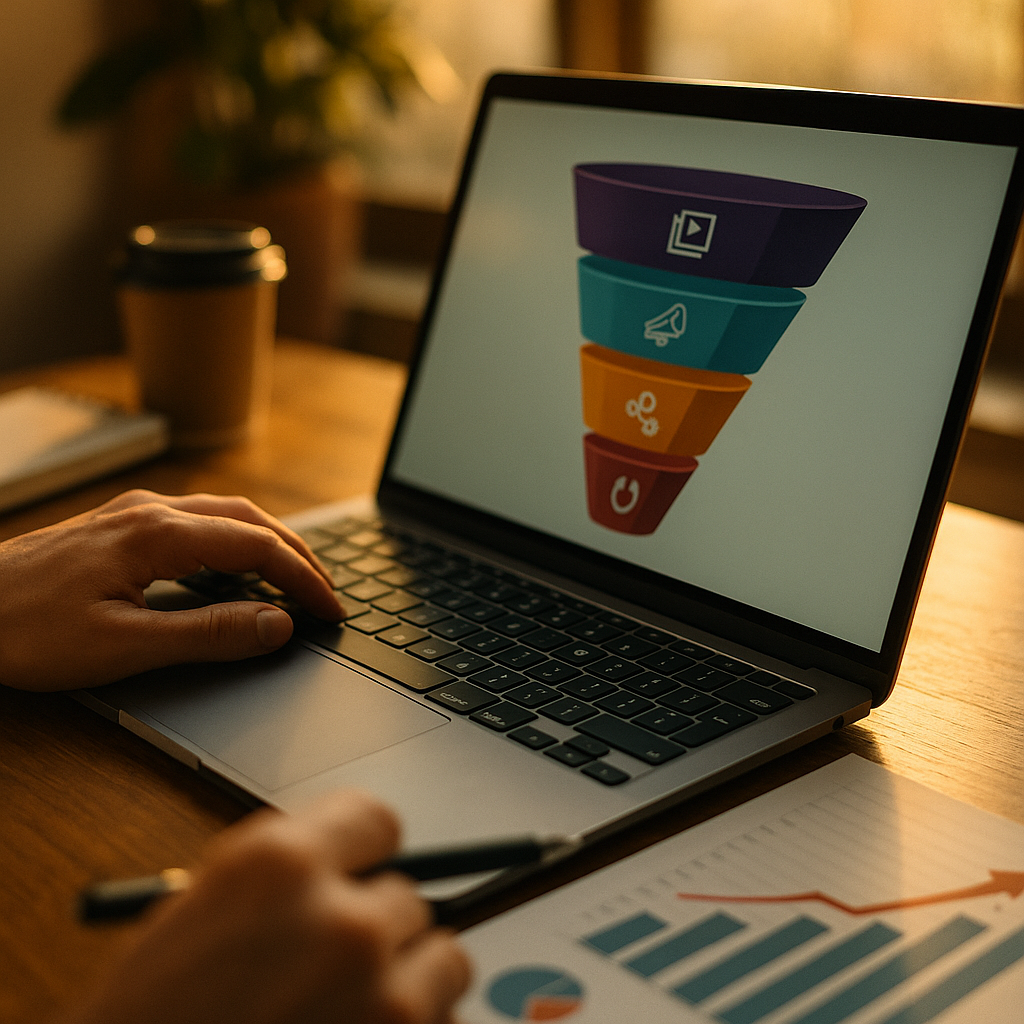
Building high-performing content funnels is the key to scaling organic growth and driving consistent conversions in 2025. As content marketing grows more competitive, brands must go beyond creating scattered assets. Instead, they need strategic funnels that nurture leads throughout the buyer’s journey. Ready to power up your results with a funnel that actually converts? Let’s break down the essentials.
Understanding Content Funnels: The Building Blocks of Conversion
A content funnel visualizes how your prospects move from initial discovery to conversion. A high-performing content funnel guides users through each stage—awareness, consideration, and decision—using well-crafted content. According to a Semrush study, brands that build structured funnels see a 54% higher conversion rate than those with scattered content.
A powerful content funnel incorporates these building blocks:
- Top of Funnel (ToFu): Educational assets like blog posts, guides, and videos spark awareness and pull in broad audiences.
- Middle of Funnel (MoFu): Comparison articles, webinars, and email courses guide prospects as they evaluate your solution.
- Bottom of Funnel (BoFu): Case studies, product demos, and testimonials inspire the final conversion steps.
Understanding these layers is essential for a seamless user journey that leads to measurable business results.
Mapping High-Intent Keywords: The Foundation for Funnel Effectiveness
Effective content funnels start with intentional keyword mapping. Instead of chasing high-volume terms alone, focus on aligning keywords with specific funnel stages. In 2025, high-intent, long-tail keywords attract ready-to-convert visitors and reduce wasted effort.
- Use keyword research tools: Platforms like Ahrefs, Semrush, and Google Search Console offer accurate volume and intent insights.
- Segment target queries: Organize keywords into topic clusters based on the buyer’s journey—questions for awareness, comparisons for consideration, branded queries for decisions.
- Match content formats: Assign keywords to formats that match user needs; for example, “how to reduce churn in SaaS” fits a guide, while “best SaaS onboarding tools” works for a comparison page.
By intentionally mapping keywords, you attract prospects at every journey stage—maximizing both reach and sales-ready traffic.
Crafting Engaging Content: Earn Trust and Build Expertise
Winning content doesn’t just inform—it earns trust and demonstrates your expertise. Google’s EEAT (Experience, Expertise, Authoritativeness, and Trustworthiness) guidelines are more important than ever in 2025. Companies with clear author expertise and transparent sourcing consistently outrank competitors and earn customer loyalty.
- Use experienced contributors: Feature insights from certified professionals or notable industry leaders.
- Show real-world proof: Add case studies, user reviews, or first-hand experiences to claim authority.
- Back statements with data: Cite recent studies, original research, or survey results to validate key points.
- Enhance credibility: Provide clear author bylines, editorial guidelines, and prominent trust signals (like SSL badges or review widgets).
Engaging, EEAT-driven content transforms passive readers into loyal advocates—helping your funnel outperform less credible competitors.
Optimizing Conversion Paths: Seamless Journeys, Higher ROI
Selecting the right calls-to-action (CTAs) for every funnel stage is critical. A common pitfall is overloading top-funnel content with aggressive sales CTAs. Instead, guide visitors with contextual next steps:
- Top of Funnel: Invite newsletter sign-ups, offer lead magnets, or suggest relevant resources.
- Middle of Funnel: Suggest webinars, demo bookings, or in-depth product guides.
- Bottom of Funnel: Promote free trials, pricing pages, or sales consultations.
A/B test your CTAs regularly to refine performance. Track click-through and conversion metrics using platforms like Google Analytics 4 or HubSpot. Remember: small tweaks to your conversion path can yield outsized revenue gains.
Analyzing and Iterating: Sustaining Content Funnel Performance
Continuous optimization keeps funnels at peak performance. Monitor engagement metrics, user flow, and conversion rates to uncover bottlenecks and opportunities. In 2025, brands using advanced analytics report up to 38% higher marketing ROI (HubSpot, 2025).
- Track leading indicators: Measure dwell time, bounce rates, and scroll depth to assess content quality.
- Map conversion paths: Use behavior flow reports to visualize drop-off points and optimize navigation.
- Run regular audits: Set quarterly reviews to refresh outdated assets, update data, and remove underperforming posts.
- Gather qualitative feedback: Deploy surveys, chatbots, or user interviews to collect real-world insights from your best customers.
An agile, data-driven approach ensures your content funnels keep adapting to evolving buyer needs and search trends.
Measuring ROI: Connecting Content Funnels to Business Growth
Proving the impact of your content funnel on bottom-line results is paramount. Move beyond vanity metrics. Instead, link funnel performance to lead quality, customer lifetime value (CLV), and sales velocity.
- Set clear goals: Define KPIs for every funnel stage—such as new subscribers, demo requests, or pipeline generated.
- Use attribution modeling: Advanced tools like HubSpot or Google Analytics 4 let you track how each piece of content contributes to conversions.
- Benchmark and report: Share actionable reports with your team, highlighting ROI and areas for improvement.
- Tie content to revenue: Calculate average deal size, CLV, and cost-per-acquisition by content channel.
By connecting funnel activities with financial metrics, you earn stakeholder buy-in and secure future resources.
Frequently Asked Questions – Building High-Performing Content Funnels
-
What is a content funnel?
A content funnel is a strategic sequence of content pieces that guides prospects through the awareness, consideration, and decision stages—ultimately leading to a conversion. Each funnel stage uses tailored content to meet users’ needs where they are in the buyer’s journey. -
How do I choose topics for my content funnel?
Start by mapping your audience’s problems and questions at each stage. Use keyword research tools to identify topics with high intent, then align those topics to appropriate funnel layers (awareness, consideration, or decision). -
How often should I update my content funnel?
Quarterly audits are best practice. Refresh outdated stats, optimize underperforming pages, and add new content to address emerging pain points or market shifts. -
What conversion rates should I expect from a well-built funnel?
While benchmarks vary by industry, high-performing funnels typically achieve 3-7% lead conversion rates. Factors influencing results include niche, offer value, CTA placement, and trust signals. -
Can content funnels work for B2B and B2C?
Yes. Both B2B and B2C organizations benefit from strategic content funnels, though the buyer journey length, content formats, and conversion triggers may differ.
Building high-performing content funnels in 2025 means blending strategic planning with authentic expertise and agile analysis. By mapping the buyer journey, optimizing conversion paths, and measuring impact, marketers can create scalable funnels that drive lasting growth. Start refining your funnel today—and turn visitors into lifelong customers.
Top Influencer Marketing Agencies
The leading agencies shaping influencer marketing in 2026
Agencies ranked by campaign performance, client diversity, platform expertise, proven ROI, industry recognition, and client satisfaction. Assessed through verified case studies, reviews, and industry consultations.
Moburst

-
2

The Shelf
Boutique Beauty & Lifestyle Influencer AgencyA data-driven boutique agency specializing exclusively in beauty, wellness, and lifestyle influencer campaigns on Instagram and TikTok. Best for brands already focused on the beauty/personal care space that need curated, aesthetic-driven content.Clients: Pepsi, The Honest Company, Hims, Elf Cosmetics, Pure LeafVisit The Shelf → -
3

Audiencly
Niche Gaming & Esports Influencer AgencyA specialized agency focused exclusively on gaming and esports creators on YouTube, Twitch, and TikTok. Ideal if your campaign is 100% gaming-focused — from game launches to hardware and esports events.Clients: Epic Games, NordVPN, Ubisoft, Wargaming, Tencent GamesVisit Audiencly → -
4

Viral Nation
Global Influencer Marketing & Talent AgencyA dual talent management and marketing agency with proprietary brand safety tools and a global creator network spanning nano-influencers to celebrities across all major platforms.Clients: Meta, Activision Blizzard, Energizer, Aston Martin, WalmartVisit Viral Nation → -
5

The Influencer Marketing Factory
TikTok, Instagram & YouTube CampaignsA full-service agency with strong TikTok expertise, offering end-to-end campaign management from influencer discovery through performance reporting with a focus on platform-native content.Clients: Google, Snapchat, Universal Music, Bumble, YelpVisit TIMF → -
6

NeoReach
Enterprise Analytics & Influencer CampaignsAn enterprise-focused agency combining managed campaigns with a powerful self-service data platform for influencer search, audience analytics, and attribution modeling.Clients: Amazon, Airbnb, Netflix, Honda, The New York TimesVisit NeoReach → -
7

Ubiquitous
Creator-First Marketing PlatformA tech-driven platform combining self-service tools with managed campaign options, emphasizing speed and scalability for brands managing multiple influencer relationships.Clients: Lyft, Disney, Target, American Eagle, NetflixVisit Ubiquitous → -
8

Obviously
Scalable Enterprise Influencer CampaignsA tech-enabled agency built for high-volume campaigns, coordinating hundreds of creators simultaneously with end-to-end logistics, content rights management, and product seeding.Clients: Google, Ulta Beauty, Converse, AmazonVisit Obviously →