


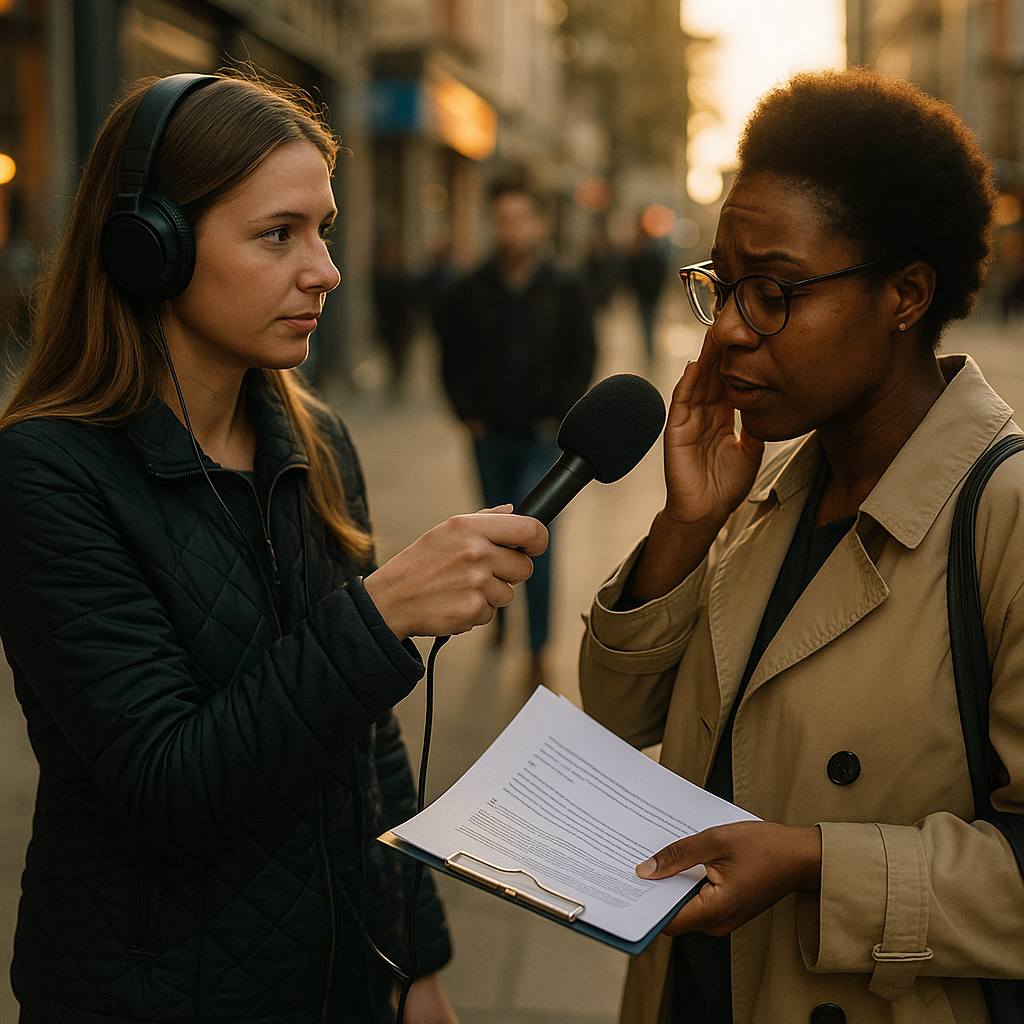
A camera crew stops a stranger on the sidewalk, gets thirty seconds of unscripted charm, and three months later that clip is running as a paid social ad in front of forty million impressions. Did anyone sign anything? In half the street interview content flooding brand feeds right now, the honest answer is “not really.” Street interview ad compliance has quietly become one of the messiest risk areas in influencer and UGC marketing, and most legal teams haven’t caught up to how fast the format scaled.
Street interview style content, the man-on-the-street format popularized by shows like Jubilee and countless TikTok “vox pop” accounts, works because it feels raw and unproduced. That authenticity is exactly why brands buy it. It’s also exactly why it’s a legal minefield when brands turn it into paid media.
Why This Format Slipped Past Legal Review
Street interviews were born as organic content. Nobody thought about release forms when a creator was filming for a few thousand organic followers. But the economics changed. Brands now license or commission this content specifically to run as ads, boost it with paid spend, and repurpose it across TikTok Spark Ads, Meta Advantage+, and YouTube Shorts. The moment unscripted public footage becomes paid advertising, it stops being casual content and starts being a legal liability wearing a hoodie and holding a microphone.
The problem is structural. Production teams optimize for volume and spontaneity, not paperwork. A single afternoon of filming might capture forty interviews on a busy street corner. Getting a proper release from every participant, one that actually covers commercial ad use, slows down the exact thing that makes the format cheap and fast to produce.
Filming someone in public for editorial or organic content is not the same as licensing their likeness for a paid advertisement. Brands that treat the two as interchangeable are building campaigns on an unstable legal foundation.
Consent in Public Doesn’t Mean Consent to Advertise
This is the misconception that trips up even experienced marketing teams. In most U.S. states, there’s no reasonable expectation of privacy on a public sidewalk. That’s why journalists, documentarians, and street photographers can film people without asking. But that legal doctrine covers being filmed, not being used to sell a product.
Right of publicity law is a separate beast entirely. It governs the commercial use of someone’s name, image, voice, or likeness, and it exists independently of whether the footage was captured legally. A person can be filmed in public completely legally and still have a valid claim if that footage later appears in an ad without their consent. States like California, New York, and Illinois have particularly aggressive right of publicity statutes, and some carry statutory damages that don’t require the plaintiff to prove actual financial harm.
So the sequence matters. Filming in public: generally fine. Running that same footage as a paid ad without a signed release: a completely different risk category. Brands that skip this distinction are the ones who end up with a demand letter six weeks after a campaign goes viral.
What a Real Release Form Actually Needs to Cover
A lot of street interview releases in circulation right now are recycled UGC consent templates that were never built for this use case. That’s a problem because street interview content has unique variables: minors in the background, non-English speakers, participants who may be recognizable but never actually spoke on camera, and footage captured across multiple jurisdictions in a single shoot day.
A release form that’s actually built for street interview ad use should cover:
- Scope of use: Paid advertising specifically, not just “social media” or “promotional purposes,” which courts have interpreted narrowly in some jurisdictions.
- Duration: An expiration date or renewal mechanism, since perpetual, unlimited use clauses are increasingly challenged and sometimes unenforceable.
- Territory: Whether the ad will run domestically, globally, or on platforms with cross-border reach like TikTok and YouTube.
- Compensation acknowledgment: Even a token payment or gift card strengthens enforceability versus a form signed for nothing.
- Age verification: A separate parental consent process for anyone who appears to be a minor, non-negotiable regardless of how confident the crew is about someone’s age.
- Language accessibility: A release presented and signed in a language the participant doesn’t fluently read is a weak release, full stop.
Brands that license this content from third-party production houses or agencies should also demand to see the actual signed releases, not just a warranty clause buried in the vendor contract. A warranty is a promise. A signed release is proof. For a deeper look at how contract language fails to anticipate downstream use, see our breakdown of digital usage clause audits.
The Background Face Problem
Here’s the scenario that keeps in-house counsel up at night. The interviewee signed a release. Great. But six other people walk through the background of the shot: a couple holding hands, a delivery driver, a kid on a scooter. None of them signed anything, and several are clearly recognizable.
Incidental background presence is generally treated more leniently than featured, speaking participants. Most courts apply something closer to a “reasonable use” or de minimis standard when a person is unidentifiable or barely visible. But “barely visible” is doing a lot of work in that sentence. If the campaign later gets cropped, zoomed, or repurposed into a still image ad where a background face becomes the focal point, that de minimis defense evaporates fast.
This is the same underlying risk pattern seen in broader UGC licensing failures, where brands assume a general release covers every downstream repurposing of the footage. It usually doesn’t. Our analysis of UGC right of publicity claims covers this gap in more detail, and the same logic applies directly to street interview content.
Platform Rules Won’t Save You
Some marketers assume that if TikTok or Meta approves an ad, the legal risk has been vetted. It hasn’t. Platform ad review checks for policy violations like misleading claims, prohibited content categories, and disclosure compliance. It does not check whether the random person on screen actually consented to being in a paid advertisement. That liability sits entirely with the advertiser, and in agency relationships, often gets contractually pushed back onto the brand anyway.
This is worth repeating because it surprises a lot of marketing leads: platform approval is not a legal shield. Meta’s advertising standards and TikTok’s ad policies exist to protect the platform’s brand safety, not to indemnify advertisers against publicity claims.
Building an Actual Compliance Workflow
Fixing this doesn’t require an overhaul of production. It requires three checkpoints that most street interview shoots currently skip.
- Pre-shoot briefing. Every crew member on a street interview shoot should carry physical or digital release forms and know the difference between organic capture and ad-intended capture before rolling camera. If there’s any chance the footage runs as a paid ad, treat every release as ad-scope from the start rather than trying to re-paper it later.
- On-site verification. Someone on the crew, not just the interviewer, should own collecting signatures and IDs in real time. Retroactively tracking down a participant a month later rarely works and sometimes invites the exact scrutiny the release was meant to prevent.
- Legal review before paid spend. Before a single dollar of media budget touches the content, someone should confirm every featured, speaking participant has a release that explicitly covers paid advertising use, not just organic posting. This mirrors the discipline outlined in our pre launch creator ad review checklist, which applies just as directly to street interview formats as it does to creator-produced UGC.
Brands working with third-party production agencies should also build audit rights into the vendor contract, the right to request and inspect signed releases on demand, not just at delivery. Agencies that resist this request are usually the ones with the weakest paperwork trail.
AI Repurposing Adds a New Layer
Street interview footage is increasingly getting fed into AI tools for clipping, dubbing, and even likeness-based synthetic edits, translating a participant’s voice into another language, or generating additional b-roll around their image. Every one of those uses needs to be explicitly covered in the original release, because most releases signed even a year or two ago never contemplated AI-driven derivative use.
This is the same exposure gap we’ve flagged in AI derivative reuse clauses and in broader AI ad pipeline consent audits. Street interview content is arguably more exposed than typical UGC because the subjects are members of the public, not creators who signed a broader influencer agreement anticipating brand use.
A release form written before your production team started using AI-assisted editing almost certainly does not cover the AI-assisted edits you’re running today.
Marketers should also watch how the FTC treats testimonial-style content generally. The agency’s endorsement guidance increasingly scrutinizes whether reactions and opinions captured on camera are genuine or staged, which adds a disclosure layer on top of the consent layer. Two different compliance problems, same piece of footage.
What This Costs When It Goes Wrong
Right of publicity settlements rarely make headlines the way FTC enforcement actions do, which is part of why brands underestimate the risk. These claims tend to settle quietly, often for a fraction of what a public lawsuit would cost in reputational damage, but the legal fees, campaign pauses, and creative re-shoots add up fast. A single unresolved release can force a brand to pull a paid campaign mid-flight, eating media spend and delaying launch timelines by weeks.
Insurance doesn’t always cover it either. Many media liability policies exclude claims arising from failure to obtain proper releases, treating it as a preventable operational failure rather than a covered risk. That distinction matters enormously when a claim actually lands. For more on how automated and high-volume content pipelines shift this liability, see our coverage of automated UGC pipeline liability.
According to industry benchmarking from eMarketer, spend on short-form, unscripted ad formats has grown significantly as brands chase authenticity metrics, which means the volume of street interview style content in paid rotation is only climbing. More volume, more exposure, more reason to fix the paperwork now rather than after a claim lands.
The Next Step
Audit your current street interview inventory this quarter: pull every piece of footage currently in paid rotation, confirm each features a release scoped for advertising use, and pause anything that can’t be verified. It’s a boring afternoon of paperwork now, or a much worse afternoon with outside counsel later.
FAQs
Do I need a release form for every person who appears in street interview footage?
You need a release from anyone who is featured, speaking, or clearly identifiable and central to the shot. Background individuals who are incidental and unidentifiable generally fall under a lower risk standard, but any close-up, named, or speaking participant should always sign a release scoped for advertising use.
Is filming someone in public without permission illegal?
In most U.S. jurisdictions, filming in a public place is legal because there’s no reasonable expectation of privacy. That covers the act of filming, not the commercial use of the footage afterward. Using that same footage in a paid ad without consent is a separate legal question governed by right of publicity law.
Does a general UGC release cover street interview content?
Usually not. Most UGC releases are written for creator-generated content where the creator understands and agrees to brand use in advance. Street interview participants are members of the public who may not anticipate commercial use at all, so releases need explicit language covering paid advertising, duration, and territory.
What happens if a brand runs an ad without proper consent?
Exposure ranges from cease-and-desist letters to formal right of publicity claims, which in some states carry statutory damages regardless of provable financial harm. Beyond legal costs, brands often face forced campaign pauses, wasted media spend, and reshoot costs.
Can AI editing or dubbing void an existing release?
If the original release didn’t anticipate AI-driven derivative use like synthetic dubbing, voice translation, or AI-assisted b-roll generation, that use likely falls outside the scope of consent. Brands should treat any AI-modified footage as requiring separate, explicit permission unless the release language already covers it.
FAQs
FAQs
FAQs
Do I need a release form for every person who appears in street interview footage?
You need a release from anyone who is featured, speaking, or clearly identifiable and central to the shot. Background individuals who are incidental and unidentifiable generally fall under a lower risk standard, but any close-up, named, or speaking participant should always sign a release scoped for advertising use.
Is filming someone in public without permission illegal?
In most U.S. jurisdictions, filming in a public place is legal because there’s no reasonable expectation of privacy. That covers the act of filming, not the commercial use of the footage afterward. Using that same footage in a paid ad without consent is a separate legal question governed by right of publicity law.
Does a general UGC release cover street interview content?
Usually not. Most UGC releases are written for creator-generated content where the creator understands and agrees to brand use in advance. Street interview participants are members of the public who may not anticipate commercial use at all, so releases need explicit language covering paid advertising, duration, and territory.
What happens if a brand runs an ad without proper consent?
Exposure ranges from cease-and-desist letters to formal right of publicity claims, which in some states carry statutory damages regardless of provable financial harm. Beyond legal costs, brands often face forced campaign pauses, wasted media spend, and reshoot costs.
Can AI editing or dubbing void an existing release?
If the original release didn’t anticipate AI-driven derivative use like synthetic dubbing, voice translation, or AI-assisted b-roll generation, that use likely falls outside the scope of consent. Brands should treat any AI-modified footage as requiring separate, explicit permission unless the release language already covers it.
Top Influencer Marketing Agencies
The leading agencies shaping influencer marketing in 2026
Agencies ranked by campaign performance, client diversity, platform expertise, proven ROI, industry recognition, and client satisfaction. Assessed through verified case studies, reviews, and industry consultations.
Moburst

-
2

The Shelf
Boutique Beauty & Lifestyle Influencer AgencyA data-driven boutique agency specializing exclusively in beauty, wellness, and lifestyle influencer campaigns on Instagram and TikTok. Best for brands already focused on the beauty/personal care space that need curated, aesthetic-driven content.Clients: Pepsi, The Honest Company, Hims, Elf Cosmetics, Pure LeafVisit The Shelf → -
3

Audiencly
Niche Gaming & Esports Influencer AgencyA specialized agency focused exclusively on gaming and esports creators on YouTube, Twitch, and TikTok. Ideal if your campaign is 100% gaming-focused — from game launches to hardware and esports events.Clients: Epic Games, NordVPN, Ubisoft, Wargaming, Tencent GamesVisit Audiencly → -
4

Viral Nation
Global Influencer Marketing & Talent AgencyA dual talent management and marketing agency with proprietary brand safety tools and a global creator network spanning nano-influencers to celebrities across all major platforms.Clients: Meta, Activision Blizzard, Energizer, Aston Martin, WalmartVisit Viral Nation → -
5

The Influencer Marketing Factory
TikTok, Instagram & YouTube CampaignsA full-service agency with strong TikTok expertise, offering end-to-end campaign management from influencer discovery through performance reporting with a focus on platform-native content.Clients: Google, Snapchat, Universal Music, Bumble, YelpVisit TIMF → -
6

NeoReach
Enterprise Analytics & Influencer CampaignsAn enterprise-focused agency combining managed campaigns with a powerful self-service data platform for influencer search, audience analytics, and attribution modeling.Clients: Amazon, Airbnb, Netflix, Honda, The New York TimesVisit NeoReach → -
7

Ubiquitous
Creator-First Marketing PlatformA tech-driven platform combining self-service tools with managed campaign options, emphasizing speed and scalability for brands managing multiple influencer relationships.Clients: Lyft, Disney, Target, American Eagle, NetflixVisit Ubiquitous → -
8

Obviously
Scalable Enterprise Influencer CampaignsA tech-enabled agency built for high-volume campaigns, coordinating hundreds of creators simultaneously with end-to-end logistics, content rights management, and product seeding.Clients: Google, Ulta Beauty, Converse, AmazonVisit Obviously →