


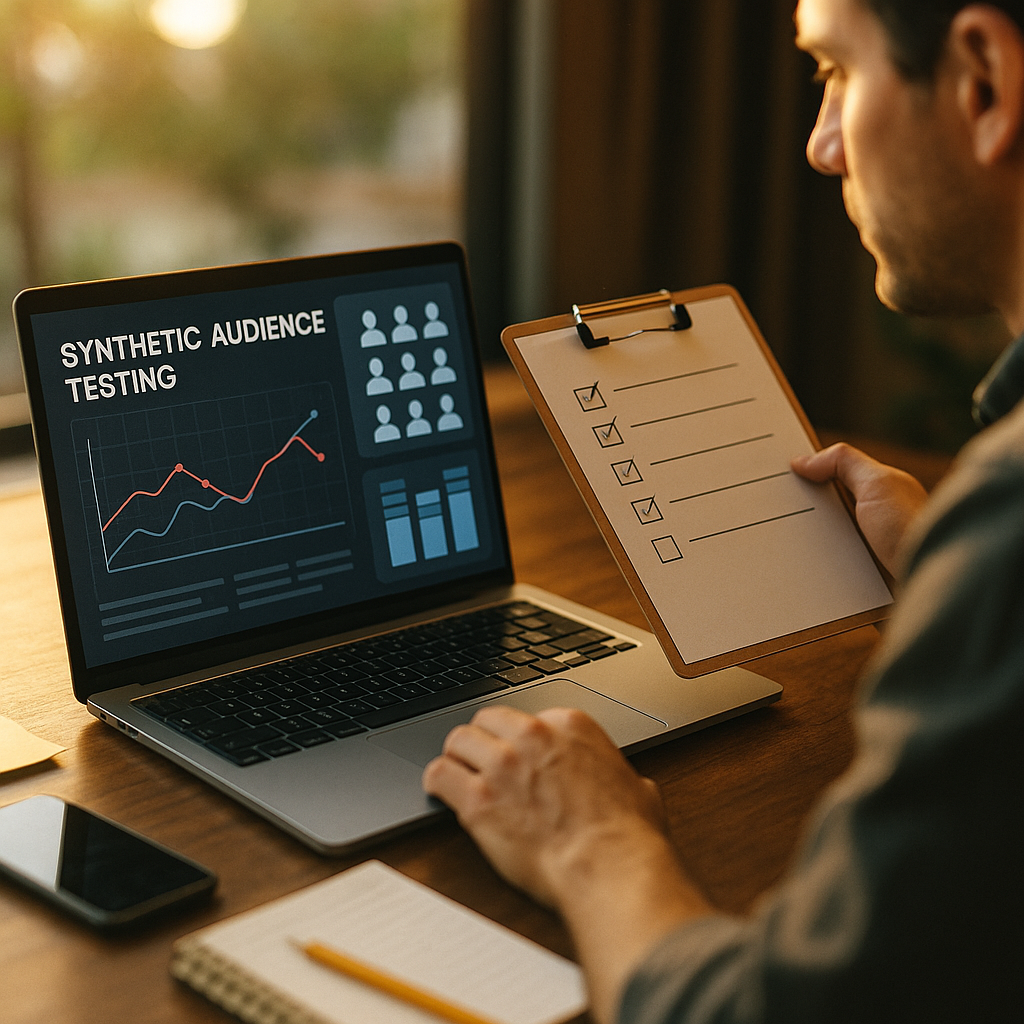
Roughly 60% of ad campaigns underperform their own forecasts, and most marketers only find out after the invoice clears. Synthetic audience testing tools promise to change that by simulating consumer reactions before a single dollar hits a media plan. The pitch is seductive: AI personas that “react” to your creative, flag weak hooks, and predict drop-off, all before launch. But which vendors actually deliver signal instead of noise?
The Pitch, and Why It’s Suddenly Everywhere
Synthetic audiences are AI-generated personas trained on behavioral, demographic, and psychographic data meant to mirror real market segments. Instead of running a $15,000 pre-launch focus group, you feed your creative into a model that simulates how a 34-year-old suburban parent or a Gen Z skincare enthusiast might respond. The output looks like research: sentiment scores, predicted CTR ranges, even simulated comment threads.
The category has exploded because traditional pre-testing is slow and expensive. Nielsen-style panels take weeks. Focus groups introduce their own bias — people perform for the room. Synthetic testing claims to compress that timeline to hours and cut costs by 70-90%, according to vendor benchmarks circulating in agency pitch decks. Whether those numbers hold up under scrutiny is a separate question, and one every buyer should ask before signing a contract.
Synthetic audience tools don’t replace market research — they triage it. Treat them as a filter for bad creative, not a crystal ball for campaign performance.
What These Tools Actually Do Under the Hood
Most platforms in this space fall into three buckets. First, there are LLM-persona simulators that prompt a language model to “role-play” as a target segment and react to ad copy or storyboards. Second, there are trained behavioral models built on historical ad performance data, panel responses, and purchase signals, which predict engagement using regression or classification rather than generative role-play. Third, a smaller group combines both — using synthetic personas to generate qualitative reactions, then scoring those reactions against a quantitative model trained on real campaign outcomes.
The distinction matters enormously for accuracy. Pure LLM role-play tools are fast and cheap but prone to hallucinated confidence — the model will happily tell you your ad “resonates strongly with budget-conscious millennials” with zero grounding in actual behavior. This is the same failure mode we’ve flagged in RAG vendor evaluations for content accuracy — generative confidence isn’t the same as validated accuracy. Vendors that blend real panel data with synthetic scaling tend to produce more defensible predictions, but they cost more and take longer to onboard.
Where the ROI Case Actually Holds Up
The strongest use case isn’t predicting exact conversion lift. It’s catching obviously bad creative before it burns media budget. If a synthetic panel flags that your hook is confusing, your CTA is buried, or your messaging skews tone-deaf for a segment, that’s actionable — and it’s the kind of signal a human creative team can miss after the fifteenth revision round.
Brands running high-frequency creative testing (think DTC performance marketers cycling 20+ ad variants a week) get the most value here. The tools act as a cheap first-pass filter, letting teams kill weak variants before they ever reach a live A/B test on Meta or TikTok. That’s a genuine efficiency gain, not hype. eMarketer has tracked rising ad production costs alongside shrinking testing budgets, which is exactly the squeeze synthetic testing is built to relieve — see eMarketer’s advertising data for broader spend trends.
Vendor Evaluation Criteria for 2026
Not all synthetic audience platforms deserve a seat at the media planning table. Here’s what actually separates the credible vendors from the demo-ware.
- Data provenance: Ask exactly what the persona models are trained on. “Proprietary consumer insights” is not an answer — demand specifics on panel size, recency, and geographic coverage.
- Validation against real outcomes: The vendor should be able to show backtested accuracy — did synthetic predictions actually correlate with real campaign performance across a meaningful sample size, not three cherry-picked case studies?
- Segment granularity: Broad personas (“Gen Z consumer”) are nearly useless. Look for tools that let you build audiences matching your actual first-party segments or CDP cohorts.
- Explainability: Can the tool show why it flagged a creative as weak, or does it just output a score? Black-box scoring is a compliance and trust liability, similar to the transparency gaps we’ve covered in explainable AI requirements for marketing.
- Bias auditing: Synthetic personas trained on skewed data will replicate that skew. Ask vendors how they test for demographic or cultural bias in persona responses.
- Integration friction: Does it plug into your existing creative workflow (Figma, Frame.io, your DAM) or require a separate upload-and-wait process that slows your team down?
Questions to Ask Before You Sign
Vendor demos are optimized to impress, not inform. Push past the polish with direct questions: What’s your model’s false-positive rate on flagging “weak” creative that later performed well? How often do you retrain on new market data? Can you show a case where the tool was wrong, and what you changed afterward? A vendor with confidence in their product will have answers ready. A vendor dodging the question is telling you something too.
It’s also worth asking whether the tool is a genuinely proprietary model or a wrapper around a foundation model API with a marketing-specific prompt layer. This distinction affects both cost structure and defensibility of results — the same scrutiny we’ve recommended when evaluating AI vendors for proprietary tech versus GPT wrappers. If pricing scales per simulation or per token, ask how costs behave at high test volume; token-based pricing models can spike unpredictably as detailed in our breakdown of token-based AI pricing at scale.
Where Synthetic Testing Breaks Down
Synthetic audiences are trained on patterns, not lived experience. They struggle with genuinely novel creative concepts, cultural nuance outside their training distribution, and emotional reactions that don’t map cleanly to historical data. A synthetic persona can tell you a joke “should” land with a demographic based on past humor patterns — it can’t tell you whether your specific joke is actually funny to actual humans in the actual cultural moment.
This is where brand safety and cultural sensitivity checks still need a human layer, particularly for campaigns touching real-time trends. Our coverage of AI creative-adaptation tools for cultural moments makes a similar point: automated systems are pattern-matchers, and cultural moments are, by definition, breaking the pattern.
There’s also a fraud-adjacent risk worth naming: synthetic testing tools trained on bot-contaminated engagement data will produce garbage predictions. If your vendor’s training data includes influencer campaign engagement that was never audited for authenticity, you’re compounding one data quality problem with another. It’s the same underlying issue explored in AI fraud detection for influencer audiences — bad inputs produce confidently wrong outputs, every time.
A synthetic panel is only as trustworthy as the real-world data it was trained on. Garbage engagement data in, confidently wrong predictions out.
Building the Business Case Internally
Getting budget approved for a new testing layer means showing the math, not just the promise. Frame it as a cost-avoidance tool, not a research replacement. If your team spends $200,000 a quarter on paid social and even a 10% reduction in wasted spend on underperforming creative pays for the tool three times over, that’s the pitch finance wants to hear.
Track a hard metric during your pilot: how many creative variants did the synthetic tool correctly flag as weak before launch, and how many of those would have burned budget in a live test? Run this in parallel with your existing testing process for at least one full quarter before replacing anything. Cutting your human research budget too early, based on unproven vendor claims, is its own kind of wasted spend.
Attribution teams should also weigh in early. If synthetic predictions don’t map cleanly to your existing measurement stack, you’ll end up with two disconnected sources of truth. This is the same identity and attribution friction covered in unified identity resolution for cross-channel attribution — new AI tools are only useful if they plug into a measurement system you already trust.
A Quick Sanity Check Before You Buy
Run a small pilot on creative you’ve already launched and measured. Feed the historical creative into the synthetic tool blind, compare its predictions against actual performance data you already have. If the tool can’t retroactively predict something you already know the answer to, it’s unlikely to reliably predict something you don’t. This single test will filter out more bad vendors than any sales call. For broader context on how AI-generated research stacks up against traditional methodologies, HubSpot’s research on marketing analytics benchmarks and Sprout Social’s social media performance data are useful reference points for what “good” prediction accuracy actually looks like in practice.
Bottom line: pilot one synthetic audience vendor against creative you’ve already launched and measured, demand backtested accuracy data before signing anything longer than a quarter, and keep a human research check in place until the tool proves itself on your own numbers — not the vendor’s case study.
Frequently Asked Questions
What is synthetic audience testing in advertising?
Synthetic audience testing uses AI-generated personas, trained on behavioral, demographic, or psychographic data, to simulate how real consumer segments might react to ad creative before a campaign launches. It’s used to catch weak messaging, confusing hooks, or tone mismatches early.
How accurate are synthetic audience predictions compared to real testing?
Accuracy varies widely by vendor and depends heavily on the quality and recency of training data. Tools that blend real panel data with synthetic scaling tend to be more reliable than pure LLM role-play tools, which can produce confident but ungrounded predictions.
Can synthetic audience tools replace focus groups or A/B testing?
No. They work best as an early-stage filter to eliminate obviously weak creative before it reaches paid testing or live focus groups, not as a full replacement for measurement against real audiences.
How much can synthetic testing reduce wasted ad spend?
Vendors commonly cite cost reductions of 70-90% versus traditional pre-launch research, though actual savings depend on how many weak creative variants the tool correctly flags before media dollars are spent. Brands should validate this with their own pilot data rather than vendor claims alone.
What should marketers ask vendors before buying a synthetic testing tool?
Ask about data provenance, backtested accuracy against real campaign outcomes, bias auditing practices, explainability of scoring, and whether pricing scales predictably at high test volumes.
Are there risks in relying on synthetic audience data?
Yes. Models trained on biased, outdated, or fraud-contaminated engagement data can produce confidently wrong predictions. Cultural nuance and genuinely novel creative concepts are also areas where synthetic personas tend to underperform human judgment.
Top Influencer Marketing Agencies
The leading agencies shaping influencer marketing in 2026
Agencies ranked by campaign performance, client diversity, platform expertise, proven ROI, industry recognition, and client satisfaction. Assessed through verified case studies, reviews, and industry consultations.
Moburst

-
2

The Shelf
Boutique Beauty & Lifestyle Influencer AgencyA data-driven boutique agency specializing exclusively in beauty, wellness, and lifestyle influencer campaigns on Instagram and TikTok. Best for brands already focused on the beauty/personal care space that need curated, aesthetic-driven content.Clients: Pepsi, The Honest Company, Hims, Elf Cosmetics, Pure LeafVisit The Shelf → -
3

Audiencly
Niche Gaming & Esports Influencer AgencyA specialized agency focused exclusively on gaming and esports creators on YouTube, Twitch, and TikTok. Ideal if your campaign is 100% gaming-focused — from game launches to hardware and esports events.Clients: Epic Games, NordVPN, Ubisoft, Wargaming, Tencent GamesVisit Audiencly → -
4

Viral Nation
Global Influencer Marketing & Talent AgencyA dual talent management and marketing agency with proprietary brand safety tools and a global creator network spanning nano-influencers to celebrities across all major platforms.Clients: Meta, Activision Blizzard, Energizer, Aston Martin, WalmartVisit Viral Nation → -
5

The Influencer Marketing Factory
TikTok, Instagram & YouTube CampaignsA full-service agency with strong TikTok expertise, offering end-to-end campaign management from influencer discovery through performance reporting with a focus on platform-native content.Clients: Google, Snapchat, Universal Music, Bumble, YelpVisit TIMF → -
6

NeoReach
Enterprise Analytics & Influencer CampaignsAn enterprise-focused agency combining managed campaigns with a powerful self-service data platform for influencer search, audience analytics, and attribution modeling.Clients: Amazon, Airbnb, Netflix, Honda, The New York TimesVisit NeoReach → -
7

Ubiquitous
Creator-First Marketing PlatformA tech-driven platform combining self-service tools with managed campaign options, emphasizing speed and scalability for brands managing multiple influencer relationships.Clients: Lyft, Disney, Target, American Eagle, NetflixVisit Ubiquitous → -
8

Obviously
Scalable Enterprise Influencer CampaignsA tech-enabled agency built for high-volume campaigns, coordinating hundreds of creators simultaneously with end-to-end logistics, content rights management, and product seeding.Clients: Google, Ulta Beauty, Converse, AmazonVisit Obviously →