


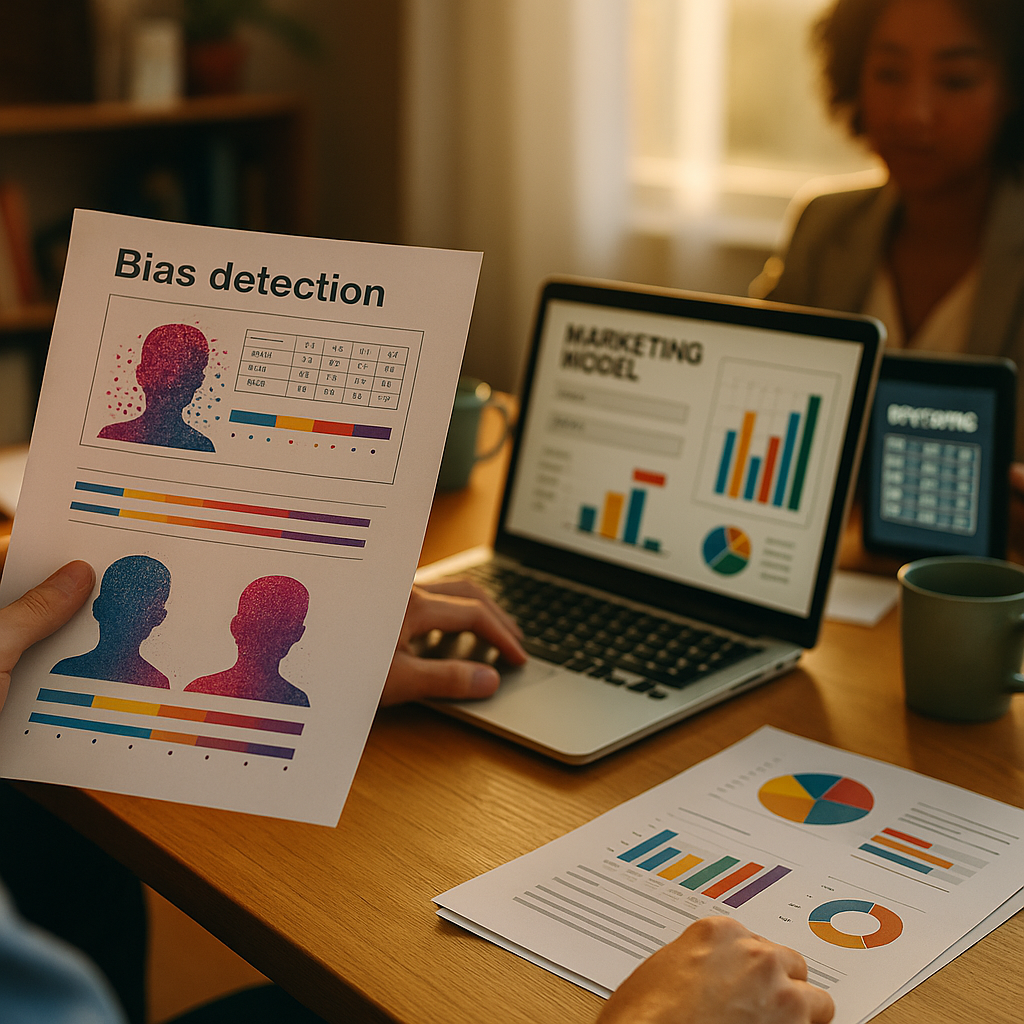
Nearly 60% of data used in AI systems could be synthetically generated by 2027, according to Gartner projections that marketing teams are already racing to catch up with. So here’s the uncomfortable question: if your brand’s recommendation engine, churn model, or creator-matching algorithm was trained partly on fake data, would you even know? And would you know if that fake data quietly baked in bias nobody caught?
Synthetic data for marketing model training isn’t a fringe experiment anymore. It’s a budget line. It’s a compliance workaround. It’s also, in the wrong hands, a bias amplifier dressed up as innovation.
What Synthetic Data Actually Is (and Isn’t)
Synthetic data is artificially generated information that mimics the statistical properties of real customer data without containing any actual customer records. Think of it as a stunt double: it looks like the real thing, performs like the real thing, but never puts an actual person at risk.
Marketing teams use it to train models for propensity scoring, lookalike audience generation, creator-brand affinity matching, and chatbot personalization. The appeal is obvious. Real customer data is expensive to license, risky to store, and increasingly restricted by regulation. Synthetic data promises the statistical utility without the legal exposure.
But synthetic isn’t a synonym for neutral. A generative model trained on biased historical data will produce synthetic data that reflects, and sometimes exaggerates, those same biases. Garbage in, synthetic garbage out — just with better packaging.
Why Brands Are Rushing to Adopt It
Three forces are driving the shift, and none of them are going away.
- Privacy regulation is tightening. Between GDPR enforcement in Europe and state-level privacy laws in the US, first-party data usage carries more legal friction than it did even two years ago. Synthetic data sidesteps a lot of that exposure because it isn’t tied to real individuals.
- Data scarcity for niche segments. If you’re building a model to predict engagement for a micro-influencer campaign in a small vertical, you may not have enough real conversions to train on. Synthetic data fills the gaps.
- Cost. Licensing third-party data panels or running large-scale surveys is expensive. Generating synthetic training sets, especially with tools built on platforms like HubSpot-style CRM exports or cloud ML services, is comparatively cheap.
Add to this the broader AI adoption wave. Marketing orgs are under pressure to ship AI-powered personalization fast, and synthetic data is often the quickest legal path to a usable training set. The problem is that “fast” and “fair” aren’t the same goal, and teams under deadline pressure tend to optimize for the former.
Synthetic data reduces privacy risk but does nothing to fix bias baked into the source model — if anything, it can launder that bias into a false sense of statistical legitimacy.
When It’s Genuinely Safe to Use
Synthetic data earns its keep in specific, well-defined situations. It’s not a blanket replacement for real data, it’s a tool for particular jobs.
Stress-testing models before launch. If you want to see how a bidding algorithm or a creator-matching engine behaves under edge cases — a sudden spike in a niche demographic, an unusual seasonal pattern — synthetic data lets you simulate scenarios you haven’t observed yet. This is genuinely low-risk because you’re testing behavior, not making production decisions from the output.
Filling gaps in small datasets without misrepresenting reality. If a brand has robust data for its top three customer segments but almost nothing for a newly launched product line, synthetic augmentation can extend the dataset proportionally, provided the underlying distributions are validated against whatever real data does exist.
Privacy-preserving A/B testing across markets. Teams working across the US and EU sometimes generate synthetic versions of customer cohorts to test campaign logic without moving real personal data across borders. This is one of the more mature use cases, and it pairs well with the kind of governance structures outlined in AI governance checklists already being adopted for autonomous media buying.
Training internal tools that never touch customer-facing decisions. Building an internal QA classifier to flag off-brand copy? Synthetic examples of “good” and “bad” copy variations are low-stakes and effective, similar to the approach used in automated brand voice testing.
When Synthetic Data Introduces Bias — and Why It’s Hard to Spot
Here’s where things get messy. Synthetic data is generated by a model, and that model learned patterns from somewhere. If the training data underrepresented certain demographics, geographies, or purchase behaviors, the synthetic output doesn’t fix that gap. It reproduces it, often with more confidence than the original data warranted.
Take creator-brand matching. If historical campaign data skews toward creators in major metro markets because that’s who brands historically worked with, a synthetic dataset generated from that history will keep suggesting the same profile of creator. It looks like the algorithm is being objective. It isn’t. It’s mirroring a historical blind spot at scale. This is the same underlying risk flagged in affinity score analysis — the model looks neutral, the data behind it rarely is.
A few specific failure modes worth watching for:
- Mode collapse. Generative models sometimes over-represent the “average” case and underproduce rare but real customer patterns, flattening diversity in the synthetic set.
- Feedback loops. If synthetic data is generated from a model’s own past predictions, and those predictions get used to train the next version, bias compounds with each generation. This is structurally similar to the drift problem covered in brand voice model drift.
- False confidence from clean data. Synthetic datasets are tidy. No missing values, no messy outliers. That cleanliness can make analysts trust the output more than they should, masking the fact that the underlying distribution never reflected reality in the first place.
A model trained on biased synthetic data doesn’t just repeat the bias — it often amplifies it, because generative processes tend to smooth toward the statistical mode and underweight edge cases that matter most for fairness.
Regulators are paying attention too. The FTC has signaled scrutiny of AI training practices that produce discriminatory outcomes, regardless of whether the underlying data was “real” or synthetic. In the UK, the ICO has published guidance treating synthetic data generated from personal data as still carrying some privacy obligations if re-identification is plausible. Synthetic doesn’t mean unregulated.
A Practical Framework: Audit Before You Train
Marketing and data teams need a lightweight but consistent process before synthetic data goes anywhere near a production model. Here’s a starting framework that works for most mid-size marketing orgs:
- Trace the lineage. Know exactly what real dataset the synthetic generator was trained on, and who was represented (or not) in it.
- Compare distributions. Run statistical comparisons between the synthetic dataset and any available real-world benchmark data. Significant divergence in demographic or behavioral distributions is a red flag.
- Test on held-out real data. Never validate a model purely against more synthetic data. Always hold back a slice of real, representative data for final validation.
- Assign ownership. Someone on the team — not a vendor, not “the algorithm” — needs to own the sign-off on synthetic data quality before it enters a training pipeline. This mirrors the human-in-the-loop principle behind human oversight protocols for autonomous systems.
- Re-audit quarterly. Synthetic data pipelines drift just like models do. What passed a bias check six months ago may not pass today, especially after a source dataset update.
This isn’t bureaucracy for its own sake. It’s the difference between a synthetic data strategy that reduces risk and one that just relocates it somewhere less visible. Teams already running martech stack audits for data fragmentation should fold synthetic data provenance into that same review cycle.
The ROI Case, Honestly Assessed
Does synthetic data actually save money? Usually, yes, particularly on data acquisition and compliance overhead. Teams report meaningful reductions in the cost of building training sets for niche audience models, and the privacy risk reduction alone can be worth it given how costly a data breach or regulatory fine has become.
But the ROI math falls apart if a biased synthetic model produces a campaign that alienates a customer segment, triggers a PR problem, or fails an audit. The cost of quietly shipping a biased lookalike model, one that never gets caught until a campaign underperforms with an entire demographic, dwarfs whatever was saved on data licensing. This is the same cost logic marketing leaders are already applying when comparing fine-tuning versus vendor licensing decisions: the cheaper option only wins if it doesn’t create downstream liabilities nobody budgeted for.
Industry benchmarking data from sources like eMarketer continues to show AI adoption in marketing outpacing measurable performance gains, a gap that’s frequently traced back to exactly this kind of foundational data problem rather than model architecture itself.
Next Step
Before your team greenlights another synthetic data pipeline, require a documented bias audit and a real-data validation step as a non-negotiable part of the build process. If a vendor or internal team can’t show you the lineage of their synthetic dataset, treat that as a red flag, not a formality.
Frequently Asked Questions
Is synthetic data safer than real customer data for marketing models?
It’s generally safer from a privacy standpoint since it doesn’t contain real personal records, but it isn’t automatically safer from a bias standpoint. Synthetic data can replicate or amplify whatever bias existed in the source data used to generate it.
Can synthetic data fully replace first-party data in marketing model training?
Not yet, and probably not soon. Most effective approaches blend synthetic data for augmentation and stress-testing with real data for final validation, rather than replacing real data entirely.
How do you detect bias in a synthetic marketing dataset?
Compare the synthetic dataset’s demographic and behavioral distributions against real-world benchmarks, check for underrepresentation of minority segments, and validate final model outputs against held-out real data rather than more synthetic data.
Does using synthetic data reduce compliance risk under GDPR or similar laws?
It can reduce risk when the synthetic data cannot be traced back to real individuals, but regulators including the ICO have noted that synthetic data derived from personal data may still carry obligations if re-identification is plausible.
Which marketing use cases are lowest-risk for synthetic data?
Internal stress-testing, scenario simulation, cross-border privacy-preserving experiments, and augmenting sparse datasets for niche segments are generally the lowest-risk applications, provided distributions are validated against real data.
Top Influencer Marketing Agencies
The leading agencies shaping influencer marketing in 2026
Agencies ranked by campaign performance, client diversity, platform expertise, proven ROI, industry recognition, and client satisfaction. Assessed through verified case studies, reviews, and industry consultations.
Moburst

-
2

The Shelf
Boutique Beauty & Lifestyle Influencer AgencyA data-driven boutique agency specializing exclusively in beauty, wellness, and lifestyle influencer campaigns on Instagram and TikTok. Best for brands already focused on the beauty/personal care space that need curated, aesthetic-driven content.Clients: Pepsi, The Honest Company, Hims, Elf Cosmetics, Pure LeafVisit The Shelf → -
3

Audiencly
Niche Gaming & Esports Influencer AgencyA specialized agency focused exclusively on gaming and esports creators on YouTube, Twitch, and TikTok. Ideal if your campaign is 100% gaming-focused — from game launches to hardware and esports events.Clients: Epic Games, NordVPN, Ubisoft, Wargaming, Tencent GamesVisit Audiencly → -
4

Viral Nation
Global Influencer Marketing & Talent AgencyA dual talent management and marketing agency with proprietary brand safety tools and a global creator network spanning nano-influencers to celebrities across all major platforms.Clients: Meta, Activision Blizzard, Energizer, Aston Martin, WalmartVisit Viral Nation → -
5

The Influencer Marketing Factory
TikTok, Instagram & YouTube CampaignsA full-service agency with strong TikTok expertise, offering end-to-end campaign management from influencer discovery through performance reporting with a focus on platform-native content.Clients: Google, Snapchat, Universal Music, Bumble, YelpVisit TIMF → -
6

NeoReach
Enterprise Analytics & Influencer CampaignsAn enterprise-focused agency combining managed campaigns with a powerful self-service data platform for influencer search, audience analytics, and attribution modeling.Clients: Amazon, Airbnb, Netflix, Honda, The New York TimesVisit NeoReach → -
7

Ubiquitous
Creator-First Marketing PlatformA tech-driven platform combining self-service tools with managed campaign options, emphasizing speed and scalability for brands managing multiple influencer relationships.Clients: Lyft, Disney, Target, American Eagle, NetflixVisit Ubiquitous → -
8

Obviously
Scalable Enterprise Influencer CampaignsA tech-enabled agency built for high-volume campaigns, coordinating hundreds of creators simultaneously with end-to-end logistics, content rights management, and product seeding.Clients: Google, Ulta Beauty, Converse, AmazonVisit Obviously →