


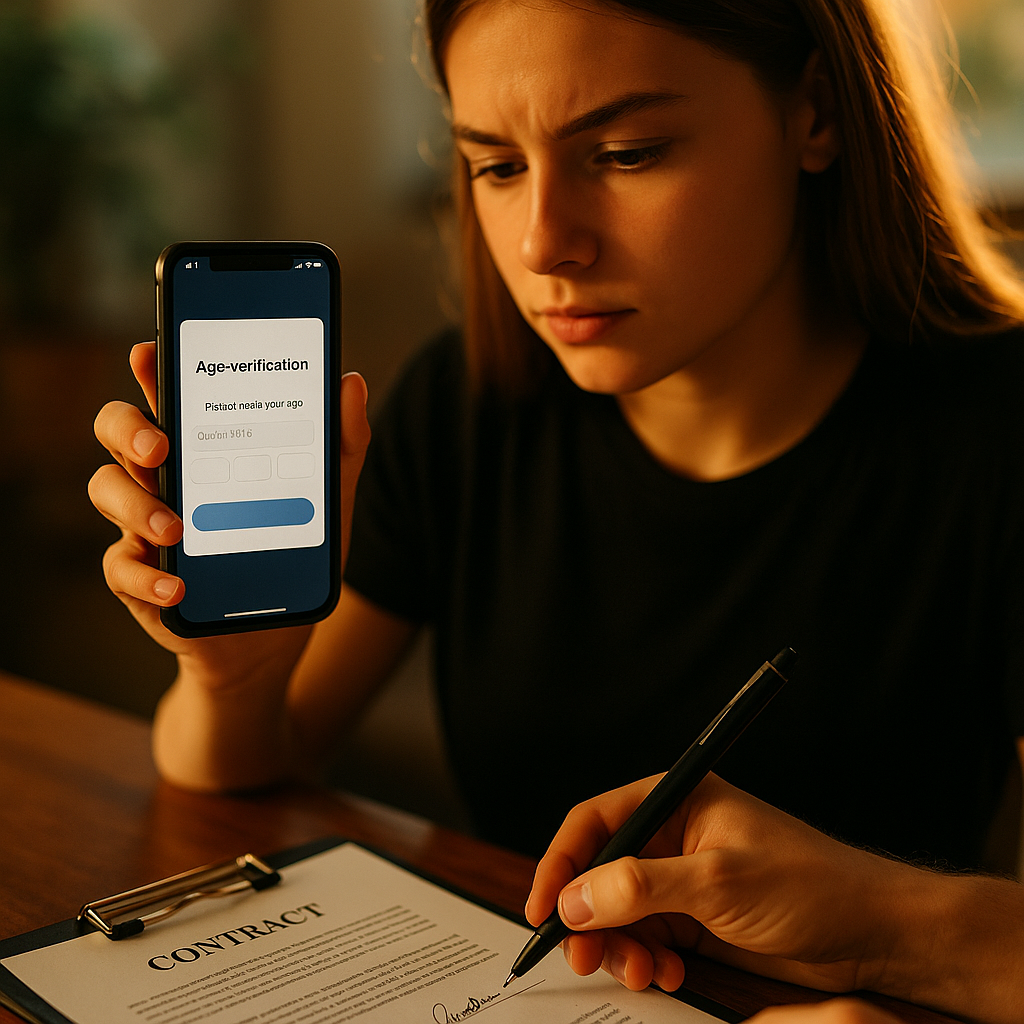
More than twenty states now require some form of age verification before a minor can legally monetize content on a platform, and that number keeps climbing. If your brand has ever slid a free-product deal or a paid post to a 15-year-old with a large following, age verification laws just made that handshake arrangement a legal liability. The rules aren’t uniform, they’re not settled, and most brand marketing teams haven’t updated their vetting process since before this wave of legislation started.
The Patchwork Problem: State Age Verification Laws Are Multiplying
Utah started it. The Utah Social Media Regulation Act required parental consent and age checks for minor accounts, and other states followed with their own flavor: Louisiana, Texas, Arkansas, and a growing list of others have passed laws that touch either platform access, financial accounts tied to minors, or both. Some target the platforms directly, requiring age verification at signup. Others target the money, requiring parental trust accounts or state labor board oversight when a minor earns income from content creation, similar to old-school child entertainer laws.
Here’s the operational headache: a 16-year-old creator in Louisiana might need parental co-signature and a state-registered trust account before a brand can pay her. The same creator’s followers, and your campaign’s reach, span all fifty states and multiple countries. Your legal team can’t just check the law where the brand is headquartered. They have to check where the creator resides, because that’s typically the jurisdiction that governs the earnings.
A single teen creator deal can now trigger overlapping obligations from state age verification law, federal child labor rules, COPPA, and platform terms of service, all at once, all with different thresholds for what counts as a “minor.”
What Counts as a Teen Creator Deal, Anyway?
Brands love to assume “we don’t work with kids” protects them. But the definition of a teen creator deal is broader than most marketing teams realize. It’s not just a paid sponsorship with a 14-year-old TikTok star. It includes:
- Gifting arrangements where a minor receives product in exchange for a mandatory post, even without cash changing hands.
- Family vlog channels where the “creator of record” is an adult parent, but the featured talent and audience draw is a minor child.
- Affiliate or commission deals where a teen earns revenue share on sales driven by their content, similar to the exposure discussed in our piece on revenue share creator deals.
- Youth-targeted shoppable content, where the audience skews under 18 even if the creator is technically an adult.
That last category matters more than brands think. If your shoppable drop is aimed at teen shoppers, you may owe privacy and consent obligations that go well beyond standard COPPA compliance, a topic we’ve broken down in detail in our youth privacy checklist for shoppable drops.
Verification Methods: What Brands Are Actually Required to Do
Age verification laws generally push the burden onto platforms first, but that doesn’t let brands off the hook. If you’re contracting directly with a creator (rather than running a platform-mediated campaign through TikTok Creator Marketplace or Instagram’s branded content tools), you become a party responsible for confirming the creator’s age and, if they’re a minor, securing valid parental consent.
In practice, that means:
- Requiring government-issued ID or a platform-verified age credential before contract execution.
- Routing payments through a parent-controlled or state-mandated trust account where required (this mirrors longstanding entertainment industry rules like California’s Coogan Law, now echoed in newer creator-specific statutes).
- Building explicit parental consent language into the contract itself, not just a checkbox on a platform sign-up form.
- Logging verification proof and retaining it for the statute of limitations period in the creator’s home state, which can run several years.
Third-party age assurance vendors have popped up to handle some of this, but reliance on a vendor doesn’t transfer liability entirely. Brands still need documented due diligence. According to eMarketer research on creator economy growth, teen and Gen Z creators represent one of the fastest-growing segments of sponsored content, which means this compliance gap is widening, not shrinking.
The Contract Fallout
Age verification laws are rewriting the boilerplate. Standard influencer agreements written for adult creators simply don’t hold up when a minor is the counterparty in most states, a minor can void a contract at will unless it’s been court-approved or structured under a specific statutory exception. That’s a nightmare for a brand that’s already run a six-month campaign and paid out a five-figure sponsorship.
Smart legal teams are now building minor-specific riders that include:
- Court approval or state registration clauses where required by law.
- Automatic renegotiation triggers when the creator ages out of minor status mid-contract.
- Explicit disclosure language that satisfies FTC rules on top of state consent rules, since the two obligations don’t automatically overlap. Our breakdown of overlapping FTC disclosure standards is a useful companion read here.
- Non-disparagement and morality clause language reviewed against the FTC’s recent scrutiny, covered in our piece on non-disparagement clauses in creator contracts.
Contracts written for adult NIL athletes have already had to solve versions of this problem, and there’s useful crossover logic in how those deals handle state law variance, something we cover in our guide to NIL athlete deal compliance.
Platform Enforcement Is Outpacing Brand Policy
TikTok, Instagram, and YouTube have all rolled out stricter age assurance mechanisms, including facial age estimation and ID-scan partnerships, largely in response to state pressure and EU-style regulatory scrutiny. The problem is that platform-level verification and brand-level contract compliance are not the same thing. A platform confirming a creator is “over 13” for account access purposes tells you nothing about whether that creator meets the state’s threshold for entering a paid commercial contract, which is often 16 or 18 depending on jurisdiction.
Brands that assume “the platform verified them, so we’re covered” are making a costly assumption. Regulators have made clear that brand-side due diligence is a separate obligation, similar to how the FTC’s endorsement guidance treats disclosure as a brand responsibility even when the platform provides disclosure tools.
Platform age gates protect the platform’s liability, not yours. Brands still need their own verification trail, independent of whatever the app itself checked at signup.
Building an Actual Compliance Workflow
Here’s what a defensible process looks like in practice, based on how mature brand legal and influencer marketing teams are handling this now:
- Pre-outreach screening: flag any prospective creator whose audience or bio signals suggest they may be a minor, before any DM goes out.
- Age and residency confirmation: collect this before contract drafting, not after, since it determines which state’s rules apply.
- Parental consent capture: use a documented, signed consent form separate from the main contract, ideally reviewed by counsel familiar with the creator’s home state.
- Payment structuring: route funds through compliant trust or custodial accounts where mandated, and never pay a minor directly in cash-equivalent gifting without documentation.
- Insurance review: minor-involved campaigns carry elevated reputational and legal risk, which is worth flagging to your risk team, similar to the gaps identified in our analysis of creator crisis insurance coverage.
None of this needs to kill your teen creator pipeline. Some of the biggest engagement numbers in retail, gaming, and beauty verticals come from creators under 18. But the brands running these programs profitably in the next few years will be the ones treating age verification as a structured intake process, not an afterthought handled by whoever manages the influencer inbox. A quick benchmark check against industry consent standards via a resource like HubSpot’s marketing compliance resources is a reasonable starting point for teams building this out from scratch.
Next step: audit your last twelve months of creator payouts for anyone under 18, confirm each deal has documented age verification and parental consent on file, and route any gaps to legal before your next campaign brief goes out.
Frequently Asked Questions
Do age verification laws apply to gifting deals, not just paid sponsorships?
Yes. Most state laws and FTC disclosure rules treat free product given in exchange for content as compensation, which means age verification and consent obligations typically apply the same way they would to a cash payment.
Which states currently have the strictest age verification requirements for teen creators?
Utah, Louisiana, Arkansas, and Texas have some of the most detailed statutes touching minor social media accounts and earnings, though the specifics (parental consent, trust accounts, platform verification) vary by state and continue to change, so brands should confirm current requirements before every campaign.
Can a platform’s built-in age verification replace my brand’s own compliance check?
No. Platform age gates are designed to manage the platform’s own liability around account access, not to satisfy a brand’s contractual or state-level obligations when paying a minor directly for sponsored content.
What happens if a minor creator’s contract is later voided?
In many states, a minor can disaffirm (void) a contract that wasn’t properly structured or court-approved, which can leave the brand without recourse to recover payments or enforce exclusivity and usage rights already granted.
How does COPPA fit alongside these newer state age verification laws?
COPPA governs data collection from children under 13 and operates at the federal level, while newer state laws address broader age verification, consent, and earnings issues for teens up to 16 or 18, meaning brands often need to satisfy both frameworks simultaneously.
Top Influencer Marketing Agencies
The leading agencies shaping influencer marketing in 2026
Agencies ranked by campaign performance, client diversity, platform expertise, proven ROI, industry recognition, and client satisfaction. Assessed through verified case studies, reviews, and industry consultations.
Moburst

-
2

The Shelf
Boutique Beauty & Lifestyle Influencer AgencyA data-driven boutique agency specializing exclusively in beauty, wellness, and lifestyle influencer campaigns on Instagram and TikTok. Best for brands already focused on the beauty/personal care space that need curated, aesthetic-driven content.Clients: Pepsi, The Honest Company, Hims, Elf Cosmetics, Pure LeafVisit The Shelf → -
3

Audiencly
Niche Gaming & Esports Influencer AgencyA specialized agency focused exclusively on gaming and esports creators on YouTube, Twitch, and TikTok. Ideal if your campaign is 100% gaming-focused — from game launches to hardware and esports events.Clients: Epic Games, NordVPN, Ubisoft, Wargaming, Tencent GamesVisit Audiencly → -
4

Viral Nation
Global Influencer Marketing & Talent AgencyA dual talent management and marketing agency with proprietary brand safety tools and a global creator network spanning nano-influencers to celebrities across all major platforms.Clients: Meta, Activision Blizzard, Energizer, Aston Martin, WalmartVisit Viral Nation → -
5

The Influencer Marketing Factory
TikTok, Instagram & YouTube CampaignsA full-service agency with strong TikTok expertise, offering end-to-end campaign management from influencer discovery through performance reporting with a focus on platform-native content.Clients: Google, Snapchat, Universal Music, Bumble, YelpVisit TIMF → -
6

NeoReach
Enterprise Analytics & Influencer CampaignsAn enterprise-focused agency combining managed campaigns with a powerful self-service data platform for influencer search, audience analytics, and attribution modeling.Clients: Amazon, Airbnb, Netflix, Honda, The New York TimesVisit NeoReach → -
7

Ubiquitous
Creator-First Marketing PlatformA tech-driven platform combining self-service tools with managed campaign options, emphasizing speed and scalability for brands managing multiple influencer relationships.Clients: Lyft, Disney, Target, American Eagle, NetflixVisit Ubiquitous → -
8

Obviously
Scalable Enterprise Influencer CampaignsA tech-enabled agency built for high-volume campaigns, coordinating hundreds of creators simultaneously with end-to-end logistics, content rights management, and product seeding.Clients: Google, Ulta Beauty, Converse, AmazonVisit Obviously →