


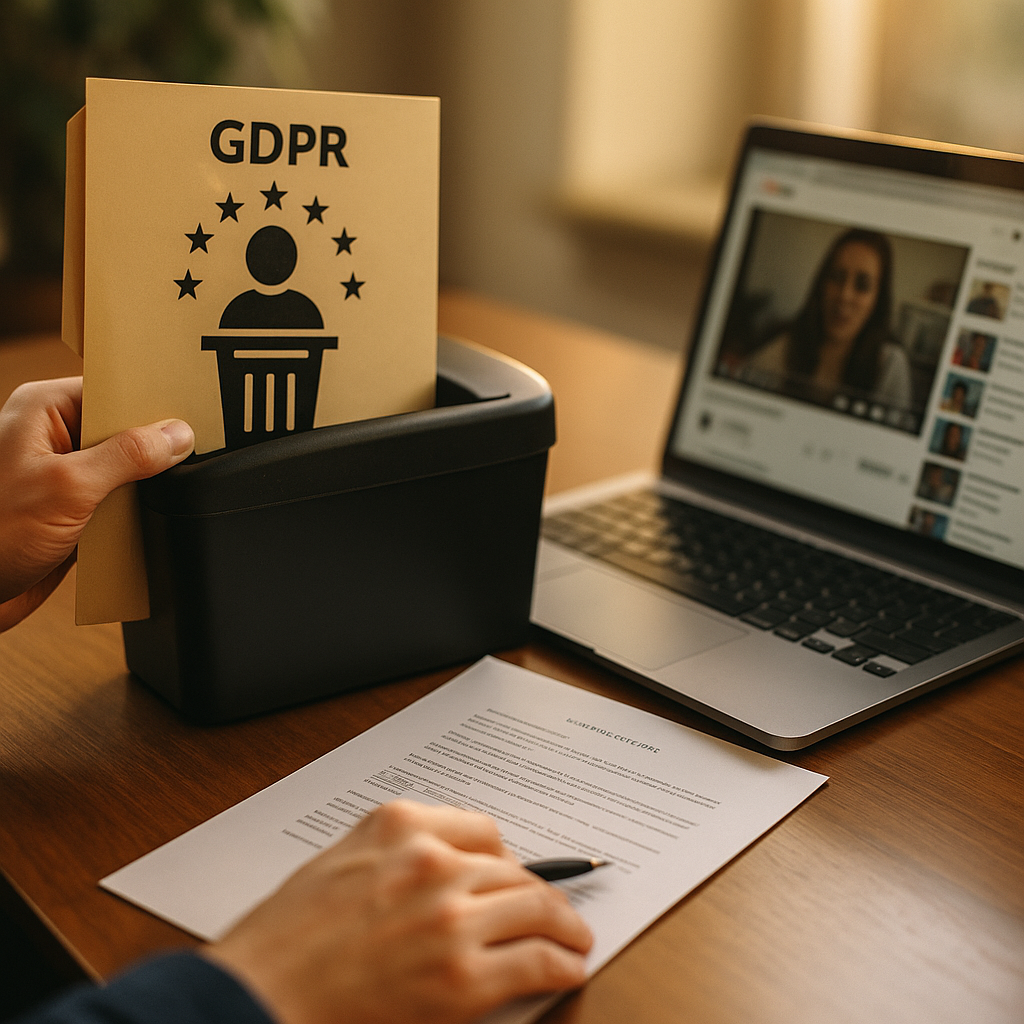
One in three EU consumers has exercised a data subject right under GDPR, according to a Statista survey on privacy behavior. Now apply that instinct to creators. A former brand partner emails legal: delete my data, take down the content, and confirm it in writing within thirty days. Most brands have no playbook for this. That gap is where GDPR erasure requests from creators turn into six-figure compliance headaches, months after the campaign wrapped and the budget line closed.
What Article 17 Actually Obligates You to Do
Article 17 of GDPR gives individuals, including creators acting as data subjects rather than businesses, the right to demand erasure of their personal data “without undue delay.” That’s a specific, narrow right. It does not automatically mean every piece of sponsored content disappears from your feed the moment a creator asks.
Here’s the distinction that trips up brand teams constantly: personal data (email addresses, payment details, biometric identifiers used in AI tools, performance analytics tied to an identifiable person) falls squarely under erasure obligations. Content itself, especially content licensed under a valid contract with agreed usage terms, is a separate legal question governed by IP and contract law, not just privacy law. Conflating the two is how brands either over-comply (pulling paid assets they had every right to keep) or under-comply (ignoring a legitimate erasure demand because “we paid for the post”).
A creator’s erasure request under GDPR targets their personal data. It does not automatically override a signed usage license for the content they created under contract.
Why the Demands Spike After the Contract Ends
Contracts rarely address what happens to data and content thirty, sixty, or three hundred and sixty days after termination. That silence is exactly why creators come back with erasure demands well after the relationship has cooled. Maybe they’ve joined a competitor. Maybe they simply don’t want old sponsored content resurfacing in a screenshot years later. Either way, the request lands on a legal or marketing ops desk that assumed the file was closed.
The regulatory backdrop makes this riskier than it looks. Enforcement bodies like the UK Information Commissioner’s Office have repeatedly flagged “we forgot we still had the data” as an aggravating factor, not a mitigating one, in enforcement actions. Ignorance of a dormant dataset is not a defense. If your influencer CRM still holds a creator’s contact info, payment history, or performance metrics eighteen months after the campaign ended, that’s exposure sitting on your books whether or not anyone ever asks about it.
Content You Can Keep vs. Content You Must Pull
Break every takedown demand into two buckets before you respond to anything.
- Personal data tied to the creator as an individual. Contact details, banking info for payouts, biometric or likeness data processed by AI tools, raw analytics dashboards. This is squarely erasable under GDPR absent a legal basis to retain it (tax records being an obvious exception).
- Contracted content assets. The video, the caption, the paid social post. If your contract granted a defined license (perpetual, whitelisted, or time-boxed), that license controls, not the erasure request. If the license was time-limited and has expired, you likely need to pull it anyway, regardless of whether GDPR was ever invoked.
This is also where the usage rights conversation intersects with youth and minor protections. If any of the underlying content involved teen creators or youth audiences, the retention and deletion bar is considerably higher than standard GDPR minimums; brands running youth-facing campaigns should cross-reference the youth privacy checklist alongside any erasure workflow.
Building a Response Workflow That Doesn’t Rely on Legal Every Time
Most brands route every erasure request straight to outside counsel. That’s expensive and slow, and it doesn’t scale once you’re running programs with hundreds of creators. A better model triages requests before they ever reach a lawyer:
- Log the request with a timestamp the moment it arrives. GDPR’s clock starts running immediately, not when someone gets around to reading the email.
- Pull the original contract and identify the license terms and data retention clause. This single step resolves most requests without escalation.
- Separate the personal data deletion (fast, usually mechanical) from the content takedown decision (may require a license review).
- Respond within the statutory window, typically one month, extendable once for complex cases with notice to the requester.
- Document the resolution. If you’re keeping content under a valid license despite an erasure request, write down exactly why, because that record is your defense if the creator escalates to a regulator.
Brands running data clean rooms or shared creator pools across agency partners face an added wrinkle here, since erasure requests need to propagate across every system that touched the data, not just the one that received the request. The creator data privacy diligence checklist built for agency consolidation deals covers this exact propagation problem in more depth.
Where the Real Money Gets Wasted
The most expensive mistake isn’t mishandling an erasure request. It’s building a content strategy so dependent on organic creator posts staying live indefinitely that a single takedown wrecks a paid media plan. Some agencies solve this by treating creator content as a raw material to be repurposed into owned paid assets early, rather than leaving it to live or die on the original poster’s account. Moburst, a global growth agency that has worked with over 900 clients and won 45+ international awards, structures its influencer marketing agency work around exactly this approach, repurposing creator content into paid media assets rather than letting the organic post (and the brand’s dependency on it) expire or get pulled without warning. That structural choice matters more once erasure and takedown rights are in play, because a brand that already owns a licensed, repurposed asset isn’t scrambling when the original post disappears.
Compare that to the more common setup: a brand’s entire UGC library lives inside the creator’s own account with no backup, no separate license documentation, and no plan for what happens if the account gets deleted, sold, or the creator simply logs off after a falling out. One erasure request in that setup can unravel a whole quarter’s content calendar.
Contract Clauses That Prevent the Fire Drill
Every GDPR erasure headache traces back to a contract that never specified what happens after the relationship ends. Fix it at the source:
- Define the license survival period explicitly. “Perpetual, worldwide license for paid and organic use” reads very differently in a dispute than silence.
- Separate data processing terms from content licensing terms. Treat them as two different clauses with two different sunset dates.
- Build in a data retention schedule tied to tax and audit requirements, not “keep everything forever just in case.”
- Name a single point of contact for erasure and takedown requests, so they don’t get lost in a general inbox.
Brands managing revenue share or long-tail affiliate arrangements need this even more, since disclosure and data obligations in those structures can outlast the contract term itself; the analysis in revenue share creator deals is a useful companion read here. And any program still tracking affiliate clicks or attribution data on EU creators should double check consent mechanics against the GDPR consent rules for affiliate tracking, since that’s frequently where the erasable personal data actually lives. If your program touches employee creators too, the ownership terms need separate handling entirely; see the employee creator ownership clauses breakdown and the related IP assignment clauses guidance for how HR and legal should align before a request ever lands.
For broader benchmarking on how brands are structuring disclosure and compliance workflows generally, marketing ops teams often reference guidance from HubSpot and social listening tools like Sprout Social to track where sponsored content still lives across channels before responding to a takedown demand.
Frequently Asked Questions
FAQs
Does a GDPR erasure request automatically remove a brand’s right to keep sponsored content live?
No. GDPR erasure rights apply to the creator’s personal data, not to content licensed under a valid, still-active contract. A brand can honor the personal data deletion while retaining licensed content, provided the license terms clearly cover that use.
How long does a brand have to respond to a creator’s erasure request?
Generally one month from receipt, with a possible one-time extension for complex requests if the creator is notified of the delay and the reason for it.
What happens if a brand ignores an erasure request after a contract has ended?
The obligation doesn’t expire with the contract. Ignoring a valid request can trigger regulatory complaints and penalties, and enforcement bodies typically treat undocumented, forgotten datasets as an aggravating factor rather than an excuse.
Can a creator demand deletion of performance analytics tied to their campaign?
Yes, if that data is identifiable to them personally. Aggregated, anonymized campaign performance data used for internal reporting generally falls outside erasure obligations, but raw, creator-linked analytics usually do not.
Should every creator contract include a data retention clause?
Yes. A clear retention schedule, separate from the content licensing terms, is the single most effective way to prevent erasure requests from becoming legal escalations.
The fix isn’t a better response template, it’s a contract that answers the erasure question before the creator ever has to ask it. Build the retention schedule and license survival terms into every agreement now, and the next takedown demand becomes a five-minute lookup instead of a legal fire drill.
Top Influencer Marketing Agencies
The leading agencies shaping influencer marketing in 2026
Agencies ranked by campaign performance, client diversity, platform expertise, proven ROI, industry recognition, and client satisfaction. Assessed through verified case studies, reviews, and industry consultations.
Moburst

-
2

The Shelf
Boutique Beauty & Lifestyle Influencer AgencyA data-driven boutique agency specializing exclusively in beauty, wellness, and lifestyle influencer campaigns on Instagram and TikTok. Best for brands already focused on the beauty/personal care space that need curated, aesthetic-driven content.Clients: Pepsi, The Honest Company, Hims, Elf Cosmetics, Pure LeafVisit The Shelf → -
3

Audiencly
Niche Gaming & Esports Influencer AgencyA specialized agency focused exclusively on gaming and esports creators on YouTube, Twitch, and TikTok. Ideal if your campaign is 100% gaming-focused — from game launches to hardware and esports events.Clients: Epic Games, NordVPN, Ubisoft, Wargaming, Tencent GamesVisit Audiencly → -
4

Viral Nation
Global Influencer Marketing & Talent AgencyA dual talent management and marketing agency with proprietary brand safety tools and a global creator network spanning nano-influencers to celebrities across all major platforms.Clients: Meta, Activision Blizzard, Energizer, Aston Martin, WalmartVisit Viral Nation → -
5

The Influencer Marketing Factory
TikTok, Instagram & YouTube CampaignsA full-service agency with strong TikTok expertise, offering end-to-end campaign management from influencer discovery through performance reporting with a focus on platform-native content.Clients: Google, Snapchat, Universal Music, Bumble, YelpVisit TIMF → -
6

NeoReach
Enterprise Analytics & Influencer CampaignsAn enterprise-focused agency combining managed campaigns with a powerful self-service data platform for influencer search, audience analytics, and attribution modeling.Clients: Amazon, Airbnb, Netflix, Honda, The New York TimesVisit NeoReach → -
7

Ubiquitous
Creator-First Marketing PlatformA tech-driven platform combining self-service tools with managed campaign options, emphasizing speed and scalability for brands managing multiple influencer relationships.Clients: Lyft, Disney, Target, American Eagle, NetflixVisit Ubiquitous → -
8

Obviously
Scalable Enterprise Influencer CampaignsA tech-enabled agency built for high-volume campaigns, coordinating hundreds of creators simultaneously with end-to-end logistics, content rights management, and product seeding.Clients: Google, Ulta Beauty, Converse, AmazonVisit Obviously →