


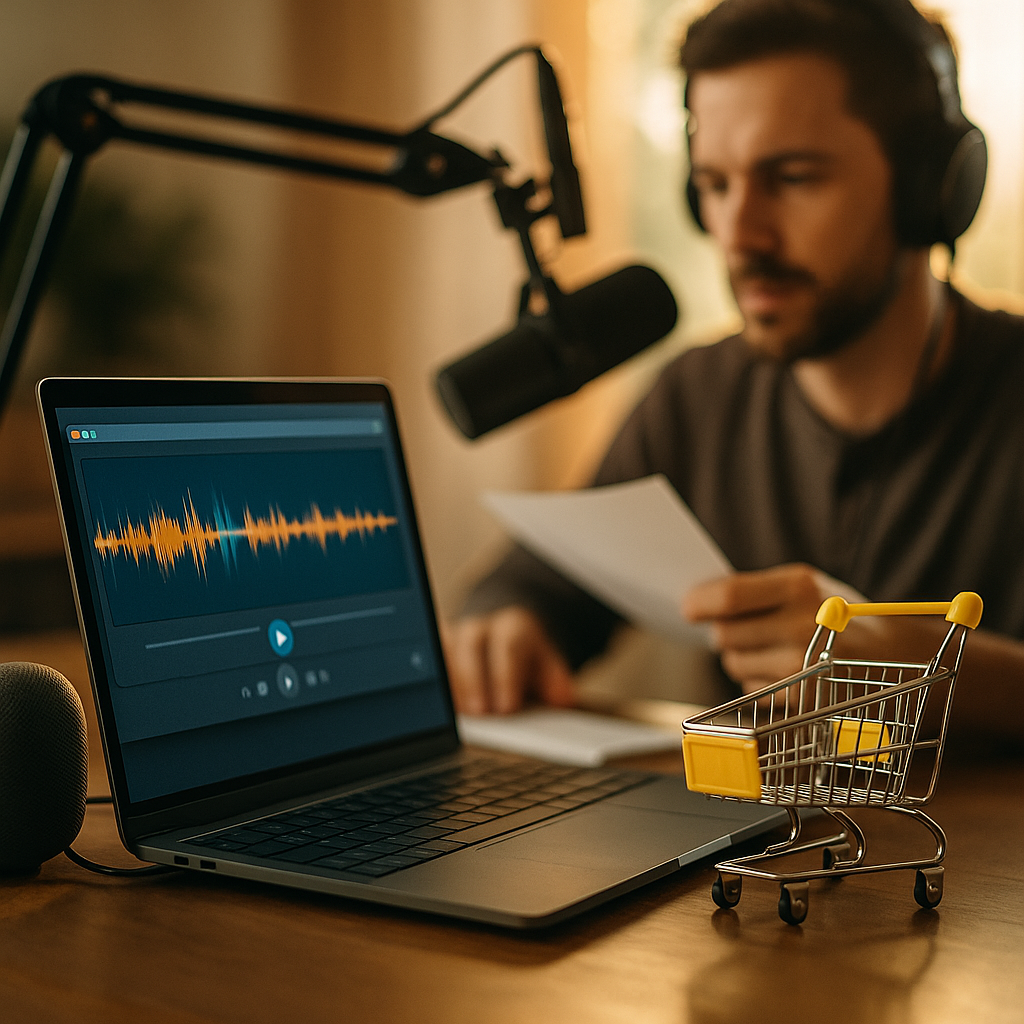
Ninety percent of the cost in a traditional voiceover ad isn’t the voice. It’s the calendar: casting, studio time, revisions, re-records when the client hates the pacing. Text to speech voiceover ads collapse that timeline to hours, sometimes minutes. The catch? Most brands still brief them like they’re booking a human actor, and that’s where the speed advantage disappears.
The Real Bottleneck Was Never the Voice
Ask any performance marketer why a 15-second ad takes two weeks to ship, and the answer is rarely creative disagreement. It’s scheduling. A voice actor’s availability, a studio booking, a round of client notes that requires a full re-record because nobody flagged the mispronunciation until the final cut.
Text to speech (TTS) removes almost all of that friction. Tools like ElevenLabs, Murf, WellSaid Labs, and Amazon Polly now generate broadcast-ready voiceover from a script in under a minute, with tone, pacing, and emotional inflection adjustable on a slider instead of a callback sheet. The bottleneck moves from production to the brief itself. If your brief is vague, you’ll spend more time regenerating takes than you ever spent scheduling a studio session.
A fast turnaround only exists if the brief is fast to execute. Sloppy input still produces sloppy output, just faster and cheaper.
What a Fast Turnaround TTS Brief Actually Needs
Most creative briefs for voiceover were written for humans who could infer tone from context, or ask a director a clarifying question. AI voice engines can’t infer anything. Every ambiguity you leave in the brief becomes a flaw in the output. A brief built for speed needs to be more specific than a traditional one, not less.
- Voice persona, not just gender and age. “Warm, mid-30s female, low energy, slight authority” performs differently than “friendly female voice.” Vague descriptors produce generic reads.
- Pacing markers in the script itself. Mark pauses with punctuation or bracketed cues (e.g., “[pause 0.5s]”). Most engines respect punctuation more literally than a human reader would.
- Emphasis flags on key phrases. Bold or bracket the words that carry the offer or CTA. Engines default to flat emphasis unless told otherwise.
- Target duration, down to the second. A 15-second CTV spot and a 30-second YouTube pre-roll need different pacing instructions, not just a shorter script.
- Platform destination. A voice that reads well over TikTok’s compressed audio can sound thin on a connected TV soundbar. Brief for the delivery environment, not the source file.
- Brand voice guardrails. Document which tones are off-limits (sarcastic, overly casual, regional accent) so approval doesn’t become a subjective back-and-forth after generation.
Write these fields into a reusable template and your turnaround time drops from days to same-day, because nobody’s waiting on a clarifying email.
Picking a Voice Engine Without Losing a Week to Trial and Error
Not all TTS engines are built for the same job. Some prioritize emotional range, others prioritize multilingual accuracy, and a few are optimized purely for low-latency real-time generation. Treating them as interchangeable is how teams burn a week testing the wrong tool.
If your priority is emotional nuance for a brand story ad, engines with granular style controls (adjustable warmth, pace, breathiness) will outperform generic API-based TTS. If you’re localizing a single ad across a dozen markets, prioritize an engine with strong multilingual pronunciation and native-sounding cadence over one with flashy English-only voices. That distinction matters even more once you’re scaling scripts across regions, which is exactly the challenge covered in script-once localization workflows.
Budget also dictates fit. Enterprise-grade engines charge per character or per minute generated, and costs scale fast if you’re producing dozens of variants for testing. Run a cost-per-variant calculation before committing to a vendor, not after your media buyer asks why voiceover line items tripled.
Where Synthetic Voice Ads Quietly Damage Trust
Here’s the uncomfortable part nobody puts in the pitch deck: audiences are getting better at detecting synthetic voice, and when they detect it without disclosure, trust drops faster than it would for a human voiceover with a flat delivery. HubSpot’s research on consumer trust consistently shows that perceived authenticity, not just polish, drives ad recall and conversion.
This is where speed can backfire. A rushed TTS brief often skips two things: disclosure language and a pronunciation QA pass. Both are avoidable, and both carry real risk.
- Disclosure isn’t optional in most jurisdictions. The FTC’s endorsement guidance increasingly applies to synthetic media, and regulators in the UK follow similar principles through the ICO’s guidance on AI-generated content. If your ad implies a real person is speaking when it’s synthetic, that’s a liability, not a style choice.
- Mispronunciation of brand names or product SKUs is the single most common QA failure in fast-turnaround TTS. Run every script through a dedicated read-through before final export, even if it adds fifteen minutes to your “instant” timeline.
These aren’t reasons to avoid TTS. They’re reasons to build compliance checks into the brief template instead of treating them as an afterthought. The same tension shows up in synthetic video, which is why volume-at-scale AI avatar production has run into consumer backlash when brands skip disclosure to move faster.
The Five-Field Brief Framework That Actually Ships Same Day
Strip away the jargon and a fast TTS brief needs five fields, no more, filled out before anyone touches the generation tool.
- Script with embedded pacing cues. Not a paragraph. A formatted line-by-line read with pause and emphasis markers built in.
- Voice persona descriptor. Two sentences, tone plus energy plus one reference comparison (“similar cadence to a mid-market financial explainer, but warmer”).
- Platform and duration constraints. Exact seconds, exact aspect ratio context if it affects pacing.
- Disclosure requirement. A yes/no flag with the exact wording if disclosure is legally required for that market.
- QA checklist. Pronunciation of proper nouns, CTA clarity, and a listen-back against brand tone guardrails.
Fill this out once as a template and every future TTS ad becomes a copy-paste-and-adjust job. That’s the actual speed unlock, not the generation tool itself.
When Human Voiceover Still Wins
TTS isn’t the answer for everything, and pretending otherwise sets up a credibility problem. Founder-led testimonials, trust-heavy financial or healthcare messaging, and anything leaning on perceived personal authenticity still perform better with a real recorded voice, a point echoed in founder-led video trust research. Use synthetic voice for speed-to-market, iteration testing, and localization at scale. Use human voice when the message itself depends on the listener believing a specific person said it.
eMarketer’s tracking of AI-generated ad creative shows adoption climbing fastest in categories with high creative volume needs (e-commerce, app installs, seasonal retail) and slowest in trust-sensitive verticals. That split is your decision filter, not a hunch.
Testing Variants Without Drowning in Files
Because generation is cheap, teams often overproduce. Ten voice variants for one script sounds efficient until your team spends more time reviewing files than they saved generating them. Cap variant testing at three voice personas per script, run them through the same media buy for a fixed test window, and kill the underperformers using standard engagement benchmarks, the same discipline Sprout Social’s paid social benchmarking recommends for any creative testing cycle. Speed only pays off if your review process scales with it.
This same discipline applies when pairing TTS with dubbed video across markets, a workflow explored in AI dubbing format selection for ROI, and when syncing voice cadence to avatar lip movement, covered in synthetic influencer consistency briefs.
Build the five-field brief once, run it through a real QA pass on the first output, and same-day turnaround becomes the norm rather than the exception on your next campaign.
FAQs
How fast can a text to speech voiceover ad actually go from script to final export?
With a complete brief and an engine you’ve already tested, most 15 to 30 second ads can move from approved script to exported audio in under an hour. The delay almost always comes from an incomplete brief, not the tool.
Do text to speech voiceover ads need a disclosure label?
In most cases, yes, particularly if the voice could be mistaken for a real person’s endorsement. Check current guidance from the FTC or your local regulator before launch, since requirements vary by market and by how the voice is presented.
Which industries benefit most from TTS voiceover ads?
High-volume, fast-iteration categories like e-commerce, app marketing, and seasonal retail see the biggest gains. Trust-sensitive categories like healthcare and financial services often still perform better with human voiceover.
Can text to speech voices match a brand’s existing tone of voice?
Yes, if the brief specifies persona, pacing, and emphasis clearly. Generic prompts produce generic reads. Detailed briefs produce voices that hold up against brand guidelines.
Is it cheaper to use TTS instead of hiring a voice actor?
Almost always, especially at volume. The savings come from eliminating studio time and re-record cycles, though licensing costs for premium voice engines should be factored into the total comparison.
Top Influencer Marketing Agencies
The leading agencies shaping influencer marketing in 2026
Agencies ranked by campaign performance, client diversity, platform expertise, proven ROI, industry recognition, and client satisfaction. Assessed through verified case studies, reviews, and industry consultations.
Moburst

-
2

The Shelf
Boutique Beauty & Lifestyle Influencer AgencyA data-driven boutique agency specializing exclusively in beauty, wellness, and lifestyle influencer campaigns on Instagram and TikTok. Best for brands already focused on the beauty/personal care space that need curated, aesthetic-driven content.Clients: Pepsi, The Honest Company, Hims, Elf Cosmetics, Pure LeafVisit The Shelf → -
3

Audiencly
Niche Gaming & Esports Influencer AgencyA specialized agency focused exclusively on gaming and esports creators on YouTube, Twitch, and TikTok. Ideal if your campaign is 100% gaming-focused — from game launches to hardware and esports events.Clients: Epic Games, NordVPN, Ubisoft, Wargaming, Tencent GamesVisit Audiencly → -
4

Viral Nation
Global Influencer Marketing & Talent AgencyA dual talent management and marketing agency with proprietary brand safety tools and a global creator network spanning nano-influencers to celebrities across all major platforms.Clients: Meta, Activision Blizzard, Energizer, Aston Martin, WalmartVisit Viral Nation → -
5

The Influencer Marketing Factory
TikTok, Instagram & YouTube CampaignsA full-service agency with strong TikTok expertise, offering end-to-end campaign management from influencer discovery through performance reporting with a focus on platform-native content.Clients: Google, Snapchat, Universal Music, Bumble, YelpVisit TIMF → -
6

NeoReach
Enterprise Analytics & Influencer CampaignsAn enterprise-focused agency combining managed campaigns with a powerful self-service data platform for influencer search, audience analytics, and attribution modeling.Clients: Amazon, Airbnb, Netflix, Honda, The New York TimesVisit NeoReach → -
7

Ubiquitous
Creator-First Marketing PlatformA tech-driven platform combining self-service tools with managed campaign options, emphasizing speed and scalability for brands managing multiple influencer relationships.Clients: Lyft, Disney, Target, American Eagle, NetflixVisit Ubiquitous → -
8

Obviously
Scalable Enterprise Influencer CampaignsA tech-enabled agency built for high-volume campaigns, coordinating hundreds of creators simultaneously with end-to-end logistics, content rights management, and product seeding.Clients: Google, Ulta Beauty, Converse, AmazonVisit Obviously →