


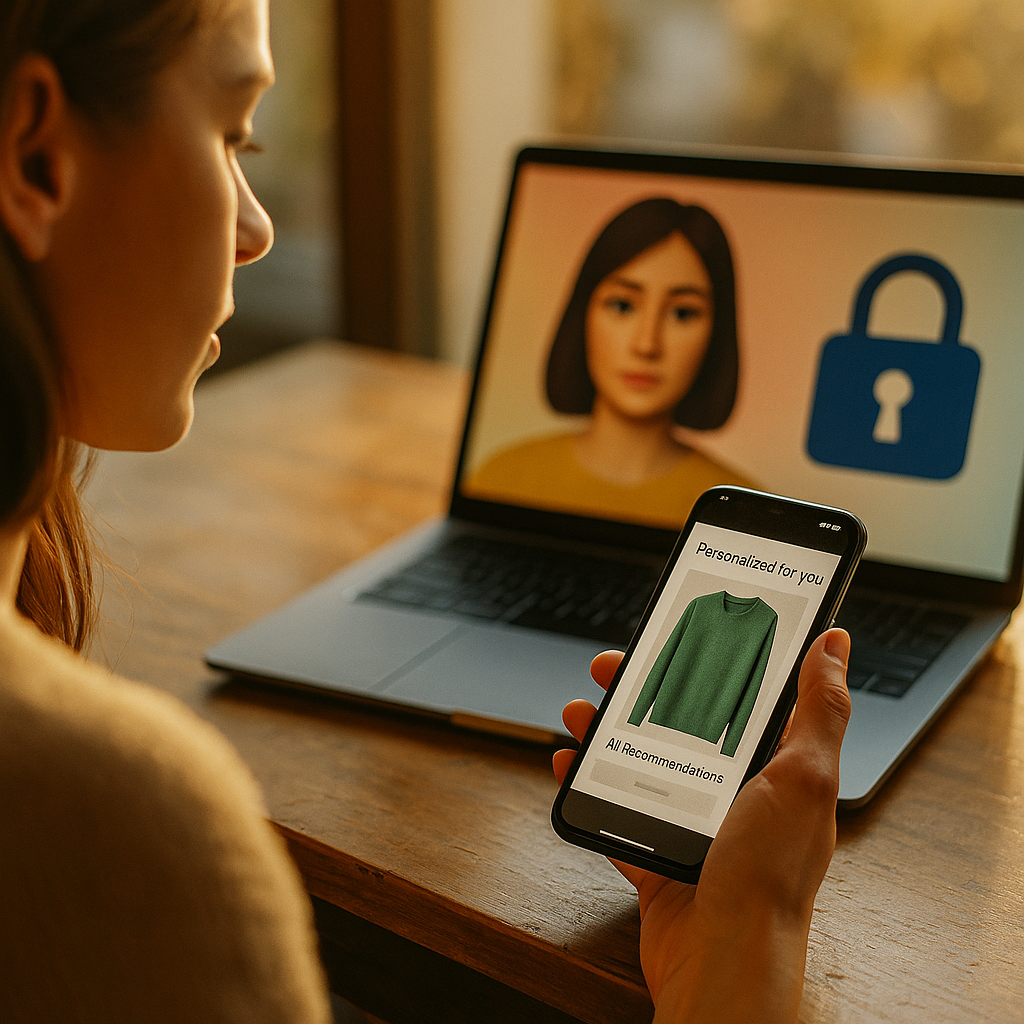
73% of consumers now use AI tools weekly. Only 34% trust brands to use AI responsibly with their data. That gap isn’t a rounding error — it’s the defining tension of marketing right now. Welcome to the AI personalization trust paradox, where adoption and confidence are moving in opposite directions, and brands caught in the middle are bleeding conversion rates without knowing why.
Marketers built the last three years of martech roadmaps on a simple assumption: more personalization equals more revenue. That assumption is cracking. Consumers happily ask ChatGPT to plan their vacations and let Spotify’s AI curate their mood. But when a retargeted ad follows them across five platforms using data they never explicitly shared, something flips. Comfort turns into surveillance. Convenience turns into creepiness.
The Paradox, Quantified
The numbers tell a story that should worry every CMO running programmatic or influencer-driven personalization at scale. Adoption metrics look fantastic. Trust metrics do not.
- Consumer use of generative AI tools has roughly doubled year-over-year across major markets, per eMarketer tracking of adoption curves.
- Meanwhile, surveys from Statista show trust in AI-driven ad targeting sitting below trust in traditional advertising formats — a reversal nobody predicted five years ago.
- Data privacy concerns rank among the top three reasons consumers give for distrusting personalized ads, ahead of ad frequency or creative quality.
This isn’t a generational quirk, either. Gen Z, the cohort most fluent in AI tools, is also the cohort most skeptical of AI-personalized advertising specifically. They’ll use an AI chatbot to write a cover letter. They will not trust an AI-generated ad that “knows” they just searched for fertility treatments.
Consumers aren’t rejecting AI. They’re rejecting AI they can’t see, question, or opt out of — and advertising is the one use case where that invisibility feels most invasive.
Why Personal AI Feels Different From Ad AI
Here’s the distinction most brand strategists miss: consumers draw a hard line between AI they control and AI that controls what they see.
When someone uses Midjourney or ChatGPT, they initiate the interaction. They type the prompt. They can walk away. AI-personalized advertising works in reverse — it initiates contact with them, using inference they never consented to in any meaningful sense. A checkbox buried in a cookie banner doesn’t count as consent in the consumer’s mental model, even if it satisfies FTC guidance on paper.
Add to that the black-box problem. Consumers can’t audit why an algorithm decided they’d respond to a specific ad at a specific moment. That opacity breeds suspicion, especially post-Cambridge Analytica, post-data breach fatigue, post-every-privacy-scandal-you’ve-read-about. Trust doesn’t erode from one incident. It erodes from cumulative exposure to a pattern: companies collect more than they disclose, and personalization is the most visible symptom.
Our earlier coverage on the AI personalization trust gap flagged this shift months before the latest data confirmed it. The gap isn’t closing. It’s becoming structural.
What This Costs Brands, Concretely
Skip the philosophy for a second. What does declining trust in AI-personalized advertising actually cost a brand running paid media and influencer programs?
- Lower click-through and conversion on hyper-targeted creative. Ads that feel “too accurate” trigger avoidance behavior — consumers scroll past faster, not slower.
- Rising ad-blocker and opt-out rates. Every opt-out is a data point lost, which degrades personalization quality further, creating a doom loop.
- Brand safety exposure. Regulators in the EU and UK are tightening scrutiny on automated ad decisioning. Check current guidance from the ICO before scaling any AI-driven targeting model.
- Creator and influencer spillover. When a sponsored creator post uses AI-personalized product recommendations, audiences apply the same skepticism to the creator’s credibility, not just the brand’s.
That last point matters more than most media plans account for. Influencer marketing has always leaned on perceived authenticity as its core value proposition. If AI personalization erodes trust in advertising broadly, it doesn’t stay contained to programmatic display. It bleeds into sponsored content, affiliate links, and creator recommendations — the exact channels brands shifted budget toward specifically to escape ad fatigue.
Influencer Marketing: The Channel Most at Risk, and Most Insulated
Here’s the irony. Influencer marketing sits at the center of this paradox in two contradictory ways.
On one hand, brands are increasingly using AI to personalize which creators get matched to which audiences, which sponsored content variants get served to which follower segments, and how affiliate offers get dynamically priced per viewer. That’s AI personalization wearing a human face — and when audiences sense it, the backlash is sharper than a banner ad ever gets, because it feels like a betrayal of the creator relationship, not just an ad platform doing its job.
On the other hand, genuine creator recommendations, the kind that aren’t algorithmically reverse-engineered per viewer, remain one of the last high-trust advertising formats left standing. That’s precisely why vetted micro-influencer networks have become a trust layer for D2C brands rather than just a reach play. Micro-influencers deliver lower CPAs partly because their audiences don’t suspect algorithmic manipulation behind the recommendation. The data backs this up: micro-influencer CPA data shows 30-60% savings versus paid social, and trust is a major driver of that efficiency.
The moment a brand automates the “personal” out of personalized creator content, it inherits the same trust deficit as programmatic advertising — just with a face attached to the betrayal.
Brands running influencer programs need to draw a bright line: use AI to identify creator fit, optimize posting times, and analyze performance data. Don’t use it to script fake-personal messages that pretend a creator “just discovered” a product an algorithm assigned them to promote. Audiences catch that faster than any brand safety team wants to admit.
Disclosure Is No Longer Optional Compliance Theater
Every brand still treating AI disclosure as a legal checkbox is underestimating where consumer expectations have moved. Transparency about AI use in advertising and content creation isn’t just an FTC requirement — it’s becoming a purchase-decision factor in its own right.
We covered this shift in depth in AI content trust gap demands disclosure policies: brands that proactively label AI-personalized ads, AI-generated creative, and AI-assisted creator content see smaller trust penalties than brands caught retrofitting disclosure after a scandal. The lesson generalizes. Disclosure early beats disclosure forced.
Practical disclosure moves worth adopting now:
- Label AI-personalized product recommendations explicitly, not buried in fine print.
- Give users a visible, one-click way to see (and adjust) what data drives their ad targeting — Meta’s ad preferences center is a workable model to study.
- Require creators to disclose when sponsored content involves AI-driven personalization at the platform or offer level, not just standard #ad tags.
- Audit your AI vendor stack quarterly for data sourcing practices, not just output quality.
Where AI-Fluent Teams Actually Win
None of this means brands should retreat from AI. That’s the wrong lesson. Adoption is only rising — per recent survey data, 95% of social pros now use AI daily, though notably still not for high-stakes strategic decisions. The winning move isn’t less AI. It’s AI used with restraint, transparency, and a clear separation between operational efficiency and manipulative personalization.
Brands should ask three questions before deploying any new AI personalization layer in advertising or creator campaigns:
- Would the consumer feel comfortable if they saw exactly what data drove this decision? If the honest answer is no, don’t ship it.
- Does this personalization improve the consumer’s experience, or just the brand’s conversion rate? Those aren’t always the same thing, and consumers can tell the difference.
- Is there a human, auditable layer between the AI’s inference and the final creative or offer? Full automation without oversight is where trust breaks fastest.
This is also a hiring and skills problem, not just a tooling one. The AI-fluent marketing talent gap means most teams don’t have the internal expertise to build these guardrails properly, let alone audit vendor claims about “ethical AI personalization.” That gap needs closing before the next platform algorithm update makes the trust problem worse.
For teams building out martech budgets around this shift, resources like HubSpot’s marketing benchmarks and Sprout Social’s consumer trust research are worth tracking quarterly, not just at annual planning time. This moves too fast for a once-a-year read.
The Takeaway
Stop chasing more personalization and start chasing more trustworthy personalization — the two are no longer the same growth lever. Audit your AI-driven targeting and creator-matching systems this quarter, disclose what you find, and let transparency, not sophistication, be the metric you optimize next.
FAQs
What is the AI personalization trust paradox?
It’s the growing disconnect between rising consumer adoption of AI tools in daily life and declining trust in AI-personalized advertising specifically. Consumers embrace AI they control (chatbots, recommendation engines they opt into) while distrusting AI that targets them without visible consent, like programmatic ad personalization.
Why do consumers trust personal AI tools but not AI-powered ads?
Personal AI tools are initiated by the user, who can walk away anytime. AI-personalized advertising initiates contact using inferred data the consumer never explicitly approved, creating a perception of surveillance rather than service.
Does declining trust in AI advertising affect influencer marketing too?
Yes. When brands use AI to automate creator-audience matching or personalize sponsored content per viewer, audiences apply the same skepticism they hold toward programmatic ads, undermining the authenticity that makes influencer marketing effective in the first place.
How can brands rebuild trust in AI-personalized campaigns?
Disclose AI use proactively rather than after backlash, give consumers visible control over targeting data, keep a human oversight layer between AI inference and final creative, and limit personalization to what genuinely improves the consumer experience rather than just conversion metrics.
Is AI personalization regulation getting stricter?
Regulatory bodies like the FTC and the UK’s ICO are increasing scrutiny of automated ad decisioning and data practices. Brands should treat current guidance as a baseline, not a ceiling, given how quickly consumer sentiment and enforcement priorities are shifting.
Visible FAQ (for reference)
See FAQ section above for full visible content matching the schema below.
Top Influencer Marketing Agencies
The leading agencies shaping influencer marketing in 2026
Agencies ranked by campaign performance, client diversity, platform expertise, proven ROI, industry recognition, and client satisfaction. Assessed through verified case studies, reviews, and industry consultations.
Moburst

-
2

The Shelf
Boutique Beauty & Lifestyle Influencer AgencyA data-driven boutique agency specializing exclusively in beauty, wellness, and lifestyle influencer campaigns on Instagram and TikTok. Best for brands already focused on the beauty/personal care space that need curated, aesthetic-driven content.Clients: Pepsi, The Honest Company, Hims, Elf Cosmetics, Pure LeafVisit The Shelf → -
3

Audiencly
Niche Gaming & Esports Influencer AgencyA specialized agency focused exclusively on gaming and esports creators on YouTube, Twitch, and TikTok. Ideal if your campaign is 100% gaming-focused — from game launches to hardware and esports events.Clients: Epic Games, NordVPN, Ubisoft, Wargaming, Tencent GamesVisit Audiencly → -
4

Viral Nation
Global Influencer Marketing & Talent AgencyA dual talent management and marketing agency with proprietary brand safety tools and a global creator network spanning nano-influencers to celebrities across all major platforms.Clients: Meta, Activision Blizzard, Energizer, Aston Martin, WalmartVisit Viral Nation → -
5

The Influencer Marketing Factory
TikTok, Instagram & YouTube CampaignsA full-service agency with strong TikTok expertise, offering end-to-end campaign management from influencer discovery through performance reporting with a focus on platform-native content.Clients: Google, Snapchat, Universal Music, Bumble, YelpVisit TIMF → -
6

NeoReach
Enterprise Analytics & Influencer CampaignsAn enterprise-focused agency combining managed campaigns with a powerful self-service data platform for influencer search, audience analytics, and attribution modeling.Clients: Amazon, Airbnb, Netflix, Honda, The New York TimesVisit NeoReach → -
7

Ubiquitous
Creator-First Marketing PlatformA tech-driven platform combining self-service tools with managed campaign options, emphasizing speed and scalability for brands managing multiple influencer relationships.Clients: Lyft, Disney, Target, American Eagle, NetflixVisit Ubiquitous → -
8

Obviously
Scalable Enterprise Influencer CampaignsA tech-enabled agency built for high-volume campaigns, coordinating hundreds of creators simultaneously with end-to-end logistics, content rights management, and product seeding.Clients: Google, Ulta Beauty, Converse, AmazonVisit Obviously →