


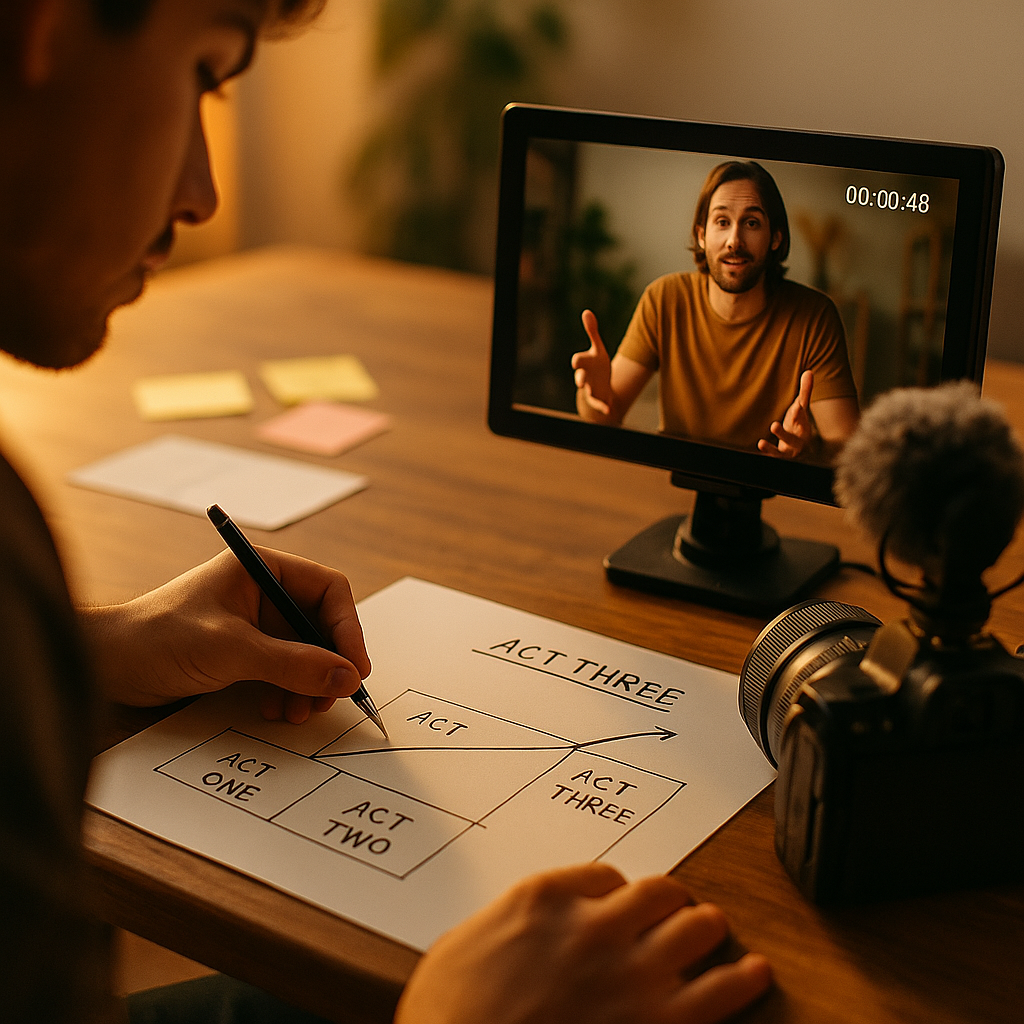
The 60-Second Story Problem Most Brands Get Wrong
Videos with narrative structure achieve 80% higher completion rates than those without, according to TikTok’s business insights. Yet most branded creator briefs still read like feature checklists, not story blueprints. The result? Content that gets skipped, suppressed by algorithms, and wasted budget. Building an immersive short-form narrative inside a 60-second vertical video is the single highest-leverage skill a brand team can develop right now — and it starts with how you brief.
Why Completion Rate Is the Only Metric That Matters First
Before engagement, before shares, before any conversion event — the algorithm needs one signal: did people watch this all the way through?
On TikTok, Instagram Reels, and YouTube Shorts, completion rate (or watch-through rate) is the primary gate to algorithmic distribution. A video with a 70% average watch-through will get pushed to 5–10x more users in the next distribution cohort than one hovering at 35%. That’s not a vanity metric. That’s the difference between 50,000 impressions and 500,000.
Algorithmic distribution on short-form platforms is binary in practice: either your completion rate clears the threshold and the content scales, or it doesn’t. Story structure is the most reliable way to clear that threshold.
So the brief can’t just say “make it engaging.” It needs to architect retention second by second. And the most proven framework for holding human attention across any time constraint is — still — the three-act structure.
Three Acts in 60 Seconds: A Structural Blueprint for Briefs
Screenwriters have used three-act structure for a century. The mechanics translate surprisingly well to short-form vertical video — but the timing compresses violently. Here’s how it breaks down for a 60-second piece:
Act I: The Hook (0–8 seconds)
This isn’t optional. It’s existential. You have roughly three seconds before a user’s thumb decides to scroll. The hook must create an open loop — a question, a contradiction, a visual disruption — that makes the viewer need resolution. Think of it as the “inciting incident” compressed into a single beat.
- Brief directive: Specify the emotional or intellectual hook. “Open with the moment right before the problem explodes” is better than “start with something attention-grabbing.”
- Example: A skincare brand doesn’t say “talk about acne.” The brief says: “Open on a close-up of your face the morning of a high-stakes event, showing the breakout. No voiceover yet — just the reaction.”
Act II: The Tension (8–45 seconds)
This is where most branded content collapses. Act II is the longest segment, and it needs escalating stakes — not a product demo. The creator must face an obstacle, try a solution, encounter a complication. This is the narrative engine that sustains watch time through the critical middle third where most drop-offs happen.
- Brief directive: Map out 2–3 tension beats. Each should raise the emotional stakes slightly. The product enters here, but as a plot device, not a sales pitch.
- Example: “Show yourself trying three rapid-fire fixes that fail — concealer melts, filter looks fake, panic sets in. Then reach for [product] as a last resort, not a first choice.”
Act III: The Payoff (45–60 seconds)
Resolution. The loop closes. The tension releases. This is where emotion converts to action — but only if it feels earned. A payoff without setup is just a product shot. A payoff after genuine narrative tension becomes shareable.
- Brief directive: Define the emotional destination, not just the CTA. “The viewer should feel relief and a little bit of envy” is more useful than “end with a call to action.”
- Example: “Final shot: you walking into the event, confident, with a knowing look at the camera. Product visible but not centered. Text overlay with the product name — no verbal sell.”
If you’re building briefs at scale, our guide on vertical video creative briefs provides a template structure you can adapt for narrative-first campaigns.
Embedding Product Without Breaking the Spell
Here’s the tension every brand marketer lives with: the product must be visible, but the moment it feels like an ad, watch time craters. Audiences — especially Gen Z — have developed near-instantaneous ad detection. According to eMarketer research, viewers decide whether content is “authentic” or “sponsored” within the first five seconds, and that judgment directly impacts whether they keep watching.
The solution isn’t to hide the product. It’s to give it a narrative role.
Three integration models that preserve narrative flow:
- The Reluctant Hero. The product enters only after other solutions fail. It earns its place in the story. This works for problem-solution categories: skincare, productivity tools, food products.
- The Constant Companion. The product is present throughout but never addressed directly. A coffee brand’s mug sits in every scene. A fashion item is worn but never “presented.” The viewer absorbs through ambient exposure.
- The Reveal Object. The product is the payoff itself — but only if Act II built genuine curiosity about it. This approach pairs well with product reveal formats that earn saves and rewatches.
What kills integration? Verbal product pitches in the middle of emotional beats. Unnatural pack shots. Creators breaking character to read a feature list. Your brief should explicitly flag these as off-limits.
The most effective product integrations don’t feel like integrations at all. They feel like plot points. Brief for narrative function, not screen time percentages.
What “Platform-Native” Actually Means in a Brief
Everyone says content should feel “native.” Few briefs define what that means operationally. Platform-native isn’t an aesthetic — it’s a set of technical and behavioral signals the algorithm and the audience expect.
For TikTok, native means: front-facing camera, casual lighting, text overlays using the app’s native fonts, trending audio or original voiceover, and a pacing rhythm that matches the For You Page cadence (fast cuts every 2–3 seconds in Act II). For Instagram Reels, native leans slightly more polished — better lighting, smoother transitions — but still handheld, still personal. YouTube Shorts splits the difference.
Your brief should specify:
- Camera setup: Front-facing, selfie-style unless the narrative demands otherwise
- Audio approach: Original voiceover, trending sound, or both layered
- Text overlay rules: Native app fonts only, positioned in the safe zone (not obscured by UI elements)
- Editing pace: Minimum number of visual cuts per act to maintain rhythm
- Aspect ratio and framing: 9:16, subject centered in the upper two-thirds
Understanding TikTok’s AI discovery layer helps you calibrate these specifications so the algorithm recognizes and rewards your content’s format signals.
Briefing for Retention Engineering, Not Just Storytelling
Story structure gets you started. Retention engineering gets you distributed.
These are the micro-techniques your brief should encourage creators to deploy — layered on top of the three-act arc:
Pattern interrupts. Every 8–12 seconds, something should change: camera angle, background, vocal tone, text appearance. Sprout Social’s data on social video confirms that visual variety within a single piece correlates strongly with higher retention.
Open loops within loops. The macro hook opens in Act I, but micro-hooks throughout Act II — “wait until you see what happened next” — keep the thumb frozen in place. Brief creators to plant at least two secondary curiosity gaps.
The “almost leave” moment. Counterintuitively, the best-performing short-form videos include a beat around the 30-second mark where the viewer thinks the story might end — then it pivots. This re-engagement spike at the midpoint is visible in Meta’s content insights data and is a reliable retention lever.
Combining kinetic text, jump cuts, and vocal emphasis creates what some creators call “dopamine stacking.” Our piece on kinetic typography techniques goes deeper on the text-layer side of this.
The Brief Document Itself: What to Include, What to Leave Out
Over-briefs kill creator performance. Under-briefs waste revisions. The sweet spot for narrative short-form:
Include:
- The emotional arc (what should the viewer feel at each act break)
- The narrative role of the product (hero, companion, or reveal)
- 2–3 mandatory story beats — not scripts, beats
- Platform-specific technical specs
- Disallowed phrases or visual approaches
- Reference videos (links, not descriptions)
Leave out:
- Exact scripts or word-for-word dialogue
- Rigid shot lists that constrain the creator’s instinct
- More than one CTA
- Brand guidelines documents exceeding two pages
If you’re running this at scale across a roster of creators, an operational framework for scaling creator output ensures consistency without micromanagement.
Your Next Move
Pull your last five creator briefs. For each one, ask: does this document specify an emotional arc, or just talking points? If it’s the latter, rewrite the brief around three acts, assign the product a narrative role, and add retention engineering cues. That single change will do more for your completion rates — and your algorithmic reach — than any budget increase.
Frequently Asked Questions
How do you structure a three-act story arc inside a 60-second video?
Allocate roughly 0–8 seconds for Act I (the hook that creates an open loop), 8–45 seconds for Act II (escalating tension with the product woven in as a narrative element), and 45–60 seconds for Act III (emotional payoff and resolution). Each act should have a distinct emotional beat specified in the creative brief, not scripted dialogue.
What completion rate should branded short-form videos aim for?
Target a minimum 50% average watch-through rate to trigger initial algorithmic distribution on TikTok and Reels. Videos that sustain 65–70% or higher typically enter expanded distribution cohorts that multiply impressions by 5–10x. Story-driven content with retention engineering techniques consistently outperforms unstructured content by 40–80% on this metric.
How do you integrate a product into a short-form narrative without it feeling like an ad?
Give the product a narrative role instead of screen time. Use one of three models: the Reluctant Hero (product enters only after other solutions fail), the Constant Companion (product is visually present but never directly addressed), or the Reveal Object (product is the earned payoff of the story). Avoid verbal product pitches mid-scene, unnatural pack shots, and breaking character to list features.
What should a creator brief include for narrative short-form video?
Include the emotional arc across all three acts, the product’s narrative role, 2–3 mandatory story beats (not scripts), platform-specific technical specs like camera setup and audio approach, disallowed phrases or visual approaches, and reference videos. Exclude rigid scripts, detailed shot lists, multiple CTAs, and brand guideline documents longer than two pages.
Why do most branded short-form videos fail to get algorithmic distribution?
Most branded videos fail because they are briefed as product showcases rather than stories. Without narrative tension to sustain viewer attention, completion rates drop below the algorithmic threshold needed for expanded distribution. Briefs that list features instead of specifying emotional arcs produce content that viewers identify as advertising within seconds, triggering scroll behavior that signals the algorithm to suppress reach.
Top Influencer Marketing Agencies
The leading agencies shaping influencer marketing in 2026
Agencies ranked by campaign performance, client diversity, platform expertise, proven ROI, industry recognition, and client satisfaction. Assessed through verified case studies, reviews, and industry consultations.
Moburst

-
2

The Shelf
Boutique Beauty & Lifestyle Influencer AgencyA data-driven boutique agency specializing exclusively in beauty, wellness, and lifestyle influencer campaigns on Instagram and TikTok. Best for brands already focused on the beauty/personal care space that need curated, aesthetic-driven content.Clients: Pepsi, The Honest Company, Hims, Elf Cosmetics, Pure LeafVisit The Shelf → -
3

Audiencly
Niche Gaming & Esports Influencer AgencyA specialized agency focused exclusively on gaming and esports creators on YouTube, Twitch, and TikTok. Ideal if your campaign is 100% gaming-focused — from game launches to hardware and esports events.Clients: Epic Games, NordVPN, Ubisoft, Wargaming, Tencent GamesVisit Audiencly → -
4

Viral Nation
Global Influencer Marketing & Talent AgencyA dual talent management and marketing agency with proprietary brand safety tools and a global creator network spanning nano-influencers to celebrities across all major platforms.Clients: Meta, Activision Blizzard, Energizer, Aston Martin, WalmartVisit Viral Nation → -
5

The Influencer Marketing Factory
TikTok, Instagram & YouTube CampaignsA full-service agency with strong TikTok expertise, offering end-to-end campaign management from influencer discovery through performance reporting with a focus on platform-native content.Clients: Google, Snapchat, Universal Music, Bumble, YelpVisit TIMF → -
6

NeoReach
Enterprise Analytics & Influencer CampaignsAn enterprise-focused agency combining managed campaigns with a powerful self-service data platform for influencer search, audience analytics, and attribution modeling.Clients: Amazon, Airbnb, Netflix, Honda, The New York TimesVisit NeoReach → -
7

Ubiquitous
Creator-First Marketing PlatformA tech-driven platform combining self-service tools with managed campaign options, emphasizing speed and scalability for brands managing multiple influencer relationships.Clients: Lyft, Disney, Target, American Eagle, NetflixVisit Ubiquitous → -
8

Obviously
Scalable Enterprise Influencer CampaignsA tech-enabled agency built for high-volume campaigns, coordinating hundreds of creators simultaneously with end-to-end logistics, content rights management, and product seeding.Clients: Google, Ulta Beauty, Converse, AmazonVisit Obviously →