


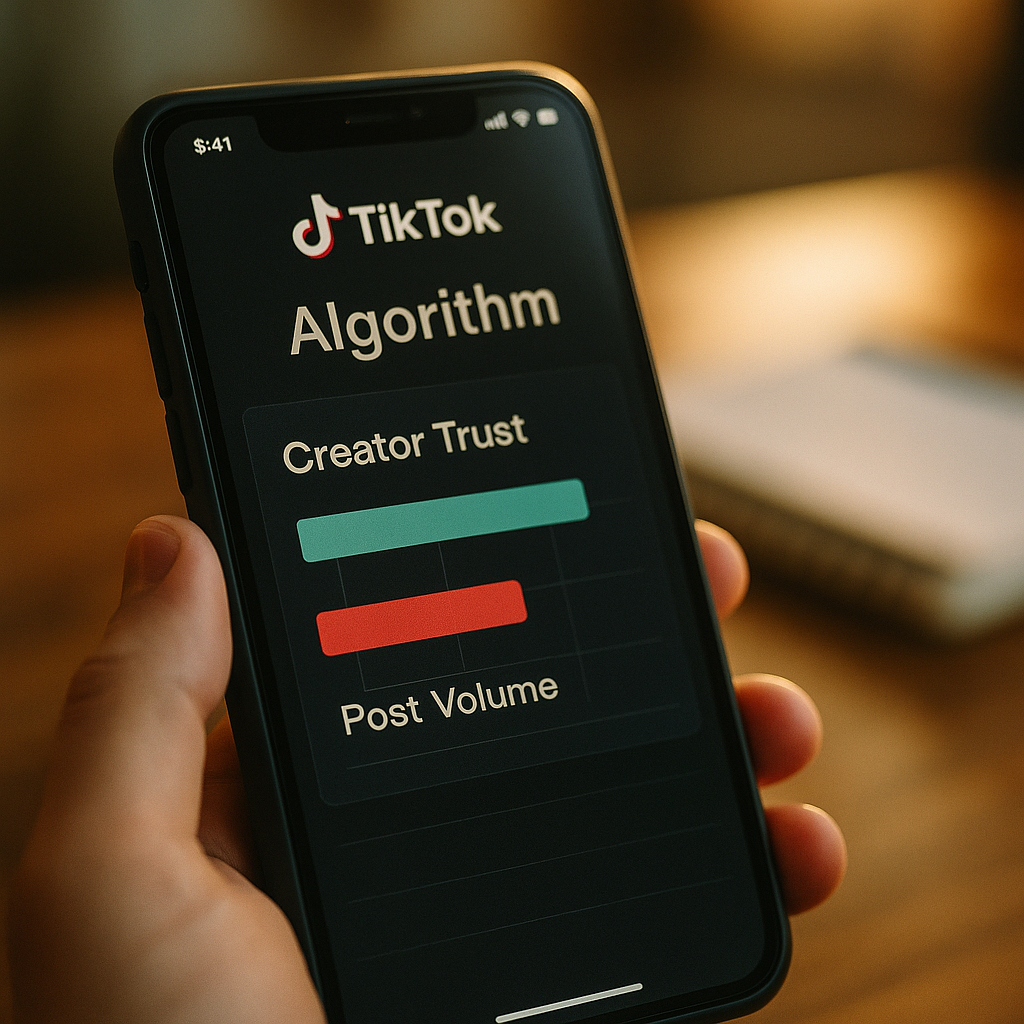
Post five times a day and still lose reach? Welcome to TikTok’s new reality. The TikTok 2026 algorithm update has quietly rewired distribution to favor creators with proven trustworthiness signals over those simply grinding out volume. For brand strategists still measuring creator value by posting cadence, this is the wake-up call.
Volume used to be the cheat code. Post more, get seen more, spend less on media. That equation is broken now, and brands clinging to it are watching CPMs climb while reach flatlines.
What Actually Changed in the Ranking Model
TikTok’s updated ranking system weights a cluster of trust signals more heavily than raw output frequency. Internally, this reportedly draws on account history, viewer retention consistency, moderation flags, and something close to a “reliability score” built from how consistently a creator’s content matches what viewers expect after clicking play.
This isn’t a cosmetic tweak. It follows a pattern the platform has been building toward for a while. If you’ve been tracking the shift toward watch-time weighted distribution, this update extends that logic: it’s not just about whether people watch, but whether the account earning the watch time has a track record of not misleading them.
Four signals appear to carry the most weight:
- Completion-to-promise ratio: Does the video deliver what the hook, caption, or thumbnail implied?
- Moderation-adjacent history: Repeated near-violations (borderline claims, flagged audio, community guideline warnings) suppress future reach, even without an outright strike.
- Audience retention stability: Creators with wildly inconsistent retention across videos get treated as less predictable, and less predictable now means less distributed.
- Disclosure compliance: Paid partnership tagging accuracy is reportedly factored into trust scoring, not just handled as a legal checkbox.
Posting volume is now a vanity metric. TikTok’s model treats a trusted creator’s third post of the week as more valuable than an unreliable account’s twentieth.
This mirrors a broader trend across platforms. LinkedIn’s push toward vetted expertise in its trusted-voice algorithm and YouTube’s emphasis on comment-based authenticity signals (covered in our breakdown of how the comment signal forces creator rebriefs) all point the same direction: platforms are optimizing for user trust, not just engagement volume, because trust is what keeps users from churning to competitors.
Why TikTok Is Doing This Now
Two forces are converging. First, regulatory pressure. The FTC has sharpened its enforcement posture on influencer disclosure over the past several cycles, and platforms that don’t self-police risk becoming the next test case. Building disclosure compliance into ranking is a defensive move as much as a product one. Check the FTC’s endorsement guidance if your compliance team hasn’t revisited it recently, because enforcement expectations have tightened.
Second, AI-generated and low-effort mass content flooded the platform. When anyone can churn out fifteen near-identical videos a day using generative tools, volume stops being a signal of effort or quality; it becomes noise. TikTok needed a way to separate creators who genuinely serve an audience from accounts gaming the system with output. Trustworthiness scoring is that filter.
eMarketer’s creator economy research has flagged this exact tension for a while: platforms are drowning in content but starving for reliability. eMarketer’s data on content saturation supports what strategists have felt anecdotally for months, that more posts no longer equals more reach.
The Brand Cost of Getting This Wrong
Here’s the operational risk nobody’s pricing in yet: your creator roster was likely built for the old system. Agencies optimized for posting frequency because that’s what the brief rewarded. If your vetting criteria still lead with “posts X times per week,” you’re paying for reach that no longer exists.
Worse, if any of your creators have a history of borderline content, even unrelated to your brand, that history now suppresses your campaign’s distribution by association. A creator’s past flags become your media inefficiency. This is a direct extension of what we outlined in TikTok’s trust-based distribution rules, and it means creator vetting can no longer stop at follower count and engagement rate.
A creator’s unrelated moderation history is now a line item in your campaign’s CPM. Vet accordingly.
Rebuilding the Creator Scorecard
Brand strategists need a new evaluation framework, and it needs to sit alongside (not replace) your existing performance metrics. Here’s a practical starting point:
- Audit account history, not just recent output. Pull the creator’s last 90 days of content and look for flagged videos, removed posts, or shadowban patterns. Tools like Sprout Social can help track engagement anomalies that often correlate with suppression.
- Score retention consistency, not average retention. A creator averaging 40% retention with tight variance is safer than one averaging 55% with huge swings. Consistency is what the algorithm rewards now.
- Check disclosure hygiene across their catalog. Sloppy #ad tagging on old posts is a red flag for how the algorithm currently treats that account, and a compliance risk for your brand regardless.
- Weight quality over cadence in contracts. Stop paying for volume-based deliverables. Shift toward fewer, higher-trust posts with performance-based bonuses tied to completion rate.
This is the same shift brands had to make when TikTok moved toward discovery-over-reach ranking. Each update pushes strategists further from “buy attention” toward “earn algorithmic confidence.” The mechanics differ, but the muscle you’re building is the same: evaluating creators as long-term trust assets, not one-off media buys.
What This Means for Briefs and Contracts
Rewrite your briefs. Seriously. If your current brief specifies a minimum number of posts per week, cut that clause or reframe it as a ceiling, not a floor. Replace it with retention and completion benchmarks pulled from the creator’s own historical data.
Add a trust-history clause to contracts, too. Agencies negotiating creator deals should request recent moderation status and platform standing as part of due diligence, the same way you’d request media kit data. This isn’t about distrust; it’s about pricing risk accurately. A HubSpot survey on creator partnerships found that HubSpot’s marketing benchmarks increasingly separate “activity metrics” from “trust metrics” when evaluating creator ROI, and that split is becoming standard practice across the industry.
Compliance teams should also revisit how partnership disclosures get implemented at scale, particularly for livestream and shoppable formats where the FTC has been more active. If you’re running TikTok Shop campaigns, this pairs directly with the disclosure gaps flagged in TikTok Shop livestream compliance coverage, and with the documentation issues raised in TikTok Shop verification requirements.
A Quick Gut Check for Your Current Roster
Before your next quarterly review, ask three questions about every creator on retainer: Has their retention rate been stable over their last ten posts? Do they have any recent moderation flags, even minor ones? Is their disclosure tagging consistent across sponsored content? If you can’t answer these confidently, that’s the gap to close first, before you renegotiate a single rate card.
FAQs
Frequently Asked Questions
What is the TikTok 2026 algorithm update, in plain terms?
It’s a ranking shift that weights creator trustworthiness signals, like retention consistency, moderation history, and disclosure accuracy, more heavily than posting frequency when determining content distribution.
Does posting less actually help reach now?
Not directly, but posting less while improving consistency and retention quality tends to outperform high-volume, inconsistent posting under the new model. Quality signals now carry more ranking weight than raw output.
How can brands check a creator’s trust signals before signing a contract?
Review the creator’s last 90 days of content for flagged or removed posts, check retention consistency across videos, and audit their disclosure tagging history. Social listening tools can help surface anomalies.
Does this update affect TikTok Shop and livestream commerce differently?
Yes. Disclosure compliance carries extra weight in shoppable and livestream formats, where FTC scrutiny is higher, making creator vetting even more important for commerce-focused campaigns.
Should brands change how they write creator briefs?
Yes. Briefs should shift from mandating minimum post counts to setting quality benchmarks around retention and completion rate, with posting frequency treated as a ceiling rather than a requirement.
The brands that win the next two quarters on TikTok won’t be the ones posting most, they’ll be the ones who audited creator trust signals first. Start with your top five retainer creators this week, not your whole roster.
Top Influencer Marketing Agencies
The leading agencies shaping influencer marketing in 2026
Agencies ranked by campaign performance, client diversity, platform expertise, proven ROI, industry recognition, and client satisfaction. Assessed through verified case studies, reviews, and industry consultations.
Moburst

-
2

The Shelf
Boutique Beauty & Lifestyle Influencer AgencyA data-driven boutique agency specializing exclusively in beauty, wellness, and lifestyle influencer campaigns on Instagram and TikTok. Best for brands already focused on the beauty/personal care space that need curated, aesthetic-driven content.Clients: Pepsi, The Honest Company, Hims, Elf Cosmetics, Pure LeafVisit The Shelf → -
3

Audiencly
Niche Gaming & Esports Influencer AgencyA specialized agency focused exclusively on gaming and esports creators on YouTube, Twitch, and TikTok. Ideal if your campaign is 100% gaming-focused — from game launches to hardware and esports events.Clients: Epic Games, NordVPN, Ubisoft, Wargaming, Tencent GamesVisit Audiencly → -
4

Viral Nation
Global Influencer Marketing & Talent AgencyA dual talent management and marketing agency with proprietary brand safety tools and a global creator network spanning nano-influencers to celebrities across all major platforms.Clients: Meta, Activision Blizzard, Energizer, Aston Martin, WalmartVisit Viral Nation → -
5

The Influencer Marketing Factory
TikTok, Instagram & YouTube CampaignsA full-service agency with strong TikTok expertise, offering end-to-end campaign management from influencer discovery through performance reporting with a focus on platform-native content.Clients: Google, Snapchat, Universal Music, Bumble, YelpVisit TIMF → -
6

NeoReach
Enterprise Analytics & Influencer CampaignsAn enterprise-focused agency combining managed campaigns with a powerful self-service data platform for influencer search, audience analytics, and attribution modeling.Clients: Amazon, Airbnb, Netflix, Honda, The New York TimesVisit NeoReach → -
7

Ubiquitous
Creator-First Marketing PlatformA tech-driven platform combining self-service tools with managed campaign options, emphasizing speed and scalability for brands managing multiple influencer relationships.Clients: Lyft, Disney, Target, American Eagle, NetflixVisit Ubiquitous → -
8

Obviously
Scalable Enterprise Influencer CampaignsA tech-enabled agency built for high-volume campaigns, coordinating hundreds of creators simultaneously with end-to-end logistics, content rights management, and product seeding.Clients: Google, Ulta Beauty, Converse, AmazonVisit Obviously →