


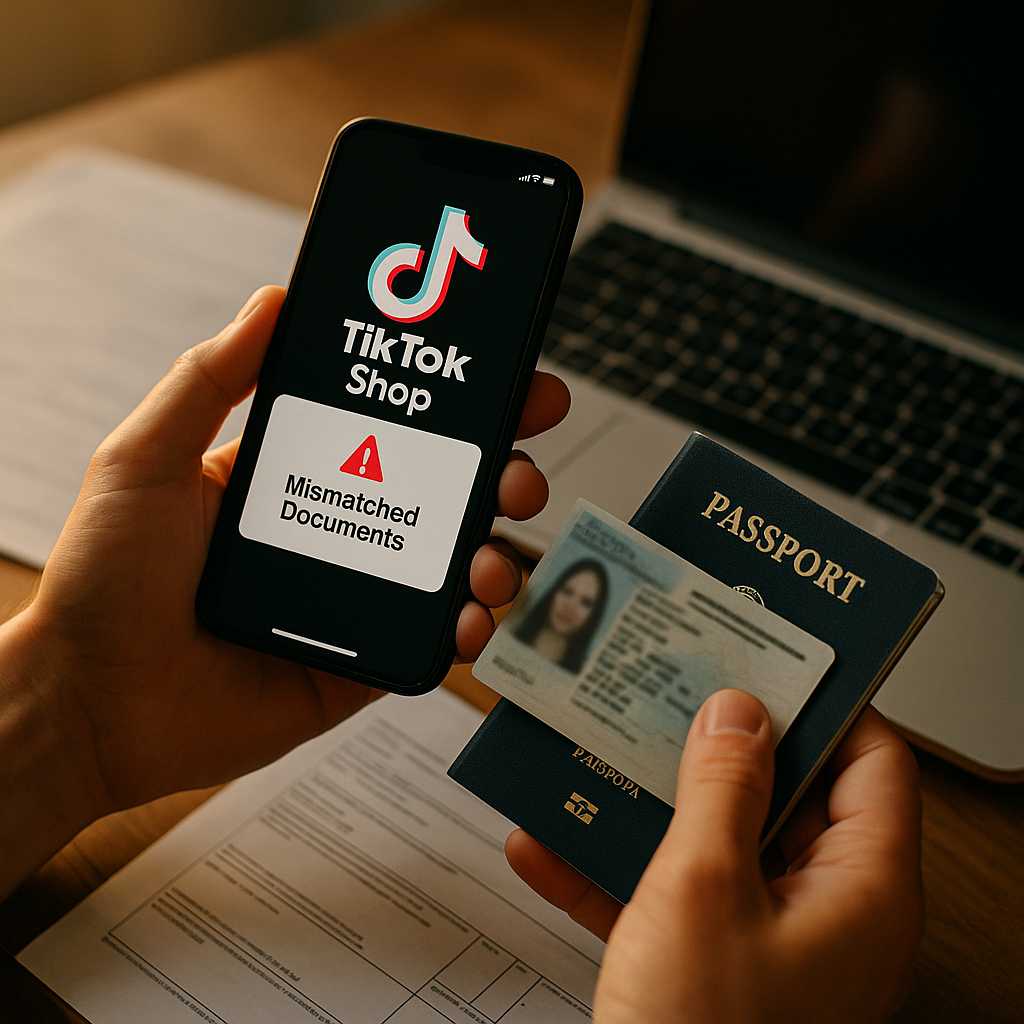
One rejected document. That’s all it takes to freeze a TikTok Shop storefront mid-quarter. As TikTok Shop verification rules tighten across every major market, merchants are discovering that a business license address that doesn’t quite match a bank statement can trigger holds, delayed payouts, or outright suspension. If your compliance team hasn’t audited your seller documents lately, now’s the time.
Why TikTok Is Cracking Down Now
TikTok Shop has grown fast, and fast growth attracts fraud. Fake storefronts, shell companies, and mismatched tax identities have become a real headache for trust and safety teams trying to keep counterfeit goods and payment fraud off the platform. The response: a tightened verification pipeline that cross-checks business registration data, banking details, and tax IDs against multiple sources instead of accepting a single uploaded PDF at face value.
This isn’t unique to TikTok. Amazon, Meta, and Google have all hardened seller and advertiser verification in recent years after regulatory pressure and high-profile fraud cases. TikTok is simply catching up, and doing it while under intense scrutiny from regulators in the US, UK, and EU. The platform has every incentive to over-correct on verification right now.
A single inconsistency, like a business name spelled differently on your license versus your bank statement, is now enough to trigger manual review and pause your payouts.
What “Mismatched Business Documents” Actually Means
This is the phrase causing panic in merchant support forums, and it’s more specific than it sounds. TikTok’s verification engine flags discrepancies between documents that should, in theory, all describe the same legal entity. Common triggers include:
- Legal name inconsistencies — your business license says “Smith Retail LLC,” your bank account is registered under “Smith Retail Group,” and your tax filing uses yet another variant.
- Address mismatches — a registered office address that differs from the address on your bank statement or utility bill used for proof of location.
- Outdated registration documents — licenses that have expired, or that reflect an old business structure after a merger, rebrand, or ownership change.
- Beneficial ownership gaps — when the person listed as the account administrator isn’t documented as an owner or authorized signatory anywhere in the submitted paperwork.
- Currency or banking region conflicts — a seller registered as a UK entity attempting payouts through a bank account domiciled elsewhere.
None of these are necessarily signs of fraud. Most are administrative sloppiness: a business that rebranded but never updated its bank records, or a multi-entity operation where the marketing team registered the shop under a different subsidiary than finance uses for banking. TikTok’s system doesn’t know the difference, though. It flags first and asks questions later.
The Real Cost of a Verification Freeze
Here’s the part that should worry brand and agency leads more than the compliance team alone: a verification hold doesn’t just delay onboarding. It can suspend an active, revenue-generating storefront mid-campaign.
Picture this. You’ve briefed twenty creators for a livestream shopping event tied to a product launch. Commission structures are set, inventory is staged, and the creators have already started teasing content. Three days out, TikTok flags a document mismatch during a routine re-verification sweep, and your shop goes into restricted mode. Checkout is disabled. Payouts freeze. Your creators are still posting, but the links don’t convert.
That’s not a hypothetical. Merchants running high-volume campaigns, particularly around beauty livestreams and seasonal drops, are exactly the accounts most likely to trip re-verification triggers because they process higher transaction volumes and attract more scrutiny.
The operational fallout compounds quickly:
- Paused affiliate commissions mean creators stop promoting, since there’s no incentive to push dead links.
- Ad spend tied to Shop ads gets wasted if the destination storefront is inaccessible.
- Brand trust erodes with creator partners who blame the brand, not TikTok, when payouts stall.
- Recovery isn’t instant. Manual review queues can take days, sometimes longer during peak shopping seasons.
Who’s Most at Risk?
Not every merchant faces equal exposure. A few patterns stand out from what agencies are reporting in seller support channels and TikTok’s own TikTok for Business resources:
- Multi-entity brands. Companies operating several legal entities across regions (a US parent, a UK subsidiary, a separate manufacturing entity) are prone to document mismatches simply because different teams manage different paperwork.
- Recently acquired or merged businesses. If your business license still reflects the pre-acquisition name while your bank account has been updated, that’s a mismatch waiting to happen.
- Agencies managing shops on behalf of clients. When an agency’s operational details (address, admin contact) get mixed into a client’s legal documentation, TikTok’s system reads it as inconsistent ownership.
- Cross-border sellers. Brands selling into the UK or EU from a US-registered entity face extra layers of tax and banking verification, and any gap between VAT registration and business licensing gets flagged fast.
- Dropshippers and marketplace resellers. Businesses without a clear, singular legal identity (using supplier addresses or third-party fulfillment centers as their registered address) are almost guaranteed to trigger reviews.
If your brand fits more than one of these categories, treat document audits as a recurring compliance task, not a one-time setup step.
How to Audit Your Documents Before TikTok Does
Waiting for a rejection notice is the expensive way to learn about a mismatch. A proactive audit costs almost nothing and takes an afternoon. Here’s what that should include:
- Pull every document you submitted at onboarding — business license, tax registration, bank statement, and proof of address — and compare legal names character by character. Even punctuation differences (“Smith Retail, LLC” vs “Smith Retail LLC”) can trip automated matching.
- Confirm your registered address matches across all filings. If you’ve moved offices or changed registered agents, update every document, not just the ones you remember.
- Verify beneficial ownership documentation is current. If ownership changed hands, or a new signatory was added to the bank account, make sure TikTok’s records reflect that.
- Check expiration dates. Business licenses and tax certificates often have renewal cycles that teams forget about until it’s too late.
- Centralize document ownership. Assign one person or team (usually finance or legal, not marketing) to own the master file of compliance documents used across every platform, not just TikTok.
This last point matters more than it sounds. Marketing teams often manage the day-to-day of a TikTok Shop, but the legal entity information belongs to finance and legal. When those teams aren’t in sync, mismatches happen almost by default.
Treat platform verification like a compliance audit, not a marketing task. The team that filed your business registration should be the same team maintaining your seller account documents.
Building Verification Into Your Onboarding Playbook
Brands scaling TikTok Shop across multiple product categories or regions should bake document verification into their standard operating procedure, the same way they’d bake in FTC disclosure checks or influencer contract review. This is especially true for teams already using structured onboarding templates like the ones covered in TikTok Shop category templates for faster creator onboarding.
A few practical steps:
- Build a verification checklist into your shop launch timeline, separate from your creator and content timelines.
- Set calendar reminders for license and tax certificate renewals well before expiration.
- If you operate under multiple entities, designate a single “TikTok Shop entity” and route all documentation through that entity consistently.
- Loop legal or compliance into any rebrand, merger, or banking change before it touches your seller account, not after.
Agencies managing shops for multiple clients should go a step further and maintain a verification tracker across accounts, flagging upcoming renewals and known risk factors per client. This kind of operational discipline pays for itself the first time it prevents a mid-campaign freeze.
Industry data on marketplace trust continues to show that verification friction is rising across the board, not just on TikTok. eMarketer and Statista have both tracked growing regulatory pressure on social commerce platforms, which suggests this trend has further to run before it plateaus.
What This Means for Creator Relationships
There’s a downstream effect worth flagging separately: creators don’t distinguish between “TikTok froze the shop” and “the brand can’t pay me.” From a creator’s perspective, a stalled commission is a stalled commission. Brands that want to protect creator trust should build verification status into their partner communications, the same way they’d flag inventory delays or shipping issues.
This connects directly to broader compliance hygiene across TikTok Shop campaigns, including the disclosure and consent practices covered in age-gating and compliance frameworks for regulated categories. Verification isn’t a standalone issue. It’s one piece of a larger risk management picture that includes FTC disclosure, data handling, and payment compliance.
For a broader read on how platform-level operational shifts are forcing brands to rebuild their creator processes, see how similar disruptions have played out with TikTok’s completion rate changes. The pattern repeats: platform tightens a rule, brands that were operating loosely absorb the cost first.
FAQs
What triggers a TikTok Shop document mismatch flag?
Common triggers include inconsistent legal business names across your license, bank account, and tax registration; mismatched addresses; expired licenses; and gaps between listed account administrators and documented beneficial owners.
How long does TikTok Shop verification review take?
Standard reviews can take anywhere from a few days to over a week, and manual review queues often lengthen during peak shopping periods. There’s no guaranteed turnaround time published by TikTok.
Can a verification hold affect an already-active shop?
Yes. TikTok periodically re-verifies active seller accounts, and a flagged mismatch can restrict checkout and pause payouts on a storefront that’s already live and generating sales.
Who should manage business document compliance for TikTok Shop?
Legal or finance teams should own the master documentation, since they typically hold the original business registration and banking records. Marketing teams managing day-to-day shop operations should coordinate with them, not manage documents independently.
Does this affect agencies managing shops for multiple clients?
Yes, and often more acutely. Agencies need to ensure client business documentation stays clearly separated from agency operational details to avoid ownership and address mismatches being flagged during review.
The Next Step
Don’t wait for a rejection notice to find out your documents don’t match. Run a document audit this week, assign clear ownership to legal or finance, and treat TikTok Shop verification as an ongoing compliance function rather than a one-time onboarding task.
FAQs
What triggers a TikTok Shop document mismatch flag?
Common triggers include inconsistent legal business names across your license, bank account, and tax registration; mismatched addresses; expired licenses; and gaps between listed account administrators and documented beneficial owners.
How long does TikTok Shop verification review take?
Standard reviews can take anywhere from a few days to over a week, and manual review queues often lengthen during peak shopping periods. There’s no guaranteed turnaround time published by TikTok.
Can a verification hold affect an already-active shop?
Yes. TikTok periodically re-verifies active seller accounts, and a flagged mismatch can restrict checkout and pause payouts on a storefront that’s already live and generating sales.
Who should manage business document compliance for TikTok Shop?
Legal or finance teams should own the master documentation, since they typically hold the original business registration and banking records. Marketing teams managing day-to-day shop operations should coordinate with them, not manage documents independently.
Does this affect agencies managing shops for multiple clients?
Yes, and often more acutely. Agencies need to ensure client business documentation stays clearly separated from agency operational details to avoid ownership and address mismatches being flagged during review.
Top Influencer Marketing Agencies
The leading agencies shaping influencer marketing in 2026
Agencies ranked by campaign performance, client diversity, platform expertise, proven ROI, industry recognition, and client satisfaction. Assessed through verified case studies, reviews, and industry consultations.
Moburst

-
2

The Shelf
Boutique Beauty & Lifestyle Influencer AgencyA data-driven boutique agency specializing exclusively in beauty, wellness, and lifestyle influencer campaigns on Instagram and TikTok. Best for brands already focused on the beauty/personal care space that need curated, aesthetic-driven content.Clients: Pepsi, The Honest Company, Hims, Elf Cosmetics, Pure LeafVisit The Shelf → -
3

Audiencly
Niche Gaming & Esports Influencer AgencyA specialized agency focused exclusively on gaming and esports creators on YouTube, Twitch, and TikTok. Ideal if your campaign is 100% gaming-focused — from game launches to hardware and esports events.Clients: Epic Games, NordVPN, Ubisoft, Wargaming, Tencent GamesVisit Audiencly → -
4

Viral Nation
Global Influencer Marketing & Talent AgencyA dual talent management and marketing agency with proprietary brand safety tools and a global creator network spanning nano-influencers to celebrities across all major platforms.Clients: Meta, Activision Blizzard, Energizer, Aston Martin, WalmartVisit Viral Nation → -
5

The Influencer Marketing Factory
TikTok, Instagram & YouTube CampaignsA full-service agency with strong TikTok expertise, offering end-to-end campaign management from influencer discovery through performance reporting with a focus on platform-native content.Clients: Google, Snapchat, Universal Music, Bumble, YelpVisit TIMF → -
6

NeoReach
Enterprise Analytics & Influencer CampaignsAn enterprise-focused agency combining managed campaigns with a powerful self-service data platform for influencer search, audience analytics, and attribution modeling.Clients: Amazon, Airbnb, Netflix, Honda, The New York TimesVisit NeoReach → -
7

Ubiquitous
Creator-First Marketing PlatformA tech-driven platform combining self-service tools with managed campaign options, emphasizing speed and scalability for brands managing multiple influencer relationships.Clients: Lyft, Disney, Target, American Eagle, NetflixVisit Ubiquitous → -
8

Obviously
Scalable Enterprise Influencer CampaignsA tech-enabled agency built for high-volume campaigns, coordinating hundreds of creators simultaneously with end-to-end logistics, content rights management, and product seeding.Clients: Google, Ulta Beauty, Converse, AmazonVisit Obviously →