


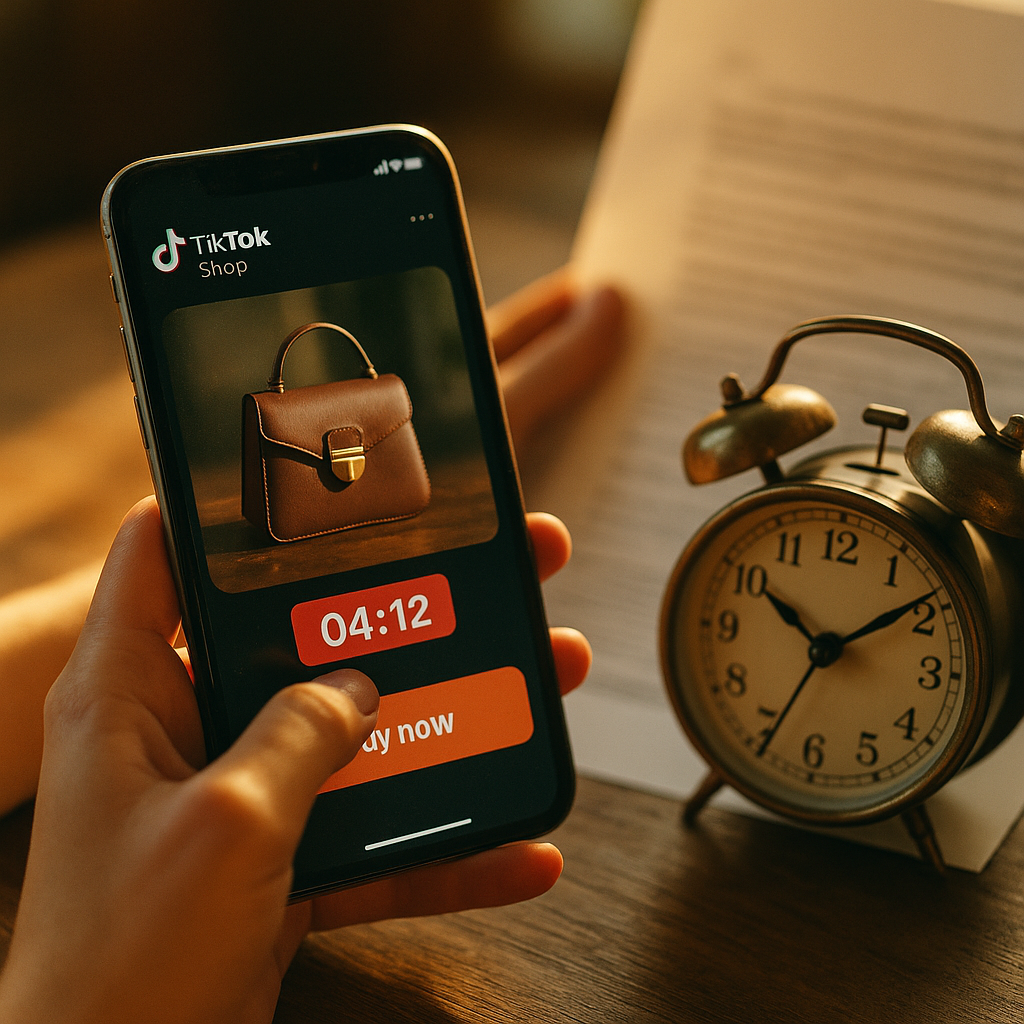
Seventeen state attorneys general have opened inquiries into “fake urgency” tactics in digital retail since last year. That number should stop every TikTok Shop live-selling team cold. The TikTok Shop countdown timer feature that drives your conversion spikes is also the exact mechanism state deceptive-scarcity statutes were written to catch. If your legal review process doesn’t touch the timer settings before broadcast, you’re one viral clip away from a subpoena.
This isn’t theoretical. Live commerce hosts routinely reset countdown clocks between shows, reuse “last chance” language across restocks, and let affiliate creators freelance their own urgency copy. Each of those habits, individually mundane, adds up to a pattern regulators now recognize on sight.
Why Countdown Timers Became a Legal Flashpoint
Countdown timers work because they exploit loss aversion — a well-documented psychological trigger. That’s precisely why they’re regulated. States including California, New York, and Colorado have deceptive-scarcity or “drip pricing” provisions that prohibit representing a deal as time-limited or inventory-limited when it isn’t. Some of these statutes predate e-commerce; they were written for car dealership “today only” banners. Live-selling just gave them a new venue.
The FTC has also signaled interest at the federal level, treating fabricated urgency claims as a form of deceptive practice under Section 5. Brands that assume TikTok’s native timer widget is “pre-cleared” for compliance are making a costly assumption. The platform builds the tool; it does not indemnify you for how you use it. For a deeper breakdown of the statutory overlap, see our countdown timer and scarcity law audit.
A countdown timer that resets after every broadcast isn’t a marketing feature anymore — in several states, it’s documented evidence of deceptive scarcity.
The Core Problem: Timers Don’t Track Reality
Here’s the operational gap nobody wants to admit: TikTok Shop’s countdown widget is a front-end display element. It doesn’t automatically sync with actual inventory counts, actual pricing history, or actual promotional windows unless your team builds that integration deliberately.
That means a host can say “only 12 left, timer’s almost up” while the backend shows 400 units in three warehouses. That’s not a hypothetical — it’s the standard failure mode when merchandising and live-production teams operate on separate systems and nobody owns the reconciliation.
- Inventory drift: Displayed scarcity doesn’t match warehouse management system data in real time.
- Timer reuse: The same 24-hour countdown gets relaunched show after show, implying a recurring false deadline.
- Price anchoring without proof: “50% off” claims without a substantiated regular price history, which several states now require.
- Creator improvisation: Affiliates ad-libbing urgency language (“this never happens again”) that isn’t in the approved script.
Which States Are Most Aggressive Right Now
Not every state treats scarcity claims the same way, and your exposure varies significantly by where your buyers live — which, in a national live-stream, is basically everywhere.
California’s Unfair Competition Law and False Advertising Law give private plaintiffs and the state AG broad authority to challenge “limited time” claims that don’t hold up. New York’s General Business Law Section 349 has been used in class actions against retailers over fake sale pricing. Colorado’s Consumer Protection Act was recently amended with language that directly contemplates digital dark patterns, including manufactured urgency. Pennsylvania and Texas have both signaled enforcement interest through consumer protection bureau statements, even without a live-selling-specific case yet on record.
The practical takeaway: if your live shows reach a national audience (and TikTok Shop broadcasts almost always do), you’re not choosing one state’s rulebook. You’re complying with the strictest one, by default, whether you meant to or not.
The Pre-Broadcast Checklist
Build this into your production run-of-show, not your quarterly compliance review. Scarcity claims happen live, in real time, which means your review window is before the red “Go Live” button, not after.
- Pull a live inventory snapshot within 30 minutes of broadcast. Cross-check the number the host will say on-air against the actual SKU count. Automate this feed if you run more than two shows a week.
- Verify the timer’s countdown target is unique to this event. If the same countdown ran last week for a different “final hours” claim, retire it. Reused timers are the single most common evidence exhibit in scarcity complaints.
- Confirm discount claims against a documented price history. Several state statutes require that a “was” price actually reflect a sustained prior selling price, not a price set an hour before the sale to make the discount look bigger.
- Lock host scripts for urgency language. Approved phrasing only. No “this is literally the last one” unless someone has confirmed that, literally, in the system.
- Brief affiliate co-hosts separately. Affiliates often aren’t W-2 employees and may not internalize brand compliance training the way in-house hosts do. Treat their scarcity language as a distinct risk category.
- Archive the broadcast and the backend data together. If a claim is challenged months later, you need the VOD and the inventory log timestamped to the same window.
- Assign one person as the on-call compliance sign-off during the show. Live production moves fast; someone needs authority to pause a claim in real time, not just flag it in a post-mortem.
This process overlaps meaningfully with broader creator claims work. If you haven’t already built a substantiation habit for on-air statements generally, our guide on substantiating claims before going live is a useful companion piece, and our look at substantiating typical-results claims covers adjacent territory for testimonial-heavy shows.
Contract Language Matters More Than You Think
Most influencer agreements address disclosure (#ad tags, FTC endorsement rules) in detail but say almost nothing about scarcity claims specifically. That’s a gap worth closing before your next contract cycle.
Add explicit language requiring hosts and affiliates to use only brand-approved urgency phrasing, with a defined process for real-time script deviations. Pair it with an indemnification carve-out addressing state consumer-protection exposure, not just FTC risk. Brands already tightening contract language around AI-selected creators should review our piece on indemnification clauses for AI-selected creators, since the underlying liability logic transfers directly to live-selling scarcity claims.
It’s also worth reviewing how your existing disclosure standards are structured across platforms. If you’re running the same live-selling program on TikTok, Instagram, and YouTube simultaneously, a single cross-platform disclosure standard reduces the odds that one platform’s compliant script becomes another platform’s violation.
What Happens If You Get It Wrong
Enforcement rarely starts with a headline lawsuit. It starts with a consumer complaint, a state AG inquiry letter, or a plaintiff’s firm scraping VOD archives for pattern evidence. TikTok Shop’s own advertising policies already prohibit misleading urgency claims at the platform level, which means a state complaint can trigger a parallel platform enforcement action, account restriction, or a verification freeze on top of the legal exposure.
Recovery from a platform-side freeze is its own operational headache. We’ve covered the mechanics in our piece on fixing the verification freeze contract gap, and the DPA-specific angle in DPA fixes to avoid merchant freezes. The lesson repeats across every one of these compliance failures: platform risk and statutory risk are no longer separate conversations. They compound.
Data from eMarketer shows live shopping continuing to scale sharply in the U.S. market, which means regulatory attention will scale with it. The FTC’s guidance on endorsements and testimonials already provides a framework state regulators are borrowing from, particularly around substantiated claims. Treat that convergence as a signal, not a coincidence.
Building This Into Your Compliance Calendar
A one-time checklist fixes tomorrow’s broadcast. A recurring audit fixes your program. If your team already runs quarterly compliance audits tied to renewals, add countdown-timer and scarcity-claim review as a standing line item, not a footnote. Tie it to the same renewal cycle you use for creator contract review, so nobody launches a new live-selling season without a fresh look at inventory-sync accuracy and script approvals.
For brands using automated tools to catch disclosure gaps before publish, similar logic applies here: build a scarcity-claim scanner into your pre-broadcast pipeline the same way you’d run an automated disclosure scanner before a sponsored post goes live. The tooling differs; the underlying discipline, catch it before it airs, not after, is identical.
Next step: Pull your last five live-selling VODs this week and match every countdown timer and “limited stock” claim against your actual inventory logs from that hour. If even one doesn’t reconcile, freeze new broadcasts until your pre-broadcast checklist is formalized and signed off by legal, not just marketing.
FAQs
What is a deceptive-scarcity statute?
It’s a state consumer-protection law that prohibits businesses from falsely representing that a product, price, or offer is limited in time or quantity when it isn’t. These statutes exist in various forms in California, New York, Colorado, and several other states, and they apply directly to live-selling countdown timers and “limited stock” claims.
Does TikTok Shop’s countdown timer feature comply with these laws automatically?
No. The timer is a display tool, not a compliance guarantee. TikTok does not verify that your countdown reflects a genuine deadline or that your stated inventory numbers are accurate. That verification responsibility sits entirely with the brand or seller running the broadcast.
Which state’s rules should a national live-selling brand follow?
In practice, the strictest applicable state law, since a national broadcast reaches buyers in every state simultaneously. Legal teams typically build compliance processes around the most restrictive statute in play rather than customizing claims by viewer location, which isn’t feasible in real-time video.
Can affiliate creators create scarcity-claim liability for the brand?
Yes. If an affiliate ad-libs urgency language during a co-hosted broadcast, the brand can still bear liability, particularly if the brand controls the product listing, pricing, and promotional framing. Contracts should explicitly restrict scarcity language to pre-approved scripts.
What documentation should brands keep after a live-selling broadcast?
Archive the full broadcast VOD alongside a timestamped inventory and pricing snapshot from the same window. This pairing is the primary evidence needed to defend a scarcity claim if it’s later challenged by a regulator or plaintiff.
FAQs
Visible FAQ content is above. JSON-LD version below.
Top Influencer Marketing Agencies
The leading agencies shaping influencer marketing in 2026
Agencies ranked by campaign performance, client diversity, platform expertise, proven ROI, industry recognition, and client satisfaction. Assessed through verified case studies, reviews, and industry consultations.
Moburst

-
2

The Shelf
Boutique Beauty & Lifestyle Influencer AgencyA data-driven boutique agency specializing exclusively in beauty, wellness, and lifestyle influencer campaigns on Instagram and TikTok. Best for brands already focused on the beauty/personal care space that need curated, aesthetic-driven content.Clients: Pepsi, The Honest Company, Hims, Elf Cosmetics, Pure LeafVisit The Shelf → -
3

Audiencly
Niche Gaming & Esports Influencer AgencyA specialized agency focused exclusively on gaming and esports creators on YouTube, Twitch, and TikTok. Ideal if your campaign is 100% gaming-focused — from game launches to hardware and esports events.Clients: Epic Games, NordVPN, Ubisoft, Wargaming, Tencent GamesVisit Audiencly → -
4

Viral Nation
Global Influencer Marketing & Talent AgencyA dual talent management and marketing agency with proprietary brand safety tools and a global creator network spanning nano-influencers to celebrities across all major platforms.Clients: Meta, Activision Blizzard, Energizer, Aston Martin, WalmartVisit Viral Nation → -
5

The Influencer Marketing Factory
TikTok, Instagram & YouTube CampaignsA full-service agency with strong TikTok expertise, offering end-to-end campaign management from influencer discovery through performance reporting with a focus on platform-native content.Clients: Google, Snapchat, Universal Music, Bumble, YelpVisit TIMF → -
6

NeoReach
Enterprise Analytics & Influencer CampaignsAn enterprise-focused agency combining managed campaigns with a powerful self-service data platform for influencer search, audience analytics, and attribution modeling.Clients: Amazon, Airbnb, Netflix, Honda, The New York TimesVisit NeoReach → -
7

Ubiquitous
Creator-First Marketing PlatformA tech-driven platform combining self-service tools with managed campaign options, emphasizing speed and scalability for brands managing multiple influencer relationships.Clients: Lyft, Disney, Target, American Eagle, NetflixVisit Ubiquitous → -
8

Obviously
Scalable Enterprise Influencer CampaignsA tech-enabled agency built for high-volume campaigns, coordinating hundreds of creators simultaneously with end-to-end logistics, content rights management, and product seeding.Clients: Google, Ulta Beauty, Converse, AmazonVisit Obviously →