


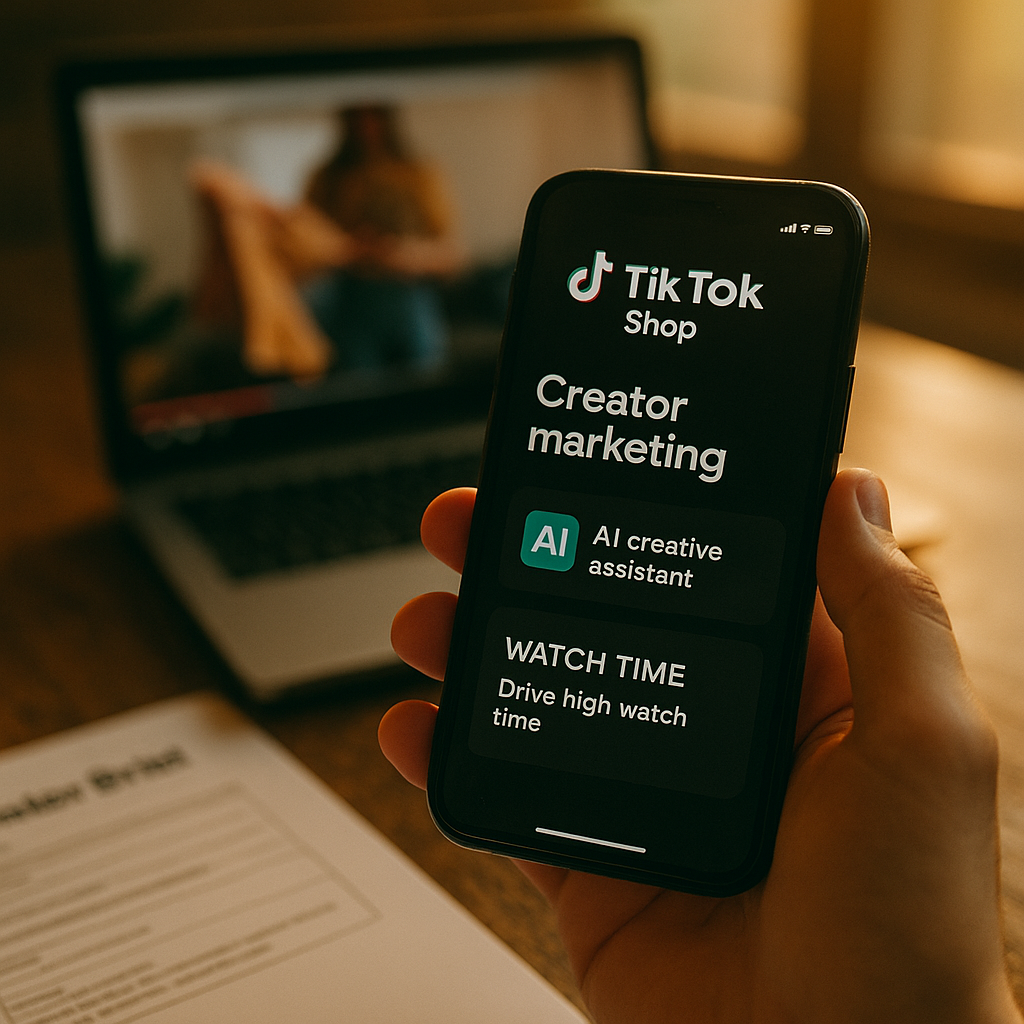
Two Algorithms, One Brief
TikTok’s shopping discovery layer has quietly become one of the most consequential surfaces in paid social — and most brand teams are still writing creator briefs as if only human viewers are watching. They’re not. According to TikTok for Business, AI-powered product recommendation surfaces now account for a growing share of TikTok Shop conversions, surfacing items based on content signals that go well beyond hashtags and bid amounts. If your creator brief isn’t built for both the human on the FYP and the recommendation engine behind the shopping tab, you’re leaving attribution — and revenue — on the table.
What the AI Shopping Layer Actually Looks For
Before you rewrite a single brief, you need to understand what TikTok’s shopping AI is scoring. It’s not reading your caption. It’s ingesting a stack of signals: product link click-through rate, add-to-cart rate, video completion rate, repeat views, shares to DMs, and the semantic relationship between your audio, on-screen text, and the product catalog entry.
That last point is underappreciated. TikTok’s system matches creator content to product catalog metadata. If a creator says “this serum changed my skin” but your catalog entry calls the product a “brightening treatment with niacinamide,” there’s a mismatch the engine will downweight. The fix is simple but rarely executed: your brief must include the exact product vocabulary from your catalog feed. Three to five specific terms the creator should work into natural speech or on-screen text, drawn directly from how the product is listed in your TikTok Shop catalog.
For brands running active TikTok Shop programs, understanding TikTok Shop AI curation mechanics is a prerequisite, not an optional deep-dive.
The TikTok shopping AI matches creator content against your product catalog metadata. Vocabulary mismatches between what a creator says and how your product is listed actively suppress recommendation placement.
Rethinking the Brief Structure for Dual Optimization
A traditional influencer brief optimizes for one thing: does this content feel authentic enough that a human will watch and maybe click? A dual-optimization brief adds a second layer of engineering without sacrificing that authenticity. Here’s how the structure shifts.
Hook section (0-3 seconds): The AI shopping layer rewards completion rate, which means your hook brief must be ruthlessly specific. Don’t write “open with something attention-grabbing.” Write: “Open with a direct product result — before/after visual, a number, or a problem statement that mirrors a top-ranked search query on TikTok’s shopping tab.” You can pull those queries from TikTok’s own keyword tools inside Ads Manager. The hook that gets a human to stay is the same hook that improves completion rate signals for the algorithm. These goals are not in conflict.
Product mention cadence: The shopping AI registers product tag interactions. Brief creators to add the product tag in the first 30 seconds, not at the end as an afterthought. An early tag gives the algorithm more viewing context to associate with that product. Late tags, added after most viewers have scrolled, generate almost no signal value.
Audio and on-screen text alignment: Brief creators to say the product name and one key benefit on camera while it appears as on-screen text simultaneously. Multimodal reinforcement improves the AI’s confidence score that this content is genuinely about the tagged product — not just an entertainment video with a product link bolted on.
If you want a practical framework for building these hook sequences, the work on TikTok hook sequences and watch time breaks down the retention mechanics that feed both human and algorithmic scoring.
The Watch-Time Signals That Still Matter Most
Don’t let the AI optimization conversation make you forget the fundamentals. Watch-time is still the foundational signal everything else sits on. A video that gets skipped at two seconds generates almost no shopping discovery data because there’s no behavior to learn from.
According to Statista, short-form video completion rates drop significantly after the 15-second mark for promotional content. That data point should shape how you structure the brief’s pacing requirements. For a 45-60 second sponsored video, the product’s core value proposition needs to land before the halfway point — not because viewers are impatient (though they are), but because the algorithm weights early engagement signals more heavily than late-video behavior.
Brief creators on loop-ability. A video that loops — where the ending connects back to the beginning naturally — doubles the effective completion signal because the replay counts as a full view. This is particularly relevant for beauty, food, and fashion categories where before/after structures create natural loop opportunities.
The operational guidance in watch-time briefs that unlock distribution covers the structural techniques creators use to hold attention past the halfway mark.
Catalog Hygiene Is a Creative Strategy Problem
Here’s where brand strategists often get blindsided: the creative brief can be perfectly engineered, but if your product catalog is poorly maintained, the AI shopping layer will fail to surface your content regardless of how good the video is. This is a creative strategy problem because it sits at the intersection of your brief workflow and your commerce operations.
Catalog issues that actively suppress AI-driven discovery include: product titles that don’t match common search behavior, missing or thin product descriptions, images that don’t match the product shown in creator content, and price or availability data that lags the live catalog. Before you finalize any creator brief for a TikTok Shop-linked campaign, someone on your team should audit the specific SKUs being featured. Not every SKU in the catalog — just the ones appearing in paid creator content. That’s a manageable scope for most mid-sized brand teams.
For a detailed look at how catalog setup intersects with creator content performance, the coverage of TikTok Shop storefronts and catalog management is worth reviewing before your next campaign build.
Compliance Inside the AI Layer
Disclosure requirements don’t change because an AI is doing the discovery. FTC guidelines require clear and conspicuous disclosure of material connections, and TikTok’s own Branded Content Policy requires the Paid Partnership label for all sponsored posts. The AI shopping layer adds a new wrinkle: if a creator tags a product without disclosure, and that content gets surfaced in TikTok’s shopping discovery feed, the brand is exposed to compliance risk at scale because the AI amplification multiplies the undisclosed impression count.
Build disclosure verification into your brief sign-off process, not your post-live audit process. The Paid Partnership toggle must be confirmed before the brief is approved for publication. This is especially relevant for affiliate-compensated creators who sometimes treat the arrangement as less formal and therefore less requiring of disclosure.
When TikTok’s shopping AI amplifies undisclosed sponsored content, it multiplies the compliance exposure. Disclosure must be a pre-publication requirement, not a post-live checklist item.
Measurement: What to Track Beyond ROAS
Return on ad spend is necessary but insufficient for evaluating TikTok shopping discovery performance. The signals that tell you whether your brief strategy is actually working for the AI layer are different from the signals that tell you whether humans liked the video.
Track these alongside ROAS: product page visits from shopping tab discovery (not just FYP), add-to-cart rate from creator content specifically (available in TikTok Shop seller center), video completion rate segmented by creator, and the percentage of views that originate from the shopping discovery surface versus FYP versus search. That last metric, available in TikTok’s Ads Manager and seller analytics, tells you directly whether your AI optimization work is generating incremental discovery placement or whether you’re still entirely dependent on organic FYP distribution.
For benchmarking purposes, resources like Sprout Social and eMarketer publish periodic benchmarks on short-form video engagement rates that help contextualize whether your creator cohort is performing above or below category norms.
If your TikTok program is running parallel to Instagram commerce activations, the comparison framework in TikTok vs Instagram creator briefs helps clarify where each platform’s algorithm rewards different brief architectures.
Audit one active creator’s TikTok Shop content this week against your product catalog vocabulary: if the spoken and on-screen language doesn’t mirror your catalog metadata, that’s your first brief revision priority.
Frequently Asked Questions
What is TikTok’s AI shopping discovery layer?
TikTok’s AI shopping discovery layer is the recommendation engine that surfaces products inside TikTok Shop’s browsing and search interfaces. It uses behavioral signals from creator content — including video completion rate, product link interactions, and semantic alignment between content language and catalog metadata — to determine which products to surface for which users. It operates alongside, but distinctly from, the FYP recommendation algorithm.
How should a creator brief change for TikTok Shop campaigns?
Briefs for TikTok Shop campaigns should include: exact vocabulary pulled from the product catalog listing, instructions to place the product tag within the first 30 seconds, multimodal product name reinforcement (spoken and on-screen simultaneously), hook language that mirrors top-ranked shopping tab search queries, and completion rate optimization techniques such as loop-able endings. Disclosure requirements and the Paid Partnership label must also be built into the brief approval process.
Does product catalog quality affect creator content performance on TikTok?
Yes. TikTok’s shopping AI matches creator content against catalog metadata. If product titles, descriptions, or availability data are thin or misaligned with how creators describe products, the AI’s confidence score for surfacing that content drops. Brands should audit the specific SKUs featured in creator content before campaign launch — not the full catalog, just the featured products — to ensure catalog hygiene supports discovery performance.
How do watch-time signals interact with shopping discovery placement?
Watch-time signals are foundational to shopping discovery performance because the AI needs sufficient behavioral data from a video to associate it with the tagged product. A video that gets skipped early generates almost no usable signal. High completion rates, especially past the midpoint, give the algorithm more data to surface the content in shopping discovery. This is why brief architecture that drives retention — strong hooks, early product value delivery, loop-able structures — directly benefits shopping discovery placement, not just FYP reach.
What compliance risks does AI amplification create for sponsored TikTok content?
When TikTok’s shopping AI amplifies undisclosed sponsored content by surfacing it in the shopping discovery feed, the undisclosed impression count scales significantly beyond what an organic post would reach. This increases FTC exposure for both the brand and the creator. Brands must require the TikTok Paid Partnership label and verbal or on-screen disclosure as a pre-publication brief requirement, particularly for affiliate-compensated creators who may treat informal arrangements as not requiring disclosure.
Top Influencer Marketing Agencies
The leading agencies shaping influencer marketing in 2026
Agencies ranked by campaign performance, client diversity, platform expertise, proven ROI, industry recognition, and client satisfaction. Assessed through verified case studies, reviews, and industry consultations.
Moburst

-
2

The Shelf
Boutique Beauty & Lifestyle Influencer AgencyA data-driven boutique agency specializing exclusively in beauty, wellness, and lifestyle influencer campaigns on Instagram and TikTok. Best for brands already focused on the beauty/personal care space that need curated, aesthetic-driven content.Clients: Pepsi, The Honest Company, Hims, Elf Cosmetics, Pure LeafVisit The Shelf → -
3

Audiencly
Niche Gaming & Esports Influencer AgencyA specialized agency focused exclusively on gaming and esports creators on YouTube, Twitch, and TikTok. Ideal if your campaign is 100% gaming-focused — from game launches to hardware and esports events.Clients: Epic Games, NordVPN, Ubisoft, Wargaming, Tencent GamesVisit Audiencly → -
4

Viral Nation
Global Influencer Marketing & Talent AgencyA dual talent management and marketing agency with proprietary brand safety tools and a global creator network spanning nano-influencers to celebrities across all major platforms.Clients: Meta, Activision Blizzard, Energizer, Aston Martin, WalmartVisit Viral Nation → -
5

The Influencer Marketing Factory
TikTok, Instagram & YouTube CampaignsA full-service agency with strong TikTok expertise, offering end-to-end campaign management from influencer discovery through performance reporting with a focus on platform-native content.Clients: Google, Snapchat, Universal Music, Bumble, YelpVisit TIMF → -
6

NeoReach
Enterprise Analytics & Influencer CampaignsAn enterprise-focused agency combining managed campaigns with a powerful self-service data platform for influencer search, audience analytics, and attribution modeling.Clients: Amazon, Airbnb, Netflix, Honda, The New York TimesVisit NeoReach → -
7

Ubiquitous
Creator-First Marketing PlatformA tech-driven platform combining self-service tools with managed campaign options, emphasizing speed and scalability for brands managing multiple influencer relationships.Clients: Lyft, Disney, Target, American Eagle, NetflixVisit Ubiquitous → -
8

Obviously
Scalable Enterprise Influencer CampaignsA tech-enabled agency built for high-volume campaigns, coordinating hundreds of creators simultaneously with end-to-end logistics, content rights management, and product seeding.Clients: Google, Ulta Beauty, Converse, AmazonVisit Obviously →