


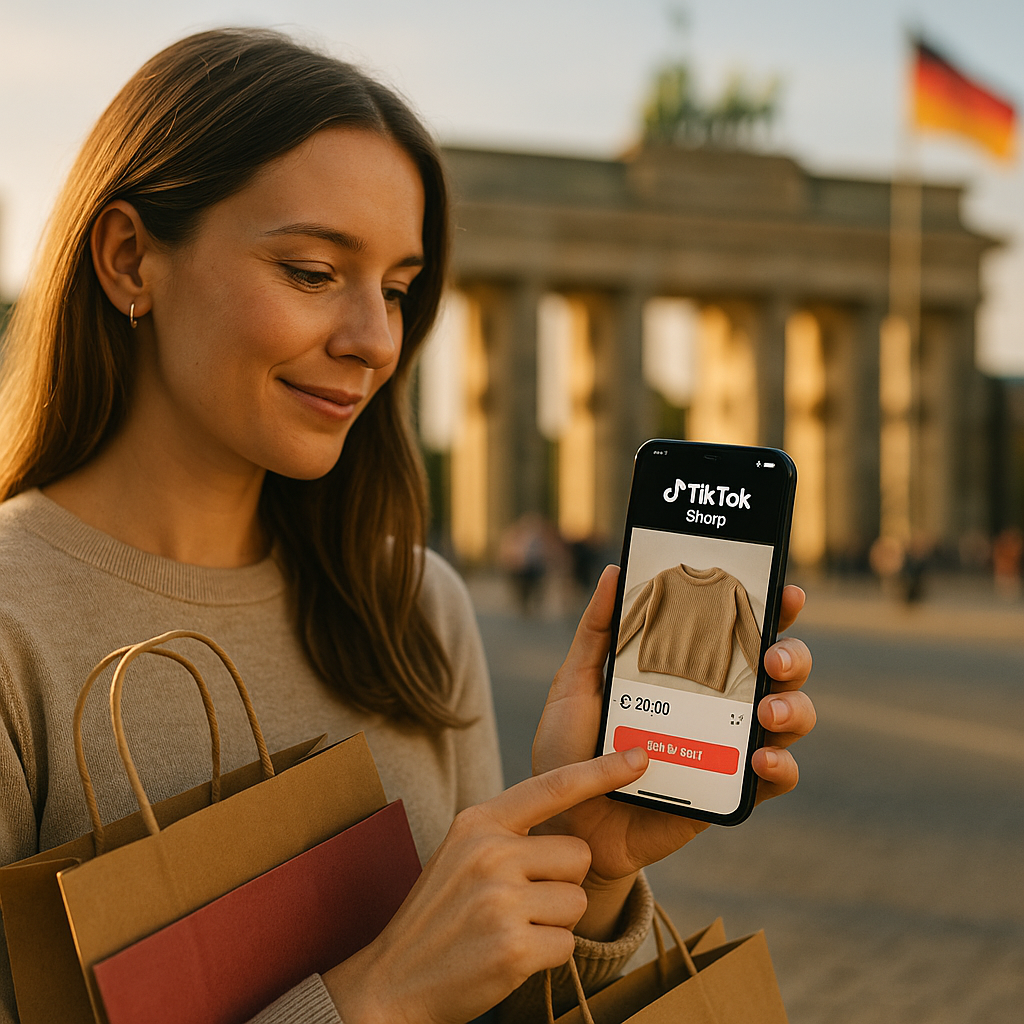
One in seven German online shoppers is already buying on TikTok Shop. That NielsenIQ figure isn’t a rounding error or an early-adopter blip — it’s a structural signal that European social commerce has reached an inflection point, and most brand managers are still treating it like a beta channel.
Why Germany Changes the Calculation for All of Europe
Germany matters disproportionately here. It’s the EU’s largest e-commerce market, historically conservative in digital payment adoption, and deeply skeptical of impulse-driven retail formats. When NielsenIQ records ~14% TikTok Shop penetration among German online shoppers, that number carries more weight than the same figure would in the UK or the Netherlands. German consumers don’t adopt new buying channels quickly — and yet they have.
For European brand managers, the implication is straightforward: if TikTok Shop is working in Germany, it is almost certainly working harder in markets with looser friction around social checkout — France, Poland, Italy, the Nordics. The German number is probably your floor, not your ceiling.
Germany’s ~14% TikTok Shop adoption rate among online shoppers should be read as a conservative baseline for European social commerce penetration — not as an outlier.
The platform itself has been deliberate about European expansion. After scaling aggressively in Southeast Asia and the UK, TikTok for Business rolled out Shop infrastructure across Germany, France, and Italy with localized fulfillment partnerships and a creator affiliate model designed to reduce brand operational load. That backend investment is now showing up in NielsenIQ’s panel data.
What “Cross-Border Social Commerce Infrastructure” Actually Means in Practice
The phrase gets used loosely. Let’s be precise about what brands actually need to build.
Catalog localization at scale. A single product feed won’t serve six European markets efficiently. Language, pricing in local currency, VAT compliance, and product-specific regulations (particularly in beauty, supplements, and food) all require market-by-market configuration. Brands using Shopify or Akeneo for product information management need TikTok Shop connectors that sync in near-real-time — static CSV uploads will create inventory and pricing errors that damage seller ratings.
Creator affiliate programs that cross borders. TikTok Shop’s affiliate mechanism is powerful, but creator eligibility, payout structures, and disclosure requirements vary across the EU. A German creator promoting a product shipped from a UK warehouse faces different compliance obligations than a French one. Brand managers need a clear matrix before they scale affiliate activation — not after a DSA (Digital Services Act) inquiry lands.
Fulfillment architecture that doesn’t kill margins. Social commerce conversion is emotionally driven and fast. The research on TikTok Shop’s emotional engagement lift confirms that purchase decisions are made in seconds. If your fulfillment SLA can’t match that urgency — same-day dispatch from a central EU warehouse, at minimum — your return rate will eat your gross margin. Cross-border social commerce without a regional 3PL strategy is a conversion machine with a leaky bucket.
The Creator Layer Is Not Optional
Some brand managers are attempting to run TikTok Shop as a pure performance channel — paid media driving directly to shop listings, no creator involvement. That approach misunderstands the platform’s mechanics. TikTok’s algorithm surfaces Shop content in the For You feed based on organic engagement signals, not just ad spend. Brands without a creator content pipeline are essentially competing in an auction where their competitors have an organic subsidy they don’t.
The micro-creator amplification playbook is especially relevant here. For European market entry specifically, nano and micro creators with hyper-local audiences in Hamburg, Munich, Lyon, or Milan deliver relevance signals that broad-reach influencers can’t replicate. A 45,000-follower German lifestyle creator with strong TikTok Shop affiliate conversion history is worth more to a cross-border launch than a 2M-follower pan-European account with diffuse audience geography.
How do you find them at scale? Tools like Modash, Kolsquare (which has strong European creator data), and TikTok’s own Creator Marketplace allow filtering by country, engagement rate, and — crucially — prior Shop affiliate activity. That last filter matters. Creators who have already driven Shop conversions have demonstrated they understand the format; they brief themselves.
Compliance Isn’t a Legal Team Problem — It’s a Brand Strategy Problem
The EU’s Digital Services Act and the updated Unfair Commercial Practices Directive have direct implications for social commerce disclosure. Germany’s Wettbewerbszentrale (the competition watchdog) has been active in pursuing undisclosed influencer promotions — and TikTok Shop affiliate posts fall squarely in scope. France’s DGCCRF has parallel enforcement appetite.
The operational fix is straightforward but requires discipline: every creator brief for a TikTok Shop affiliate activation must include mandatory disclosure language, and your affiliate dashboard should be configured to flag posts that go live without it. Data protection obligations around pixel tracking within Shop environments add another layer for brands collecting behavioral data across EU markets.
This is also where your creator attribution methodology needs to be robust. Dark social sharing — users copying product links and sending them in WhatsApp groups or private Instagram DMs — is significant in European markets and will undercount your TikTok Shop-driven revenue if you’re relying purely on last-click attribution from the platform’s native analytics.
Reading the NielsenIQ Data Beyond the Headline Number
The 1-in-7 figure is the hook, but brand managers should push for the underlying cuts. NielsenIQ’s German panel data typically segments by age cohort, household income, and purchase category — and those cuts tell a more actionable story than aggregate penetration.
Which categories are over-indexing? Globally, TikTok Shop has seen disproportionate volume in beauty, personal care, and consumer electronics accessories. If your category isn’t in that set, your conversion funnel will look different and your creator brief strategy needs to account for a longer consideration phase — which is possible on TikTok but requires a different content architecture (tutorials, comparisons, community Q&A formats rather than pure product showcases).
Age cohort data is similarly instructive. If 1-in-7 German online shoppers is the average, and Gen Z over-indexes substantially, brands in categories skewing toward 35+ demographics need to be more realistic about near-term TikTok Shop revenue — and more focused on building the infrastructure now for the cohort that will age into their category over the next several years. For those thinking about format ROI by vertical, this cohort nuance is non-negotiable input.
Aggregate penetration numbers are strategy inputs, not strategies. The real work is in the demographic and category cuts that tell you whether TikTok Shop is a Q3 activation or a three-year infrastructure investment.
Measurement Infrastructure Before You Scale
Brands that scale TikTok Shop spend across multiple European markets without clean measurement architecture will end up with a tangle of platform-reported data that doesn’t reconcile with their ERP or their paid media reporting. Fix this before you launch at scale, not after.
At minimum, you need: UTM parameter discipline across all Shop affiliate links, a server-side events setup that keeps your pixel firing cleanly post-iOS and post-cookie deprecation, and a defined incrementality testing protocol — geo holdout tests work well for cross-border social commerce because you can isolate country-level spend. The emerging standards in AI-verified measurement are increasingly applicable to social commerce attribution, particularly for brands running creator content alongside paid Shop ads simultaneously.
Platforms like NielsenIQ and Statista provide useful market-level benchmarks, but your internal measurement stack is what will let you optimize at the campaign level. Don’t outsource that dependency.
What to Do This Quarter
If you’re a European brand manager who has been watching TikTok Shop from a distance, the NielsenIQ Germany data is a reasonable forcing function. Audit your catalog readiness for TikTok Shop integration in your two or three highest-priority EU markets. Identify five to ten micro-creators per market with verified Shop affiliate history. Map your compliance obligations under DSA and national-level disclosure rules before your first activation. And set your measurement infrastructure before you commit budget — not after. The window to build this competency before your category competitors do is narrowing faster than most planning cycles will account for.
Frequently Asked Questions
What does the NielsenIQ Germany TikTok Shop data actually show?
NielsenIQ’s panel data for Germany shows that approximately one in seven German online shoppers has used TikTok Shop to make a purchase. Given Germany’s historically conservative digital retail behavior, this penetration rate signals significant mainstream adoption and suggests even higher rates in more socially commerce-forward EU markets.
Why does German TikTok Shop adoption matter for cross-border brand strategy?
Germany is the EU’s largest e-commerce market. When a conservative digital retail market reaches ~14% penetration for a new social commerce channel, it indicates that the infrastructure, trust, and consumer habit are sufficiently established to justify cross-border investment. Brands that treat Germany as a proxy for EU-wide readiness should view this figure as a floor, not a ceiling.
What compliance obligations should European brands be aware of for TikTok Shop?
The EU’s Digital Services Act, the updated Unfair Commercial Practices Directive, and national-level advertising disclosure rules (particularly active in Germany and France) all apply to TikTok Shop affiliate content. Every creator brief should include mandatory disclosure language, and brands should configure their affiliate dashboards to flag non-compliant posts. Data collection within TikTok Shop environments is also subject to GDPR obligations.
How should brands select creators for European TikTok Shop campaigns?
For cross-border social commerce, micro and nano creators with hyper-local European audiences typically outperform broad-reach influencers on conversion efficiency. Tools like Modash and Kolsquare allow filtering by country, engagement rate, and prior Shop affiliate activity. Prioritize creators who have already driven Shop conversions — they understand the format and require less briefing overhead.
What measurement infrastructure do brands need before scaling TikTok Shop across Europe?
Brands need UTM parameter discipline across all affiliate links, a server-side events setup to maintain pixel accuracy post-cookie deprecation, and a defined incrementality testing protocol (geo holdout tests are effective for cross-border social commerce). Platform-reported data from TikTok’s native analytics should be reconciled against ERP and paid media reporting before budgets are scaled.
Is TikTok Shop viable for categories outside beauty and electronics?
Yes, but the content strategy and funnel architecture differ. Categories outside TikTok Shop’s core high-velocity verticals (beauty, personal care, accessories) require longer consideration-phase content — tutorials, comparisons, community Q&A formats — rather than pure product showcases. Brands should also assess their target demographic’s overlap with TikTok’s core age cohorts before projecting near-term revenue.
Top Influencer Marketing Agencies
The leading agencies shaping influencer marketing in 2026
Agencies ranked by campaign performance, client diversity, platform expertise, proven ROI, industry recognition, and client satisfaction. Assessed through verified case studies, reviews, and industry consultations.
Moburst

-
2

The Shelf
Boutique Beauty & Lifestyle Influencer AgencyA data-driven boutique agency specializing exclusively in beauty, wellness, and lifestyle influencer campaigns on Instagram and TikTok. Best for brands already focused on the beauty/personal care space that need curated, aesthetic-driven content.Clients: Pepsi, The Honest Company, Hims, Elf Cosmetics, Pure LeafVisit The Shelf → -
3

Audiencly
Niche Gaming & Esports Influencer AgencyA specialized agency focused exclusively on gaming and esports creators on YouTube, Twitch, and TikTok. Ideal if your campaign is 100% gaming-focused — from game launches to hardware and esports events.Clients: Epic Games, NordVPN, Ubisoft, Wargaming, Tencent GamesVisit Audiencly → -
4

Viral Nation
Global Influencer Marketing & Talent AgencyA dual talent management and marketing agency with proprietary brand safety tools and a global creator network spanning nano-influencers to celebrities across all major platforms.Clients: Meta, Activision Blizzard, Energizer, Aston Martin, WalmartVisit Viral Nation → -
5

The Influencer Marketing Factory
TikTok, Instagram & YouTube CampaignsA full-service agency with strong TikTok expertise, offering end-to-end campaign management from influencer discovery through performance reporting with a focus on platform-native content.Clients: Google, Snapchat, Universal Music, Bumble, YelpVisit TIMF → -
6

NeoReach
Enterprise Analytics & Influencer CampaignsAn enterprise-focused agency combining managed campaigns with a powerful self-service data platform for influencer search, audience analytics, and attribution modeling.Clients: Amazon, Airbnb, Netflix, Honda, The New York TimesVisit NeoReach → -
7

Ubiquitous
Creator-First Marketing PlatformA tech-driven platform combining self-service tools with managed campaign options, emphasizing speed and scalability for brands managing multiple influencer relationships.Clients: Lyft, Disney, Target, American Eagle, NetflixVisit Ubiquitous → -
8

Obviously
Scalable Enterprise Influencer CampaignsA tech-enabled agency built for high-volume campaigns, coordinating hundreds of creators simultaneously with end-to-end logistics, content rights management, and product seeding.Clients: Google, Ulta Beauty, Converse, AmazonVisit Obviously →