


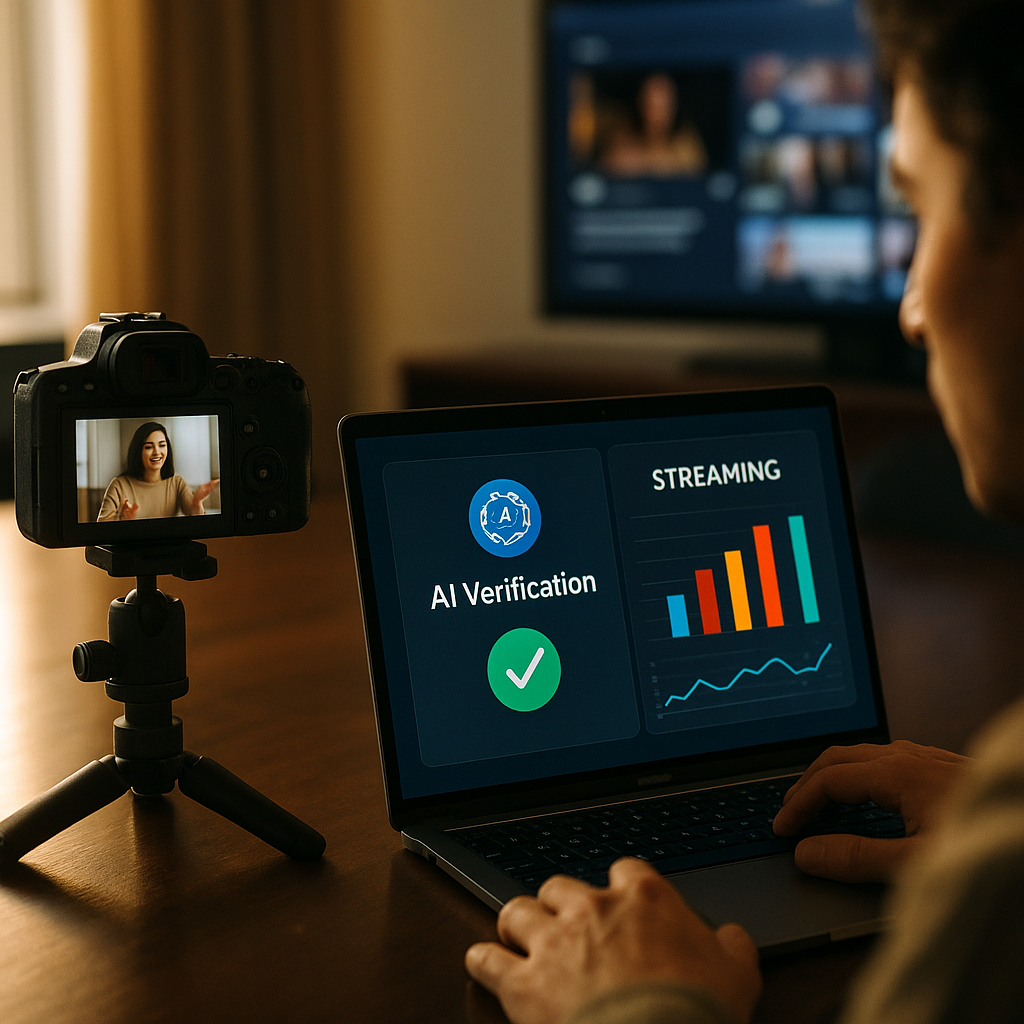
Media buyers entering upfront negotiations are now demanding AI-verified outcome measurement as a baseline — not a premium add-on. For brands running creator-to-streaming integrations, that shift changes everything about how you structure deals, attribute results, and justify spend.
The Measurement Gap That’s Finally Costing Brands Real Money
For years, brands accepted a comfortable fiction: that a creator’s TikTok mention of a streaming original, combined with a TV spot in the same campaign, was somehow producing halo lift. Nobody could prove it. Nobody was forced to. That era is over.
Upfront buyers — representing major holding companies including GroupM, Publicis Media, and IPG Mediabrands — are now writing AI-verified outcome measurement clauses directly into their upfront commitments. According to eMarketer, connected TV ad spending continues to outpace linear, with streaming inventory commanding premium CPMs precisely because it promises deterministic audience data. When buyers spend at that level, they want proof that creator content is pulling its weight in the funnel — not just generating impressions in a silo.
The practical implication? If your creator program and your streaming media buy are still being planned, executed, and measured in separate workstreams, you have an attribution problem that’s about to become a negotiation problem.
Brands that can’t demonstrate connected attribution between creator content and streaming outcomes will face discounted negotiating leverage in upfront deals — and inflated CPMs on inventory that buyers believe they’re carrying the risk for.
What “AI-Verified” Actually Means in This Context
The phrase gets thrown around loosely. Let’s be specific.
AI-verified outcome measurement in the upfront context refers to the use of machine learning models — typically trained on household-level ACR (automatic content recognition) data, pixel-based attribution, and deterministic ID graphs — to connect exposure events across screens and content types to downstream outcomes. Platforms like iSpot.tv, VideoAmp, and EDO are increasingly being positioned as the currency measurement alternatives that buyers are demanding alongside (or instead of) Nielsen.
For creator content specifically, the challenge is more complex. A creator’s YouTube integration or Instagram Reel doesn’t have native ACR data. It doesn’t sit inside a broadcaster’s measurement stack. So when a viewer watches a creator’s content mentioning a streaming series, then sees a pre-roll ad on Peacock, then subscribes — how do you credit the creator’s role? That multi-touch, cross-environment attribution problem is exactly what AI-verified models are being built to solve, and why brands need to get ahead of it now.
Understanding how full-funnel AI visibility works is no longer optional for marketing leaders building integrated campaigns.
Structuring Creator-to-Streaming Integration the Right Way
Most brands are still treating creator integrations as top-of-funnel awareness plays bolted onto a media buy. That’s the wrong architecture.
To meet AI-verified measurement standards, creator content needs to be structurally embedded into the attribution framework from the brief stage. That means three things:
- UTM and pixel discipline: Every creator asset — whether it’s a YouTube long-form integration, a Shorts clip, or an Instagram Story swipe-up — must carry properly structured UTM parameters that feed into the same attribution environment as your CTV buy. This sounds basic. Most brands still don’t do it consistently at scale.
- Audience segment handoffs: Creator content should be building defined audience segments (through pixel fires, QR code scans, or platform-specific engagement signals) that can then be activated as targeting inputs on streaming platforms. Roku’s OneView, Amazon’s DSP, and Google’s DV360 all support this kind of segment ingestion. Use it.
- Unified KPI frameworks before activation: The KPIs you’re measuring for your creator program and your CTV buy need to be agreed upon — in writing — before any content goes live. If your creator team is optimizing for view-through rates while your media team is optimizing for incremental reach, you’ll produce data that tells contradictory stories and satisfies neither a CFO nor an upfront buyer.
This also has implications for how you renegotiate creator partnerships — especially when measurement accountability is now a contractual requirement, not a nice-to-have.
Attribution Standards: The Three Models in Play
Brands currently navigating creator-to-streaming attribution are working within one of three models, each with different fidelity levels and operational complexity:
Last-touch attribution is still used by too many brands. It’s nearly useless for cross-channel creator programs because it systematically undercredits the creator touchpoint, which almost always occurs earlier in the journey. Don’t build your upfront pitch on last-touch data.
Data-driven attribution (DDA), powered by Google’s models or proprietary ML stacks built inside platforms like Meta, distributes credit across touchpoints based on observed conversion probability. This is a meaningful step up, but it’s still largely walled-garden — it can’t see across environments without identity resolution infrastructure underneath it.
Unified measurement / MTA (Multi-Touch Attribution) is where the market is moving. Companies like Rockerbox, Northbeam, and Triple Whale have built cross-channel MTA products that can ingest creator content signals alongside paid media. For brands spending at the level where upfront commitments make sense, this is the infrastructure investment that unlocks credible AI-verified reporting.
The FTC’s ongoing disclosure requirements around influencer content also intersect here — AI-verified measurement doesn’t exempt you from disclosure obligations when creator content is integrated into paid streaming inventory.
Why Creator Selection Now Has a Measurement Prerequisite
Here’s a structural implication most brand teams aren’t discussing yet: if AI-verified outcome measurement is the standard, then creators who cannot support attribution infrastructure are a liability in upfront-linked campaigns.
That’s not a statement about talent quality. It’s about technical compatibility. A creator who refuses to include proper UTM parameters, won’t allow pixel placement on their link-in-bio, or whose platform of primary activity (say, a closed Discord community) produces no attributable signal is effectively invisible in an AI-verified measurement environment.
This shifts how you approach niche creator curation for streaming-integrated campaigns. Reach and engagement rate are still inputs — but technical attribution compatibility needs to be a selection criterion alongside them. Build it into your creator brief and vetting process now.
It’s also worth thinking about the dark social attribution gap that exists when creators share content through channels with limited tracking visibility — a real structural risk in campaigns where upfront buyers will be auditing measurement methodology.
In a measurement-audited upfront environment, a creator’s attribution compatibility is as important as their audience quality. If your media buyers can’t see the signal, the spend won’t survive the next budget review.
What Buyers Are Actually Asking For in Negotiations
Upfront buyers aren’t asking for perfect measurement. They’re asking for verifiable, consistent methodology. The distinction matters.
According to IAB guidance on cross-channel measurement standards, buyers are increasingly requiring that measurement vendors be disclosed, methodology be auditable, and outcome definitions (reach, frequency, conversion, brand lift) be agreed upon pre-campaign rather than retroactively defined to flatter results. That last point is where many brand-side teams get caught — they let agencies define success metrics after seeing early data, which produces reports that satisfy nobody in a rigorous upfront review.
If you’re a brand building creator-to-streaming integrations that will be included in upfront packages, you need measurement governance documents that travel with the campaign plan — not with the post-campaign report. That means defining: what constitutes a valid creator-driven streaming conversion, which measurement vendor’s methodology governs disputes, and how creator content impressions will be normalized against GRP-equivalents for media planners who still think in linear terms.
For brands assessing creator program ROI structures in the context of larger media commitments, this governance layer is often the missing piece between a strong creative concept and a defensible budget line.
The Operational Shift This Requires
Realistically, most brand marketing teams aren’t structured to execute this. Creator programs typically sit in social or brand, while CTV buys sit in media or performance. AI-verified measurement infrastructure sits in data or analytics — or worse, in the agency’s black box.
The brands that will navigate upfront measurement demands successfully are those that create a formal integration point between these functions before Q4 planning begins. That means a shared measurement framework document, a named measurement partner, and a brief template that forces creator content into the attribution architecture from day one.
Platform partners like TikTok for Business are building toward cross-channel measurement connectivity, but the brand-side governance still has to exist. Technology doesn’t fix organizational silos.
Start there. Assign measurement ownership to a specific role — not a committee — and make that person accountable to both the creator program output and the upfront reporting deliverable. That single structural change will do more for your upfront negotiating position than any measurement vendor you add to your stack.
FAQ
Frequently Asked Questions
What is AI-verified outcome measurement in the context of TV upfronts?
AI-verified outcome measurement refers to the use of machine learning models trained on data such as ACR signals, deterministic ID graphs, and pixel-based attribution to connect content exposure events across screens to measurable business outcomes. In upfront negotiations, buyers are requiring that this methodology be disclosed, auditable, and agreed upon before campaigns activate — not applied retroactively.
How should brands structure creator content to meet upfront attribution standards?
Brands need to embed attribution infrastructure into creator briefs from the start. This means requiring consistent UTM parameters on all creator assets, building audience segments from creator engagement that can be activated in CTV environments, and aligning KPIs between creator and media teams before any content goes live. Creator selection should also factor in a creator’s technical compatibility with attribution tracking.
Which measurement platforms are buyers using for cross-channel attribution?
Buyers are increasingly referencing platforms such as iSpot.tv, VideoAmp, and EDO as currency measurement alternatives to Nielsen for streaming inventory. For cross-channel multi-touch attribution that includes creator content, tools like Rockerbox, Northbeam, and Triple Whale are being used on the brand side to build unified measurement environments.
Does AI-verified measurement change how brands should select creators?
Yes. In campaigns tied to upfront-linked streaming buys, creators who cannot support attribution infrastructure — through UTM compliance, pixel-compatible link destinations, or platform-native tracking — create gaps in the measurement chain. Brands should add technical attribution compatibility as a creator selection criterion alongside reach, engagement rate, and audience quality.
What is the difference between multi-touch attribution and last-touch attribution for creator programs?
Last-touch attribution credits the final touchpoint before conversion, which systematically undercredits creator content that appears earlier in the consumer journey. Multi-touch attribution (MTA) uses statistical or algorithmic models to distribute conversion credit across all touchpoints in proportion to their observed contribution — making creator content’s role in driving streaming outcomes visible and defensible in budget reviews.
Top Influencer Marketing Agencies
The leading agencies shaping influencer marketing in 2026
Agencies ranked by campaign performance, client diversity, platform expertise, proven ROI, industry recognition, and client satisfaction. Assessed through verified case studies, reviews, and industry consultations.
Moburst

-
2

The Shelf
Boutique Beauty & Lifestyle Influencer AgencyA data-driven boutique agency specializing exclusively in beauty, wellness, and lifestyle influencer campaigns on Instagram and TikTok. Best for brands already focused on the beauty/personal care space that need curated, aesthetic-driven content.Clients: Pepsi, The Honest Company, Hims, Elf Cosmetics, Pure LeafVisit The Shelf → -
3

Audiencly
Niche Gaming & Esports Influencer AgencyA specialized agency focused exclusively on gaming and esports creators on YouTube, Twitch, and TikTok. Ideal if your campaign is 100% gaming-focused — from game launches to hardware and esports events.Clients: Epic Games, NordVPN, Ubisoft, Wargaming, Tencent GamesVisit Audiencly → -
4

Viral Nation
Global Influencer Marketing & Talent AgencyA dual talent management and marketing agency with proprietary brand safety tools and a global creator network spanning nano-influencers to celebrities across all major platforms.Clients: Meta, Activision Blizzard, Energizer, Aston Martin, WalmartVisit Viral Nation → -
5

The Influencer Marketing Factory
TikTok, Instagram & YouTube CampaignsA full-service agency with strong TikTok expertise, offering end-to-end campaign management from influencer discovery through performance reporting with a focus on platform-native content.Clients: Google, Snapchat, Universal Music, Bumble, YelpVisit TIMF → -
6

NeoReach
Enterprise Analytics & Influencer CampaignsAn enterprise-focused agency combining managed campaigns with a powerful self-service data platform for influencer search, audience analytics, and attribution modeling.Clients: Amazon, Airbnb, Netflix, Honda, The New York TimesVisit NeoReach → -
7

Ubiquitous
Creator-First Marketing PlatformA tech-driven platform combining self-service tools with managed campaign options, emphasizing speed and scalability for brands managing multiple influencer relationships.Clients: Lyft, Disney, Target, American Eagle, NetflixVisit Ubiquitous → -
8

Obviously
Scalable Enterprise Influencer CampaignsA tech-enabled agency built for high-volume campaigns, coordinating hundreds of creators simultaneously with end-to-end logistics, content rights management, and product seeding.Clients: Google, Ulta Beauty, Converse, AmazonVisit Obviously →