


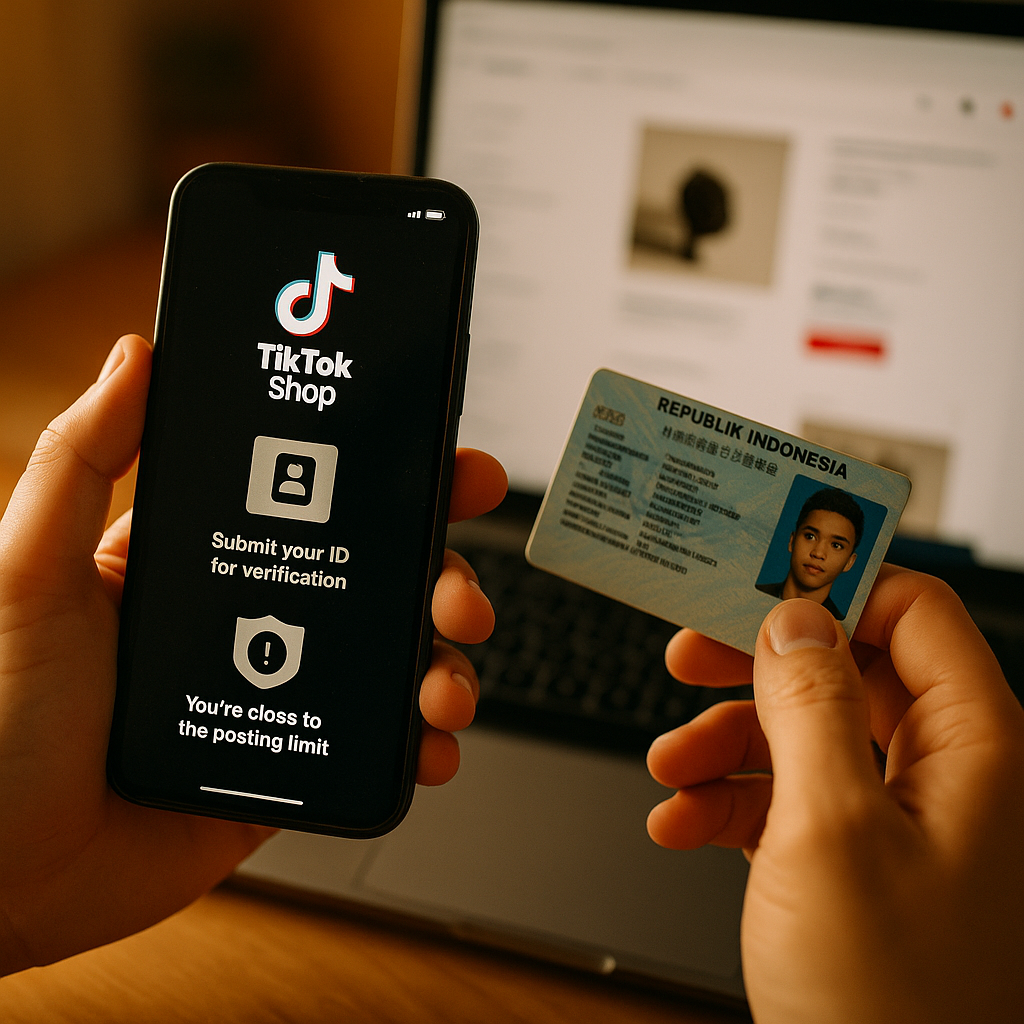
One expired ID upload. One paused shop. One missed live-selling window during a peak sales day. That’s the new reality for TikTok Shop sellers who thought verification was a one-time checkbox. TikTok Shop’s enhanced identity verification and posting limits aren’t a minor policy update — they’re the clearest signal yet that TikTok is trading unchecked growth for governance, and brands that treat this as a compliance footnote are going to get burned.
For years, the platform’s pitch to sellers and creators was simple: post fast, sell faster, figure out the rules later. That era is closing. What’s replacing it looks a lot more like the operational rigor brands already deal with on Amazon and Meta — tiered access, verified identity, and throttled activity for anyone who hasn’t earned trust yet.
What Actually Changed
TikTok Shop has rolled out stricter identity verification requirements for sellers and affiliate creators, layering in government ID checks, business registration matching, and in some markets, biometric liveness checks tied to the account holder. Alongside that, the platform has introduced posting limits — caps on how many shoppable videos, livestreams, or affiliate links an account can push out in a given window, especially for newer or unverified accounts.
The stated reason is fraud reduction: fake product listings, counterfeit goods, and bot-driven engagement have been persistent problems on TikTok Shop since its US and UK expansion. But the mechanics matter more than the messaging. Verification tiers now gate feature access. Accounts that skip steps or fail checks get throttled visibility, reduced posting frequency, or outright suspension — often with limited warning.
Posting limits tied to verification status mean your account’s growth ceiling is now a function of your compliance status, not your content quality.
That’s a fundamental shift. Historically, the algorithm rewarded volume and velocity. Now, unverified or partially verified accounts hit a ceiling regardless of how good the content is. This mirrors moves TikTok has made elsewhere — see how TikTok’s trust-based algorithm forces brands to rethink reach, where distribution increasingly depends on signals beyond engagement metrics.
Why This Isn’t Just About Fraud
Fraud prevention is the cover story. The bigger story is regulatory pressure. TikTok is operating under intense scrutiny in the US, UK, and EU, and every one of those jurisdictions has tightened rules around commerce transparency, youth safety, and data handling. Identity verification isn’t just about stopping scam sellers — it’s about TikTok being able to prove, to regulators, that it knows who is transacting on its platform and can act on bad actors quickly.
This is the same logic driving youth-safety rules forcing one global algorithm standard across major platforms. Governments aren’t asking platforms to grow responsibly anymore — they’re mandating it, with fines attached. TikTok Shop’s IP and identity verification pushes are a direct response to that pressure, and we’ve already covered how TikTok Shop IP verification requires brands to prepare now for exactly this kind of tightening.
Compare this to what’s happened in other markets. Mexico’s privacy reform pushed brands to treat data trust into a genuine sales edge rather than a legal chore. TikTok Shop verification is following the same arc — compliance infrastructure that, if you build it early, becomes a competitive moat instead of a cost center.
The Operational Risk Brands Are Underestimating
Here’s the part that should worry brand marketers more than creators: agency and brand-run TikTok Shop accounts, multi-seller storefronts, and affiliate networks built on speed are exactly the structures these new rules target.
If your influencer program routes commerce through dozens of creator-affiliate accounts, each one now needs to clear its own verification bar. One weak link — a creator who hasn’t updated their business registration, an agency-managed account with mismatched ownership details — can throttle the whole campaign’s visibility at the worst possible moment. Think Q4 launch week, or a live-shopping event tied to a paid media push.
A single unverified affiliate account in your creator network can cap reach for an entire campaign, regardless of how much media spend sits behind it.
This is a direct parallel to what we flagged in TikTok Shop reviews revealing algorithmic dependency risk — brands that built entire revenue lines on TikTok Shop’s algorithm without diversification are now facing a second layer of fragility: governance dependency on top of algorithmic dependency. It’s not enough to rank well. Now you have to be verifiably compliant to even be eligible to rank.
Sellers in mature markets are already feeling this. The UK market alone recently crossed 300,000 active sellers, per our coverage of TikTok Shop UK hitting 300,000 sellers as the market matures — and maturity brings exactly this kind of tightening. Early-stage platforms chase growth. Mature ones protect it.
How This Fits the Bigger Platform Pattern
TikTok isn’t alone here, and that’s the real headline. Every major platform with a commerce or creator-monetization layer is quietly shifting from open-door growth to gated, tiered access.
- Amazon has been building out verification and standardization requirements through its broader commerce protocol work, forcing sellers to fix data and identity gaps before they can scale (see our analysis of Amazon’s universal commerce protocol and what brands must fix now).
- YouTube is under FTC pressure for affiliate disclosure failures, with 68% of affiliate videos violating FTC disclosure rules — a compliance gap regulators are no longer ignoring.
- Meta has tightened commerce integrations regionally, as seen in the MercadoLibre-Meta Mexico integration, which bakes verification and trust signals into the commerce layer from day one rather than bolting them on later.
The pattern is consistent: platforms that once competed purely on reach and virality are now competing on trust infrastructure. It’s not a TikTok Shop problem. It’s a category-wide maturation, and it’s happening faster than most brand playbooks have adjusted for.
What Brands Should Actually Do About It
Governance-first platforms reward operational discipline over creative hustle. That means your influencer ops team needs a seat at the table alongside your creative and media teams — probably for the first time.
Practical steps worth taking this quarter:
- Audit every affiliate and seller account tied to your brand’s TikTok Shop presence. Confirm verification status before launch windows, not during them.
- Centralize identity documentation for agency-managed or multi-creator accounts so verification renewals don’t become a bottleneck.
- Build buffer time into campaign timelines — assume verification reviews or posting-limit resets could delay activation by days, not hours.
- Diversify distribution so a single account’s throttling doesn’t tank an entire campaign. This echoes the diversification argument in our algorithmic dependency risk coverage.
- Treat compliance as a KPI, not a legal afterthought. Track verification status the way you’d track engagement or conversion.
Smaller creators feel this too, and it’s reshaping pricing dynamics across the platform. As TikTok’s algorithm shifts pricing power to micro-creators, expect verified, high-trust micro-accounts to command a premium over larger but less-compliant creator networks. Trust is becoming a pricing variable, not just a risk variable.
For a deeper read on how regulatory pressure is reshaping platform economics generally, eMarketer’s research and Statista’s platform data both track the acceleration of compliance-driven feature gating across social commerce. The FTC’s own guidance on endorsement and disclosure rules is also worth bookmarking, since it’s the regulatory backbone behind a lot of this tightening. If you’re managing UK-facing campaigns, the ICO’s guidance is the equivalent reference point.
The Takeaway
TikTok Shop’s verification and posting-limit changes are not friction to route around — they’re the new floor for participation. Brands that build verification audits and compliance tracking into their influencer ops now will avoid the account freezes and reach throttling that are about to blindside everyone who waited.
Frequently Asked Questions
What are TikTok Shop’s new identity verification requirements?
TikTok Shop now requires sellers and affiliate creators to complete government ID checks, business registration matching, and in some markets biometric liveness verification before gaining full posting and selling privileges.
How do posting limits work under the new system?
Posting limits cap the number of shoppable videos, livestreams, or affiliate links an account can publish in a given period. Unverified or partially verified accounts face lower caps, while fully verified accounts get broader access.
Why is TikTok Shop tightening governance now?
Regulatory pressure from the US, UK, and EU around commerce transparency, fraud, and youth safety is pushing TikTok to prove it can identify and control bad actors on its commerce platform, not just moderate content.
How can brands protect campaigns from verification-related disruption?
Audit all affiliate and seller accounts before launch windows, centralize documentation for agency-managed accounts, build extra time into campaign timelines, and diversify distribution across multiple verified creators rather than relying on one account.
Is this trend unique to TikTok Shop?
No. Amazon, YouTube, and Meta have all introduced similar verification, disclosure, or compliance requirements recently, signaling a platform-wide shift from open growth toward gated, trust-based access.
FAQs
Top Influencer Marketing Agencies
The leading agencies shaping influencer marketing in 2026
Agencies ranked by campaign performance, client diversity, platform expertise, proven ROI, industry recognition, and client satisfaction. Assessed through verified case studies, reviews, and industry consultations.
Moburst

-
2

The Shelf
Boutique Beauty & Lifestyle Influencer AgencyA data-driven boutique agency specializing exclusively in beauty, wellness, and lifestyle influencer campaigns on Instagram and TikTok. Best for brands already focused on the beauty/personal care space that need curated, aesthetic-driven content.Clients: Pepsi, The Honest Company, Hims, Elf Cosmetics, Pure LeafVisit The Shelf → -
3

Audiencly
Niche Gaming & Esports Influencer AgencyA specialized agency focused exclusively on gaming and esports creators on YouTube, Twitch, and TikTok. Ideal if your campaign is 100% gaming-focused — from game launches to hardware and esports events.Clients: Epic Games, NordVPN, Ubisoft, Wargaming, Tencent GamesVisit Audiencly → -
4

Viral Nation
Global Influencer Marketing & Talent AgencyA dual talent management and marketing agency with proprietary brand safety tools and a global creator network spanning nano-influencers to celebrities across all major platforms.Clients: Meta, Activision Blizzard, Energizer, Aston Martin, WalmartVisit Viral Nation → -
5

The Influencer Marketing Factory
TikTok, Instagram & YouTube CampaignsA full-service agency with strong TikTok expertise, offering end-to-end campaign management from influencer discovery through performance reporting with a focus on platform-native content.Clients: Google, Snapchat, Universal Music, Bumble, YelpVisit TIMF → -
6

NeoReach
Enterprise Analytics & Influencer CampaignsAn enterprise-focused agency combining managed campaigns with a powerful self-service data platform for influencer search, audience analytics, and attribution modeling.Clients: Amazon, Airbnb, Netflix, Honda, The New York TimesVisit NeoReach → -
7

Ubiquitous
Creator-First Marketing PlatformA tech-driven platform combining self-service tools with managed campaign options, emphasizing speed and scalability for brands managing multiple influencer relationships.Clients: Lyft, Disney, Target, American Eagle, NetflixVisit Ubiquitous → -
8

Obviously
Scalable Enterprise Influencer CampaignsA tech-enabled agency built for high-volume campaigns, coordinating hundreds of creators simultaneously with end-to-end logistics, content rights management, and product seeding.Clients: Google, Ulta Beauty, Converse, AmazonVisit Obviously →