


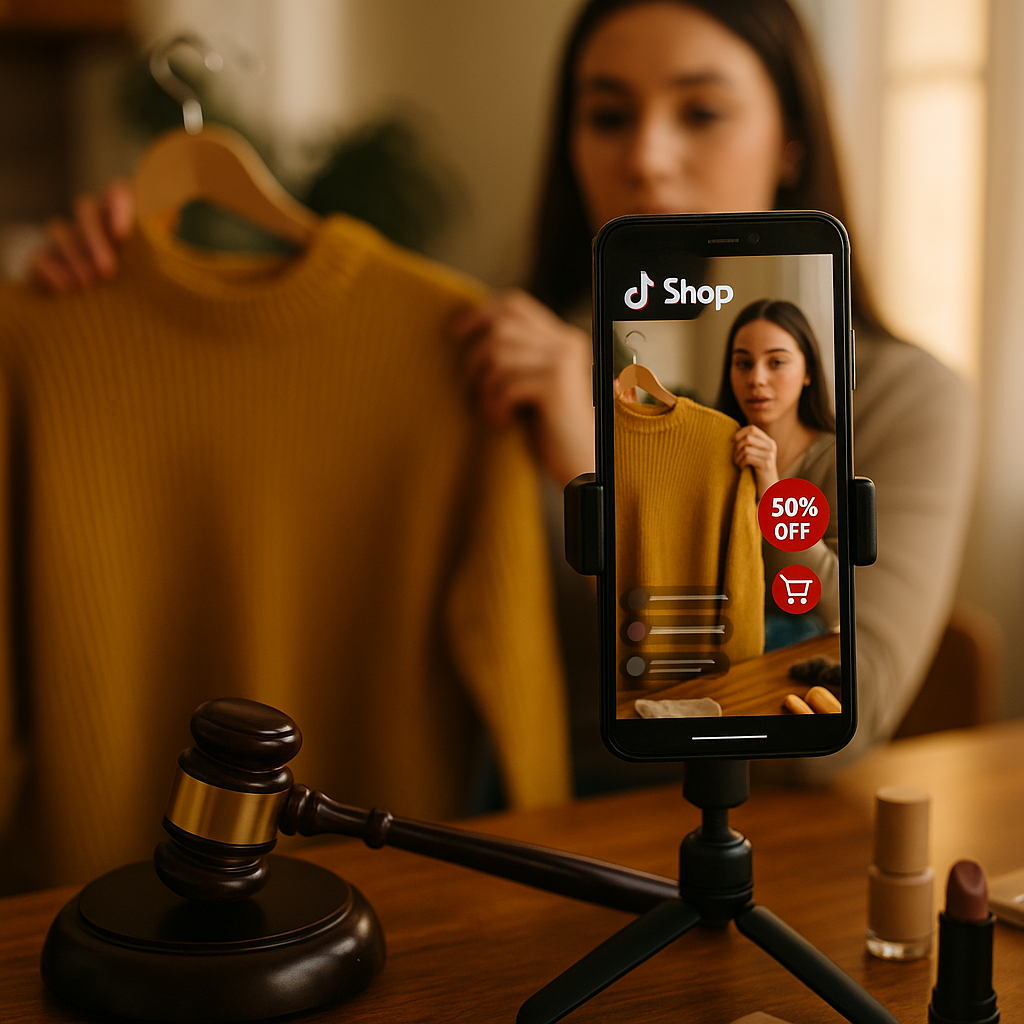
Ninety seconds. That’s roughly how long a TikTok Shop countdown timer runs before it resets, restarts, or magically “extends” during a live sale. Multiply that by thousands of concurrent livestreams and you’ve got a compliance exposure most brands haven’t priced in. TikTok Shop livestream compliance isn’t a nice-to-have anymore, it’s the difference between a scalable revenue channel and an FTC inquiry letter.
Brands are pouring budget into livestream shopping because it converts. But urgency mechanics, the countdown clocks, the “only 12 left,” the flash-discount banners, sit in a legal gray zone that most creator briefs never address. Let’s fix that.
Why Urgency Tactics Are Under the Microscope
The FTC has spent the last several years tightening rules around dark patterns and fake scarcity. Its guidance on deceptive urgency claims makes clear that countdown timers, limited-stock claims, and “today only” pricing must reflect reality. If the timer resets after it hits zero, or the “limited” discount reappears in the next stream, that’s not urgency marketing. That’s a misrepresentation, and the agency has shown it’s willing to enforce against it.
Livestream shopping compounds the risk because everything happens in real time, unscripted, often by a creator who’s improvising. There’s no static landing page for legal to review before it goes live. The claim is made, purchased on, and gone in seconds. That’s precisely why brands need a structured playbook rather than a verbal reminder in the pre-show briefing.
A countdown timer that resets after expiring isn’t a marketing tactic anymore. It’s evidence in a false-urgency case.
What Counts as a “Real-Time Discount Claim” Anyway?
Definitions matter here because enforcement hinges on specificity. A real-time discount claim is any statement made during a livestream that ties a price, quantity, or availability window to the current moment: “this price disappears when the clock hits zero,” “only 50 units at this price,” “flash deal ends in 10 minutes.” These claims are powerful precisely because they compress the decision window. They’re also the exact claims regulators scrutinize first, because they’re the easiest to falsify and the hardest to verify after the fact.
Compare that to a general promotional claim like “20% off this month,” which is verifiable against a static calendar. Real-time claims live and die on the stream itself. If TikTok’s platform doesn’t retain (or make accessible) full replay data proving the timer behaved as claimed, the brand is the one holding the liability, not the creator, and not TikTok.
The Four Failure Points Brands Keep Hitting
After reviewing dozens of livestream compliance reviews across categories like beauty, supplements, and home goods, the same four issues surface repeatedly:
- Timer manipulation. Producers reset or extend countdown clocks mid-stream to keep urgency alive, without disclosing the extension to viewers who already saw the original deadline pass.
- Phantom scarcity. Creators say “only a few left” when inventory systems show hundreds of units in stock, often because nobody briefed them on actual numbers.
- Discount stacking confusion. The displayed price drops multiple times during a single stream, and viewers can’t tell which “discount” is real versus cumulative marketing theater.
- No audit trail. When a complaint surfaces weeks later, the brand can’t reconstruct what was actually said, shown, or promised during the live event.
Any one of these, on its own, might not trigger scrutiny. Stack two or three together across a high-volume livestream calendar and you’ve built a pattern. Patterns are what regulators look for.
Building the Compliance Layer Into Your Livestream Ops
Here’s the operational shift: urgency compliance can’t be a legal afterthought bolted onto a livestream script. It has to be baked into pre-production, live moderation, and post-stream archiving. Think of it as three checkpoints.
Pre-production: Every countdown timer needs a hard-coded expiration tied to actual inventory or pricing systems, not a producer’s manual toggle. If the discount is genuinely limited to 100 units, the backend should reflect that number and stop the offer automatically when it’s hit. No human discretion, no “let’s just extend it five more minutes because engagement is good.”
Live moderation: Assign a compliance monitor, not just a community moderator, to every livestream over a certain revenue threshold. Their job is narrow: flag any verbal claim that contradicts the on-screen timer or stated inventory. This is the same operational muscle brands built for TikTok Shop supplement demos, where health claims needed real-time flagging too.
Post-stream archiving: Save the full replay, the chat log, and a timestamped record of every price change. TikTok Shop’s seller backend retains some of this, but don’t rely on the platform alone. Export and store it independently for at least the FTC’s typical lookback window.
If your legal team can’t reconstruct a livestream from six weeks ago in under an hour, your compliance program has a gap that will eventually cost you.
Scripting Urgency Without Faking It
The good news: urgency still works when it’s true. Genuine limited-time pricing converts. The trick is scripting creator language that stays persuasive without crossing into fabrication.
Give creators approved phrasing tied to real data. Instead of “only a few left,” script “we’ve got 40 units at this price, tracker’s live on screen.” Instead of “this deal ends when the timer hits zero” followed by a mysterious reset, script a hard stop: when the timer ends, the price changes on screen in real time, visibly, so viewers see the mechanism rather than just hear a claim.
This is also where creator briefs earn their keep. A well-structured brief should specify exact numbers, exact time windows, and forbidden phrases (anything implying scarcity that isn’t verified). Brands running high-volume shop content have already learned this lesson the hard way with supplement conversion campaigns, where overstated claims created both FTC and platform-policy exposure simultaneously.
Where TikTok’s Own Rules Fit In
TikTok Shop has its own seller policies around pricing accuracy and promotional claims, layered on top of FTC requirements. Sellers who violate platform rules risk account-level penalties: reduced visibility, suspended shop features, or removal from live shopping eligibility entirely. TikTok’s advertising policies increasingly mirror regulatory expectations around substantiated claims, which is a signal, not a coincidence.
This dual exposure, platform penalty plus regulatory risk, is why brands should treat livestream compliance as a two-track review: does this comply with TikTok Shop’s terms, and does it independently satisfy FTC urgency guidance? A claim can pass one and fail the other. Build your checklist to cover both, not just whichever seems more urgent that week.
The loyalty-tier and repeat-purchase mechanics TikTok has been testing add another layer here too. As covered in our look at the TikTok Shop Plus loyalty test, urgency claims tied to tiered pricing will need even more precise disclosure, since different viewers may see different “real” prices simultaneously.
Training Creators Who Aren’t Employees
Here’s the uncomfortable part: most livestream hosts are independent creators, not brand employees, and they’re improvising in real time in front of thousands of viewers. You can’t fully script a two-hour livestream. You also can’t afford to let a creator freelance urgency claims without guardrails.
The solution isn’t more paperwork. It’s better rehearsal. Run a 15-minute pre-stream briefing that covers exactly three things: current inventory numbers, exact discount mechanics, and forbidden phrases. Keep it verbal and visual, show them the dashboard they’ll be referencing on screen. Creators who understand *why* a claim is risky make better real-time judgment calls than creators who were just handed a script.
This mirrors the disclosure discipline brands have had to build around labeling generally. The same rigor that now governs labeled paid partnerships on other platforms applies here: transparency isn’t just a legal requirement, it’s increasingly an algorithmic and trust advantage too.
The Documentation Habit That Saves You Later
If there’s one operational habit worth installing immediately, it’s this: treat every livestream like it might be audited, because eventually one will be. That means:
- Timestamped screenshots of every price and inventory claim shown on screen.
- A saved copy of the creator brief used for that specific stream.
- Internal sign-off confirming inventory numbers were accurate at stream time.
- A record of who monitored the stream live and what, if anything, they flagged.
None of this is glamorous. It’s also the exact documentation that separates “we made an honest mistake” from “we had a pattern of deceptive practices,” should a regulator ever come asking. Brands running frequent livestream shopping cadences should build this into their livestream commerce measurement stack alongside standard conversion metrics, not as a separate legal exercise bolted on after the fact.
Data backs the urgency around getting this right: livestream shopping in the U.S. has grown into a multi-billion dollar category, and retail livestream forecasts show no signs of slowing. Regulatory attention scales with commercial scale. The bigger this channel gets, the more scrutiny it invites.
FAQs
Frequently Asked Questions
Can brands use countdown timers on TikTok Shop livestreams at all?
Yes, countdown timers are permitted and can be effective conversion tools. The compliance issue isn’t the timer itself, it’s whether the timer accurately reflects a real, non-renewable deadline. Timers that reset or extend without disclosure create legal exposure under FTC urgency guidelines.
Who is liable if a creator makes a false scarcity claim during a livestream?
Typically the brand, since the FTC generally holds advertisers responsible for claims made in sponsored commercial content, even when a third-party creator delivers them live. This is why pre-stream briefings and real-time monitoring matter so much.
How long should brands retain livestream replay data?
Best practice is to retain full replays, chat logs, and pricing timestamps for at least as long as your legal team’s standard record-retention window, often a year or more, independent of whatever TikTok’s platform retains natively.
Does TikTok Shop have its own urgency-claim policies separate from the FTC?
Yes. TikTok Shop seller policies address pricing accuracy and promotional claims independently. Brands need to satisfy both platform rules and FTC guidance, since a claim can violate one without violating the other.
What’s the simplest first step for a brand with no formal compliance process yet?
Start by tying countdown timers and stock counters to real backend inventory data instead of manual producer control, and assign one person per livestream whose only job is monitoring urgency claims in real time.
The brands winning at livestream commerce next year won’t be the ones with the flashiest countdown graphics. They’ll be the ones whose timers, claims, and inventory numbers all tell the exact same story, every single time.
Top Influencer Marketing Agencies
The leading agencies shaping influencer marketing in 2026
Agencies ranked by campaign performance, client diversity, platform expertise, proven ROI, industry recognition, and client satisfaction. Assessed through verified case studies, reviews, and industry consultations.
Moburst

-
2

The Shelf
Boutique Beauty & Lifestyle Influencer AgencyA data-driven boutique agency specializing exclusively in beauty, wellness, and lifestyle influencer campaigns on Instagram and TikTok. Best for brands already focused on the beauty/personal care space that need curated, aesthetic-driven content.Clients: Pepsi, The Honest Company, Hims, Elf Cosmetics, Pure LeafVisit The Shelf → -
3

Audiencly
Niche Gaming & Esports Influencer AgencyA specialized agency focused exclusively on gaming and esports creators on YouTube, Twitch, and TikTok. Ideal if your campaign is 100% gaming-focused — from game launches to hardware and esports events.Clients: Epic Games, NordVPN, Ubisoft, Wargaming, Tencent GamesVisit Audiencly → -
4

Viral Nation
Global Influencer Marketing & Talent AgencyA dual talent management and marketing agency with proprietary brand safety tools and a global creator network spanning nano-influencers to celebrities across all major platforms.Clients: Meta, Activision Blizzard, Energizer, Aston Martin, WalmartVisit Viral Nation → -
5

The Influencer Marketing Factory
TikTok, Instagram & YouTube CampaignsA full-service agency with strong TikTok expertise, offering end-to-end campaign management from influencer discovery through performance reporting with a focus on platform-native content.Clients: Google, Snapchat, Universal Music, Bumble, YelpVisit TIMF → -
6

NeoReach
Enterprise Analytics & Influencer CampaignsAn enterprise-focused agency combining managed campaigns with a powerful self-service data platform for influencer search, audience analytics, and attribution modeling.Clients: Amazon, Airbnb, Netflix, Honda, The New York TimesVisit NeoReach → -
7

Ubiquitous
Creator-First Marketing PlatformA tech-driven platform combining self-service tools with managed campaign options, emphasizing speed and scalability for brands managing multiple influencer relationships.Clients: Lyft, Disney, Target, American Eagle, NetflixVisit Ubiquitous → -
8

Obviously
Scalable Enterprise Influencer CampaignsA tech-enabled agency built for high-volume campaigns, coordinating hundreds of creators simultaneously with end-to-end logistics, content rights management, and product seeding.Clients: Google, Ulta Beauty, Converse, AmazonVisit Obviously →