


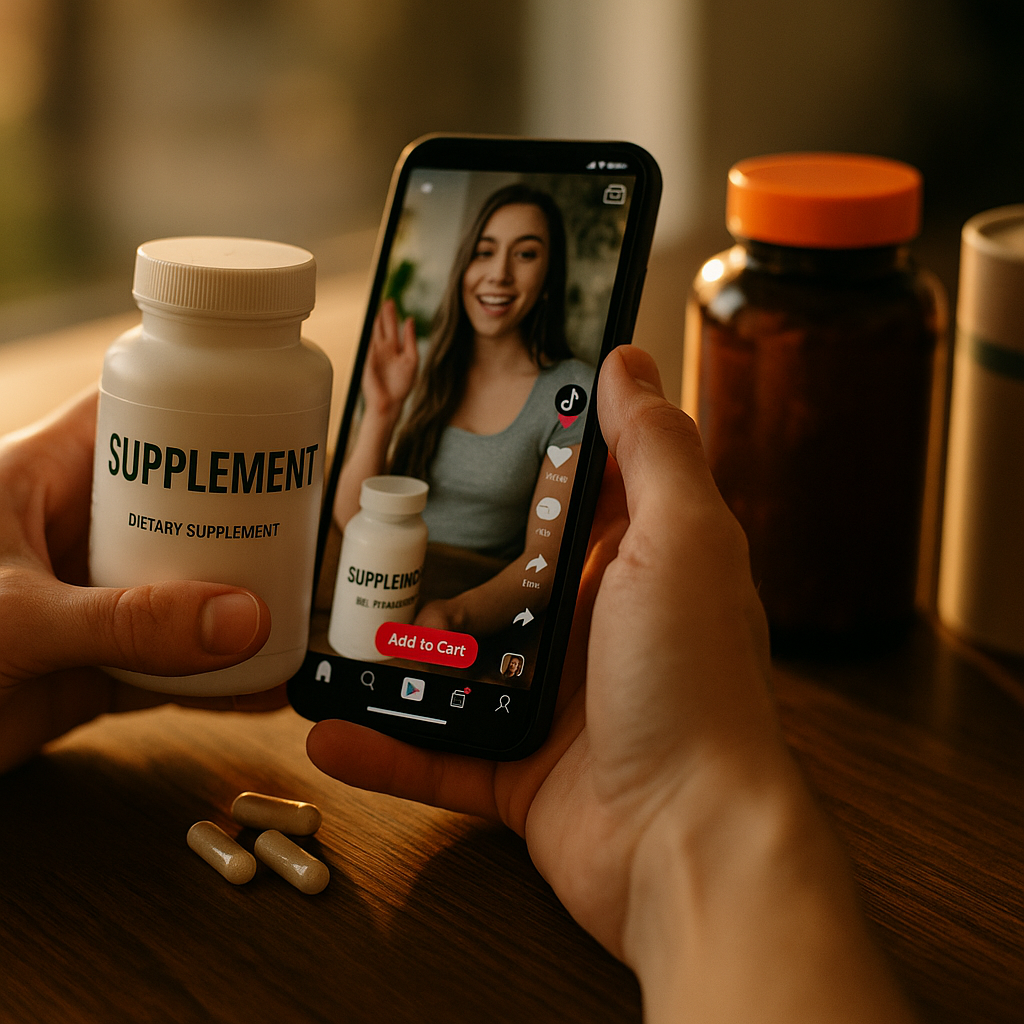
Nearly one in five TikTok Shop supplement carts converts within the same session — a number that would make most DTC teams weep with joy. That’s the headline from recent seller data circulating among agency partners, and it’s forcing CPG brands that sat out TikTok Shop’s in-app purchase flow to rethink their timeline. Supplements aren’t just performing on TikTok Shop. They’re rewriting what category expansion looks like there.
The Conversion Numbers Nobody Expected
Supplements were supposed to be a hard sell on social commerce. Regulatory friction, skepticism about ingestible products from strangers on the internet, and the sheer crowding of the wellness category all pointed toward weak conversion. Instead, supplement SKUs on TikTok Shop are converting at rates that outpace beauty and apparel in several seller cohorts, according to data shared by commerce agencies managing eight-figure TikTok Shop portfolios.
The mechanism is simple, even if the psychology is not. TikTok’s checkout flow removes almost every point of friction that normally kills a supplement purchase decision. A viewer watches a 40-second video about a magnesium glycinate product, taps the shopping bag icon, and completes checkout without leaving the app, often in under 90 seconds. No redirect to a landing page. No re-entering shipping details if payment info is saved. No cart abandonment triggered by a slow-loading Shopify theme.
Supplement categories are converting inside TikTok Shop at rates 2-3x higher than their equivalent Meta-to-Shopify funnels, largely because the checkout removes every decision point a skeptical buyer would normally use to talk themselves out of the purchase.
That compression of the decision journey matters more for supplements than almost any other CPG vertical. Buyers researching a sleep aid or a pre-workout blend typically take days to convert on traditional e-commerce, bouncing between reviews, Reddit threads, and competitor pricing. TikTok Shop’s in-feed, video-native discovery collapses that research phase into the content itself. The creator becomes the review. The comment section becomes the objection-handling.
Why the Checkout Flow Is the Real Product
Marketers keep talking about TikTok Shop as a discovery channel. That’s half true. The bigger story is checkout architecture. TikTok has quietly built one of the lowest-friction purchase flows in commerce, and supplements are the category best positioned to exploit it because the buying decision is impulsive, habitual, and often emotionally driven (energy, sleep, skin, gut health — all pain points people want solved now, not after three days of comparison shopping).
Consider the mechanics:
- Saved payment credentials reduce checkout to two or three taps for returning TikTok Shop users.
- In-feed video-to-cart transitions keep the buyer inside the emotional context of the content, rather than dropping them onto a sterile PDP.
- Bundled shipping and TikTok-run logistics for many sellers reduce the “will this even arrive” anxiety that plagues newer supplement brands.
- Live shopping urgency, especially countdown-driven livestream formats, pushes supplement buyers to convert before they second-guess themselves.
That last point deserves its own callout. Brands running countdown livestreams for supplement SKUs are seeing conversion spikes that dwarf standard in-feed video performance, a pattern we’ve broken down in our commission tiers and countdown livestreams guide. The scarcity mechanic, paired with a checkout flow that takes seconds, is proving unusually effective for a category that used to require extensive label-reading and trust-building.
The Compliance Tightrope Brands Keep Walking
Here’s the uncomfortable part. High conversion doesn’t mean low risk. Supplements sit in one of the most heavily scrutinized categories on the platform, and TikTok Shop’s speed can outpace a brand’s compliance review process if teams aren’t careful. The FTC has been explicit about disclosure and substantiation requirements for health claims, and enforcement hasn’t slowed down just because the sales channel is new (see the FTC’s guidance on endorsements and claims for the baseline every legal team should already know cold).
The risk isn’t hypothetical. Creators making unverified claims about a supplement “curing” anxiety or “melting” fat get flagged, videos get pulled, and in worse cases, brands get named in enforcement actions. We covered this exact tension in TikTok Shop supplement marketing conversion risk and compliance, and the core finding still holds: the brands winning on conversion are the same ones running the tightest creator vetting and claims-review pipelines.
Fast checkout amplifies both good and bad outcomes. A compliant, well-substantiated product claim converts faster. So does a reckless one — until it gets pulled, the account gets restricted, or a regulator takes notice. Speed is not a substitute for a compliance workflow; it’s a multiplier on whatever workflow you already have.
What This Means for CPG Category Expansion
Supplement performance is now the proof point CPG category leads use to justify budget reallocation toward TikTok Shop. If a heavily regulated, trust-dependent category like supplements can convert at this rate, the argument goes, adjacent categories — functional beverages, sports nutrition, even OTC-adjacent wellness products — should follow a similar curve.
That logic holds up reasonably well, with caveats. Category expansion on TikTok Shop isn’t just about copying the supplement playbook into a new vertical. It’s about matching the checkout-flow advantages to categories with similarly impulsive, emotionally-driven purchase triggers. Snacks, beauty, and personal care already fit that mold, which is part of why TikTok Shop consistently outperforms Instagram and YouTube shopping for these impulse-driven CPG categories specifically.
Where it gets trickier is durable goods, higher-consideration purchases, or anything requiring a multi-step configuration (think appliances or anything with a warranty conversation attached). Those categories don’t benefit as much from a compressed checkout, because the buyer’s hesitation isn’t about checkout friction — it’s about the decision itself. Category leads need to separate “this converts because checkout is fast” from “this converts because the checkout matches the purchase psychology of the category.” Supplements happen to sit at the intersection of both.
Speed as a Category Selection Filter
Brand teams evaluating whether to greenlight a new TikTok Shop category should be asking a blunter question than “will this sell.” Ask instead: does this product benefit from a sub-90-second decision window? If the honest answer is no, TikTok Shop’s checkout advantage won’t move the needle much, and budget might be better spent elsewhere.
This is also where checkout speed benchmarking becomes a genuine planning tool, not just a vanity metric. Our analysis in TikTok Shop checkout speed forcing brands to rebuild creative found that creative teams briefing for TikTok Shop now need to design for the compressed decision window explicitly — shorter claim-to-CTA gaps, earlier social proof, and creator hooks that front-load the “why now” instead of building to it slowly.
If your product doesn’t naturally suit a sub-90-second buying decision, TikTok Shop’s checkout speed advantage becomes largely irrelevant — and category expansion decisions should be filtered through that lens before budget follows the hype.
Comparative checkout data backs this up. Our breakdown of TikTok Shop vs Instagram Shopping speed to checkout found TikTok’s in-app flow consistently beats Instagram’s, particularly for first-time buyers who haven’t already saved payment details on Meta’s commerce surfaces. That gap alone should factor into channel-mix decisions for any CPG brand weighing where to launch a new SKU.
Operational Groundwork Before You Chase the Conversion Rate
Brands rushing into supplements or supplement-adjacent categories on TikTok Shop need three things in place before scaling spend:
- A claims-review process that operates at creator speed. If your legal review takes five business days but creators post within hours of receiving product, you have a structural mismatch that regulatory risk will eventually expose.
- Creator vetting that accounts for trust signals, not just follower count. TikTok’s own distribution algorithm increasingly favors accounts with consistent trust signals, a shift detailed in TikTok’s trust-based distribution algorithm update. Vetting creators on trust indicators, not just reach, reduces both compliance risk and wasted spend.
- Attribution clarity between TikTok Shop’s native checkout and your broader retail footprint. If your supplement is also sold on Amazon or in retail, make sure your measurement stack can separate TikTok Shop-driven demand from halo effects elsewhere, particularly as TikTok Shop’s web storefronts reshape SEO and attribution models brands relied on.
None of this is exotic. It’s the same operational discipline good CPG marketers already apply to retail media and Amazon DSP. TikTok Shop just moves faster, which means the operational gaps show up faster too.
Third-party data platforms tracking social commerce, including eMarketer’s retail media and social commerce coverage and category benchmarking from Statista, back up the directional trend: supplement and wellness categories are among the fastest-growing verticals on TikTok Shop by both GMV and unit volume. The conversion rate data isn’t an anomaly limited to a few viral SKUs. It’s a category-wide pattern.
The Takeaway for Budget Owners
Treat TikTok Shop’s supplement conversion data as a filter, not a template. Run the checkout-speed test against your product’s actual purchase psychology before reallocating budget, and build your compliance pipeline to match creator posting speed — not the other way around.
Frequently Asked Questions
Why do supplements convert so well on TikTok Shop’s in-app checkout?
The in-app flow removes most friction points, letting buyers move from a creator’s video directly to purchase in under 90 seconds in many cases. Supplements benefit disproportionately because purchase decisions in this category are often emotional and habitual (sleep, energy, gut health), and the compressed checkout window matches that impulsive buying psychology.
Is high conversion on TikTok Shop worth the compliance risk for supplement brands?
It can be, but only with a claims-review process fast enough to keep pace with creator posting speed. Brands that skip robust vetting risk FTC scrutiny, video takedowns, and reputational damage that erase any conversion gains.
Which other CPG categories are likely to see similar conversion gains?
Categories with impulsive, emotionally-driven purchase triggers — beauty, snacks, personal care, functional beverages — tend to benefit most from TikTok Shop’s fast checkout. Higher-consideration purchases like durable goods see less lift because the buying hesitation isn’t rooted in checkout friction.
How does TikTok Shop’s checkout speed compare to Instagram Shopping?
TikTok Shop’s native checkout generally converts faster than Instagram Shopping, particularly among first-time buyers who haven’t already saved payment credentials on Meta’s platforms. The gap narrows for repeat buyers with stored payment information on both platforms.
What operational changes should CPG brands make before expanding into TikTok Shop?
Build a claims-review workflow that matches creator posting speed, vet creators using trust signals rather than follower count alone, and set up attribution systems that separate TikTok Shop-driven sales from halo effects on other retail channels.
Frequently Asked Questions
Why do supplements convert so well on TikTok Shop’s in-app checkout?
The in-app flow removes most friction points, letting buyers move from a creator’s video directly to purchase in under 90 seconds in many cases. Supplements benefit disproportionately because purchase decisions in this category are often emotional and habitual (sleep, energy, gut health), and the compressed checkout window matches that impulsive buying psychology.
Is high conversion on TikTok Shop worth the compliance risk for supplement brands?
It can be, but only with a claims-review process fast enough to keep pace with creator posting speed. Brands that skip robust vetting risk FTC scrutiny, video takedowns, and reputational damage that erase any conversion gains.
Which other CPG categories are likely to see similar conversion gains?
Categories with impulsive, emotionally-driven purchase triggers — beauty, snacks, personal care, functional beverages — tend to benefit most from TikTok Shop’s fast checkout. Higher-consideration purchases like durable goods see less lift because the buying hesitation isn’t rooted in checkout friction.
How does TikTok Shop’s checkout speed compare to Instagram Shopping?
TikTok Shop’s native checkout generally converts faster than Instagram Shopping, particularly among first-time buyers who haven’t already saved payment credentials on Meta’s platforms. The gap narrows for repeat buyers with stored payment information on both platforms.
What operational changes should CPG brands make before expanding into TikTok Shop?
Build a claims-review workflow that matches creator posting speed, vet creators using trust signals rather than follower count alone, and set up attribution systems that separate TikTok Shop-driven sales from halo effects on other retail channels.
Top Influencer Marketing Agencies
The leading agencies shaping influencer marketing in 2026
Agencies ranked by campaign performance, client diversity, platform expertise, proven ROI, industry recognition, and client satisfaction. Assessed through verified case studies, reviews, and industry consultations.
Moburst

-
2

The Shelf
Boutique Beauty & Lifestyle Influencer AgencyA data-driven boutique agency specializing exclusively in beauty, wellness, and lifestyle influencer campaigns on Instagram and TikTok. Best for brands already focused on the beauty/personal care space that need curated, aesthetic-driven content.Clients: Pepsi, The Honest Company, Hims, Elf Cosmetics, Pure LeafVisit The Shelf → -
3

Audiencly
Niche Gaming & Esports Influencer AgencyA specialized agency focused exclusively on gaming and esports creators on YouTube, Twitch, and TikTok. Ideal if your campaign is 100% gaming-focused — from game launches to hardware and esports events.Clients: Epic Games, NordVPN, Ubisoft, Wargaming, Tencent GamesVisit Audiencly → -
4

Viral Nation
Global Influencer Marketing & Talent AgencyA dual talent management and marketing agency with proprietary brand safety tools and a global creator network spanning nano-influencers to celebrities across all major platforms.Clients: Meta, Activision Blizzard, Energizer, Aston Martin, WalmartVisit Viral Nation → -
5

The Influencer Marketing Factory
TikTok, Instagram & YouTube CampaignsA full-service agency with strong TikTok expertise, offering end-to-end campaign management from influencer discovery through performance reporting with a focus on platform-native content.Clients: Google, Snapchat, Universal Music, Bumble, YelpVisit TIMF → -
6

NeoReach
Enterprise Analytics & Influencer CampaignsAn enterprise-focused agency combining managed campaigns with a powerful self-service data platform for influencer search, audience analytics, and attribution modeling.Clients: Amazon, Airbnb, Netflix, Honda, The New York TimesVisit NeoReach → -
7

Ubiquitous
Creator-First Marketing PlatformA tech-driven platform combining self-service tools with managed campaign options, emphasizing speed and scalability for brands managing multiple influencer relationships.Clients: Lyft, Disney, Target, American Eagle, NetflixVisit Ubiquitous → -
8

Obviously
Scalable Enterprise Influencer CampaignsA tech-enabled agency built for high-volume campaigns, coordinating hundreds of creators simultaneously with end-to-end logistics, content rights management, and product seeding.Clients: Google, Ulta Beauty, Converse, AmazonVisit Obviously →