


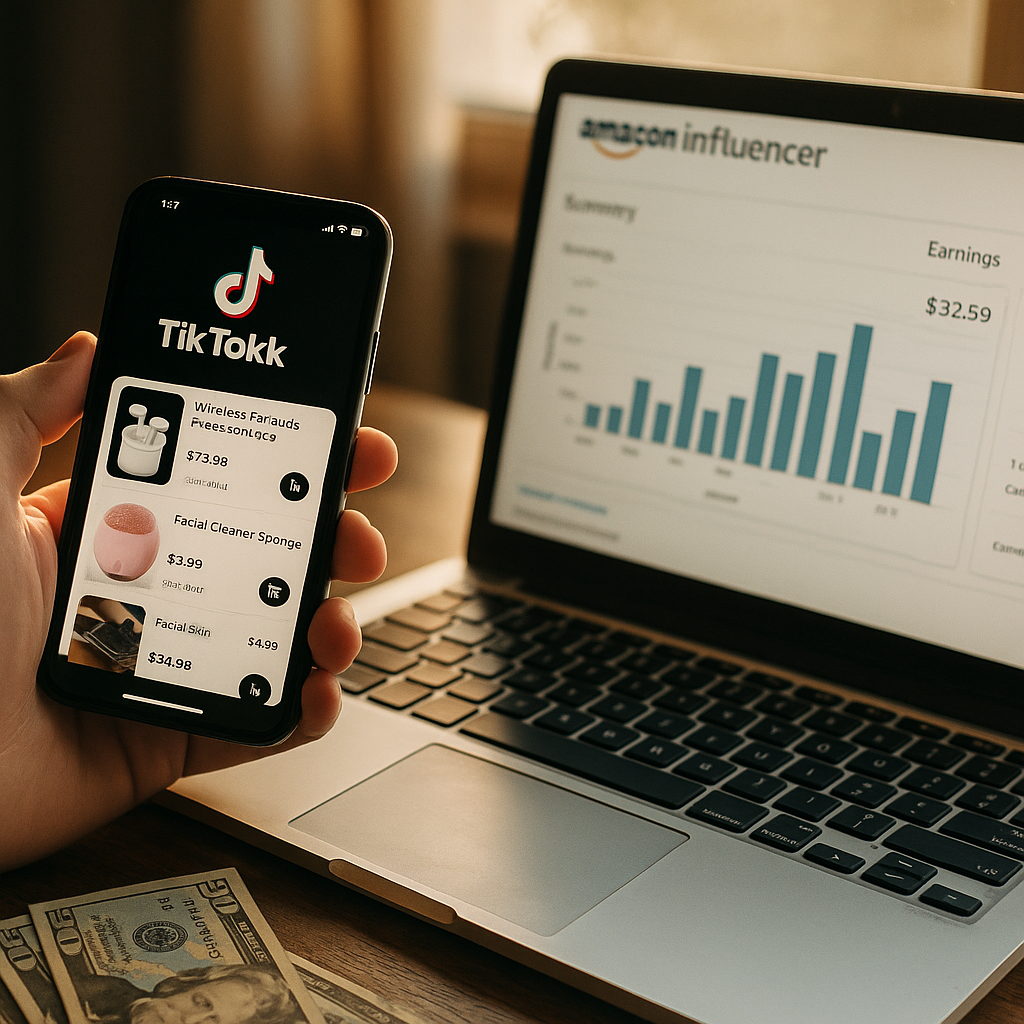
Here’s an uncomfortable number for anyone running affiliate budgets in 2026: the average Amazon Influencer Program commission sits in the 1% to 10% range, while top TikTok Shop affiliates routinely negotiate 15% to 30% on bestsellers. Same creator economy, wildly different economics. If you’re still splitting budget between these two channels based on last year’s assumptions, you’re probably overpaying on one and underfunding the other. The TikTok Shop vs Amazon Influencer Program decision isn’t philosophical anymore. It’s a spreadsheet problem, and most brands are solving it wrong.
Two Very Different GMV Engines
Amazon’s Influencer Program was built as a storefront extension. Creators get a personalized URL, curate product lists, and earn a cut when followers click through and buy, often outside Amazon itself (on YouTube, Instagram, blogs). The content lives off-platform. The purchase happens on-platform. That split matters because it means Amazon’s GMV attribution depends heavily on click tracking and cookie windows, not native checkout.
TikTok Shop flips that model entirely. Content and checkout live in the same feed. A creator posts a video or goes live, a shoppable cart appears, and the purchase closes in-app within seconds. There’s no redirect, no cookie decay, no “did they actually buy” guessing game. That’s why TikTok Shop GMV has scaled so fast: eMarketer has tracked social commerce growth rates that outpace traditional e-commerce by a wide margin, and TikTok Shop is a major driver of that curve.
The core difference isn’t the creators or the products. It’s where the purchase decision closes: on-platform impulse versus off-platform research.
Payout Structures: Commission Versus Negotiation
Amazon’s payout is standardized and unglamorous. Rates are set by category (luxury beauty might earn 10%, electronics often under 3%), and creators have almost zero room to negotiate beyond choosing which products to feature. It’s a passive, long-tail model. A creator who built a “home office setup” list two years ago can still earn from it today if the links stay live and the products stay in stock.
TikTok Shop payouts are a negotiation, not a rate card. Brands set commission tiers inside the Seller Center or Affiliate Dashboard, and top creators will often push back, asking for higher percentages, flat fees on top of commission, or exclusivity windows. This is closer to traditional influencer marketing deal structures than passive affiliate links. If you’re managing this at scale, the workflow differences between dashboard-driven offers and custom brief negotiations get complicated fast, which is why we built out a dashboard versus brand briefs workflow guide for teams juggling both.
The practical result: Amazon rewards patience and content longevity. TikTok Shop rewards negotiation skill and creator relationship management. Different muscles, different headcount requirements.
What the GMV Data Actually Shows
TikTok Shop’s GMV growth has been aggressive, particularly around live shopping events and seasonal pushes. Brands running live commerce campaigns have reported conversion spikes during flash sales that dwarf typical affiliate link performance, largely because urgency and in-feed checkout remove friction. We’ve covered the mechanics of this in our TikTok Shop live commerce conversion guide, and the pattern holds across categories: beauty, supplements, and home goods see the sharpest lift during live sessions.
Amazon’s strength is different. It’s not spiky, it’s steady. A well-placed influencer storefront link can generate GMV for months or years after the original post, especially if the creator has evergreen SEO-friendly content (think “best skincare for dry skin” roundups that rank in Google search). That’s a durability advantage TikTok Shop content simply doesn’t have, since the FYP algorithm buries old posts within days.
So which has better GMV? Wrong question. Ask instead: are you optimizing for a 48-hour sales spike or a 18-month content asset? Amazon fits the second use case. TikTok Shop dominates the first.
Inventory and Fulfillment Risk Changes the Math
GMV numbers mean nothing if you can’t fulfill the orders. TikTok Shop’s live commerce format can generate demand spikes that blow through inventory forecasts within hours, not days. Brands that haven’t built stockout buffers into their supply chain get burned here, and it tanks both your seller rating and the creator relationship when their audience can’t check out. Our inventory sync and stockout prevention guide walks through the operational side of this, which matters more on TikTok Shop than on Amazon, where fulfillment is already standardized through FBA.
Commission Structures, Compared Line by Line
- Amazon Influencer Program: Fixed category-based rates (roughly 1% to 10%), no negotiation, passive long-tail earning, attribution via 24-hour cookie window.
- TikTok Shop: Brand-set commission tiers (often 10% to 30% on promoted items), negotiable for top creators, in-app attribution with no cookie dependency, plus optional flat-fee add-ons for exclusivity or live appearances.
- Payout timing: Amazon pays out on a standard monthly cycle tied to its affiliate program terms. TikTok Shop payouts route through the Seller Center and can include both commission and negotiated flat fees, often on separate schedules.
- Return and refund impact: Both platforms claw back commission on returned items, but TikTok Shop’s live commerce impulse buys tend to carry higher return rates than considered Amazon purchases, which eats into effective GMV more than the headline number suggests.
That return-rate detail trips up a lot of finance teams. A campaign that looks like it generated $50,000 in GMV can shrink meaningfully once refunds clear, and TikTok Shop’s impulse-driven checkout tends to see higher refund rates than Amazon’s more deliberate purchase path. Build that discount into your ROI model before you report numbers upward.
Which Program Fits Which Brand?
If your product has a long consideration cycle (skincare, supplements, home goods with a learning curve) and your content strategy leans on SEO and evergreen reviews, Amazon’s Influencer Program is the lower-lift, higher-durability play. You’re essentially renting shelf space in creator content that Google will keep surfacing for years.
If your product is visual, impulse-friendly, and benefits from urgency (limited drops, flash sales, trend-driven items), TikTok Shop’s live commerce and in-feed checkout will out-convert Amazon every time. The tradeoff is operational: you need tighter inventory controls, faster creator vetting, and a team that can negotiate commission tiers instead of just setting a rate and walking away.
Most mature brands we talk to aren’t choosing one. They’re running both, with Amazon handling the long-tail SEO layer and TikTok Shop handling the spike-driven launch layer. That’s consistent with the broader trend toward always-on budget allocation rather than campaign-by-campaign spend.
A Note on Measurement and Reporting
Whichever platform you prioritize, your reporting stack needs to account for the attribution gap. Amazon’s cookie-based model undercounts assisted conversions that happen across devices, while TikTok Shop’s in-app GMV reporting doesn’t always reconcile cleanly with your broader marketing mix model. If you’re managing creator programs across multiple platforms, standardizing this reporting through a programmatic API reporting layer saves your analytics team from manually reconciling three different CSV exports every month. Tools like Sprout Social and HubSpot have both expanded commerce attribution features for exactly this reason.
Compliance matters here too. The FTC has been explicit that affiliate commissions and discount codes count as material connections requiring disclosure, regardless of which platform hosts the content. Check the FTC’s endorsement guidance before you brief creators on either program, since both Amazon and TikTok Shop affiliate relationships fall under the same disclosure rules.
FAQs
Frequently Asked Questions
Is TikTok Shop more profitable than the Amazon Influencer Program for brands?
It depends on the product category. TikTok Shop typically drives higher short-term GMV through live commerce and impulse buying, but commission rates are also higher and negotiated per creator. Amazon offers lower, fixed commission rates but generates durable, long-tail GMV from evergreen content that keeps converting for months.
Can a brand run both programs at the same time?
Yes, and most established brands do. The two programs serve different purposes: Amazon supports SEO-driven research content, while TikTok Shop supports urgency-driven launches and live shopping events. Running both requires separate creator vetting and commission strategies, but they rarely cannibalize each other.
Why do TikTok Shop commission rates vary so much between creators?
Unlike Amazon’s standardized category rates, TikTok Shop commissions are set by the brand and often negotiated directly with creators, especially those with strong sales history. Top affiliates can command higher percentages or flat fees for exclusivity, live appearances, or guaranteed posting volume.
How does attribution differ between the two platforms?
Amazon relies on a cookie-based attribution window tied to its affiliate links, which can undercount cross-device conversions. TikTok Shop’s checkout happens natively in-app, so attribution is more direct but doesn’t always reconcile cleanly with external marketing mix models or multi-platform reporting tools.
Do returns affect reported GMV differently on each platform?
Yes. TikTok Shop’s impulse-driven live commerce format tends to generate higher return rates than Amazon’s more deliberate purchase journey. Brands should factor expected refund rates into their ROI calculations rather than reporting headline GMV figures as final revenue.
The move for 2026 isn’t picking a winner. It’s assigning each platform the job it’s actually good at: Amazon for durable, search-driven GMV, TikTok Shop for spike-driven launches, and a reporting system that doesn’t force your team to reconcile two incompatible attribution models by hand.
Top Influencer Marketing Agencies
The leading agencies shaping influencer marketing in 2026
Agencies ranked by campaign performance, client diversity, platform expertise, proven ROI, industry recognition, and client satisfaction. Assessed through verified case studies, reviews, and industry consultations.
Moburst

-
2

The Shelf
Boutique Beauty & Lifestyle Influencer AgencyA data-driven boutique agency specializing exclusively in beauty, wellness, and lifestyle influencer campaigns on Instagram and TikTok. Best for brands already focused on the beauty/personal care space that need curated, aesthetic-driven content.Clients: Pepsi, The Honest Company, Hims, Elf Cosmetics, Pure LeafVisit The Shelf → -
3

Audiencly
Niche Gaming & Esports Influencer AgencyA specialized agency focused exclusively on gaming and esports creators on YouTube, Twitch, and TikTok. Ideal if your campaign is 100% gaming-focused — from game launches to hardware and esports events.Clients: Epic Games, NordVPN, Ubisoft, Wargaming, Tencent GamesVisit Audiencly → -
4

Viral Nation
Global Influencer Marketing & Talent AgencyA dual talent management and marketing agency with proprietary brand safety tools and a global creator network spanning nano-influencers to celebrities across all major platforms.Clients: Meta, Activision Blizzard, Energizer, Aston Martin, WalmartVisit Viral Nation → -
5

The Influencer Marketing Factory
TikTok, Instagram & YouTube CampaignsA full-service agency with strong TikTok expertise, offering end-to-end campaign management from influencer discovery through performance reporting with a focus on platform-native content.Clients: Google, Snapchat, Universal Music, Bumble, YelpVisit TIMF → -
6

NeoReach
Enterprise Analytics & Influencer CampaignsAn enterprise-focused agency combining managed campaigns with a powerful self-service data platform for influencer search, audience analytics, and attribution modeling.Clients: Amazon, Airbnb, Netflix, Honda, The New York TimesVisit NeoReach → -
7

Ubiquitous
Creator-First Marketing PlatformA tech-driven platform combining self-service tools with managed campaign options, emphasizing speed and scalability for brands managing multiple influencer relationships.Clients: Lyft, Disney, Target, American Eagle, NetflixVisit Ubiquitous → -
8

Obviously
Scalable Enterprise Influencer CampaignsA tech-enabled agency built for high-volume campaigns, coordinating hundreds of creators simultaneously with end-to-end logistics, content rights management, and product seeding.Clients: Google, Ulta Beauty, Converse, AmazonVisit Obviously →