


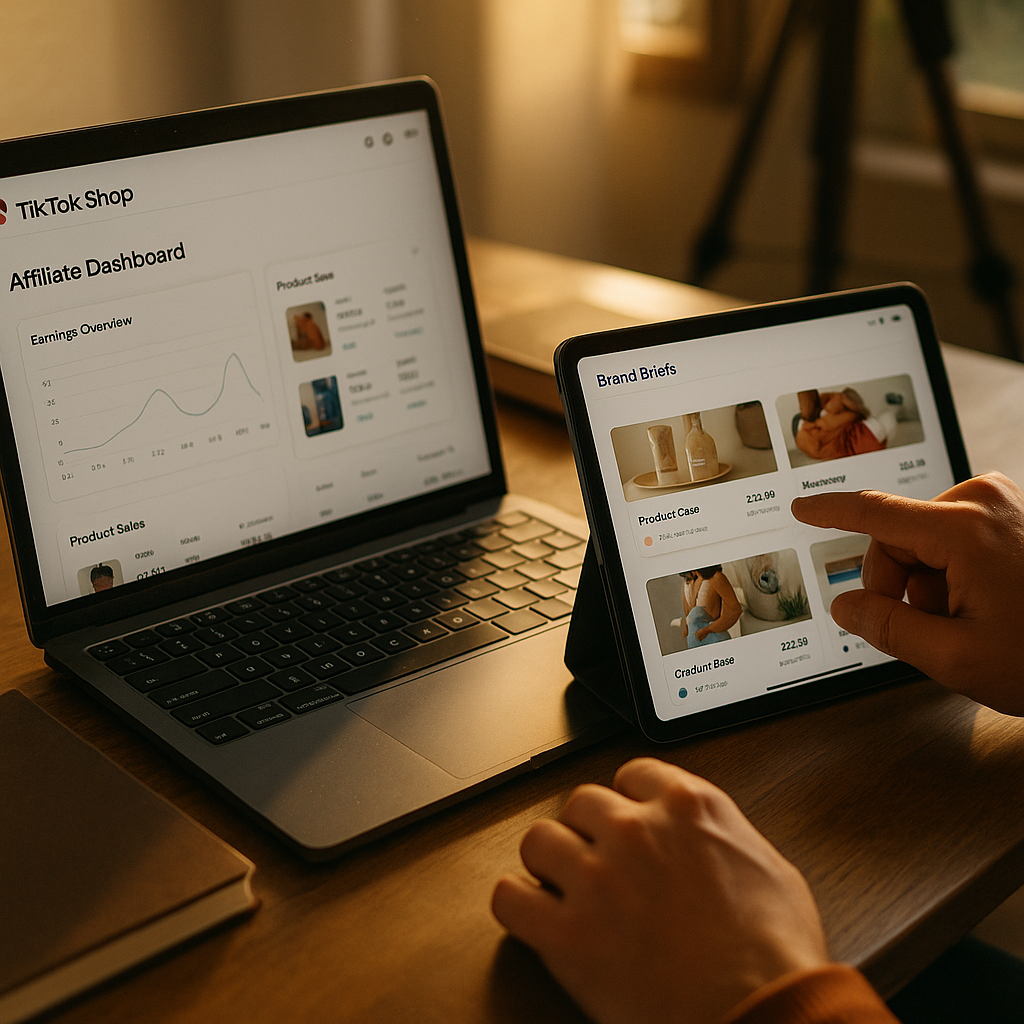
Brands running TikTok Shop affiliate programs are leaving creators to self-select products with zero messaging guardrails, then wondering why conversion rates stall at launch. Meanwhile, teams clinging to rigid brand briefs watch competitors flood the For You page with volume they simply can’t match. The TikTok Shop affiliate dashboard and the traditional brand brief represent two fundamentally different philosophies of creator management, and most teams are using the wrong one for their actual goals.
Two Workflows, Two Very Different Bets
The affiliate dashboard is TikTok’s native, self-serve system. You set commission rates, upload product samples or let creators request them, and the platform matches your catalog to creators who opt in. There’s no brief, no approval gate, no creative direction beyond what’s in your product listing. Creators post what they want, when they want, and get paid on performance.
Brand briefs are the opposite bet. You identify specific creators, write detailed creative direction (hooks, talking points, compliance language, disclosure requirements), negotiate flat fees or hybrid deals, and review content before it goes live. It’s slower. It’s more expensive per creator. But it’s controlled.
Neither is inherently better. The question is what your team is optimizing for this quarter: volume and velocity, or narrative consistency and risk control.
When the Affiliate Dashboard Wins
If your goal is raw sales volume and you have a product that’s visually simple to demo (skincare, snacks, gadgets under $50), the affiliate dashboard is hard to beat on efficiency. You’re not paying anyone unless they convert. Commission structures typically run 10 to 30 percent per sale, which sounds steep until you compare it against flat-fee creator rates that may never deliver attributable revenue.
The dashboard also solves a scale problem that briefs can’t touch. Writing individual briefs for 200 creators is operationally impossible for most teams. The affiliate model lets hundreds of nano and micro creators discover your product organically, test their own hooks, and surface what’s actually working before you spend a dollar on amplification.
Brands that pair affiliate program entry with a light sampling strategy consistently see higher creator retention than those relying on commission alone, because free product removes the first barrier to content creation.
This is the same logic behind TikTok Shop live commerce strategies, where volume and real-time social proof matter more than polished scripting. If your category thrives on authenticity signals, the dashboard’s hands-off nature is a feature, not a bug.
The Hidden Cost: Brand Safety Gaps
Here’s what the affiliate dashboard doesn’t tell you upfront: you have almost no control over claims creators make about your product. A supplement brand running an open affiliate program risks creators making unverified health claims. A financial product risks compliance violations under FTC guidance on endorsements. If you’re in a regulated category, the dashboard’s lack of pre-approval is a liability, not a convenience.
This is exactly the tension explored in FinTok compliance discussions, where the FTC’s endorsement guidelines leave little room for improvisation. Review the FTC’s endorsement guidance before opening affiliate access to any product with regulatory exposure.
When Brand Briefs Still Make Sense
Briefs earn their cost when you need narrative precision. Launching a new product line, entering a sensitive category, or running a campaign tied to a cultural moment all require messaging control that an open affiliate system can’t guarantee. If one creator’s phrasing could trigger a PR problem or a compliance flag, you need review rights before anything publishes.
Briefs also make sense when you’re working with mid-tier or macro creators whose audience trust depends on consistent positioning. A creator with 500,000 followers isn’t going to freelance their way through your messaging the same way a nano creator chasing commission might. For these relationships, a structured brief (with clear deliverables, usage rights, and disclosure language) protects both sides.
Consider how creator brief structures have evolved to accommodate shoppable formats. The same discipline applies to TikTok Shop campaigns that need tighter creative control than the dashboard allows.
The Hybrid Model: What Smart Teams Actually Do
Most sophisticated brands aren’t choosing one workflow exclusively. They’re running a tiered system where the affiliate dashboard handles the long tail of nano and micro creators, while briefs govern a smaller cohort of strategic partners whose content anchors the campaign narrative.
This mirrors the logic in tiered distribution strategies: a handful of anchor creators set the tone with briefed, approved content, while a much larger group of affiliate-driven creators amplify reach and generate the volume of organic-feeling posts the algorithm rewards.
- Tier 1 (brief required): Macro creators, launch partners, anyone with contractual usage rights or paid media amplification attached.
- Tier 2 (light brief or guidelines): Mid-tier creators who get talking points and disclosure requirements but creative freedom on execution.
- Tier 3 (affiliate dashboard only): Nano and micro creators who discover the product independently and post without pre-approval.
This structure gives you narrative control where it matters most and scale where volume matters more than precision. It also solves a budget allocation problem many teams struggle with when they try to force every creator relationship through the same approval pipeline.
Operational Reality: Who Manages What
The hybrid model only works if your team has clear ownership. Affiliate dashboard management is largely a product and operations function: catalog uploads, commission tuning, payout monitoring. Brief management is a creative and compliance function: messaging approval, legal review, contract negotiation. Trying to have one person run both without dedicated tooling is where programs fall apart.
This is where programmatic creator APIs are increasingly filling the gap, pulling affiliate performance data into the same reporting dashboards used for briefed campaign tracking. Without that integration, you end up with two disconnected data sets and no single view of total program ROI.
Budget and Reporting: Where the Two Systems Diverge
Affiliate dashboard spend is inherently variable. You don’t know your total payout until sales happen, which makes forecasting harder but also means you’re never paying for content that doesn’t convert. Brief-based spend is fixed and predictable, which finance teams generally prefer, but it carries the risk of paying for content that underperforms regardless of creative quality.
According to eMarketer, performance-based creator compensation models have grown steadily as brands push for tighter attribution, a trend that aligns with broader shifts toward always-on budget allocation rather than campaign-by-campaign spending. If your finance team wants predictability, lean brief-heavy. If they want efficiency tied directly to revenue, lean affiliate-heavy.
Reporting is another divergence point. The affiliate dashboard gives you clean, TikTok-native sales attribution: clicks, orders, GMV, all tied to specific creator codes. Brief-based campaigns usually rely on promo codes, UTM links, or post-campaign surveys, which are messier and slower to reconcile. If your leadership wants fast, defensible ROI numbers, the dashboard’s native attribution is genuinely hard to replicate elsewhere.
Making the Call for Your Team
Ask three questions before deciding. First, what’s your tolerance for off-message content? Second, how fast do you need to scale creator volume? Third, does your category carry regulatory or reputational risk that demands pre-approval?
If you answered low tolerance, slow scale, and high risk, you’re a brief-first team. If you answered high tolerance, fast scale, and low risk, the affiliate dashboard should carry most of your program. Most brands land somewhere in between, and that’s fine. The mistake isn’t picking one system. It’s refusing to run both because it feels operationally messy.
For teams exploring how shoppable formats are reshaping creative control more broadly, the shift toward hybrid structures shows up across platforms, not just TikTok Shop. Reviewing how feed ranking factors influence brief requirements on other platforms can help clarify where your own guardrails should sit.
Frequently Asked Questions
Can a brand use both the TikTok Shop affiliate dashboard and brand briefs at the same time?
Yes, and most established programs do. A common structure uses the affiliate dashboard for scale (nano and micro creators) while reserving brand briefs for a smaller group of strategic or macro creators where messaging control matters more.
Does the TikTok Shop affiliate dashboard require creator pre-approval?
No. The dashboard is largely self-serve. Creators can request samples or purchase products and post content without brand review unless you’ve set specific product access restrictions.
Which approach gives better ROI data?
The affiliate dashboard typically provides cleaner, platform-native attribution (clicks, orders, GMV) tied directly to creator codes. Brief-based campaigns usually require manual tracking through promo codes or UTM links, which takes longer to reconcile but can be layered with deeper brand lift metrics.
Is the affiliate dashboard risky for regulated industries?
It can be. Without pre-approval, creators may make unverified claims, which is a significant risk for finance, health, and supplement brands. These categories should lean toward brief-based workflows with compliance review built in.
How do commission rates typically compare to flat-fee brief deals?
Affiliate commissions generally run 10 to 30 percent per sale, paid only on conversion. Brief-based flat fees are paid regardless of performance, which can cost more per creator but guarantees content delivery and creative control.
FAQs
See full FAQ answers above.
Next step: Audit your current creator roster this week and sort them into the three tiers above. If more than half your budget is going to briefed content that isn’t outperforming your affiliate conversion rates, you’re overpaying for control you don’t need.
Top Influencer Marketing Agencies
The leading agencies shaping influencer marketing in 2026
Agencies ranked by campaign performance, client diversity, platform expertise, proven ROI, industry recognition, and client satisfaction. Assessed through verified case studies, reviews, and industry consultations.
Moburst

-
2

The Shelf
Boutique Beauty & Lifestyle Influencer AgencyA data-driven boutique agency specializing exclusively in beauty, wellness, and lifestyle influencer campaigns on Instagram and TikTok. Best for brands already focused on the beauty/personal care space that need curated, aesthetic-driven content.Clients: Pepsi, The Honest Company, Hims, Elf Cosmetics, Pure LeafVisit The Shelf → -
3

Audiencly
Niche Gaming & Esports Influencer AgencyA specialized agency focused exclusively on gaming and esports creators on YouTube, Twitch, and TikTok. Ideal if your campaign is 100% gaming-focused — from game launches to hardware and esports events.Clients: Epic Games, NordVPN, Ubisoft, Wargaming, Tencent GamesVisit Audiencly → -
4

Viral Nation
Global Influencer Marketing & Talent AgencyA dual talent management and marketing agency with proprietary brand safety tools and a global creator network spanning nano-influencers to celebrities across all major platforms.Clients: Meta, Activision Blizzard, Energizer, Aston Martin, WalmartVisit Viral Nation → -
5

The Influencer Marketing Factory
TikTok, Instagram & YouTube CampaignsA full-service agency with strong TikTok expertise, offering end-to-end campaign management from influencer discovery through performance reporting with a focus on platform-native content.Clients: Google, Snapchat, Universal Music, Bumble, YelpVisit TIMF → -
6

NeoReach
Enterprise Analytics & Influencer CampaignsAn enterprise-focused agency combining managed campaigns with a powerful self-service data platform for influencer search, audience analytics, and attribution modeling.Clients: Amazon, Airbnb, Netflix, Honda, The New York TimesVisit NeoReach → -
7

Ubiquitous
Creator-First Marketing PlatformA tech-driven platform combining self-service tools with managed campaign options, emphasizing speed and scalability for brands managing multiple influencer relationships.Clients: Lyft, Disney, Target, American Eagle, NetflixVisit Ubiquitous → -
8

Obviously
Scalable Enterprise Influencer CampaignsA tech-enabled agency built for high-volume campaigns, coordinating hundreds of creators simultaneously with end-to-end logistics, content rights management, and product seeding.Clients: Google, Ulta Beauty, Converse, AmazonVisit Obviously →