


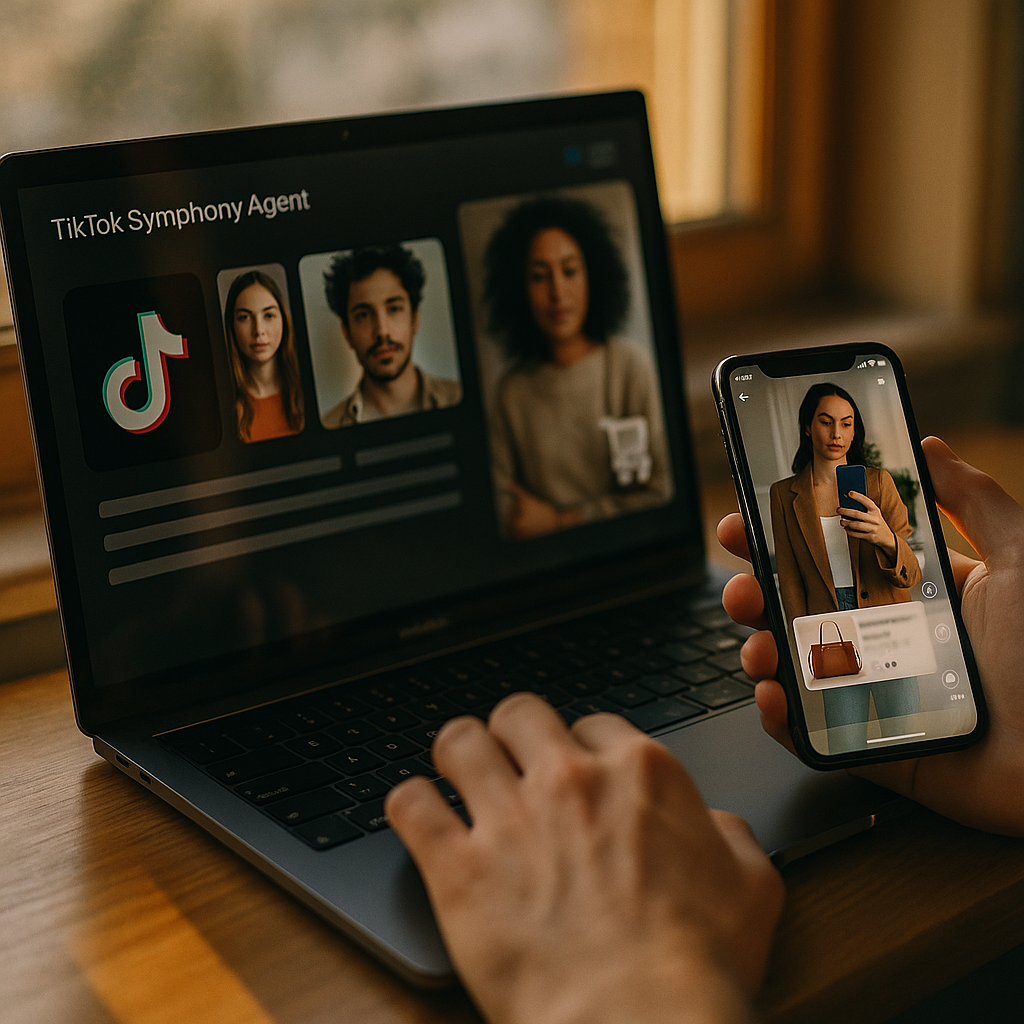
TikTok claims Symphony Agent can cut creator sourcing time by more than half. That’s a bold promise in a channel where brands already burn 15-20 hours a week on manual creator vetting. The TikTok Symphony Agent is now rolling out to more ad accounts, and media buyers need to know whether it’s a genuine efficiency unlock or another walled-garden black box dressed up as innovation.
This breakdown looks at what Symphony Agent actually does under the hood, where the AI matching logic holds up, and where brand teams should keep a human in the loop.
What Symphony Agent Actually Is
Symphony Agent sits inside TikTok’s broader Symphony suite, the ad platform’s generative AI toolkit for creative production, dubbing, and now creator-brand pairing. Think of it as three linked functions stitched together: creator discovery, brand-video repurposing, and shoppable ad assembly. TikTok positions it as a self-serve alternative to the Creator Marketplace’s manual search filters.
The pitch is straightforward. Upload a brand brief or existing video asset, and Symphony Agent suggests creators whose content style, audience demographics, and past brand-partnership performance align with your campaign goals. From there, it can take a creator’s organic video (with rights clearance) or a brand’s raw footage and convert it into a shoppable ad unit, complete with product tagging pulled from TikTok Shop’s catalog.
That’s the theory. In practice, the matching engine leans heavily on TikTok’s first-party engagement data, not third-party brand-safety signals. That distinction matters a lot for regulated categories like finance, health, or alcohol.
The AI Matching Logic: Signals In, Creators Out
Symphony’s creator-matching model reportedly weighs four signal clusters: content category performance, audience overlap with the advertiser’s existing customer file (when Events API data is connected), historical branded-content completion rates, and creative “style fingerprinting” derived from video pacing, hook structure, and caption tone.
That last one is the interesting part. TikTok’s system doesn’t just match on follower count or niche — it’s trying to predict whether a creator’s editing rhythm will resonate with a specific brand’s existing top-performing ads. It’s a similar logic to what recommendation engines already do for the For You feed, just repurposed for partnership sourcing.
The real differentiator isn’t the matching algorithm itself — it’s that Symphony Agent operates entirely on TikTok’s closed data loop, meaning brands trade transparency for convenience.
Compare that to independent creator discovery platforms, which often blend cross-platform data with brand-supplied performance history. If you’ve evaluated tools in this space before, the tradeoffs will feel familiar — see our comparison of AI creator discovery tools for how third-party platforms differ in data sourcing and transparency.
Brand-Video-to-Shoppable-Ad: How the Conversion Pipeline Works
This is where Symphony Agent earns its keep for performance marketers. The conversion pipeline takes a source video, whether brand-produced or licensed creator content, and runs it through four automated steps:
- Product detection: computer vision identifies on-screen products and cross-references them against the connected TikTok Shop catalog.
- Tag placement: shoppable tags get auto-positioned at moments of visual product prominence, timed to avoid overlapping key hooks in the first three seconds.
- Format variant generation: the same source clip gets reformatted into multiple aspect ratios and caption styles for Spark Ads versus in-feed placements.
- Performance prediction scoring: a pre-flight score estimates likely CTR and conversion lift based on similar historical ad units in the same vertical.
For media buyers managing dozens of SKUs, this cuts a real bottleneck. Manually tagging products across creator-generated content at scale has always been a resourcing headache, especially for catalogs with frequent seasonal turnover. Automating that step alone could justify testing the tool.
But the performance prediction score deserves scrutiny. TikTok hasn’t published methodology details on how that score is calculated, and early buyer feedback suggests it correlates more closely with historical platform engagement than with actual purchase conversion. Treat it as a directional signal, not gospel. Run your own A/B tests against Symphony-recommended variants before reallocating budget based on the predicted score alone.
Where the Matching Falls Short
No AI matching system is bias-free, and Symphony Agent is no exception. Because the model trains on historical branded-content performance, it tends to over-recommend creators who’ve already worked successfully with similarly-sized brands in the same vertical. That’s a reasonable default, but it creates a discovery ceiling: emerging creators with strong audience trust but thin brand-partnership history get systematically deprioritized.
If your program strategy depends on finding undervalued micro-creators before competitors do, Symphony Agent’s recommendations will skew toward the same well-trodden roster everyone else is seeing. That’s a structural limitation, not a bug that gets patched next quarter.
There’s also the audience-overlap signal to consider. It only activates meaningfully when you’ve connected first-party customer data via TikTok’s Events API. Brands without clean server-side tracking will get weaker match quality, full stop. This is where the broader martech conversation around server-side tagging becomes directly relevant to influencer ops teams, not just performance marketing teams. If your tagging infrastructure is client-side only, you’re feeding Symphony a thinner dataset than competitors with proper server-side implementation.
Attribution: The Question Every Buyer Should Ask First
Here’s the uncomfortable part. Symphony Agent’s shoppable ad conversions get reported inside TikTok’s own attribution window, using TikTok’s own conversion definitions. That’s standard for any walled-garden ad product, but it means cross-channel attribution gets murkier, not clearer, once Symphony-generated ads enter your media mix.
If you’re running influencer content across TikTok, Meta, and YouTube simultaneously (most mid-market brands are), you need an identity resolution layer that sits above any single platform’s reporting. Otherwise you’re comparing Symphony’s self-reported lift against a completely different measurement standard from your Meta or Google campaigns, and making budget calls on apples-to-oranges data.
Platform-native attribution will always flatter the platform. Cross-channel identity resolution is the only way to know if Symphony-sourced conversions are incremental or simply reallocated from budget that would have converted anyway.
This is where a lot of brand teams are investing right now, and for good reason. Our recent look at fixing attribution with an identity graph covers how to layer resolution on top of platform-native reporting without a full stack rebuild. Similarly, comparisons like Rokt mParticle vs IQM are worth reviewing if Symphony becomes a meaningful spend line in your creator program.
Compliance and Disclosure: Don’t Assume Symphony Handles It
Automated ad conversion tools raise a quiet but important compliance question: who’s responsible for disclosure compliance when a brand converts a creator’s organic video into a paid shoppable ad? The FTC’s endorsement guidelines still apply regardless of which tool assembled the final ad unit. Symphony Agent doesn’t automatically append disclosure language to converted ads, and creator contracts need explicit language covering AI-repurposing rights before any conversion happens.
Brand legal and compliance teams should treat Symphony-converted assets the same way they’d treat any paid usage of creator content: usage rights, disclosure requirements, and duration terms all need to be locked down in the original creator agreement, not assumed after the fact. This isn’t unique to TikTok, but the speed of Symphony’s automated conversion makes it easier to skip that step accidentally.
How Symphony Agent Compares to Third-Party Discovery Tools
The honest answer: it depends on what you’re optimizing for. Symphony Agent wins on speed and native integration, since there’s zero data transfer friction between discovery, content conversion, and ad delivery within TikTok Ads Manager. For brands running high-velocity, TikTok-first programs, that closed loop is genuinely valuable.
Third-party tools win on transparency and cross-platform reach. If your influencer program spans Instagram, YouTube, and TikTok simultaneously, a platform-agnostic discovery tool gives you a single source of truth rather than three disconnected dashboards. Our breakdown of AI sourcing versus agency-led discovery is a useful reference point for weighing cost-per-discovery against match quality across different sourcing models.
Cost is also worth flagging. Symphony Agent’s usage is bundled into standard TikTok Ads Manager spend, meaning there’s no separate licensing fee, but that also means you have less negotiating leverage on pricing compared to standalone SaaS creator platforms with tiered contracts.
A Practical Testing Framework for Media Buyers
Before committing meaningful budget to Symphony-sourced creator pairings, run a structured pilot:
- Allocate no more than 15-20% of a single campaign’s budget to Symphony-matched creators initially.
- Run a parallel manually-sourced creator set as a control group with matched audience size and content category.
- Track conversion using your own identity resolution layer, not just TikTok’s native dashboard.
- Audit at least five Symphony-recommended creators manually for brand safety and content quality before greenlighting partnerships.
- Review disclosure language on every converted ad unit before it goes live.
Data from eMarketer continues to show TikTok Shop’s shoppable video format outperforming standard in-feed ads on conversion rate, so the underlying format has proven demand. The question isn’t whether shoppable video works. It’s whether Symphony’s automated matching gets you better creators, or just faster access to the same pool everyone else is already tapping.
FAQs
Frequently Asked Questions
What is TikTok’s Symphony Agent used for?
Symphony Agent is an AI tool inside TikTok Ads Manager that matches brands with creators based on content style and audience data, and converts brand or creator video into shoppable ad units with automated product tagging.
Does Symphony Agent replace the TikTok Creator Marketplace?
No. It operates alongside the Creator Marketplace as a more automated discovery layer, but manual search and vetting through the Marketplace remains available for buyers who want direct control over filtering criteria.
How accurate is Symphony’s performance prediction score?
TikTok hasn’t published full methodology, and early buyer feedback suggests the score correlates more with platform engagement history than confirmed purchase conversion. Treat it as directional, and validate with independent A/B testing.
Does using Symphony Agent handle FTC disclosure compliance automatically?
No. Brands remain responsible for ensuring proper endorsement disclosure on any converted ad unit, and creator contracts need explicit language covering rights to repurpose organic content into paid shoppable ads.
Is Symphony Agent better than third-party AI creator discovery tools?
It depends on your program structure. Symphony wins on speed and native TikTok integration; third-party tools generally offer more transparency and cross-platform discovery for brands running multi-platform influencer programs.
Pilot Symphony Agent on a capped budget, run it against a manually-sourced control group, and measure both through an identity layer you control, not TikTok’s dashboard alone. The tool is worth testing. It’s not yet worth trusting blindly.
Top Influencer Marketing Agencies
The leading agencies shaping influencer marketing in 2026
Agencies ranked by campaign performance, client diversity, platform expertise, proven ROI, industry recognition, and client satisfaction. Assessed through verified case studies, reviews, and industry consultations.
Moburst

-
2

The Shelf
Boutique Beauty & Lifestyle Influencer AgencyA data-driven boutique agency specializing exclusively in beauty, wellness, and lifestyle influencer campaigns on Instagram and TikTok. Best for brands already focused on the beauty/personal care space that need curated, aesthetic-driven content.Clients: Pepsi, The Honest Company, Hims, Elf Cosmetics, Pure LeafVisit The Shelf → -
3

Audiencly
Niche Gaming & Esports Influencer AgencyA specialized agency focused exclusively on gaming and esports creators on YouTube, Twitch, and TikTok. Ideal if your campaign is 100% gaming-focused — from game launches to hardware and esports events.Clients: Epic Games, NordVPN, Ubisoft, Wargaming, Tencent GamesVisit Audiencly → -
4

Viral Nation
Global Influencer Marketing & Talent AgencyA dual talent management and marketing agency with proprietary brand safety tools and a global creator network spanning nano-influencers to celebrities across all major platforms.Clients: Meta, Activision Blizzard, Energizer, Aston Martin, WalmartVisit Viral Nation → -
5

The Influencer Marketing Factory
TikTok, Instagram & YouTube CampaignsA full-service agency with strong TikTok expertise, offering end-to-end campaign management from influencer discovery through performance reporting with a focus on platform-native content.Clients: Google, Snapchat, Universal Music, Bumble, YelpVisit TIMF → -
6

NeoReach
Enterprise Analytics & Influencer CampaignsAn enterprise-focused agency combining managed campaigns with a powerful self-service data platform for influencer search, audience analytics, and attribution modeling.Clients: Amazon, Airbnb, Netflix, Honda, The New York TimesVisit NeoReach → -
7

Ubiquitous
Creator-First Marketing PlatformA tech-driven platform combining self-service tools with managed campaign options, emphasizing speed and scalability for brands managing multiple influencer relationships.Clients: Lyft, Disney, Target, American Eagle, NetflixVisit Ubiquitous → -
8

Obviously
Scalable Enterprise Influencer CampaignsA tech-enabled agency built for high-volume campaigns, coordinating hundreds of creators simultaneously with end-to-end logistics, content rights management, and product seeding.Clients: Google, Ulta Beauty, Converse, AmazonVisit Obviously →