


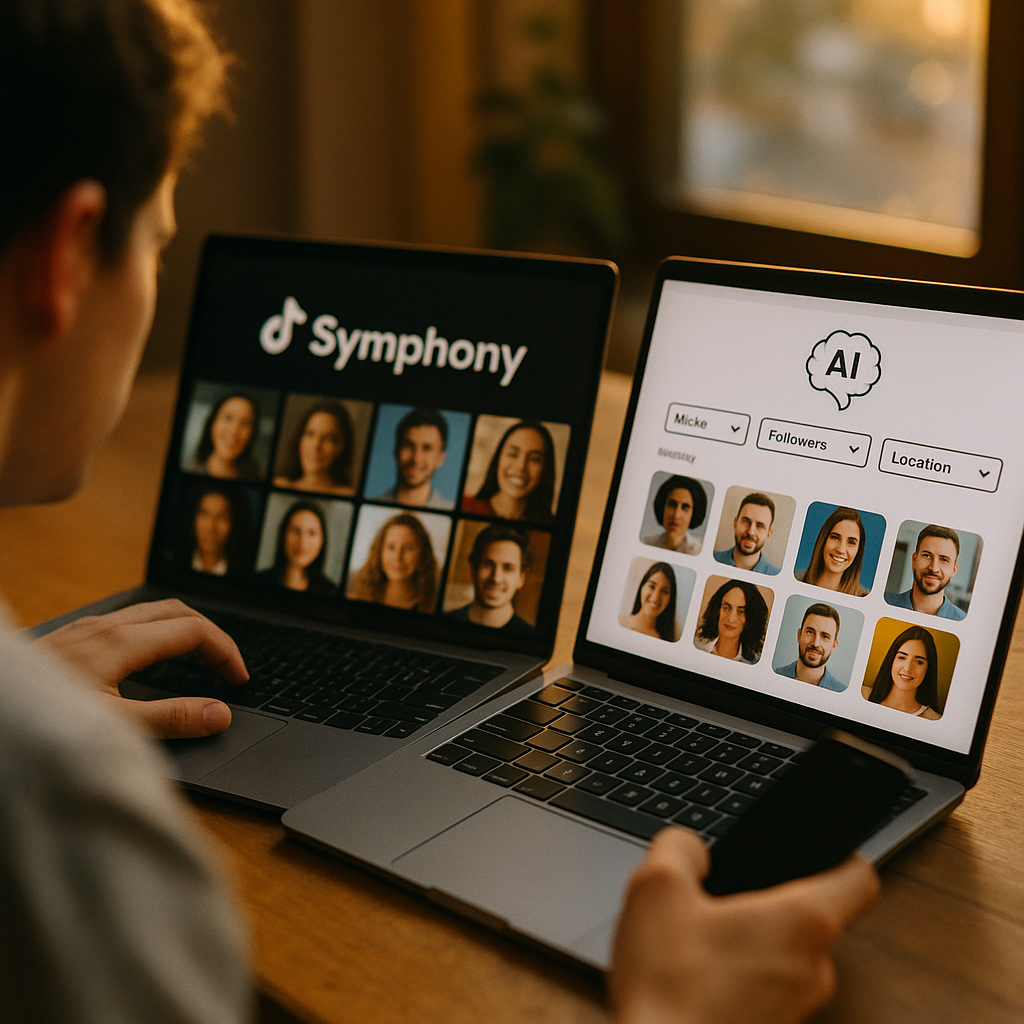
Seventy-three percent of brands say finding the right creator still takes longer than it should, even with AI in the mix. TikTok Symphony Agent promises to fix that with automated matching, briefing, and content generation baked into one platform. But is it actually better than the wave of independent AI creator-matching tools now competing for the same budget line? Let’s pull it apart, feature by feature.
Why This Comparison Matters Right Now
Influencer marketing budgets have matured past the “let’s just try it” phase. Marketing leaders now expect the same rigor from creator tools that they demand from paid media platforms: measurable ROI, audit trails, and predictable output. TikTok Symphony Agent entered this environment as a native, platform-owned solution — built directly into TikTok’s ad ecosystem, trained on TikTok’s own content signals, and positioned as an all-in-one creative and matching assistant.
Meanwhile, a crop of platform-agnostic AI matching tools has emerged, built by vendors with no stake in any single social platform. That neutrality is either their biggest selling point or their biggest limitation, depending on who you ask. Brands running multi-platform programs (TikTok, Instagram, YouTube Shorts) increasingly need to decide: go native and optimize for one channel, or go independent and optimize for the whole portfolio.
The real decision isn’t “which tool is smarter.” It’s “which tool’s blind spots cost you less.”
What Symphony Agent Actually Does
TikTok Symphony Agent isn’t just a creator search bar with AI branding slapped on it. It’s a suite: creator matching, script generation, video editing assistance, and performance prediction, all trained on TikTok’s internal engagement data. The pitch is compelling — nobody has more granular behavioral data on TikTok users than TikTok itself.
In practice, Symphony’s matching engine leans heavily on historical campaign performance within TikTok’s own ad manager. It suggests creators based on predicted view-through rates, audience overlap, and brand-safety scores calculated from TikTok’s content moderation systems. For brands already running TikTok ad campaigns, the integration is close to seamless. Data flows from creator discovery straight into campaign launch without leaving the dashboard.
The catch? It’s TikTok-only. Symphony has no visibility into a creator’s Instagram Reels performance, YouTube Shorts audience, or cross-platform brand safety history. If your creator strategy lives entirely on TikTok, that’s a non-issue. If it doesn’t, you’re back to stitching data together manually, which is exactly the workflow AI tools are supposed to eliminate.
The Emerging Competitors: What They Do Differently
Independent AI creator-matching tools take a different bet: rather than optimizing for one platform’s data, they aggregate signals across platforms and layer in audience intelligence that platform-native tools typically don’t expose. This includes fake follower detection, sentiment scoring on past brand deals, and audience overlap analysis across a creator’s full channel footprint, not just their TikTok handle.
Some of the more notable capabilities showing up in this category:
- Cross-platform audience overlap detection — flagging when a creator’s “reach” is actually the same audience buying across three platforms, inflating perceived value.
- Historical brand-fit scoring — using past campaign outcomes (not just follower demographics) to predict fit with a specific brand voice.
- Compliance and disclosure tracking — automated flagging of FTC-required disclosure gaps before a campaign goes live, which matters more each quarter as enforcement tightens.
- Budget-tier filtering — matching creators not just by fit but by realistic rate-card alignment with campaign budget, cutting negotiation cycles.
This is where tools reviewed in audience intelligence platforms tend to outperform native tools like Symphony. Follower-count vetting has been dead for a while; the market just took time to catch up.
Feature-by-Feature: Where Each Platform Wins
Data depth vs. data breadth. Symphony wins on depth — nobody sees TikTok engagement signals as clearly as TikTok. Independent tools win on breadth, pulling from multiple platforms and often third-party audience panels. If your brand runs a single-platform TikTok Shop strategy, depth matters more. If you’re running an omnichannel creator program, breadth wins outright.
Speed to match. Symphony’s native integration means matching-to-launch can happen in a single session, particularly useful for brands running high-volume, always-on TikTok Shop campaigns (a workflow also covered in our piece on TikTok Shop catalog operations). Independent tools typically require an extra export/import step to push matched creators into the ad platform of choice, adding friction but also adding a checkpoint for human review.
Brand safety and compliance. This is where the gap widens. Symphony’s brand-safety scoring is built on TikTok’s content moderation categories, which are useful but narrow. Independent platforms increasingly bake in disclosure compliance checks aligned with FTC endorsement guidelines, something brands in regulated categories (finance, health, alcohol) genuinely cannot skip. If your legal team requires documented disclosure audit trails, native tools currently fall short.
Attribution and reporting. Symphony ties cleanly into TikTok’s own attribution stack, which is fine until a finance stakeholder asks how TikTok spend compares to Instagram or YouTube performance. That’s a cross-platform attribution problem, and it’s one reason platforms like those discussed in creator match rate comparisons keep gaining ground with mid-market and enterprise brands running multi-channel programs.
A tool that matches you with the “perfect” creator but can’t prove disclosure compliance isn’t a matching tool. It’s a liability generator.
Cost and Operational Overhead
Symphony Agent is bundled within TikTok’s ad platform, so there’s no separate licensing fee in the traditional sense — the cost shows up as ad spend efficiency (or inefficiency) rather than a subscription line. That’s attractive to procurement teams who want to avoid adding another vendor contract.
Independent AI matching tools typically run on tiered SaaS pricing, often scaling with the number of creators tracked or campaigns managed monthly. For brands running fewer than a handful of campaigns a quarter, this can feel like overkill. For brands managing hundreds of creator relationships across platforms, the operational time saved on manual vetting alone tends to justify the spend within one or two quarters, according to patterns we’ve seen across the eMarketer creator economy data set.
There’s also a talent cost most teams underestimate: someone still has to validate AI matches before campaigns launch. Neither Symphony nor its competitors are fully autonomous yet, despite the marketing copy suggesting otherwise. Budget for human QA time regardless of which tool you pick.
Where the Category Is Headed
Platform-native AI agents will keep improving, and TikTok has an obvious incentive to make Symphony indispensable for anyone spending ad dollars on the platform. But the broader trend in social media marketing points toward composable stacks, not walled gardens. Brands increasingly want interoperable tools that plug into their existing CDP, attribution stack, and compliance systems rather than platform-specific silos.
That’s consistent with what we’ve documented in composable MarTech stack analysis: all-in-one suites win on convenience early, then lose ground once a brand’s data needs outgrow a single vendor’s walls. Symphony Agent is excellent at what it does inside TikTok. It’s not designed to be your only creator-matching tool, and TikTok probably knows that.
Expect independent vendors to keep closing the “native data depth” gap by negotiating direct API access with platforms, similar to how identity resolution vendors have improved match rates over time, a dynamic explored in identity resolution comparisons. The moat isn’t permanent. It’s a head start.
Which One Should Your Team Actually Pick?
If TikTok is 80%+ of your creator budget, Symphony Agent’s native integration probably beats the friction of a third-party tool. The matching quality is genuinely strong within its lane, and the speed-to-launch advantage is real for high-volume Shop campaigns.
If your creator program spans three or more platforms, or if your legal and compliance teams require documented audit trails, an independent AI matching tool is the safer long-term bet. You’ll pay more upfront in subscription costs, but you’ll spend less time reconciling disconnected data later, and you’ll sleep better during an FTC compliance review.
Most enterprise brands we’ve tracked end up running both: Symphony for TikTok-specific execution, an independent tool for cross-platform vetting and compliance oversight. It’s not the tidiest stack. It’s the one that actually holds up under scrutiny.
Frequently Asked Questions
Is TikTok Symphony Agent free to use?
Symphony Agent is bundled within TikTok’s advertising platform rather than sold as a standalone subscription, so there’s no separate licensing fee. Costs are reflected in ad spend and campaign management rather than a distinct software line item.
Can Symphony Agent match creators across other platforms like Instagram or YouTube?
No. Symphony Agent’s matching engine is trained on and limited to TikTok’s own data, so it has no visibility into a creator’s performance or audience on other platforms.
Do independent AI creator-matching tools integrate with TikTok’s ad manager?
Most require an export or API-based handoff rather than a fully native integration, which adds a step compared to Symphony but often adds a useful human review checkpoint before launch.
Which option is better for compliance-heavy industries like finance or healthcare?
Independent tools generally offer stronger disclosure and compliance tracking aligned with FTC endorsement guidelines, which matters significantly for regulated categories facing audit risk.
Should brands running multi-platform campaigns use Symphony Agent at all?
Yes, but typically as one component of a broader stack rather than the sole matching tool, since it excels at TikTok-specific execution but lacks cross-platform visibility.
Frequently Asked Questions
Is TikTok Symphony Agent free to use?
Symphony Agent is bundled within TikTok’s advertising platform rather than sold as a standalone subscription, so there’s no separate licensing fee. Costs are reflected in ad spend and campaign management rather than a distinct software line item.
Can Symphony Agent match creators across other platforms like Instagram or YouTube?
No. Symphony Agent’s matching engine is trained on and limited to TikTok’s own data, so it has no visibility into a creator’s performance or audience on other platforms.
Do independent AI creator-matching tools integrate with TikTok’s ad manager?
Most require an export or API-based handoff rather than a fully native integration, which adds a step compared to Symphony but often adds a useful human review checkpoint before launch.
Which option is better for compliance-heavy industries like finance or healthcare?
Independent tools generally offer stronger disclosure and compliance tracking aligned with FTC endorsement guidelines, which matters significantly for regulated categories facing audit risk.
Should brands running multi-platform campaigns use Symphony Agent at all?
Yes, but typically as one component of a broader stack rather than the sole matching tool, since it excels at TikTok-specific execution but lacks cross-platform visibility.
The bottom line: pick Symphony Agent for TikTok-native speed, pick an independent tool for cross-platform coverage and compliance defensibility, and audit both against real campaign outcomes quarterly before renewing either contract.
Top Influencer Marketing Agencies
The leading agencies shaping influencer marketing in 2026
Agencies ranked by campaign performance, client diversity, platform expertise, proven ROI, industry recognition, and client satisfaction. Assessed through verified case studies, reviews, and industry consultations.
Moburst

-
2

The Shelf
Boutique Beauty & Lifestyle Influencer AgencyA data-driven boutique agency specializing exclusively in beauty, wellness, and lifestyle influencer campaigns on Instagram and TikTok. Best for brands already focused on the beauty/personal care space that need curated, aesthetic-driven content.Clients: Pepsi, The Honest Company, Hims, Elf Cosmetics, Pure LeafVisit The Shelf → -
3

Audiencly
Niche Gaming & Esports Influencer AgencyA specialized agency focused exclusively on gaming and esports creators on YouTube, Twitch, and TikTok. Ideal if your campaign is 100% gaming-focused — from game launches to hardware and esports events.Clients: Epic Games, NordVPN, Ubisoft, Wargaming, Tencent GamesVisit Audiencly → -
4

Viral Nation
Global Influencer Marketing & Talent AgencyA dual talent management and marketing agency with proprietary brand safety tools and a global creator network spanning nano-influencers to celebrities across all major platforms.Clients: Meta, Activision Blizzard, Energizer, Aston Martin, WalmartVisit Viral Nation → -
5

The Influencer Marketing Factory
TikTok, Instagram & YouTube CampaignsA full-service agency with strong TikTok expertise, offering end-to-end campaign management from influencer discovery through performance reporting with a focus on platform-native content.Clients: Google, Snapchat, Universal Music, Bumble, YelpVisit TIMF → -
6

NeoReach
Enterprise Analytics & Influencer CampaignsAn enterprise-focused agency combining managed campaigns with a powerful self-service data platform for influencer search, audience analytics, and attribution modeling.Clients: Amazon, Airbnb, Netflix, Honda, The New York TimesVisit NeoReach → -
7

Ubiquitous
Creator-First Marketing PlatformA tech-driven platform combining self-service tools with managed campaign options, emphasizing speed and scalability for brands managing multiple influencer relationships.Clients: Lyft, Disney, Target, American Eagle, NetflixVisit Ubiquitous → -
8

Obviously
Scalable Enterprise Influencer CampaignsA tech-enabled agency built for high-volume campaigns, coordinating hundreds of creators simultaneously with end-to-end logistics, content rights management, and product seeding.Clients: Google, Ulta Beauty, Converse, AmazonVisit Obviously →