


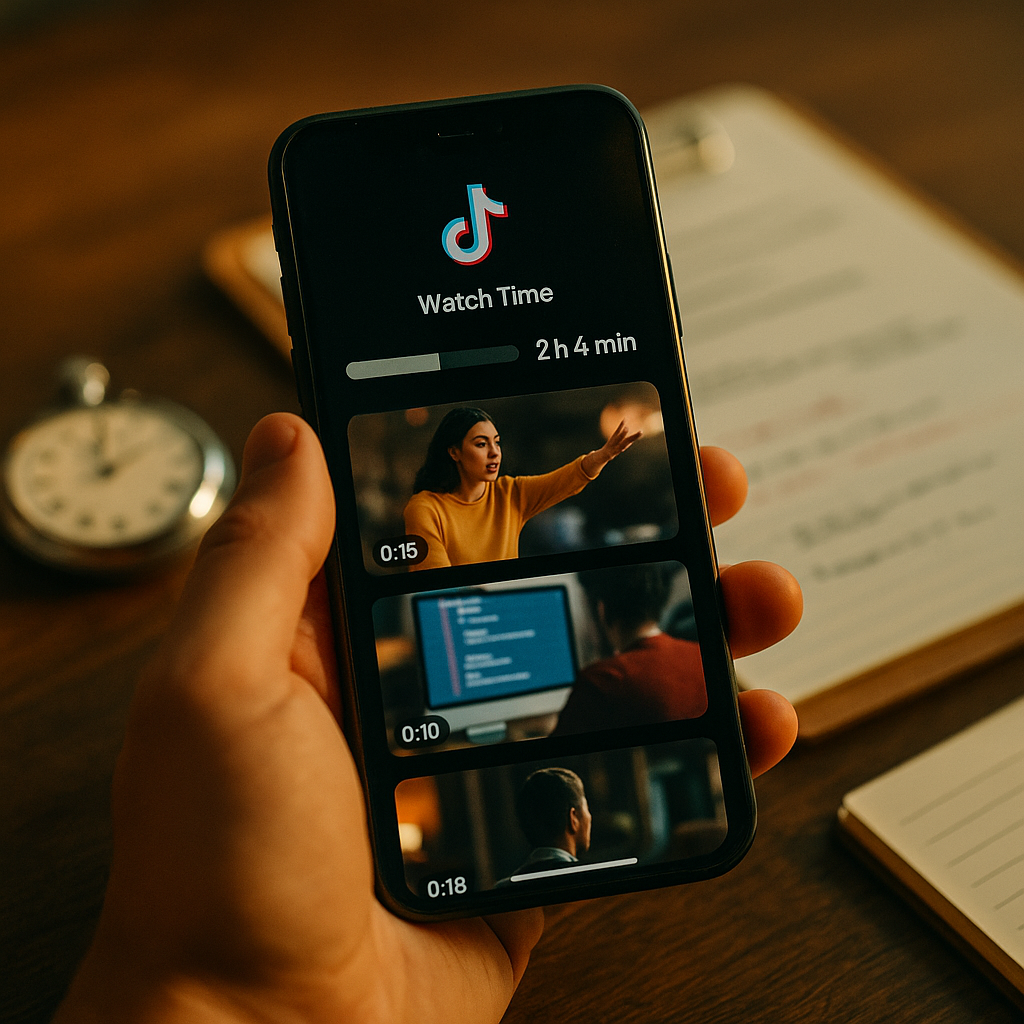
TikTok’s feed no longer asks “did they finish it?” It asks “how long did they stay, and did they come back?” That single shift has quietly wrecked the performance of briefs written for the old completion-rate era. If your TikTok watch-time-weighted feed strategy still optimizes for finishability over depth, you’re leaving reach on the table — and probably paying creators for the wrong outcomes.
The Metric That Changed Everything
For years, TikTok’s ranking signals leaned heavily on completion rate and immediate engagement — likes, comments, shares in the first hour. Creators and brands both learned to game it: tight 9-second loops, abrupt cuts, cliffhanger endings that technically counted as “watched to completion” because the video was short enough to loop twice before anyone noticed.
That era is ending. TikTok’s recommendation system has shifted toward cumulative watch time and session-level retention — how long a viewer stays engaged not just with one video, but across the session that video triggers. A 45-second video that holds attention through three rewatch loops now outperforms a 9-second video with a 98% completion rate but zero rewatch behavior. The platform is optimizing for time-on-app, and it’s rewarding content that earns it.
Completion rate tells you a viewer didn’t leave. Watch time tells you they didn’t want to leave. TikTok’s new weighting cares almost exclusively about the second signal.
This isn’t a minor tweak. It’s a fundamental rewrite of what “good creative” means on the platform, and most brand briefs haven’t caught up.
Related shift, worth reading alongside this one: our breakdown of hook and pacing rebuilds covers the mechanics in more technical depth.
Why Your Old Briefs Are Actively Hurting You
Most creator briefs still include language like “keep it under 15 seconds” or “front-load the hook and get to the CTA fast.” That advice was correct for the discovery-and-completion algorithm. It’s now working against you.
Short, punchy, CTA-forward content maximizes completion rate but caps watch time by design — there’s simply not enough runway for the algorithm to register sustained attention. Meanwhile, brands running longer, narrative-style content with mid-video hooks and rewatchable moments are seeing distribution lifts of 20-40% in internal agency benchmarks, even with lower raw completion percentages.
eMarketer and Sprout Social have both flagged 2026 as the year attention-based metrics overtake vanity engagement across short-form platforms — a trend TikTok is leading, not following. See eMarketer’s ongoing coverage of platform algorithm shifts for broader context on where the industry is heading.
If your KPI dashboard still leads with completion rate, you’re measuring the wrong thing. Full stop.
Restructuring the Brief: Five Changes That Actually Move the Needle
Here’s where the operational work happens. A watch-time-weighted algorithm demands specific, tactical changes to how you write briefs, not just a philosophical shift.
- Kill the arbitrary length caps. Stop telling creators “30 seconds max.” Instead, brief for pacing density — how much narrative or visual change happens per 5-second interval. A 60-second video with six distinct beats can outperform a 20-second video with two.
- Brief for mid-roll retention, not just opening hooks. The old model obsessed over the first 3 seconds. The new model needs a retention plan for seconds 15-30 and 30-45, where most drop-off historically happens. Ask creators to build a “second hook” — a reveal, twist, or payoff — around the 15-second mark.
- Design for rewatch behavior, not just watch-through. Content with a visual or informational element that rewards a second viewing (a fast list, a hidden detail, a joke that lands better on rewatch) gets weighted favorably. Brief this explicitly: “include one moment designed to be rewound or replayed.”
- Sequence CTAs later, not sooner. Front-loaded CTAs shorten effective watch time because viewers who convert or bounce early stop contributing to session signals. Push the CTA past the 20-second mark where possible, after value has been delivered.
- Brief for session continuation, not just single-video performance. This is the biggest mental shift. TikTok now credits creators whose content leads viewers into related searches, comment threads, or follow-on videos. Briefs should include a “conversation hook” — an open question or debate-starter — that keeps viewers in-app rather than exiting after one watch.
None of this means longer is automatically better. It means every second in the video needs to justify its runtime with a retention payoff. Padding kills you just as fast under this model as it did under the old one — arguably faster, because bored viewers now actively hurt your session-quality score.
What This Means for Creator Selection and Compensation
Retention-based ranking changes who your best creators are, and it should change how you pay them.
Creators who’ve built loyal, comment-heavy communities — where viewers linger, argue, and rewatch — are now more valuable than creators with big follower counts but shallow engagement. A micro-creator with 40,000 followers and an average watch time of 70% of video length is a better bet than a macro-creator with 500,000 followers and a 25% average watch time.
Start asking creators for their TikTok Creator Center analytics before signing — specifically average watch time and traffic source breakdown (For You Page vs. Following vs. Search). Creators driving traffic through search and hashtag discovery, rather than pure FYP luck, tend to have more durable retention patterns because their audience is actively seeking the content, not just scrolling into it.
On compensation: flip incentive structures to reward watch-time benchmarks over view counts. A simple performance bonus tied to average view duration percentage (available in TikTok’s business analytics) gives creators a direct incentive to build retention into their edits rather than chase vanity view spikes. This is a similar operational lesson to what we’ve documented in the YouTube hook architecture playbook — platforms increasingly reward creators who structure for sustained attention, and compensation models need to follow suit.
The Compliance and Brand-Safety Angle
Longer-form, retention-optimized content introduces new brand-safety considerations agencies need to bake into briefs upfront. More runtime means more opportunity for off-message tangents, unscripted claims, or FTC-relevant disclosure issues to creep into the middle of a video rather than staying contained to a short, easily-reviewed clip.
Update your review checklist to include mid-video disclosure placement — not just an opening #ad tag that a viewer might skip past before the algorithm-favored “second hook” even happens. The FTC’s endorsement guidance is clear that disclosures need to be clear and conspicuous throughout, not just at video open; longer runtimes make this a bigger compliance surface. Review current guidance at the FTC’s official site before finalizing updated brief templates.
If you’re running TikTok Shop-integrated content alongside these organic-style retention plays, compliance gets even tighter. Our TikTok Shop livestream compliance guide covers the return and shipping disclosure requirements that intersect with longer-format sponsored content.
Measurement: What to Actually Track Now
Retire completion rate as your north star metric. Replace it with a small, focused dashboard:
- Average watch time (seconds and percentage) — the primary algorithmic signal now.
- Rewatch rate — available through TikTok’s business suite, this flags content earning loop behavior.
- Traffic source mix — track how much reach comes from FYP versus search versus profile visits, since search-driven traffic tends to correlate with higher-intent, longer watch sessions.
- Session-continuation proxy — comment volume and comment length as a rough stand-in for whether your content sparked in-app conversation.
Run a four-week A/B test: half your creator roster gets the old brief template, half gets the restructured one above. Compare average watch time and organic reach lift at the two-week and four-week marks. Most agencies running this test have seen reach differentials large enough to make the case internally without needing a full quarter of data. HubSpot’s marketing analytics resources offer solid frameworks for structuring this kind of test if your team needs a template starting point.
This isn’t the first algorithm pivot TikTok has forced brands through, and it won’t be the last. The playbook that’s served us well: treat every major ranking shift as a brief-rewrite trigger, not a one-off creative tweak. Our discovery-over-reach playbook walks through the last major pivot using the same restructuring logic, if you want the historical pattern.
Next Step
Pull your last ten sponsored TikTok briefs, strike every line that mentions a hard length cap or front-loaded CTA, and rewrite them around mid-video retention beats and rewatch triggers — then measure average watch time, not completion rate, on your next campaign cycle.
FAQs
What is TikTok’s watch-time-weighted feed?
It’s a shift in TikTok’s recommendation algorithm that prioritizes cumulative watch time and session-level retention over completion rate and immediate engagement signals like likes or shares in the first hour.
How is watch time different from completion rate?
Completion rate measures whether a viewer watched a video to its end, which is easy to game with very short clips. Watch time measures how long viewers actually stay engaged, including rewatches, and better reflects genuine interest.
Should brands stop making short-form TikTok content entirely?
No. Video length should match the story being told, not an arbitrary cap. The key is ensuring every second earns its place through pacing, mid-video hooks, and rewatch-worthy moments, regardless of whether the final runtime is 20 seconds or 90.
How do I brief creators for retention instead of completion?
Ask for a documented “second hook” around the 15-second mark, a rewatch-triggering moment, a later-placed CTA, and a conversation-starting element near the end that encourages comments or shares rather than an immediate exit.
What metrics should replace completion rate in campaign reporting?
Track average watch time (seconds and percentage), rewatch rate, traffic source mix (FYP versus search versus profile), and comment volume as a proxy for session continuation and audience engagement depth.
Top Influencer Marketing Agencies
The leading agencies shaping influencer marketing in 2026
Agencies ranked by campaign performance, client diversity, platform expertise, proven ROI, industry recognition, and client satisfaction. Assessed through verified case studies, reviews, and industry consultations.
Moburst

-
2

The Shelf
Boutique Beauty & Lifestyle Influencer AgencyA data-driven boutique agency specializing exclusively in beauty, wellness, and lifestyle influencer campaigns on Instagram and TikTok. Best for brands already focused on the beauty/personal care space that need curated, aesthetic-driven content.Clients: Pepsi, The Honest Company, Hims, Elf Cosmetics, Pure LeafVisit The Shelf → -
3

Audiencly
Niche Gaming & Esports Influencer AgencyA specialized agency focused exclusively on gaming and esports creators on YouTube, Twitch, and TikTok. Ideal if your campaign is 100% gaming-focused — from game launches to hardware and esports events.Clients: Epic Games, NordVPN, Ubisoft, Wargaming, Tencent GamesVisit Audiencly → -
4

Viral Nation
Global Influencer Marketing & Talent AgencyA dual talent management and marketing agency with proprietary brand safety tools and a global creator network spanning nano-influencers to celebrities across all major platforms.Clients: Meta, Activision Blizzard, Energizer, Aston Martin, WalmartVisit Viral Nation → -
5

The Influencer Marketing Factory
TikTok, Instagram & YouTube CampaignsA full-service agency with strong TikTok expertise, offering end-to-end campaign management from influencer discovery through performance reporting with a focus on platform-native content.Clients: Google, Snapchat, Universal Music, Bumble, YelpVisit TIMF → -
6

NeoReach
Enterprise Analytics & Influencer CampaignsAn enterprise-focused agency combining managed campaigns with a powerful self-service data platform for influencer search, audience analytics, and attribution modeling.Clients: Amazon, Airbnb, Netflix, Honda, The New York TimesVisit NeoReach → -
7

Ubiquitous
Creator-First Marketing PlatformA tech-driven platform combining self-service tools with managed campaign options, emphasizing speed and scalability for brands managing multiple influencer relationships.Clients: Lyft, Disney, Target, American Eagle, NetflixVisit Ubiquitous → -
8

Obviously
Scalable Enterprise Influencer CampaignsA tech-enabled agency built for high-volume campaigns, coordinating hundreds of creators simultaneously with end-to-end logistics, content rights management, and product seeding.Clients: Google, Ulta Beauty, Converse, AmazonVisit Obviously →